Showing posts with label Chaitanya Tamhane. Show all posts

Sunday, September 27, 2020

Life's Little Disappointments

 The Disciple (2020) - Tamhane
the-disciple
Chaitanya Tamhane's follow up to his great debut, Court, is The Disciple, about an artist struggling with a life long self-doubt. It might be a more personal subject, but it's even more nuanced observation of life than his previous film. The Disciple shows Tamhane is wise far beyond his age portraying subjects such as ambition, devotion and pride as well as realizing life's crushing disappointments as we age.

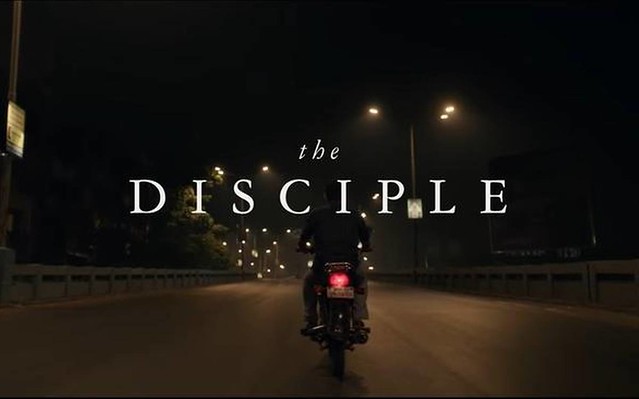
Khayal, I am told, is a classical Indian singing style that puts emphasis on improvisation and micro-tonal changes. For devotees of this art, mastering it is an eternal quest. Young Sharad (Aditya Modak), practicing this Hindustani classical music is a vocation he was sort of born into - his father was a devotee of this music tradition even though he ultimately failed as a singer. Studying under his guru/mentor (Arun Dravid) and listening to lectures, given by legendary, reclusive singer Maai, who was guru to both his father (who secretly recorded her lectures) and his mentor. Maai was almost a yogi figure, preaching purity and discipline in body and mind to truly devote to the music. She never allowed recordings of her music nor had her images taped or photographed. Tamhane provides some great night tracking shot of Mumbai, of Sharad riding his motorbike in slow motion, listening to Maai's lectures on tape. Emphasizing the lonely road the young man has chosen. The year is 2006.

Sharad practices and practices while dealing with all the distractions of life - constant nagging of his grandmother, pressure to get a job, loneliness, lust, etc. He is not winning any awards at singing competitions, at least not yet.

Sharad now is a fat middle aged man with a mustache, still trying to get his music career off the ground. He teaches music at a school, still takes care of his now ailing guru, while seeing others, more talented than him passing him by, career-wise. One of his pupil's mother comes to the school asking him for his advice: should her son join a fusion band in his college? He tells them not to come back to school if the young man joins the band. Some TV singing competition shows a young woman's transformation from a homely classical singer to a Bollywood style pop sensation. Is purity of the music and personal pride that important? Even Maai's words get warped in his mind. She directly addresses to him that his guru loves him so he doesn't have hearts to tell him that he is not talented, just like his father.

In one flashback scene, meeting with a rare music collector who seems to have dirt on everybody crushes Sharad's idols, including his guru and even Maai, whom he recalls as a self-righteous, pretentious fraud.

The Disciple deals with any artist's nightmare - total devotion is hard to achieve while living in the real world. In the mean time, self-doubt eats you away slowly over the years. Modak gives a beautiful, heart breaking performance, transforming himself from a bright eyed young man to a defeated middle-aged schlub . Both Modak and Dravid are actual singers and the music in this film is truly glorious. Tamhane again, proves himself to be one of the brightest and most talented filmmakers working today.

Monday, July 13, 2015

Sobering Look at India's Judicial System

*Originally posted on 3/25/15 for New Directors/New Films coverage

Court (2014) - Tamhane
 photo 7f82bd88-acca-4fb5-80fa-ecacd8a3558e_zpsdc0az9ek.jpg
Winner of the two prizes at Venice Film Festival 2014, Chaitanya Tamhane's Court lends an earnest look at India's judicial system. The film is a sobering, eye opening experience.

It starts with an arrest of an old folk singer and tutor of children, Narayan Kamble (Vira Sathida) at an outdoor stage in a Mumbai slum, as he sings an incendiary, but deliciously catchy song about government corruption and unjust system. In the court, he is accused of abetting the suicide of a sewer worker who died in a manhole. It was one of his songs that allegedly drove the worker to his death. He was working the same job for 5 years but he was found dead without any protective gear inside the manhole, so says the prosecution.

The charges are obviously absurd and unfounded, but as we soon learn, everything needs to go through the judicial proceedings. Narayan seems to be used to this: he's been a radical activist in the slums since the 70s. When he is asked if he wrote and performed a song, "Manhole workers should suffocate and die," he wryly responds, "I haven't written that one yet, but now I might." 

It's his human rights activist attorney Vinay Vora (Vivek Gomber, who also serves as a producer) who is more affected by the arrest because without bail, the possibly lengthy trial and being in the judicial custody will undoubtedly worsen the health of 65 year old defender. The presiding judge, following the procedure by the rules, just orders that.

John Grisham Courtroom thriller it's not, Court has no star witnesses or heart stopping twists and turns. The crowded courtroom is shown in static shots where other cases are waiting one after another. Narayan's case is one of many of that day in front of the same judge. With the rigid caste system, the film paints much more complicated picture of the society than a simple white-trash-been-done-wrong-by-the-big-corporation scenario. Tamhane avoids the film becoming a melodramatic hero/villain story. We don't see Narayan in jail at all. Instead, the film follows the inner lives of Vinay the defense attorney, the public prosecutor (wonderfully played by Geetanjali Kulkani) and the judge (Pradeep Joshi) in succession.

Vinay is the face of India's global elite society: from a wealthy household, he drives an expensive car, listens to jazz and hangs out with his suave friends in chic bars where a musician sings English and Portuguese songs on stage. Still living at home, he is seen throwing tantrums at his nagging parents. Yet he is a compassionate one, trying to do right by his defendant.

We see the prosecutor taking the public transportation, talking to her friends about the latest fashion, picking up her son from a daycare, going home and cooking food for her diabetic husband. Her family time is in front of the small TV set. For entertainment, her family goes to see a comedy play that is extremely jingoistic. For the judge, he goes to a water park with his large extended family for the summer vacation.

For our public prosecutor and judge from the middle class backgrounds, even though they are socially close to the defendants they are persecuting, they process the cases by the book, lacking any kind of sympathy or considerations. The film raises questions about the nature of our society where only wealthy can afford to be compassionate and the within-the box-mentality of the judicial system.

After finding out the prosecution's witness is likely bought by the police and wife of a dead worker testifies that the dead man never wore any protective gear while cleaning the sewer and drank heavily before the job to ease the smell (these facts are revelatory for everyone involved), the case against Narayan is dismissed and the bail's granted. Vinay ends up paying for the bail.

The most powerful and telling scene plays out in a car ride. After testifying, the dead man's wife and her family is chaperoned by Vinay in his white sedan. He instructs her to fasten her seat belt which she doesn't seem to know how to. It's her bewildered expression as the car passes through the streets of Mumbai that tells thousand words. She fled out of fear to her village when her husband died and doing so she lost her job in the city. She tells Vinay that she would take any kind of job so if he knew any, please send them her way. She doesn't want his monetary help, she just wants a job. He drops them off in a slum populated by a murder of crows.

The next scene is Narayan getting picked up by the police again from a printing press factory while supervising his book, A History of Humiliation, getting printed. This time, the charge is using his tutoring place as a breeding ground for terrorist elements who are obviously into seditious activities. The police's persecution of the untouchables continue, packing up the courtrooms, making the procedure an unending cycle.

When Vinay protests that summer recess will put the defendant in judicial custody for a long time, the same judge replies, "We are closed, but you can always take it up to High Court."

All the performances are stellar, considering many of them are non-actors. In the heart of it all is Vira Sathida. A real life activist, his rhythmic, infectious, biting songs come to life whenever he performs. I would love to see him perform for hours.

Tamhane's understated, layered script highlights the lack of understanding among different social strata in a complex society which is still deeply bound in tradition in the 21st century. As the film ends with the judge falling asleep on his chair on his vacation, the audience is left to grapple with the death of a sewer worker who's already forgotten by everyone. It is also chilling to think that there isn't going to be any kind of investigation on the condition of these lowly workers. Biting and devastating, Court is one the best films I've seen so far this year.

Court opens July 15 at Film Forum in NY. Please visit their website for tickets and times.