Showing posts with label Charlie Kaufman. Show all posts

Monday, March 16, 2026

No More Memories

How to Shoot a Ghost (2025) - Kaufman Screen Shot 2026-03-16 at 5.41.05 AM Screen Shot 2026-03-16 at 5.50.44 AM Screen Shot 2026-03-16 at 5.56.26 AM Screen Shot 2026-03-16 at 5.59.56 AM Screen Shot 2026-03-16 at 6.06.08 AM Screen Shot 2026-03-16 at 6.02.03 AM Screen Shot 2026-03-16 at 6.03.12 AM Charlie Kaufman directs a script written by his friend and poet, Eva H.D. How to Shoot a Ghost, a short shot in Athens, Greece, is a film, unsurprisingly for Kaufman, about our mortality and anxiety of leaving something/nothing behind. Narrated by H.D., and without any dialog, the film tells the two recently departed young people, played by Jessie Buckley and Joseph Akiki, as they walk around and trying to capture the daily lives of citizens of Athens. Beautifully captured by Michal Dymek (EO, The Girl with the Needle) and melancholic score by Ella van der Woude, the film is an elegiac look at the existence of human lives and what we leave behind, in the background of dense cityscapes, old remnants of ancient civilization and liminal spaces. Mixd in is newsreel footages of tumultuous recent Greek history under dictatorship.

Buckley, donning a colorful wig, emotes a young woman as she argues with her father (?) and loses herself in a disco club and taking polaroid pictures of Athenians and the like. As two strangers in a foreign country, not fitting in with society's norms- Buckley and Akiki are soulful and magnetic in their presence, trying to leave a trace in the world that no longer belong to them. As H.D.'s narration goes, what you do in life is enough. You don't have to worry about what you leave behind. How to Shoot a Ghost is less agonizing existential trip, but more spiritually in tune with Joachim Trier's August 31st or Hirokazu Kore-eda's Afterlife.

Wednesday, September 9, 2020

Fast Train to Hell

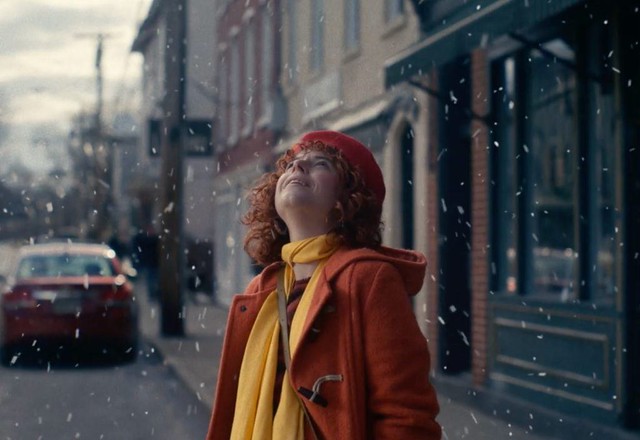
I'm Thinking of Ending Things (2020) - Kaufman Ending Things The film starts out with Lucy/Lucia/Amy? (Jessie Buckly)'s narration. She's met her current boyfriend Jake (Jesse Plemmons) about 6-7 weeks ago (she doesn't exactly remember when?), but she is already contemplating dumping him. She agreed to go on a road trip to his parents who live in a rural farm. It's a long ride during the snowstorm. Does Jake hear her thoughts? He looks over frequently and asks if she said something. She likes him. He is shy, quiet, introverted but intelligent. She needs that. And they have a lot in common. She is a physicist and a poet and a painter and a waitress who needs to get back to the city to take her shift after the dinner at the farm. They have a lot of things to talk about - poetry, films, Cassavettes, David Foster Wallace... 

The awkward meeting with the eccentric parents (David Thewlis and Toni Collette) who seem to be growing old and young as the night progresses, lending more to Jake's inner life. It seems pretty clear that Lucy and Jake are the same person and Lucy, however three dimensional she is, is a fantasy character of Jake, who himself might or might not be an old janitor at a high school which he was once a student of. Lucy is smart, assertive in her thoughts, a multi-talented brainiac who is pretty enough but not pretty-pretty - those girls in his high school who shunned him and bullied him. 

With talking animated pigs, dance sequences and Oklahoma!, I'm Thinking of Ending Things is filled with idiosyncratic moments very much like Kaufman's other films. But they can't overcome the film's overwhelming sense of existential dread. Kaufman's neuroses are in full display from traumatized, friendless high school years, consuming books and movies and becoming a reference of a person. Even Lucy, however quirky dreamgirl she is, is just a composite of whatever he got from books and painting and movies. It's a pity that we only see Lucy in the confined space the whole time. I do like Jessie Buckly the actress a lot. But she has given very little to express herself, unlike, say Clamentine from Kaufman scripted Eternal Sunshine of the Spotless Mind.

Jake is a frustrated, extremely insecure man. Even his fantasy is considering dumping him. He sees all the niceties and family life lies. As he accepts a Nobel Prize, and give a speech from some cheesy Hollywood movies and sing a song from Oklahoma! on stage in front of his family and friends who are wearing heavy makeup, I'm Thinking of Ending Things is not Fellini's 8 1/2. It's not celebration of life. Life is a fast train to hell. I mean heck.

Friday, December 12, 2014

All the world's a stage, And all the men and women merely players

Synecdoche, New York (2008) - Kaufman *rewatch
 photo 6ba2e19c-8017-43f3-adf1-96d7265d2d79_zps5b238e51.png
Loneliness and death. For Caden (Phillip Seymour Hoffman) they figure greatly into his unraveling life. Yes there are other important things like finding self and representing truth in art and such. But the bottom line is, everyone dies some day. Don't know how Caden ended up in a loveless, downright cynical marriage and a daughter. His stage play gets a good reception and he gets smitten by a flirtatious box office girl Hazel (Samantha Morton) but waves her advances off to be truthful to his family. But as he struggles as a playwright and with his hypochondria, his artist wife Adele (Katherine Keener) leaves with their 4 year old daughter Olive to become a successful painter. Then he gets a MacArthur Fellowship/Genius Grant. He wants to put up a massive play that reflects real life. Caden, so caught up with producing something truthful, he loses track of time. Time passes aggressively fast. He sets up a duplicate copies of everything in a massive warehouse space, the buildings, people he knows in real life. With a blink of an eye Caden is old, Olive is a lesbian stripper covered with tattoos, dying of ink poisoning, Adele has died after leading successful career as an artist who did tiny paintings of people, just like how she used to make Caden feel- insignificant, during their marriage.

This multi-layered, ambitious film affected me like no other. Kaufman touches upon universal theme of loneliness and melancholy through the eyes of an obsessive artist who builds a replica of life on stage within the replica, within the replica.... Kaufman gives the well worn premise of life imitating art- vice versa and life as a stage play with more depth and intimacy. However absurd the idea of recreating life that is just like the one you are living in in a giant warehouse in New York, Synecdoche's consistently somber mood takes the surrealist whimsy down to earth. Forever romantic, he allows Caden and Hazel to finally unite, but too old to 'fuck each other until they merge into chimera'. There is more in Synecdoche than every 10 yr old's inclination that the world evolves around him/her. As Caden, nearing the end of his life after overseeing the ongoing, unfinished work - the lifelike biosphere he created, realizes that he too, is playing the role, directed by an actress who plays a cleaning lady (Diane Wiest). Synedoche is a massive undertaking that is at once deeply personal, complex and touching as much as any works of Bergman or Fellini.