Showing posts with label Ethan Hawke. Show all posts

Thursday, July 2, 2020

Familial Truth

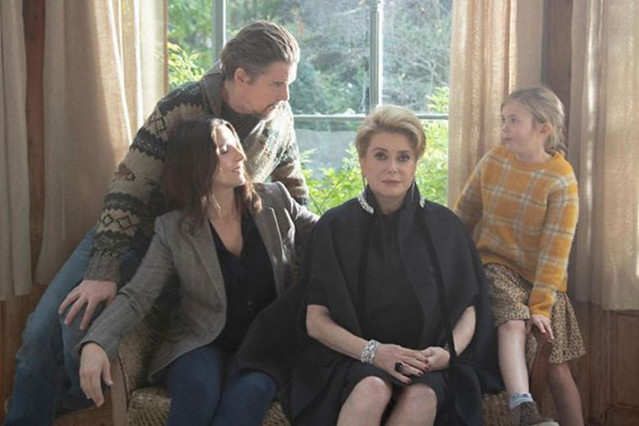
The Truth/La Vérité (2019) - Kore-eda
The Truth
Born out of forever adventurous French actress Juliette Binoche's years of insistence to work with Kore-eda Hirokazu, The Truth marks the famed Japanese writer/director's first film shot outside Japan and in non-Japanese language with international cast. And still, it is, in many ways, a very much Kore-eda film: about family dynamics with thorns and all, yet unmistakably gentle and humanistic. The only departure from his filmography I detect (other than not being Japanese) is that the characters aren't ordinary middle to lower class people that he usually portrays in his films. But I guess the prospect of working with a legendary French film star, Catherine Deneuve, made Kore-eda taking on a different direction. If the appeal of Kore-eda's films is in their universality, especially concerning adults in his films such as Still Walking and After the Storm - the innate goodness in people, admitting their shortcomings, small redemptions and letting the past go, The Truth shows that no matter the class distinctions, the concept of a 'family' still rings true to all of us.

The story concerns Fabienne Dangeville (Deneuve), a legendary French film star and her screenwriter daughter Lumir (Juliette Binoche). Fabienne's memoir titled The Truth is coming out and to celebrate the occasion, Lumir and her American, second-rate TV actor husband Hank (Ethan Hawke) and their bi-lingual preteen daughter Charlotte (Clémentine Grenier) pay her a visit in a secluded grand mansion where Lumir grew up.

Upon reading the memoir, Lumir finds there are glaring omissions and falsehood from her childhood. For instance, Fabienne never picked up Lumir from school, like ever, unlike she says that she always picked her up even during her busy schedule. Fabienne's defense is , "Actors never tell the naked truth" in public. Everyone's memories are subjective anyway, she quips.

To make the matters worse, Luc (Alain Libolt), a long time devout assistant to Fabienne, calls it quits over not mentioning one word about him in the memoir. Now all the personal assistant duties fall on Lumir - receiving messages, accompanying Fabienne to movie sets, etc., whether she likes it or not- after all, she is her mother.

The catalyst for Fabienne happens when she takes an acting job, a supporting role in a low budget Sci-fi movie, aptly titled Memories of My Mother, by an unknown young director. Her co-star, a rising actress Manon (Manon Clavel), reminds her of her acting rival and close friend Sarah back in the day. It was kind-hearted Sarah who became a mother figure for young Lumir in Fabienne's absences.

Memories of My Mother, this movie-within-a-movie, is about a woman who is terminally ill, so she takes off to space in order to stop the advancing disease. She only comes down to earth every seven years to see her daughter, Amy, grow. She, herself forever young, gets to witness her daughter grow old. Fabienne is playing the old Amy part.

First, Fabienne tries to outdo her perceived rival in acting, scoffing and jabbing with pointy remarks at everyone around her, using her diva status indiscriminately. Then she realizes that Manon, like Sarah, is a genuinely warm-hearted soul and also a talented actress with great potential. This makes her to reassess her relationship with her daughter and people around her.

Is Fabienne character a thinly disguised reflection of Catherine Deneuve? Is The Truth a sly take on real life and movie industry and stardom in the likes of Postcard from the Edge? It is pretty clear that Kore-eda's interest is elsewhere. Given the opportunity to utilize a screen legend, he makes it larger than life, but at the core, The Truth is a superb family drama full of heart.

Fabienne says to Lumir in her defense things like, "I'd prefer to be a bad mother, bad friend but a great actress." It is true that we say the meanest, most hurtful things to those closest to us. Like it or not, we've all experienced it in our family. It's not because we mean it, but rather, because we can (and often shouldn't), precisely because we are family. For Kore-eda, who often examines the concept of family, understands this and creates beautiful, three-dimensional characters and great dynamics here. Deneuve is flawlessly in the role of aging diva. Binoche, a struggling daughter always in the shadow of her mother is also great. Ethan Hawke assumes his goofiness and brings in much needed (self-deprecating) humor and warmth.

With no huge emotional explosions and tearful scene-stealers, The Truth might come across as too subtle. But that's how Kore-eda always has been operating. Even though there is nothing Japanese about the film, he proves that there is universality in family dynamics anywhere. Quietly affecting with superb performances, The Truth is a welcome variation from always reliable Kore-eda.

The Truth opens July 3. Please visit IFC Films for more info.

Dustin Chang is a freelance writer. His musings and opinions on everything cinema and beyond can be found at www.dustinchang.com

Saturday, July 21, 2018

The World is Ending, Let's Fall in Love

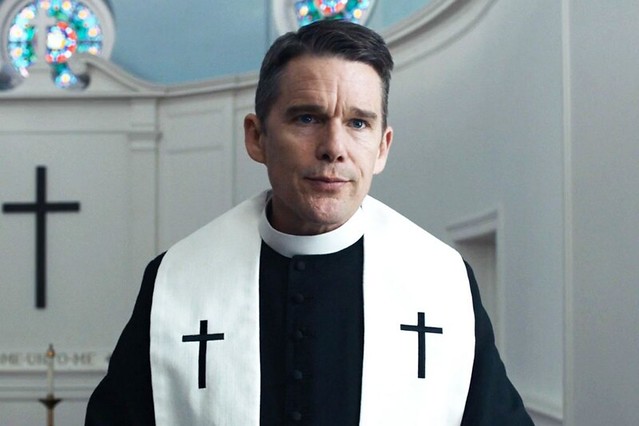
First Reformed (2017) - Schrader
Screen Shot 2018-07-21 at 10.12.36 AM
Toller (Ethan Hawke) is a mild mannered, wise pastor of the First Reformed church in small town upstate New York. His congregation is tiny. Even though the historic white chapel church is about to be reconsecrated for being 250 years old, it is functioning more as a tourist site and in Toller's own words, "gift shop", to the megachurch next door, Abundant Life. He lost his son in the Iraq war and so his marriage fell apart. He drinks and has health problems which he won't seek out help for. In the beginning of the movie, we see Toller starting a journal where he pours out his heart and soul. It's a test, self discipline of sorts. When it's filled, he will rip it up and burn the pages. We see the glimpse of internal struggle with his faith already there.

Things get shaken when a young couple come for his advice. Mary the pregnant wife (Amanda Seyfried) says her environmental activist husband Micheal (Philip Ettinger) is conflicted. He visits them at home. There Michael lays out the evidence of man-made destruction of the earth. That he sees no point of bringing a child to the world. Toller's typically wise man of god talk won't comfort the troubled man. After Michael blows his brains out, Toller's laissez-faire attitude at least from the outside perspective, changes. Not to complicate the suicide case, Toller tells Mary to get rid of any possible incriminating evidences - including a suicide bomb vest that her husband hid in his garage for whatever reason. Helping Mary coping with the death draws them closer too.

Things come to focus as Toller sees that the big donor of the church, is a coal baron whose industry is wrecking a havoc on the environment. As the First Reformed reconsecration service looms, he has one thing left to do.

I believe Schrader mentioned Bergman's Winter Light as a source of inspiration. And yes, there is more than the narrative thread with the suicide and everything in the beginning, that the film has its affinity with. But also that sinewy human entanglement that many Bergman's characters see as a prison is there too - definitely Bergman-esque. But whether you consider Schrader's filmography spotty at best, he is responsible for penning Taxi Driver. First Reformed is definitely not a rehash of the masters' older films he is inspired by. Dealing with the contemporary issue that we all face (it was the threat of atom bomb in Bergman's film), Schrader squarely puts the ball on our court to toil with.

Shot in stately full frame 4:3 and simple, straightforward narrative, First Reformed is an extremely lean film. There is a lot of humor in it too. Mystery Magic Tour scene alone is worth the admission. Ethan Hawke, with his craggy forehead, finally aging appropriately, gives the best performance of his career as a conflicted, religious man in the time of uncertainty. The ending goes haywire in the most beautiful way and I really loved it.

Sunday, November 30, 2014

Time, The Revelator

Boyhood (2014) - Linklater
 photo 2f58ce67-7e82-43a3-a830-0d74ecbc5784_zps8df81857.jpg
Before Sunrise, that perennial hit, the milestone of a generation, didn't hit me even though I was still in college when it came out. I thought it was too precious of a subject to be portrayed right and that there was no way to show young adult's romance without being pretentious. I thought the movie brought out/added to the worst traits in precautious, sensitive young men: a false sense of self confidence and self-righteousness. Linklater was the proto-hipster. I shunned him and his movies forever (ok, I watched Before Sunset, Waking Life and some others over the years).

I don't know why, but I gave Boyhood a go. Maybe because I wanted to prove me right the point I have been espousing for years that there is absolutely no salvageable profundity in movies about suburban white boy's life. Maybe I just got up too early after having all that thanksgiving food and booze and wanted to watch something. Maybe I thought I could place a safe distance to be objective because the subject is about childhood not adulthood. But Boyhood touched me to no end. There is nothing much going on in the film. It charts a Texan boy Mason (Ellar Coltrane) and his nuclear family for about ten years until he goes off to college. Linklater plays with time- the great revelator and equalizer, more expressively here than his 'Before' series. At first it plays out like a stripped down, down to earth version of the childhood segment of Tree of Life (which was by far the best part of that film). There are a lot of moments that are just as magical as Jessica Chastain spinning off the ground: a little talk in the car where dead beat dad, Mason Sr (Ethan Hawke) tells Mason about the blue whale as a proof that magic exists, or forever frazzled mom (Patricia Arquette)'s existential musing when Mason leaves for college, or the Mason talking with the girl he just met about the moments seizing you instead of the other way around.

Linklater chugged along consistently sticking to his gentle street philosophizing without a care in the world: no one really knows the big answers in life. I finally see his guilelessness in his films. Whether he observes life with the help of his famous actor friends, he is honestly portraying characters with what life throws at them. Seeing a boy growing up and forming his opinions and minds while acknowledging the time zipping him by is really something. Boyhood is a culmination of everything he's done before and it's marvelous. Still, Linklater's optimism is still very much American and it annoys me sometimes for a fact that we never see Mason cry or having a real tragedy in life. But I also understand it's called Boyhood, not Boyz 'n' da Hood. It is about celebration of growing up and unseen possibilities. Tragedies come later. They can wait.