It is always a delight to listen to Christian Petzold, German director of such films as Barbara, Phoenix and Transit, because he is a master storyteller. I could listen to him for hours on end as he enthusiastically talks about his filmmaking process.
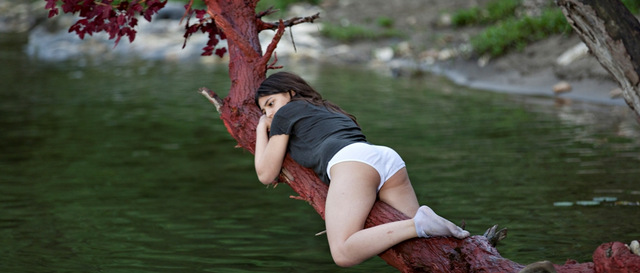
His new film Undine is his take on the fantasy genre - about a water creature which takes a human form and takes revenge on humans when her love is not reciprocated. Melding this fantasy with the tumultuous history of the city of Berlin, Petzold concocts another beautifully written and gorgeously realized film that is at once seductive and thought provoking.
Even though we were conducting our interview over a Zoom session due to Covid, his enthusiasm and exquisite storytelling abilities were not diminished in any way. Below is the result of our conversation that took place in May.
Undine hits theaters and VOD platforms via IFC Films on 6/4.
Where are you now at the moment?
I am in Brooklyn. Are you in Berlin?
Yes. Berlin in the chilly spring afternoon. Waiting for the summer, waiting for the end of the pandemic.
Yeah, I was wondering. I heard that it's still pretty bad in Berlin and in Germany in general.
No, I think the peek is behind us. I hope that the cinemas will open in coming weeks. I can't stand looking at my TV set anymore. I miss going to movie theaters and the loneliness of being in the big crowd.
I hear you. Everything's okay with you and your family?
Yes, thank you. You know, I had Covid one year ago around this time.
Oh no!
It was not too serious, but for a full week, I had to stay in bed. I changed my whole plans for the future and put my dystopia script away. It was based on this book that I have bought the rights to, but I'm not interested in dystopia anymore. I don't want to see walking dead in a desert world. I really can’t say I want to do that anymore.
During my time in bed, I read many books including many novellas of Chekov and saw many films. My distributor in France sent me the Eric Rohmer box set as a gift. I said, my god, I haven’t seen Rohmer since back in the school days! What is it called, La Collectioneuse! I was impressed how well it holds up. It’s been such a long time. We had a teacher at the film academy who told us that we have to make movies, so 20, 30 years from now people will know how we had kissed, how we had touched, how we had walked through the streets and how our social life was. I was so impressed by Rohmer’s films so I started writing a new story and I am now finished with the script. It's about a group of young people, in the summer at the Baltic sea, surrounded by forests and the forest are burning and their desire and their hearts are also burning, and the fire in the end is out of control. So this is what I wrote during Covid and I’d love to make it. Paula Beer will play the main female role. But I have to wait for the next summer because it's a summer story and I need the sun. I need a world where we can touch each other without being tested!
Christian, I love to see your summer movie. That sounds amazing! I watched Undine last year at the New York film festival. It's such a beautiful film and it's visually really stunning. I really, really enjoyed it. And I'm glad it's coming out in theaters.
You always dealt with genre cinema to tell your stories - you’ve done noir, horror, pollcier, sci-fi even, with your last film Transit. Now you are taking on the fantasy genre. It’s really interesting to see you melding it with the history of Berlin. And I'm just wondering how that came about, in terms of the story.
Yeah. You know, I grew up in, near the river Rhine in west Germany and this part of Germany it's filled with myths and songs and old tales. And when I was 20, I leave for Berlin for school. West Berlin was a big laboratory of politics, acting, theater and all that. But you know, this is a very modern city without tales, without myths, without songs, it doesn't have anything. The only myth we have is Adolf Hitler. Maybe it’s an oversimplification but the point is it's a very modern city. And the people in Berlin, they know so much about tales and myths because they are people like me, coming from other parts of the world, because it's a city where people are connected with their stories and with their backgrounds and so on.
The place I was born (West German city of Haan) was between two rivers and also Berlin is a city of the two rivers, Havel and Spree. Yeah. But these rivers are very boring: they are small and very narrow. Nobody's really interested in these and there are no songs. I grew up in this part of Germany between, the river Rhine and the Wupper. The Rhine is a very, very big river. And it's filled with songs about myths and sirens. And also it's that river where you, as a child, would be standing in front of, and you are thinking about going away- to take a boat and go to the sea and perhaps go to America, for instance. We have that sentimental-journey feeling associated with the river Rhine. The Wupper, there are no boats on the water because it's a wild river. And there's a saying in German, “geh über die Wupper”/to go over the Wupper means you know, this is the river Styx, the river of death. Someone's going over the Wupper means he's going into the land of the dead.
So we have the Rhine, which means you are going far away and the Wupper you're going into the end of your life. I'm thinking that living between those two rivers also had something to do with cinema. There's a cinema, which says to you it’s a road movie. And there's also a breaking through a wall, to go over border, to go into another life or could be the death, could be a bank robbery, with a head shot at the end. And so, I thought about my rivers from my youth and my work on Undine started.
That’s amazing! Also, there are a lot of talks about architecture in the movie and how Berlin was built in such a way. And there is obviously a division of the east and west. Paula Beer’s lecture monologue was very interesting. What struck me was when she says, “form follows function.” Can you tell me about that?
That's a very good question, because Paula loved the sentence. I think she loved the sentence more than when she says, “If you leave me, I will have to kill you.” I think of Berlin as a raped city architecturally. Every 3 years someone is coming with new architecture plans. The concept is making money with very cheap buildings with retro style buildings and no form follows function. The idea is totally out. They just want to make money.
Right.
Before you have a fascist architecture. That was a form following function. Now it’s for tourism. Nothing can grow here. There's no organic life here. But Berlin has always tried to defend itself. So we have these idealist and we have the defenders. I'm so disappointed because in 1989, Berlin had the chance: we had a whole city being united, which was now in the hands of the government, it was not a private property. It was our property. We could’ve made something beautiful. In five, six years, they sold it to people who are only interested in making money. And so Berlin is now raped by money, by the banks in the US. I must say that.
And so this, someone like Undine who's been living here for centuries, with all these changes, she is like a sad witness of our changing times. So this was our idea.
I remember when we were shooting the (guide tour) scenes and Paula was very very anxious, I must say. It was a bit of a stage fright she had, because it was 18 pages of monologue in the script. I told her that all the extras in that architectural model room were intellectuals: I don't hire dumb extras for an hour. They were university students and professors. So she had to give a very convincing presentation and I liked this as a director, capturing her nervousness.
The situation in that scene is that the city we are living in, we don't even know so much about it. But now at that moment, we understand what’s happening: it’s the Humbolt Forum. It's a museum in the form of a castle. And Paula is in there surrounded by intellectuals stating that form follows function. I am also commenting on the state of cinema: we haven't got this form follows function anymore. It’s a little disappointing.
Interesting.
I have to say that the Paula and Franz (Rogowski) have amazing chemistry together. I enjoyed them immensely in Transit before, but there is really something to them in Undine. I’d like to know how it was working with them.
Yeah. I had the idea for Undine during filming Transit because of these two actors. I've never seen a couple like this before. Neither have the German stage theater education. They never worked for the stage as an actor in their careers. They are quite different in their movement and speech, there is certain innocence about them in that way that I like. Interesting thing is they both are dancers. Franz is a professional dancer. He is from a dance background.
My experience in Transit, when we did rehearsals in the morning, the first two or three hours, they didn’t talk about their lines or talked with me about the script or psychology of the characters. For example when they enter the hotel room, they walk around and touch things - windows, bed and they danced around. It was more like Pina Bausch: their concerns were more like, what is the distance and when can we touch each other? For me it was a fantastic experience working with these two very physical actors. It was more like two young actors dancing their lines.
So when I was thinking about making Undine, I couldn’t think of anyone else but those two for the part. So when three of us were doing rehearsals, especially in the apartment scene, it was like the same rehearsals in Transit: Who is in the terrace? Who is going out of the terrace? Who is going to the window? It was more like they were swing dancing!
So the first six or seven days of shooting, we filmed scenes without any dialogue. This is in their bodies. It’s the movement of their bodies that tells the story - how she puts her head on his shoulder. I always had a feeling that their movements were as if they were filmed underwater.
Forgive me saying this: not that your previous films are not visually beautiful, but I find Undine absolutely gorgeous. Especially underwater sequences with the Big Günter, the catfish and everything. Did you have those scenes in mind when you were writing the script?
I have never done storyboards before. I do rehearsals and make the storyboard afterward. But for those underwater scenes, I needed to do storyboards. It was like doing a graphic novel. All the things I drew for the movie, they were from other films: The catfish comes in like the scene from Jaws where they go under water to investigate the broken ship and find the decapitated head coming out of the hole. I wanted to have the catfish appear like that. Or the scene from 20,000 Miles Under the Sea and Creature from Black Lagoon by Jack Arnold, where the creature almost touches the legs of the girl…. Underwater scenes in cinema are like a liquid memory room. You don’t invent new things but the images are lodged in your subconsciousness. That’s why I like them so much.
It’s really beautifully done.
I think my time is up but I wanted to tell you that the ‘Staying Alive’ scene was hilarious as well as very romantic.
They really use it in Germany. It is in the lessons for the lifeguards. My producers were begging me not to use it because it’s Bee Gees and it was in another movie, the rights to it cost 17,000 dollars. But I had to have it in the film. It was just too good!


 Hirokazu Kore-eda's Air Doll appears to be tackling the modern society's illness - urban loneliness and soullessness, the themes explored by by other prominent Japanese auteurs of its time, namely, Kiyoshi Kurosawa, Sion Sono and Shinji Aoyama, with Korean actress Bae Doona (Linda, Linda, Linda, Sympathy for Mr. Vengeance, Host). The result is a mixed bag.