Showing posts with label French New Wave. Show all posts

Wednesday, November 19, 2025

Smells Like Indie Spirit

Nouvelle Vague (2025) - Linklater Screen Shot 2025-11-16 at 8.20.21 AM Screen Shot 2025-11-16 at 8.28.23 AM Screen Shot 2025-11-16 at 9.31.57 AM Screen Shot 2025-11-18 at 6.09.28 AM Screen Shot 2025-11-18 at 6.14.23 AM Screen Shot 2025-11-18 at 6.11.24 AM Screen Shot 2025-11-18 at 6.12.20 AM Screen Shot 2025-11-18 at 6.14.40 AM Screen Shot 2025-11-16 at 9.04.25 AM Screen Shot 2025-11-16 at 9.26.25 AM Screen Shot 2025-11-18 at 6.16.04 AM Screen Shot 2025-11-18 at 6.08.39 AM Breathless, a perennial French New Wave film that started everything and changed filmmaking forever, is closely reenacted and memorialized along with the movement and people involved. I got to admit, being a diehard Godard-head, I was very skeptical going into this film. But rest assured, Linklater, coming from the experimental indie filmmaking background, knows his history of cinema and understands how to pay homage without being nostalgic and sentimental about the New Wave and its influences that had on him as a filmmaker. And Linklater's assumption is right about his view on Breathless as a granddaddy of indie filmmaking.

Casting and working with French speaking actors, Linklater commands a very convincing reenactment of the events in and surrounding the production of Godard's tumultuous feature debut.

Godard, played wonderfully by Guillaume Marbeck, encouraged by/and riding the coattails of the success of his two Cahier du Cinema colleagues' directorial debuts not too long ago - François Truffaut's 400 Blows (1959) and Claude Chabrol's Le Beau Serge (1958), finally tries his hands in directing a feature, with the help of a producer Beaureguard (Bruno Dreyfürst). With the rebellious spirit of countering the cinema that came before, and his own eccentricities, Godard embarks on directing a film as unconventionally as possible. Working off of a thin treatment that Truffaut and Chabrol wrote, about real life incidents of a car thief who ends up killing a police officer, Godard charges on Breathless without a script. Casting includes a newbie actor/boxer named Jean-Paul Belmondo (Aubry Dullin) and a reluctant American movie star Jean Seberg (Zoey Deutch). In 23 days of shooting with no lights and all hand-held camera by army vet, documentary photographer Raoul Coutard (Matthieu Penchinat), who later went on to shoot most of the memorable Godard films.

Linklater makes sure that who's who of the French New Wave are all mentioned in the film- portrait style with their names appearing on the screen - Truffaut, Chabrol, Suzanne Schiffman, Rivette, Rohmer, Rozier, etc. Godard's mentors/idols also appear on screen - Jean Pierre Melville, Roberto Rosselini, Jean Cocteau and even has a run in with Robert Bresson in the subway where the master is in his production of Pickpocket, around the same time.

Sure, championed by Cahier writers, including Truffaut and Godard, The Auteur Theory elevates the director as the primary creative force behind a film, but Linklater shows and acknowledges that there are a lot of people contributing their talents and hard work and time in making a film - that extends to the job of an assistant director, script continuity, make-up, editor, so and so forth.

Yes, the film's monochrome shot on 35mm and impeccable period set design and costume take us into a nostalgia trip. But the film is never corny or sentimental. Linklater is after something more direct, only concentrating on the production of Breathless; people involved in it and the overall climate that incubated the French New Wave.

It's a lovely, charming and endlessly enjoyable homage to one of the most influential film movements and which birthed perhaps the most singular and unique filmmaker ever lived. Loved it.

Friday, June 7, 2024

Another Generation

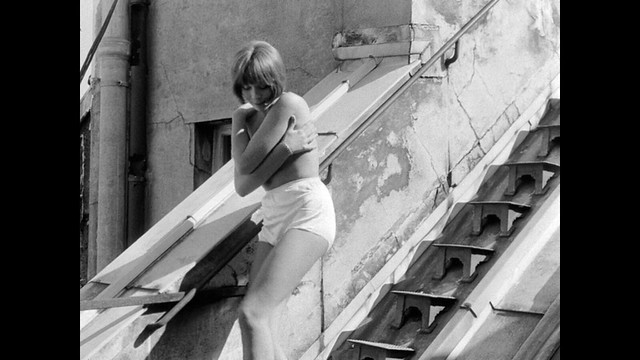
Adieu Philippine (1962) - Rozier Screen Shot 2024-06-07 at 8.52.12 AM Screen Shot 2024-06-07 at 11.27.39 AM Screen Shot 2024-06-07 at 9.01.13 AM Screen Shot 2024-06-07 at 9.12.58 AM Screen Shot 2024-06-07 at 9.20.26 AM Screen Shot 2024-06-07 at 10.40.55 AM Screen Shot 2024-06-07 at 10.46.03 AM Screen Shot 2024-06-07 at 11.05.16 AM Screen Shot 2024-06-07 at 11.30.13 AM Jacques Rozier, an unsung hero of French New Wave, directed his debut feature Adieu Philippine in 1962, the same year as Godard's Breathless. In its free wheeling narrative, you can see the traces of Jules et Jim, many of Godard's road movies and even Vera Chytilova's Daisies. It's a pity that the film is just as cool and reflective of the emergence of the younger generation in French society in the 60s as Breathless, but Rozier and Adieu Philippine are much less known today.

It concerns Michel (Jean-Claude Aimini), a good looking young man who works as a cable runner in a TV studio and his on and off relationship with Juliette (Stephania Savatini) and Lilian (Yveline Céry) who are best friends since childhood. The year is 1960 and Michel is going to be called in for military draft in two months to serve in Algeria. The film tells the girls' vain attempt to stop the draft from happening while struggling with their jealousies.

The generation gap is stressed: while youngsters are working, they live at home and come home for dinner and listen to their parents. At the dinner table, the conversation ranges from the Algerian War to the legitimacy of television to financial contribution to the household. Older generation thinks the youngsters got it too easy. Girls use their charms on older men to get what they want but still very tame for today's standards.

While dating Juliette and Lilian separately, Michel gets fed up with the job at the studio and leaves for a Club Med vacation in Corsica where the vibe is very much like Spring Break in Florida. The girls follow him there to track down a sleazy film producer who owes Michel money for his commercial work. Driving and camping outdoors in a rugged Corsican coast tests the girls' resolve and temper. Their road trip comes to an end when Michel gets a notice to report in four days. He will need to sail back to the mainland.

Paris scenes are energetic in that verité style, filled with street tracking shots where people look at the camera. Michel's working in a TV studio as a working stiff is also well documented, so is a group of his friends buying an old car together to take turns to drive and pick up girls. The Corsica setting affords some very beautiful cinematography.

Rozier didn't make too many films and worked many years in TV. But if Adieu Philippine is any indication, he should be held in high regard as a pioneering director of French New Wave.

Tuesday, January 17, 2023

Body Parts

Une femme mariée (1964) - Godard screen shot 2023-01-14 at 11.23.16 am screen shot 2023-01-14 at 12.31.22 pm screen shot 2023-01-14 at 7.42.49 am screen shot 2023-01-14 at 8.02.49 am married woman 1 screen shot 2023-01-14 at 11.49.42 am screen shot 2023-01-14 at 11.56.42 am Macha Méril's Charlotte is a coquettish married woman vacillating between two men: a brutish plane obsessed husband (Philippe Leroy) and a narcissistic actor lover (Bernard Noël). It starts out with the static shot of each body part of Charlotte. Her days are spent on shopping, going to the cafes and the movies. She finds out that she is pregnant but doesn't know who the father is.

Godard's take on women being objectified in the consumerist 60s is on full display here. Also the talk of holocaust hangs like a cloud. Charlotte doesn't know what Auschwitz is as the men talk about it on the way back from the nazi trials in Hamburg. Biting and provocative.