Showing posts with label Georgia. Show all posts

Friday, October 4, 2024

Manifestation

April (2024) - Kulumbegashivili April After her impressive debut film, Beginning (2020), about a woman's plight in a deeply religious and patriarchal society, Georgian director Dea Kulumbegashivili returns with April. And it's a challenging feminist work, to say the least. The film features some difficult to stomach scenes of real time medical procedures.

April starts in the complete darkness, then there is a hideous naked creature, traversing shallow pool of water in the dark. Her skin's all saggy and her feature is shapeless. The sound of children playing in the water accompanies this disturbing sight. Throughout the film, we see the creature over and over again.

We are then introduced to Nina (Beginning's Ia Sukhitashvili, starring in another challenging main role), an OB/GYN delivering the baby in an operating room. It's a real-time birth filmed. After the graphic birth, the baby is not moving. Later, the father of the still birth baby blames Nina for its death. There's a rumor going around that Nina performs illegal abortions in this rural, agricultural region of Georgia. Nina rebuffs the insinuations and points out the fact the ignorant, superstitious local population - that the couple had no prior consultations or pre-natal care at the hospital until it was too late to find out that there were complications with the young mother's pregnancy. It turns out Nina does perform outpatient abortions for unwanted pregnancies (young mothers, rape victims, etc., usually on the patient's kitchen table). Her colleague David warns her about her extracurricular activity, that the hospital admins are itching to get rid of her with any excuses, "That's the side-job for the under-paid nurses, you don't need to do it. You are not changing the world."

In her spare time, Nina visits bars and cattle auctions at night, looking for anonymous sexual encounters which results in violence. It is as if she is actively challenging what she can get away with as an educated, professional woman, in a male dominant, deeply religious and superstitious society, even if it means bodily harm and even losing her career.

There is a prolonged scene where we are presented with a young deaf-mute girl's exposed midriff on the dining room table as Nina performs an abortion. Her older sister summoned her knowing she does the procedure. It is revealed that they don't know the who the father is. Yet they refuse to take pills (the older sister has five children, all delivered by Nina) because of the religious reasons and they can't let the man of the house know about the pregnancy. The scene is not graphic per se; It's procedural and detached. But It goes on forever. April is one of the few films that deals with the same subject matter that does not resort to making the actual procedure as a selling point or the emotional crux of the film. It comes later, involving the same girl.

Kulumbegashivili's formalist approach in April - full frame, long continuous shots, minimal coverage and mostly from its protagonist's POV, is effective in creating dread and isolation Nina feels in an oppressive society where she sees no reprieve for women. The director delves in to metaphysics (as she did with Beginning), and one can interpret the creature as a modern day witch. A medieval monster who kills babies and being reviled and persecuted by male dominant society, still steeped in superstitions.

Wednesday, November 3, 2021

Fairytale and Power of Cinema

What Do We See When We Look at the Sky (2021) - Koberidze What do we see It seems Georgian cinema is having a renaissance of sorts past few years; there was Beginning, a stunning debut film, indicting religious patriarchy, by Dea Kulumvegashibli and Comets, a complex lesbian love story, by Tamar Shavgulidze just last year, now we are blessed with What Do We See When We Look at the Sky?, a modern day fairytale that is patiently observant and whimsical as well as politically astute and cinematically daring, by a relative newcomer Alexandre Koberidze (Let the Summer Never Come Again).


With other former Soviet block countries which became Independent States - Ukraine, Bosnia-Herzegovina, Georgia have been experiencing a rocky relationship with Putin's Russia, which flexes its political muscle with military might in the region with number of incursions and invasions over the years. For Georgia, not only dealing with Russia but also two pro-Russian separatist states within its borders, Abkhazia in the west and South Ossetia, north of Tbilisi, Georgia's capital. The not so distant civil wars and incursions are not far from the collective psyche of its citizens and make them look over the shoulder with any sort of disturbances. Enter the magic of cinema to offer a momentary reprieve. For the next 150 minutes, you are introduced to a peaceful, unhurried life in the ancient Georgian city of Kutaisi.


In What Do We See When We Look at the Sky? we are introduced to two attractive young people, Lisa (Oliko Barbakadze), a pharmacist and Giogi (Giogi Ambroladze), a soccer player, as they bump into each other twice, and falling in love at first sight. Without exchanging numbers, they promise each other to meet the next day in the park. But alas, the ancient spirits have different ideas. And they put a curse on the couple. As they go to sleep at night, Koberidze warns the audiences to close their eyes momentarily, because when they wake up, they will be completely different people.


Now Lisa and Giogi are played by Ani Karseladze and Giogi Bochorislivili. They lose the power of their profession (part of the curse) and have to take menial jobs at a same cafe near the Rivoli river without knowing that they are cursed lovers. 


For next two leisurely hours, we are introduced to the daily rhythm of the idyllic small town in the summer where we get to focus on every person, element and even each stray dog, told by an omniscient narrator. It's the World Cup season and everyone is glued to the big TV screen, and as the ritual goes, there are two spots where townspeople and dogs choose to go to watch. We unhurriedly move from kids playing soccer in slow motion, to a vibraphone practice at the music school across town, to outdoor parties where young people hang out, to the bridge over Rivoli river where Giogi has set up a pull bar, as a silly marketing gimmick by an old man who owns the cafe. The film is full of charm, wonder and the pleasure of watching everyday miracles. Faraz Fesharaki's sun kissed cinematography and immersive sound design accentuate the peace and tranquility. 


But let's not lose the sight of our cursed lovers to be - Lisa and Giogi. There is an old documentary filmmaker team going around town selecting couples to be filmed. Lisa and Giogi catch their eyes and even though they are not a couple (yet!), both are too polite to say no. So they decide to pose for the documentarians. And the power of cinema does its magic.


The film is about training our gaze on ordinary things. There are so much violence and hate in the world, why don't we focus on the beauty and wonder of our daily lives, the omniscient narrator seems to suggest. Gentle, joyous, and beguiling, What Do We See When We Look at the Sky? floats like a calm river over you and makes you forget about the ugliness of the outside world for a short while and embrace the power of cinema in revealing the beauty of everyday life.

What Do We See When We Look at the Sky? has a preview screening as a part of What We See: New Georgian Cinema at Museum of Moving Image on November 6 and in theaters November 12 at Film at Lincoln Center and Metrograph in NYC. National expansion to follow. A Mubi release.

Saturday, July 4, 2020

Macho Dance

And Then We Danced (2019) - Akin
And then we danced
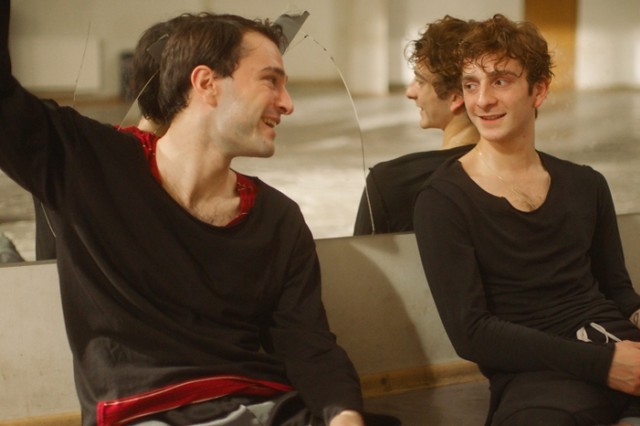
Tradition and love collide in a superb new film, And Then We Danced. Merab (Levan Gelbakhiani) is a dedicated dancer in National Georgian Ensemble, a prestigious and traditional Georgian dance academy under Aleko, a stern disciplinarian. Merab's estranged father was also a dancer who didn't see the future in the traditional dancing and now a mechanic. His delinquent brother David is also in the academy, but his foot is always half-way out the door. A new dancer Irakli (Bachi Valishvili), catches Merab's attention - his skills and masculinity, are well suited for rigidity of Georgian traditional dance, which Merab lacks (according to Aleko). Along with Merab's long time dance partner and childhood friend Mary (Ana Javakishvili), friendships blossom among them.

There is going to be an audition for a male dancer spot in the national dance team, vacated by a dancer who is accused of homosexuality and committed to a clinic. Naturally, Merab and Irakli are strong contenders for this audition. They practice hard while juggling jobs and family life. But their attractions to each other is growing. At the Mary's birthday party, Merab and Irakli make out. The forbidden affair takes hold of Merab, as it's his first love. Irakli disappears and David gets kicked out of the group. In despair, Merab injures his ankle during a practice run. At David's shotgun wedding, Irakli reappears, citing his absence to attending his dying father back home and a girlfriend he will probably need to marry for his father's wishes. And he will probably not come back to the academy. Now Merab is determined to express himself at the audition.

Anchored by Gelakhiani's stellar performance, And Then We Danced is a life affirming coming-of-age film and also a resistance film in the face of rigid and traditional society. Akin's portrayal of young loves and self-expressions are captured with pulse pounding energy and grace.

Thursday, October 25, 2012

Trumping Masculinity

The Loneliest Planet (2011) - Loktev
loneliest planet
Julia Loktev's breakdown of masculinity is very interesting. A young, engaged American couple, played by non-Americans (Gael Garcia Bernal and Israeli actress Hani Furstenberg) are trekking breathtaking Georgian outdoors with a enigmatic local guide Dato (Bidzina Gujabidze). The couple are playful, and very much in love until one act of cowardice changes the foundation of their relationship. Loktev slowly builds up to a turning point mid-way. Everything is stripped down. Nothing is stereotypical. There is no emotional breakdown, just a lot of brooding and self reevaluating. Bernal underplays his usual hunky masculinity and internalizes his thought process silently and it's a site to see. Deeply uncomfortable yet fascinating, The Loneliest Planet is an Antonioni-esque film where dissection of masculinity is at its sharpest.

Wednesday, October 24, 2012

Aftermath: Julia Loktev Interview

julia
It's been six years since we heard from Julia Loktev after her minimalist, downright Bressonian suicide bomber film, Day Night Day Night. Her new film The Loneliest Planet, shot in the Caucasus mountains in Georgia, is just as enigmatic and elliptical as her first one, if not more. In person, Loktev appears to be fiercely intelligent and thoughtful. But just like her films, I had a very hard time pinning her down on what the film is all about.

It's been a while since your last film Day Night Day Night, why the gap?

What a rude question to ask a filmmaker?! (laughs)

Oh I didn't mean to be rude...


I was just talking to someone about how we were supposed to shoot the film one year earlier. We had to delay it for a year because it took a while to get the money together. It's amazing how long it takes to get everything done. I wish I could make a film a year. In this day and age, I think that's very hard to accomplish. In this case we had most of the budget, we needed about twenty five percent of it. And the story takes place in the mountains, so there is a very short window to shoot from the month of May through September. After that, it's all snow and they are closed for business. We were going to shoot the previous summer and had an investor who came in and said, "We will give you the last 25 percent of the money, if you could move the location to China. So we were going to move to China even though the script was originally set in Georgia. Then they pulled the plug two weeks before the shoot, and we had to wait another year. Luckily, by that time I had Gael (Gael Garcia Bernal) and Hani (Israeli actress Hani Furstenberg) cast and they both stuck with the project and came back after a year to do it.

That's pretty awesome. How long did it take you to write the script?

That's a hard thing to measure because you know, it takes a while to come up with the initial idea and there is a germination period before you flesh out what you want to say. I never understand people asking "what version of the script are you on?" because I keep on writing everyday even on the set. And I'm constantly editing while I am writing it, it's much more of a fluid process for me.

You said it was conceived with Georgia in mind and the film is stunning to look at. Why Georgia?

I was born in Russia (technically in Soviet Union) when Georgia was part of the USSR. It's where I can still get around speaking Russian even though it is a different country with their culture and language. That's where my mother used to go for hikes when she was a university student. So there was this kind of family connection to the mountains even though I went to Georgia for the first time for a film festival a few years back.

Was it very hard to shoot in the mountains?

It was the hardest thing I've ever done. Yes, it was incredibly difficult. Not because we were shooting in Georgia. Georgians are actually amazingly easy to work with and made everything very easy for us, we really couldn't have done it without them. We had a small international crew and some of them were made up of Georgian mountaineers. It was run like an expedition, so in terms of organization, it was fantastic. But what made difficult was the sun because I had a very specific visual in mind. Most of the time the sun was too harsh to shoot. We had very short windows to shoot with a particular direction in mind and it really, completely limited how we shot. Perhaps limited is not the right word. The sun was definitely an obstruction and a challenge.

There was a rainy scene in the film though.

We did manage to get one rainy day scene. We planned it and waited for it and got it done. Most of the time we couldn't find a cloud in the sky. We wanted to get a nice overcast look but no luck. There was a heat wave and we had to wait for the sun to go behind the mountain so we could get some relief.

How big of a crew did you have?

About a dozen on set. It had to be very small and mobile because we had to hike into a lot of our locations. We came back all thinner and healthier. (laugh)

I find it interesting to see non-American actors (Bernal and Furstenberg) playing an American couple. Same with Day Night Day night, where young suicide bomber (Louisa Williams) is of unknown ethnicity. Do they share the theme of anonymity?

I wouldn't say it's anonymous. But they are not caricatures. They are not a blonde haired, blue eyed couple from Wisconsin and I wanted to make a point of that. Look at us here sitting and talking. Where are you from?

Korea.
You are from Korea and I'm from Russia. To me that's the world that surrounds me- many people I know are from somewhere else and to me that's very natural.

What happens in the middle of the film, I have to say, I never have seen such a subtle and sharp criticism of masculinity anywhere.

I don't know if it's a criticism of masculinity or desire for masculinity.

I've seen some other films that deal with the same theme, Bruno Dumont's "29 Palms" and possibly Claire Denis' "White Material" in which emasculating circumstances bring about the violence and destruction. Alex (Gael Garcia Bernal)'s action in the film baffles himself.

That's a very... reductive way to look at it. But it's incredibly hard to be a man now for sure. (laughs) Yes. In our culture it is incredibly difficult. As a woman I have a lot of flexibility: I can be strong, I can be vulnerable. I can kind of choose how I want to play that. And we are telling guys to be sensitive. I do like sensitive men. But there are times part of me wants a man to be a man with a capital M. That's always kind of confusing to me, about myself.

There is something vulnerable and boyishness about his behavior, like hiding behind his mom...

I don't really equate vulnerability and boyishness.

Cowardice?

No, cowardice will fall in any case. I mean we all have a case when we feel vulnerable. All the way from our childhood to old age, there are moments that challenge who you are and catch you off guard, that aren't planned for and wherein you fail. And then what do you do? It's always the aftermath, that's the question. I wouldn't call it cowardice. It's quite natural. Then, would it be more forgivable if it was a woman in his shoes? Most people would say that I wouldn't have a movie if it was like that. That's so screwy now, I mean, all this talk about challenging gender roles, we always come back to that fact. It could've been man and man or woman and woman. But we are veering off from the subject...

Well, the character's played by Gael, who obviously brings in certain masculinity and that's why that scene is so surprising.

Yeah, I think it's very important but it's not someone big. You would expect this to be built into their character but what he does something that is very out of character. That was the reason I cast Gael. Because he always seems like he knows what he's doing.

How did it come about casting Gael and Hani?

Obviously they were committed to the project even though it was delayed. I think they were both attracted to the central question in the script. They tried to find a way into those characters and tried to unpack all those very complicated yet very simple and primal emotions. The way they worked together was incredibly important to me. How they clicked from the very first day they met. They had a very good chemistry together. On the first day, they looked like a believable couple and they brought things out from each other. And also how they fit with the guide (Bidzina Gujabidze). I think the chemistry among them is what made the film work.

There is something very Antonioni about this film. How does the location factor into the couple's relationship?

I think it is like music. It colors the tone and feel of the film. The landscape completely affects the emotions and I don't mean in a straightforward way necessarily. I didn't want to have an emotionally difficult story in a difficult landscape. Like a desert for example. I actually like the idea that it is set in a soft and lush landscape. It becomes more and more beautiful as their relationships get more and more strained. It's a beautiful place. I've traveled a lot and went up a lot of mountains. But it really is an astonishing looking place and I've never been any place like that before.

Are there any contemporary filmmakers you find affinity with?

I don't know if I can say I find affinity with any particular directors. There are certainly directors I like. And I like a lot of different directors- from Claire Denis to Park Chan-wook. But I tend to be attracted to the movies that deal with image and sound more strongly than just talking.

The last half of the film is pretty much dialog-less, except for Bidzina's long monologue at the end. How did you approach that with the actors?

It's all about their inability to talk about this thing- it should be talked about but it can't be talked about. What on earth can they possibly say afterward? How do they negotiate the space between them and try to find the way toward each other? They have no idea what to say and don't have any space to talk either because they are not alone. There is the guide present the whole time. So they try to show it with their body language and so on. I think they did a tremendous job.

Is there anything you are working on right now?

Not enough I want to talk about. (laughs) It's always easier to talk about it afterward. And I don't want to jinx it.

Both of your films are really fascinating. And I'm hoping you come out with more films, because I'm really interested in what you are after.

Well thank you. I hope so too.

The Loneliest Planet opens Oct. 26 in New York and Los Angeles and will be available on VOD Oct. 30.