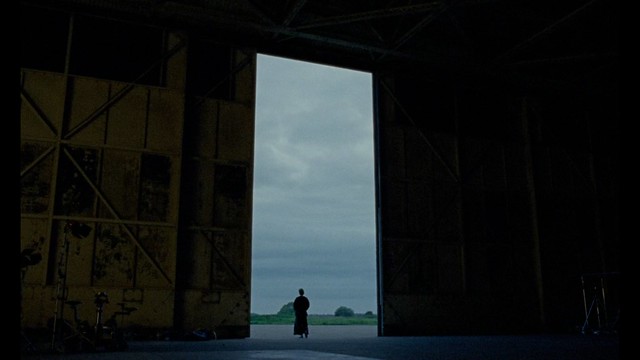
With her new film
Exhibition beginning a two-week exclusive engagement at the Film Society of Lincoln Center today, along with her two previous films
Unrelated and
Archipelago getting theatrical runs concurrently, British filmmaker Joanna Hogg is in town and I was lucky enough to catch up with her for a chat.
I saw
Exhibition at last year's New York Film Festival and was blown away by it, so I was eager to pick her brains about her Antonioni-esque use of the environment in her family/relationship dramas. Unguarded and sincere, she opened up to all the questions and explained away lengthily much more so than many other directors I've talked with over the years. For this, I thank you Ms. Hogg.
An exclusive theatrical run of Exhibition starts 6/20 and continues through 7/3. Unrelated and Archipelago have a one-week engagement 6/27 - 7/3 at FSLC. Please visit their website for more info.
All throughout your films, the settings, the places play important roles. Do you have certain places in mind when you start writing a script?
With all three of my feature films, they all started with a specific place in mind. It's very important for me to have an idea about the place. I don't see the settings for my films as 'locations'. It's fundamental for me that it's about a place that I know very well, that I have a lot of connection with. That was with all three films, a place being a springboard for the story.
Compared to your previous films, EXHIBITION is even more place specific. This modern architecture house the couple calls home: Can you tell me a little about this house and how you decided to shoot there?
Yes. Would you want me to go through all three films with that? Because each one was all very different.
Of course, by all means!
With Unrelated, which was my first feature film after many years of working in television, and toward the end of my television career -- had worked about 12 years there -- I started renting a small apartment in Italy on a farm in the south of Sienna. And I found this place which became very inspiring to me. Whenever I stayed there, I started to write ideas. I was painting when I was there. I felt very creative when I was there in this apartment. And it was a lot to do with the land around it. It was very close to a motorway. It sort of cut through the idea of sort of 'Tuscan village life'. The motorway was only a mile long and didn't go anywhere.
But the whole landscape was kind of exciting to me and I was trying to think of stories and ideas for a film because being in television for so long I very much wanted to do cinema. So I started to come up with the idea but all set within this place where I had the apartment. And that eventually turned into Unrelated. So it came from living in this place myself. The place became a creative space for me.
And ARCHIPELAGO?
As a child, my family used to go on Easter holidays to an island off of Cornwall, the Scilly Isles. We went to the same island for many years and stayed in the same place. This was in the 70s through early 80s. There was only one place to stay, this little hotel. And I revisited after a long time. I had a very powerful feeling being in this place reminding me of my childhood holidays and of love of the landscape.
I think the love of a place also often to do with familiarity. Childhood memories and connections can be very intense and that place took me back to those feelings. So I decided to set the film on that island. But again, I didn't have a complete story in mind. I had to construct it. But I constructed it from getting to know this place again.
But I must say that it sounds so far that both Unrelated and Archipelago are autobiographical and I would say they are not. With Archipelago...
[We are interrupted by loud police sirens outside whizzing by.]
Sirens here are so crazy! It has a very different sound in London... it really intrudes here, doesn't it? Sorry I am losing my train of thought here.
So with Archipelago, yes I completely constructed the story. Of course there are ideas in there that are very personal but it's...yeah, my family wasn't like that. There are things I have experienced that are in there but it's sort of a big cauldron you throw different things into and it becomes its own animal.
Yes, I was gonna ask you about that aspect of your films but I'll save it for later. So we move on to EXHIBITION.
Exhibition. That was different because I knew the house and I knew the architect who built the house in 1969. I met him in the early 90s when he was still living in the house he built for himself and his wife. I became friends with them and the house made a big impression on me. So it was somewhere I thought about when I started thinking about making a film about a couple who are artists. It seem to be a perfect container for that sort of story in a way.
Who was the architect?
James Melvin.
It was built in 1969?
'69, yes.
It looks very modern.
Yes. It had a redesign in the mid 90s by an architectural practice called Saurbruch Hutton, based in Berlin. They are colorist in a way. They work with color. They can possibly be credited to introducing color into modern architecture. A lot of the color elements in the house were added by them. The original 60s design was very monochromatic and didn't have many color at all. When they redesigned it in the 90s, they added colors.
For instance, the pink sliding doors you see in the film which became a practical effect in his study. And there are other parts of the house that had a color added to them. The fundamental details of the house -- the large glass windows, the spiral stair case, the lift in the middle, the structure of the house is exactly how it was. That's all James Melvin. Some people think that there was this big disruption in the late 60s but it's not. It's not pure in a sense but that's why it's more interesting. It's not a museum piece. It's had people lived in.
I am assuming everything was shot on location.
Yes.
Were there any challenges shooting on location?
It's interesting you ask that because I have a friend who is a photographer/cinematographer who's been to the house himself, said to me that he didn't think it was possible to shoot there. It's a cube. It's almost square with the lift block in the middle of it. So when you are in the living room, you got this interruption of the lift block. So he thought it would be very difficult to shoot in. And also he thought the amount of glass, in terms of reflection, it would be impossible to deal with.
Of course! Those things he said would be difficult became the gift for the film. Because I was interested in the reflections. You see a lot of the architecture through the reflection because when you are looking outside you are looking back at the house with yourself in the way. So that inside out aspect was very interesting to me. And even the lift block, I mean, was a kind of nice interruption. So the you don't see the space completely. It's always broken up by something. In fact, with Ed Rutherford, my cinematographer, we avoided shooting too wide. Whenever we set up a shot and we go wide, the panoramic view looked like a real estate agent catalog. Sort of a property photograph. (laughs) So we shot a lot with 50mm lens. So we kept things more contained. You never see the house in its entirety from inside or outside. The only time we see the entire house from the outside is when they have the cake (molded in the shape of the house).
So all the limits worked in your advantage.
It did. But from a practical point of view, it was sort of cruel for the crew. Because the only way to get up the different floors in the house was on the spiral staircase.
I thought it was pretty remarkable how you use sound and space to create the couple's connection/disconnection, as you might say. How much of a sound design went into the film?
Well, a lot of sound was created afterward, based on the recordings that were made after the shoot. I recorded sound myself and also the sound designer. We also used the location sound recordist had recorded during the shoot directly from the scene. I made sure that the sound recordist would capture everything around us that was going on.
For example, the road works outside the house, which we didn't organize - it just happened on the second day of the shoot and for almost entire shoot. We made sure to record those sound, lots of drilling. For me it was important that there is a real authenticity about the sound that it's not coming from a (sound) library that it's new recordings specific to that locations we were shooting in.
And that house has a particular way of soaking in sounds from the outside. I was really interested in this and I don't think I exaggerated really in the film. When you are standing in the house, there is a corner you can here a sound, like someone talking, closing a door from outside. It travels back in and you feel like those sound is coming from within the house. As I described the visual structure, being inside out, it was the same with the sound.
EXHIBITION is much more of a visual/aural experience than your previous films. Do you feel that it's a big departure for you artistically as a filmmaker?
It seems like a departure but I feel the other films were just building to that. Each one I become a little braver. I am always interested in pushing myself as a filmmaker and not staying with what I'm comfortable with. One of the main differences that I was really challenging myself with was the idea of a narrative that was less linear. The other two have relatively linear storylines. Whereas Exhibition, I wanted something more fragmented to represent different levels of reality and unreality, dream and memory. Again, increasing interest in sound design. I wanted to push that much further. And the reduction of characters, concentrating on one married couple without an extended family, contained in this...cube.
You've used non actors in your films. Especially artists. Christopher Baker, Viv Albertine, Liam Gillick. Do you know them personally? And how do you approach them being in your films?
I don't always know them personally. In the case of Christopher Baker, he has been my painting teacher for many years. I met him in 2002 and have been painting with him on and off since then. So I knew him even before I started making Unrelated. He can possibly be credited for helping get my creativity back on track. So I know him quite well. I'd watch him during painting lessons and I remember thinking at a certain point, 'I'd like to find a part for him in my film one day'. And Archipelago was obviously the right one.
There is this zen-like quality about him that is infinitely patient and wise.
He is like that in real life. But at the same time he was playing the part of the story. I think it's because I had a privilege of observing him for many years, I was able to fit him in the story. I like sometimes having that 'real-life filtering in to fiction'.
And Liam and Vive. Vive has been a friend of mine for many years. But I neve thought of casting her before. I haven't looked at her before thinking, 'I'd put her in a film' until less than a couple of weeks before shooting. I've been looking at many people. Casting had taken a long time because I wanted to find my couple early on. Because I needed to find them early on to fit into the story and have them get to know each other and get to know the house. But it all happened last minute.
Oh wow.
Possibly that ended up being good. But it was certainly a bit chaotic two weeks before filming and I was getting a little nervous. Liam I didn't know at all. I knew his work as an artist but I didn't know him personally until just before the shoot. So I was very happy to find him.
They both are great and have a great chemistry together. Were there any improvisation involved?
Yes. I mean, it's...I always hesitate to call it improvisation because I always feel that gives a feeling that it has no plan or design or precision at all. How I work is very precise. But as I described working with Christopher, I like the approach of bringing something from real life in to fiction with my actors and non-actors. With Vive and Liam, I sort of sometimes feed them lines and other times they would put things in their own words.
I had a precise plan on paper but I didn't show it to them because I didn't want them to worry about what was going to happen next. Then there was certain point in the shoot where I'd write a scene the night before and then show it to them about half an hour before shooting, just enough of time for them to see the map of what I'm trying to do.
I'm pretty sure you get to be asked a lot about Tom Hiddleston, who is in all of your films and now a big star. How did your working relationship begin?
Well, I met him for Unrelated. The casting director was helping me with that film. I'd seen him in a play at his drama school and was very impressed by him. And when I was looking for an actor to play Oakley, she introduced me to Tom and he was really wonderful in Unrelated obviously. He was much younger then. But we had a great working relationship and I thought of him straight away when I was preparing for Archipelago. He is so good at transforming himself into different characters. It's always irresistible to find him new characters to play. Although I like to work with actors and non-actors alike, Tom is different. He can totally become that character in a way that feels very real.
I mean he is completely different in UNRELATED and ARCHIPELAGO.
Yes. He is channeling something different for each one. And with each one, also in Exhibition, even though it's a much smaller role, he is taking it just as seriously.
Would you work with him again, even though he is a big movie star now doing all these blockbusters?
Yeah, I would. If there is time. (laughs) He is always busy with other films but I have plans for something else I want to do with him.
I'd very much looking forward to that.
The scene where Viv's character fakes fainting during dinner where her friends are talking incessantly about their children made me and my wife laughing out loud in the theater. (we both laugh) We don't have children and my wife really wants to try the fake fainting spell at a boring dinner like that.
Yeah she should do that because I ruined it for myself. Since I put it in the film, I don't think I can get away with that. (Laughs)
Is that from a real life experience?
It's a fantasy. (Laughs)
Childlessness and I wouldn't say the absence of good parenting, maybe a disconnection between different generations are always present in your films. Are they based on your real life concerns or are they external themes you want to explore?
Childlessness is from my own experience. I don't have children and I've grappled with the idea of wanting to have children then trying to come to terms with...you know, been though different processes. So that was something I wanted to express. So when I made Unrelated, it was very much something I was going through at that time. With Archipelago I don't deal with that. I deal with the family in a different way.
Then I wanted to come back to that theme again with Exhibition but with a different stage in life. The stage where they come to terms with it, possibly. Although as we see, it's something that comes and goes. I think there is still a sadness there. It's something that never goes away. I still feel ambivalent about it. But if I had children, I wouldn't be making films, so I value filmmaking. They are my children in a way.
Excellent. So what's next for you? What are you planning?
It's always difficult to talk about the next film... because I am still constructing it. But I'm gonna go back in time.
Oooh, a period piece?
Well, not too far. To the 80s. And it's also going to be set part in London again. I'm in the period of making city films.
I can't wait.
Read my review of Exhibition
here
Read my review of Archipelago
here
 A big black sedan rolls in the foggy English countryside. The sun is setting. Ominous flute piece is playing in the background. The car finally pulls up to a grand manor at dusk. If it weren’t for the car, you'd think of the opening sequence of The Eternal Daughter as the start of a Hammer Horror film or an adaptation of a Henry James novel. We are introduced to a mother, Rosalind, and daughter, Julie (both played by Tilda Swinton) and Rosalind's dog, Louis. They are arriving late to check in and the curt, young receptionist (Carly-Sophia Davis) has no records of them reserving the specific room on the second floor. After much polite haranguing, the receptionist relents and the mother and daughter finally settle in to the room they wanted. This is not a good start for the stay Julie was hoping for.