Showing posts with label Robert Pattinson. Show all posts

Sunday, December 21, 2025

Suffocating Conformity

Die My Love (2025) - Ramsay Screen Shot 2025-12-20 at 7.55.16 AM Screen Shot 2025-12-20 at 6.27.31 AM Screen Shot 2025-12-20 at 6.30.18 AM Screen Shot 2025-12-20 at 6.43.47 AM Screen Shot 2025-12-20 at 6.43.59 AM Screen Shot 2025-12-20 at 6.47.51 AM Screen Shot 2025-12-20 at 6.55.03 AM Screen Shot 2025-12-20 at 6.55.10 AM Screen Shot 2025-12-20 at 6.57.56 AM Screen Shot 2025-12-20 at 7.04.47 AM Screen Shot 2025-12-20 at 7.21.57 AM Screen Shot 2025-12-20 at 7.40.14 AM Screen Shot 2025-12-20 at 7.57.06 AM Screen Shot 2025-12-20 at 7.58.42 AM Screen Shot 2025-12-20 at 8.09.55 AM Screen Shot 2025-12-20 at 8.12.05 AM Screen Shot 2025-12-20 at 8.12.24 AM Lynne Ramsay depicts a young woman experiencing the perils of motherhood at great length with the help of a feral performance by Jennifer Lawrence and intimate/expansive images by DP Seamus McGarvey, in their second collaboration after We Need to Talk About Kevin (2011).

Short on backstories in typical Ramsay fashion, Die My Love is mostly told visually, from a young woman's perspective as she goes through a postpartum depression. Grace (Lawrence) and Jackson (Robert Pattinson) are a young couple, moving into an old fixer-upper farm house in the countryside that belonged to Jackson's relative. The house is all covered in old wall papers and has rat problems. No matter, the young couple is enthusiastic to start a life together and Grace soon becomes pregnant with a son. Left alone to her own devices while her partner Jackson is away for a job in the city half of the time, Grace's daily life, bored and living in her own head, veers dangerously into fantasy territory.

Foreshadowing with Grace roaming around the yard on all fours with a kitchen knife in her hand, Ramsay makes a point that the film is not about Grace suffering from depression, but how a young woman is perceived when she behaves outside societal norms.

Grace does act irrational and compulsive - throwing herself through the glass window while arguing with Jackson, strips to her underwear and jumps into the kitty pool at a party, fantasizes about a married neighbor (LaKeith Stanfield). Family and friends are left helpless, not knowing how to help her. And the film shows how normal society deals with a 'difficult woman' - either marry her or institutionalize her. Jackson does both, but that doesn't fix Grace.

Filled with many details and nuances with McGarvey's 4:3 ratio shot images simultaneously confining and expansive, and great supporting cast- Pattinson as wide eyed, frustrated partner, the great Sissy Spacek as Jackson's sleepwalking, shotgun totting mom and the only person who understands Grace (reminiscent of her character in Badlands) and Nick Nolte as Jackson's dementia suffering dad, Die My Love is a great film about suffocating conformity of a life of a young woman. I really liked it.

Monday, November 4, 2019

Madness at Sea

The Lighthouse (2019) - Eggers
the Lighthouse
From its mucky, grainy B&W academy ratio cinematography to off-the-wall acting by two of the most distinguished faces in Hollywood, Robert Eggers' The Lighthouse is one of the most original American films I've seen in quite a while. Eggers one-ups his great debut, The Witch, in terms of formalist filmmaking, originality and ambition.

OK. Two men cooped up to keep the lighthouse going, on an island (the rock as it is referred to) surrounded by stormy sea, for two hour running time, you'd think it would be an all formalist, all talk, My Dinner with André style snorefest. Not so. In this two-men stranded on an island set up, the elder is a bearded, flatulent sea man, Wake (Willem Dafoe), and the rookie is Winslow (Robert Pattinson), running away from his troubled lumberjack past. Wake soon exercises his stern authority over the young man. So Winslow is burdened with extreme physical, day-to-day chores - bringing up the coals in a wheelbarrow in a rocky, muddy hill, cleaning their cavernous cabin, maintaining the gears and wheels of the lighthouse. He also has to content with Wake's noisy bodily functions and general below-hygiene standards in close living proximity and also crippling loneliness.

But Eggers wastes no time plunging Wake and Winslow into cabin fever induced, lust deprived hallucinations and madness. The men's backstories figure less into the film as they devolve into the nights of binge drinking, ugliest shitfaced free-fall soon enough. There's gonna be a mermaid with fishy vagina. There's gonna be tentacles. There's gonna be a severed head filled with crabs. Seeing the giant revolving light on top of the lighthouse becomes the ultimate goal for Winslow, since it is forbidden to him - only Wake has the key to the entrance all to himself.

The Lighthouse is a crazy hallucinogenic trip that is extremely original. The two actor's physiognomy, Dafoe's troll-like, gangly body and posture and bushy beards (right out of Van Gogh's paintings) and Pattinson's bulging eyes and angular face, is very well used. There are many unforgettable imageries. The Lighthouse is a quite unique movie watching experience.

Wednesday, October 3, 2018

Basic Human Needs...in Space: Claire Denis' Rapturous New Film, High Life

High Life (2018) - Denis
i29623Y-1
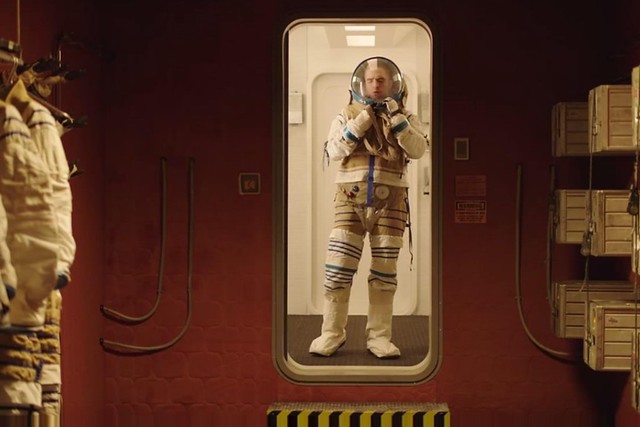
Hazy mist sprays over the vegetable garden from a sprinkler system. Monte (Robert Pattinson) in space suit is seen outside the space craft, doing some sort of repair. There is a baby in a makeshift crib. He is cooing the baby through the speaker system. As she cries louder and louder, he loses his concentration and drops his wrench into the void. So starts a rapturous new film by Claire Denis, High Life.

With jumbled timeline and voiceovers over the course of the film, we gather this square, retro looking spaceship once was populated by convicts on death row being subjects to medical experiments as they get close to the nearest black hole. Doctor on board is Dibs (Juliette Binoche) who apparently killed her entire family on earth. She administers drugs and experiments to the crew mostly comprised young people of all genders and races. It's their reproductive abilities near the black hole she is most concerned about. The experiment can't fail because the ship is programmed to cut off life supplies if it does. It's now Monte's job to keep it going. So this is the basic idea for High Life.

It's all about basic human needs- eating, shitting, fucking and making little babies, in space. It's all about the human bodily fluids. Shit happens and people die. The ship's interior is beige colored and stained (with human fluids) and worn out in that queasy 70s way. Doing Science Fiction, Denis goes about it with bare minimum - no grand establishing shots of the interiors, no extreme high-tech, anticeptic looking dingerdos, just because it's not her concern. There is a 'fuck box' where crew uses to get their rocks off. Monte is practicing celibacy because he wants to control himself. But Dr. Dibs has other ideas about that. Denis pushed the limit of what is considered good taste with The Bastards. With High Life, she pushes even further - Taboo isn't taboo anymore. It has sharp edges like her other films. And It's those ecstatic moments, like in many of her other films - frozen bodies floating in space, meteor showers, baby eating dirt in the vegetable garden, dead dog in the stream, sudden burst of violence and emotions that puts High Life very much in the top tier of all Claire Denis-ean film.

Sunday, November 12, 2017

Good Time for Whom?

Good Time (2017) - Safdie
Good Time
I understand what Josh and Benny Safdie are going for. From what I've seen and heard, their films are all about small moments - not narratively gregarious, concentrating on small encounters, naturalistic settings, characters in motion. And there are quite few of those moments in Good Time. When they work, they work great. But does the movie work as a whole? I'm not so sure. Good Time has many things going for it - solid performances by wide eyed Robert Pattinson, playing a small time crook taking charge over his mentally handicapped brother (Benny Safdie), heart pumping score, 16mm gritty cinematography... But it also is very unsatisfying especially when there is no one you can root for. Pattinson's Connie is a hard character to sympathize with, as he works his charm over various women and resort to violence when things get dire. I get that he cares for his retarded brother but there is no indication of his background or what his real motives for the bank robbery is - in short, who he is.

OK, so those moments. Loved the interaction btwn Pattinson and Safdie in the bathroom of Pizza Hut after their robbery has gone horribly wrong. Loved the teen black girl in the house in Queens where Connie invites himself into. It's very unlikely that a sassy, pot-smoking black teen would be hanging out with an older white stranger, but I let that go because their interactions are really great. Loved the idea of breaking into an amusement park at night. But that moment's also somewhat tampered by that Somali actor (Barkhad Abdi) who is in everything now- the treatment he gets (from Connie) was almost racist.

People stop comparing Good Times to 70s NY movies. The Safdies ain't no Lumet. Their aim is quite different- it's smaller and narrower. But it's as if they don't ever wanna bite off more than they can chew. If getting those couple of moments are their aim for two hour movie, that's fine. But I feel they are putting emphasis on the wrong things- for instance, extensive (and surely expensive) aerial shot of the city in the beginning and following Connie's car on the street from aerial view. Good Time feels like as if they are afraid to tackle something bigger, grander things. I don't know. I guess I don't like their timid ways.

Sunday, October 16, 2016

The Lost City of Z, for an adventure movie, lacks bravado

The Lost City of Z (2016) - Gray
 photo 89047dcf-1033-45a3-b998-860563e4e4bc_zpsviaivsvi.jpg
The Lost City of Z, an unabashedly old fashioned, bows-and-arrows school boy fantasy based on David Grann's non-fiction bestseller of the same name, stars Charles Hunnam as a British army officer turned explorer, Col. Percival Fawcett, who had a perilous obsession with the Amazon jungle.

Despite years of being stationed overseas and proving his leadership abilities, according to his sneering superiors Fawcett "had a bad choice of his ancestry" -- his father was a drunkard and a gambler, and therefore forfeited his advancement in the army. With the help of the uppity Royal Geographical Society, together with Britain's interests in rubber industry in the Amazon, Fawcett is granted an expedition into Eastern Bolivia to map the fuzzy Bolivian and Brazilian border deep in the jungle.

The two-year expedition means being away from his spirited wife Nina (Sienna Miller) and his young son, Jack. But man must do what he's got to do -- to restore his family name in good standing in a rigid society and be a hero and whatnot.

Fawcett's small team, including Costin (Robert Pattinson) and Manley (Edward Ashley) with an Indian guide, goes up the river only to be attacked by various Indian tribes and suffer diseases and hardship. But the explorers not only find the source of the river, they also find evidence of an ancient civilization: broken potteries and sculptures of human figures.

After returning home, Fawcett becomes an advocate against the general notion of the natives of America as arrow chucking, cannibalistic savages who are forever stuck in the early Iron Age. Finding the lost civilization in the Amazons becomes an obsession for him.

With the backing of rich patron/fellow explorer James Murray (Angus Macfadyan), Fawcett and his team set out a second expedition, despite angry objections from Nina. When disease and the unforgiving climate of the jungle becomes too much for out-of-shape Murray, they have to abandon the mission. At home, the accusations fly and Fawcett strains his ties with the Royal Geographical Society.

The first World War interferes with Fawcett's obsession as he is sent to the frontline, where he sees many of his friends die and himself getting injured in the horrific battle of Somme. Now nearing 50, and his son Jack a young man, father and son try once again to find the lost city.

You can't escape the shadow of Werner Herzog when it comes to making a film set in the Amazon. Aguirre, The Wrath of God and Fitzcarraldo, about a man's obsession and his futile attempt to wield the course of nature both spiritually and physically, are towering examples to measure up to. All the hardships and suffering in the making of these films are justified by the breathtaking end results.

It might not be fair to compare, since Gray is a very different kind of filmmaker, who prides himself in emotionally fine-tuned dramas. Despite all the glorious pretty picture show, well-rounded characters and fine acting don't really suit the adventure genre. But that's just it. His attempt at showing 'it's the journey not the destination' lacks a proper bravado and zeal, constantly interrupted by Fawcett struggling with domestic life and in finding his stature in the rigid society.

Shot on 35mm by Darius Khondji (who also shot Gray's period piece The Immigrant), The Lost City of Z is a very handsome movie. Gray does his best to be faithful to the source material and instill every character with humanism. But I find Nina Fawcett's proto-feminist character too propped up to be believable in otherwise this male-oriented adventure film.

There is nothing particularly wrong with The Lost City of Z. I buy that one man's obsession -- 'a man's reach should exceed his grasp' -- is a worthy subject for a movie. Obviously, it's much less offensive than that last Indiana Jones film or Apocalypto when the depiction of natives are concerned. But do we need another film about a white man's journey to validate another culture's worth in this day and age?

The Lost City of Z (and as well as The Immigrant), as a sumptuous and elegant epic it might be, doesn't quite justify all the effort put in by everyone involved.

The film had its world premiere at the New York Film Festival. It is being distributed by Amazon Studios in theaters in early 2017.

Thursday, July 21, 2016

Making of a Monster in Brady Corbet's Accomplished Directorial Debut

The Childhood of a Leader (2016) - Corbet
 photo 896eab18-bdbd-4dd9-85fc-176cba0374d5_zpsdxynw5ee.jpg
An allegorical tale set in the shadow of WWI Europe, The Childhood of a Leader is a very accomplished first feature from 27 year-old American actor Brady Corbet. Considering his face has been showing up in the films of who's who in European arthouse cinema over the years -- Haneke, von Trier, Bonello, Assayas, Hansen-Løve, just to name a few -- this exclusively European production (UK/Hungary/France) seems far less surprising.

The film sees an American diplomat (played by Liam Cunningham) working for President Woodrow Wilson to end the horrific war that the world has ever experienced after the industrial revolution. His newly transplanted family consists of an educated, worldly wife (Berenice Bejo, The Artist, The Past) and an effeminate young boy (amazing Tom Sweet) with a bobcut blond hair, holed up in an old chateau in rural France.

With his parents always busy, the boy is neglected and being brought up by servants and tutors. In the first segment of the film "A Sign of Things to come," the boy is seen throwing rocks at the fellow church goers after the Christmas mass. Their stern, but emotionally distant parents don't know what to make of his violent behavior but still too preoccupied to do anything solid about it.

The film is divided into the boy's 'tantrums' and builds up to its violent climax. These could be seen as minor outbursts of a normal boy his age, maybe a little more violent and erratic. He paws at the breasts of his French tutor (Stacey Martin, Nymphomaniac) and manipulates a sympathetic old servant (Yolanda Moreau), getting them both fired by his mother. The boy, whose name is revealed toward the end as Prescott, is a bratty, spoiled kid who can be seen as a result of bad parenting or Devil Incarnate, like Damien in the Omen movies.

Despite its allusions to the political dictators of the past, Corbet and cowriter Mona Fastvold set the film and the boy's age somewhat removed from the rise of Fascism and Bolshevism in order to not to make it an overtly obvious biography of someone in particular.

You can tell that young Corbet takes a lot from Michael Haneke in terms of theme and stoic presentation. Cinematically speaking, the film is an impressive feat: Lol Crawley (45 Years, Here), director of photography, is responsible for the seriously underexposed cinematography (practically lit interiors) and Scott Walker's stirring string score dominate the film's dark, jarring mood, comparable in its greatness to Jonny Greenwood's blood-pumping There Will Be Blood soundtrack.

There are many fine small moments that wink at immoral adults who surround Prescott. It seems that there are some amorous relationships occurring in the father and the tutor and mother and the family friend in the form of an expat (Robert Pattinson). He also hints that neither parent wanted Prescott in the first place: mother never wanted to be a housewife, father wanted a daughter.

Tonally restrained yet vigorously formalist, Corbet's directing debut definitely doesn't feel like the work of a first-time filmmaker. Corbet also gets uniformly subdued performances from the veteran actors involved. Bearded Robert Pattinson does a fine job playing a double role in two of the film's most enigmatic roles.

But The Childhood of a Leader owes big to its young star Tom Sweet. As a wide eyed, bratty kid, his brave performance alone will cause a string of nature vs nurture debates in the minds of many audience members long after leaving the theater.

After winning the Best Director and Best Debut Prizes at the Venice International Film Festival - Horizons, The Childhood of a Leader had its New York debut at BAMcinemaFest and will open theatrically in New York on Friday, July 22, as well as on VoD, before rolling out nationally.

Sunday, August 19, 2012

The Rat is the New Unit of Currency!

Cosmopolis (2012) - Cronenberg
cosmopolis
Faithful word by word to Don DeLillo's source material, Cronenberg breezes through the one day in the life of the master of free market Eric Packer (Robert Pattinson). Spending most of his screen time in an indistinguishable white stretch limo, surrounded by glowing screens of charts and numbers and the interior design straight out of Prometheus, Packer conducts his daily business there. The president is in town. The streets are packed, with cars, protesters and ordinary people you will barely see or hear. It is Packer's universe we are living in, not the other way around.

There is a tangible threat to Packer's life, according to his high-tech security team. But he really need to go across town to get a haircut. Dialog is stilted and encounters are stagey just like in many of the other Cronenberg films. He is betting against Yuan (whatever that means) and by the end of the film he would be penniless. His demeanor doesn't change- he doesn't get hysterical or have a sudden epiphany. Detached as ever, his death wish gets fulfilled in the hand of a former employee (Paul Giamatti) living in a squalid building.

Cronenberg brilliantly captures DeLillo's take on the hideous amount of wealth accumulated by the Wall Street types before the crash. Packer's glass kingdom is done in not by the global protest movement, but by him questioning himself 'what's all this for?' He needs constant physical act to feel something- screwing, being voluntarily tased , shooting through his own hand. Juliette Binoche shows up for a quicky, only to be told by him to make an offer to buy an entire chapel filled with Rotko paintings, Samantha Morton drops in as his chief theorist and Matthieu Amalric cameos as the world's greatest pieing activist. Pattinson is perfect as a dead-eyed 28 year old master of the universe and the rest of the casting, impeccable like everything else about the film- sound design, cinematography, etc. You can take Cosmopolis as the driest black comedy in years- it's hilarious. One of the year's best.