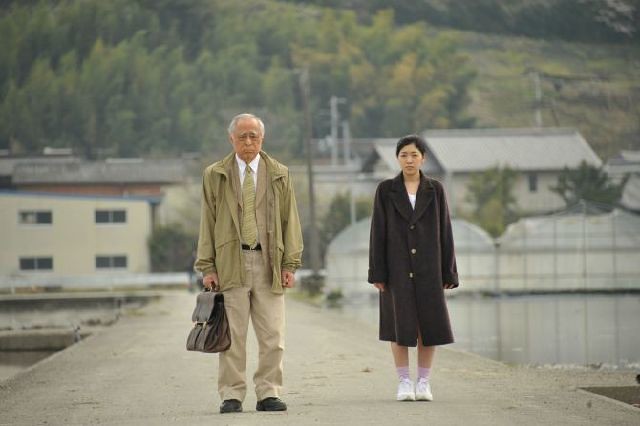
Monster (2023) - Kore-eda
What seemingly starts out as a rashomon style abuse accusation in a school drama, Kore-eda's new film Monster is actually about something completely different. It's a massively poignant lovestory and an indictment of the bigotted society where people assume the worst in each other. It tells a elementary school kid Minato (Soya Kurokawa) being accused of bullying another child Yori (Hinata Hiiragi), and in turn punished by a young teacher Hori (Eita Nagayama). When Minato's single mom (Sakura Ando) notices about his son's odd behavior and sullenness, she complains to the principal of the school. But the principal and other teachers have already built an impenetrable wall to protect school's reputation and repeats the scripted response and apology to her. Enraged, mom finally gets Hori fired. But her son's odd behavior doesn't stop. On the eve of a tropical storm approaching the area, Minato disappears. His mom and Hori, start looking for him in the storm.
Then the film goes back to tell the same moments - some seemed insignificant and some pivotal before, from the kid's perspective and reveals innocent friendship and moving lovestory between two kids. Japan, like other countries (let's not kid ourselves, all countries are conservative) still maintain gender affirming activities in media and at home. Parents convince themselves that they can 'fix' their children if boys or girls are not behaving like boys or girls. We scrutinize everyone for their supposed roles in society and presume their shortfalls- Single mothers are drama queens, too protective of their children, Teachers should never visit bar hostesses, for example.
The society full of stereotyping and prejudices, children can't express what they feel, not only not to adults but to each other either. Rather they become cruel liars. It's not that they are evil. But the harm is done.
As is the case with Kore-eda films, he gets the most outstanding performances out of young actors. Both Kurokawa and Hiiragi shine in their demanding roles emoting in their uncertain stares and silences. As usual, Sakura Ando is a national treasure as a frustrated single mom and an unsuspecting role model. And both Nagayama and Yuko Tanaka (who plays the principal) are great in their supporting roles. The late Ryuichi Sakamoto's score adds to the film's greatness.
0.5mm (2014) - Ando
Clocking just over 3 hours, 0.5 mm tells a sprawling journey of a young caretaker of elderly people (director Momoko Ando's little sister, Sakura) as she travels through Japan. It's a comical, tender and deadly honest look at aging Japan and its seemingly unbridgeable generation gap.
Sawa (Sakura Ando), is a comely caretaker of an bedridden old man- she changes his diapers, cleans his fluid tubes and feeds him every day. The man obviously hasn't long to live. Sawa expertly handles it all. One day, the man's daughter asks him if she's willing to sleep with the dying man- that it is his dying wish, and assuring her that he is quite flaccid. Breaking the agency protocols for a large sum of money and compassion, Sawa agrees to go through with it. But it only ends in a disaster that costs the old man's life. Something breaks in Sawa and she takes off on the road.
Without any money, she witnesses an eccentric elderly man (Tatsuo Inoue) who's compulsively going around town stealing bicycles and puncturing tires. She blackmails him into pressing herself into his life as his live-in caretaker. There are many funny moments in this prolonged segment as Sawa flirts and disinfects his desires, fights off a sleazy scammer of elderly people, until he decides to go to the fancy retirement home, leaving Sawa his long, worn-out winter coat and his beloved old vintage sport car which has been sitting in his garage.
Sawa moves on to another elderly man, a former professor (Masahiro Tsugawa), who pretends to go to teach every morning, but instead hangs out in the mall all day and spends his time looking at dirty magazines instead. No challenge is small for Sawa, as she pushes herself into the professor's life, guising herself as a former student and admirer of the professor, she forms an uneasy alliance with his older housekeeper and caretaker of his bedridden wife. Sawa insists upon taking care of the wife, who must have been a cultured woman, as she sings arias in the middle of the night. The professor was a navy captain in the war. He reflects contemporary Japan's directionlessness. With the collective will of the people, they could've moved a mountain 0.5mm if they wanted, back then. Just like his wife, he too, slowly loses his mind to aging.
Sawa travels to a small fishing village where she meets a slovenly mute boy whom she's known before and follows him to a shack where his brutish scavenger father lives. The boy turns out to be a girl underneath all the baggy clothing and Sawa and her father has several physical altercations.
With these encounters, Ando takes a current snapshot of Japan, where elderly population problem needs to be dealt with. That they need to be respected and seen with compassion. She also vilifies the post war generation who lacks compassion. They are passing responsibilities of taking care of elderly on to the directionless younger generation. In the center of 0.5mm is brave, ferocious, magnificent Sakura Ando. Not afraid of the physicality and wackiness of her character but also conveys deep compassion and understanding Sawa has for her elderly counterparts. With 30 percent of Japan's population over the age of 65, it's no surprise that Japanese cinema is the first to tackle growing elderly population problems. Biting, uncompromising and deeply poignant, 0.5mm is an impactful film mostly because its untethered, sprawling narrative. There are certain new breed of Japanese indie-filmmakers who totally ignore the typical 3-act narrative structure- Sion Sono, Shinji Aoyama come to mind. I see Ando is also the cut of the same cloth. There is a sense of freedom, freshness to their storytelling.
Thanks to Japan Society's fabulous Shannon Jowett, I was able to see some of the best contemporary Japanese films making New York premiers at this year's Japan Cuts. In it's 9th outing, the series is not only North America's largest celebration of Japanese cinema, but also remains to be one the best film event in the city.
Here are 4 outstanding quality films I got to see:
HIBI ROCK: PUKE AFRO AND THE POP STAR - Opening Night Film. July 9, 9pm [Introduction and Q&A with director Yu Irie, followed by OPENING NIGHT Party!]
Returning to Japan Cuts this year with two films (Hibi Rock and Joker Game), Yu Irie is a familiar face around this part of the world with his crowd pleasing films depicting Japan's indie music scene- 8000 Miles Series, Ringing in their Ears. His new film Hibi Rock: Puke Afro and The Pop Star, once again, plunges us into that music world he knows intimately.
Based on the popular manga by Katsumasa Enokiya, Hibi Rock concerns the minimally talented rock band Rock 'n' Roll Brothers (Hibinuma- guitar/vocal, Yoda- drums and Kusakabe- bass). The film is, more than any other Irie films, at its most cartoonish, but also most fun: lead singer Hibinuma (Shuhei Nomura), with his afro, deer in the headlight expression and his mouth agape, is ripped straight out of a freeze frame of a manga page. There are a lot of kicking balls and instantaneous nose-bleedings at exposed boobies also.
Always an underdog, Rock 'n' Roll Brothers barely survive on cleaning toilets of the small venue they sometimes get to play at. But their luck changes when a super pop idol Saki Udagawa (Fumi Nikaido of Ringing in Their Ears and Why Don't You Play in Hell?) shows up and take an interest in their music. It's not really their skills she's thrilled with, but their infectious energy and freedom. Because what's the point of rocking out if you are not free? Saki reminisces about her humble beginning in a high school band playing guitar. She tells Hibi that she is empty inside even though she is a mega star. She is well aware that her fame and popularity will fade away. She wants him to write her a song.
After getting rejected by Saki's all powerful promoter, downtrodden Rock 'n' Roll brothers split up. Hibi ends up working at a fish cannery, gutting fishes, Yoda in construction and Kusakabe a lumberjack. Hibi learns the news that Saki is hospitalized and in serious condition and decides to deliver the song he wrote for her. So he runs to Tokyo, the note he wrote the song on in one hand and a dead fish in the other.
As usual, Irie's penchant for portraying lovable losers and youthful energy takes the center stage in Hibi Rock. Nomura's perfect as an all out cartoonish front man and a virgin. Even though she plays a sick girl, Nikaido's smile still kills. Hibi Rock is a loving tribute to the spirit of Rock 'n' Roll.
ASLEEP - Centerpiece Presentation. July 16, 6:30pm [Introduction and Q&A with star Sakura Ando]
Based on one of the 3 stories from Banana Yoshimoto's novel of the same name, Asleep, tells a story of Terako (Sakura Ando of Love Exposure, 0.5mm, Penance), a young woman having an affair with an older, married man, Iwanaga, whose wife is in a coma. Terako spends most of her days in her bed under the fluffy covers in her underwear. She is kind of a kept woman in a sense, because Iwanaga wants her at his beck and call. She prods him about his wife in their rendez-vous in cheap hotel rooms, but he obviously doesn't want to talk about it much. Terako also struggles with the memories of Shiori, her roommate whose suicide impacted her life greatly. Shiori was sort of a 'sleep prostitute' - a person who keeps you company when you sleep.
The act of sleeping in Asleep is akin to a clinical depression. It's an exhausting affair. Terako finally realizes that Shiori's role to all those lonely people was to absorb their darkness like a sponge. Hence, she theorizes her roommate's death as sheer exhaustion from taking all that darkness. She needs to get out of her sleep-walking life. And the help comes from an unexpected source.
The film is far from being sad and gloomy. Always enigmatic Ando channels her soft, feminine side and gives our somnambulist heroine the subtlest, perfect emotional range. Photographer cum director Wakagi Shingo's uncluttered simple, airy look also betrays its potentially dark subject. In Wakagi's soft-edged world via quietly whimsical writings of Yoshimoto, waking moments are just as comforting and warm as your own bed.
100 YEN LOVE - Centerpiece Presentation. July 16, 8:45pm [Introduction and Q&A with star Sakura Ando with CUT ABOVE award ceremony. Followed by the PUNCH LOVE Party!]
I'm madly in love with Sakura Ando. The film tells a 32-year old no-do-gooder and a virgin slob Ichiko (Ando) still living with her parents, not helping her mom's small bento shop business and getting into a fist-fight with her just-divorced-single-mom sister. Her only outside contacts are a 24-hour 100 yen shop- American equivalent of a dollar store, where she gets her sustenance (junk food) from and a nearby boxing gym where she gets to glimpse of a boxer Yuji (Hirofumi Arai) exercising. He's not a good looking or anything, but she is entranced somehow.
After a big fight with her sister, Ichiko moves out and with the help of her softie mom, she gets a small flat and gets a night shift at the same 100 Yen store. Working there, she meets an assortment of weirdos who are just as much losers as she is. She even hooks up with Yuji, who always seem to forget his bananas he just bought at the store. "Why did I ask you out? Because I knew you wouldn't say no." He said coldly at their first date at the zoo. He invites her to his boxing match where he gets beaten badly. He says that he's 37 and that was his last match.
After being raped by a shady older co-worker, she decides to take up boxing herself. The coach mistakenly thinks that she's there to lose some weight but slowly but surely sees that she is determined to kick some ass, or maybe her own ass.
She finds Yuji inebriated in the corner of the street and takes him in and nurses him back to health. They become lovers of sorts. She still trains and works her night shift at the store.
It's a Jake LaMotta style transformation, only in reverse- Ichiko trains really hard and becomes a fit, ferocious girl. When asked by Yuji why box, she demurely answers, "I like how you hug each other and tap your shoulders after the match".
She bugs her coach, day and night, to give her a chance to get into the ring. The coach tells her that she is too old to be a professional boxer. The age limit for woman is 32. But she is determined to get that last chance to show the world that she is somebody. The coach tells her that it's no cakewalk.
We know she is 100 Yen kind of a gal. She says so herself. But would she stay a loser forever? The film is a total underdog story that largely relies on the shoulder of Ando and she gives, hands down, the best performance of the year here. Heart breaking and poignant, 100 Yen Love is easily one of the best films I've seen years.
VOICE OF WATER - July 17, 8:45pm
Veteran indie filmmaker Masashi Yamamoto (Three Points) directs this intriguing story involving a beautiful Zainichi (Korean-Japanese) shaman.
What started out as a half-hearted, simple easy money making scheme- palm reading with the help of her best friend Mina (Shuri), Minjung (Hyunri), a granddaughter of shimbang (Korean Shaman) becomes a face of a religious cult, God's Water, backed by a suave ad executive Akao (Jun Murakami) who sees money in the venture. Her sincere attitude, exoticism and beauty are mainly the selling point, showing real compassion for troubled, but gullible souls who pour out their sob stories in front of her.
In the meantime, Minjung's no-good father Mikio, who owes a lot of money to a ruthless yakuza, shove himself again in to her life and in to God's Water organization as a janitor.
Minjung starts to feel the fang of conscience about what she's doing. Mina assures conflicted Minjung that even though she doesn't have special powers, she is indeed helping these lost souls. After Minjung's encounter with an old blind woman, she has a breakdown and announces that she is leaving God's Water. It's a shock to everyone and puts the organization in frenzy to find a replacement. She embarks on a journey to find her family roots and her purpose in life in the woods of Saitama.
Yamamoto's interest doesn't rely on sensational aspect of the religious cult as it is often portrayed in films. It's also not an all out satire on modern illness of gullible lost souls grabbing at the straws for salvation. It's mostly about a Zainichi woman's journey to find her family roots that she never knew before, through traditional elements from her ancestry. The ending is somewhat predictable with the gangster plot and you-can't-cure-damaged-goods storyline. But Voice of Water is deeply humanistic and thoughtful and a completely different take on typical prejudice, racism ridden minority story.
One might wonder that whether we need yet another film about a blow up sex doll, especially one coming from the long time Hirokazu Kore-Eda's cinematographer Yutaka Yamasaki. Not that Kore-Eda's approach in Air Doll was in any way sensationalistic, but Yamasaki's Torso is neither an over the top titillating sex comedy nor a whimsical fantasy about an inanimate semen receptacle coming to life. It's rather a quiet character study deeply rooted in realism.
Hiroko (Makiko Watanabe) is a thirty something office worker and by all account, a cold fish. She seems quite satisfied with her single woman status. Her interactions with people including her younger half-sister Mina (Love Exposure's Sakura Ando) are curt and distant. She declines invitations to the night outings by the men-hungry coworkers at the office. With no makeup and her scant wardrobe in shambles, she doesn't seem to try very hard even though she's not unnoticeable- with her black rimmed glasses and her hair tightly held back, she can pass as a sexy librarian. But she has a secret: every night, she inflates her male blowup torso, takes bath and snuggles up in bed with it. As the film progresses, we realize that this inflatable object is more than just a sex toy.
The tension rises when Mina moves in to Hiroko's tiny apartment after a fight with her abusive boyfriend Jiro (with whom Hiroko has a history with) and declares that she is pregnant. Forever a pesky little sister, Mina accuses her introverted older sister of ruining her life by introducing the womanizing brut to her. There is a strong sibling rivalry and complicated family dynamics at play. Their mother favors Mina and hates Hiroko for all her late husband's misdeeds. "When people die, they all become saints," mother replies, effectively cutting off Hiroko's reason for hating her dead stepfather and not showing up at his funeral.
There is a funny beach getaway scene involving ecstatic Hiroko and her headless, limbless boyfriend in a Speedo that ends in skinny dipping. It's the first time we see her smile and giggle like a little schoolgirl. She seems to find the situation just as hilarious as the viewers do.
In Torso, there are no huge confrontations or public embarrassments to speak of. It is inevitable that Mina's snooping in the small apartment would result in finding out her sister's little secret. Would that be a big deal? Would it be less embarrassing if it was a dildo?
Yamasaki handles what could easily have been a sordid material with subtlety and maturity. Fortunately, in his hands, the inflatable object remains to be the inflatable object and never takes over the film as a centerpiece. It is Hiroko's emotional support system, a symbol of comfort against hurtful things. But she can't stay in her comfort zone forever. Torso is an astute observation on the state of arrested development, aided by hand-held, natural photography and pitch perfect acting by Watanabe and Ando.
Torso will be screening as part of Japan Cuts 2011on Sunday, July 17th You can find out more information at Japan Cuts 2011 website
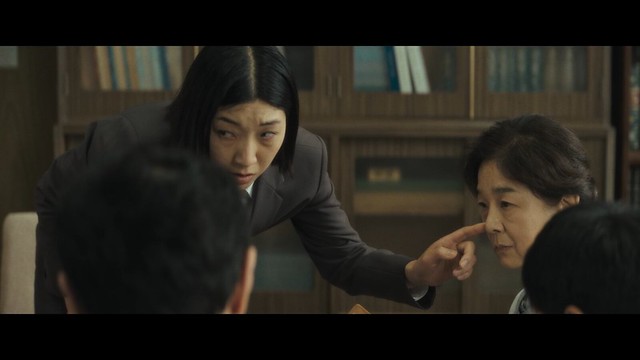
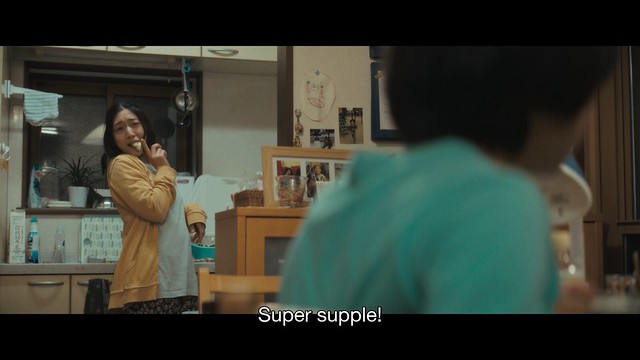

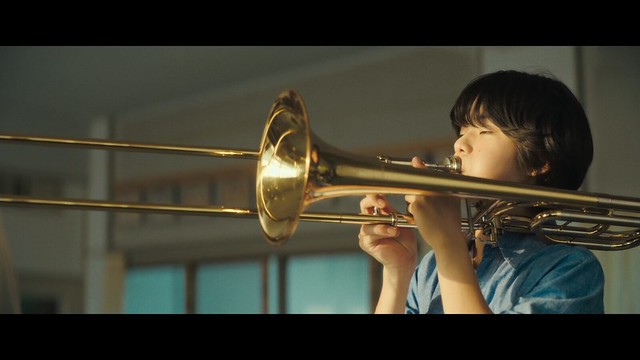
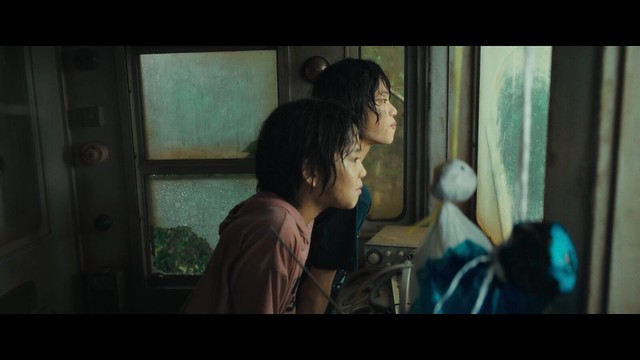 What seemingly starts out as a rashomon style abuse accusation in a school drama, Kore-eda's new film Monster is actually about something completely different. It's a massively poignant lovestory and an indictment of the bigotted society where people assume the worst in each other. It tells a elementary school kid Minato (Soya Kurokawa) being accused of bullying another child Yori (Hinata Hiiragi), and in turn punished by a young teacher Hori (Eita Nagayama). When Minato's single mom (Sakura Ando) notices about his son's odd behavior and sullenness, she complains to the principal of the school. But the principal and other teachers have already built an impenetrable wall to protect school's reputation and repeats the scripted response and apology to her. Enraged, mom finally gets Hori fired. But her son's odd behavior doesn't stop. On the eve of a tropical storm approaching the area, Minato disappears. His mom and Hori, start looking for him in the storm.