Showing posts with label Animation. Show all posts

Thursday, May 15, 2025

Existential Angst in Animated Feature

La mort n'existe pas/Death Does Not Exist (2025) - Dufour-Laperriére Death Does Not Exist A group of young activists are about to embark on their plan to kill an industrialist in her remote mansion in the forest. Their aim is to shock the status-quo of powers that be, as the rich and powerful destroy nature without any repercussions. Their actions will make ripples.

But Hélène, a young member of the group, is having second thoughts about the terrorist act she is about to be part of. Their plan plays out with many casualties on both sides, with Hélène, frozen in fear, witnessing all the carnage, especially the graphic death of a young man who professed his love for her.

Before their attack, he hands her a letter in an envelope and she says she would read it after their deeds. As the film progresses, this unopened letter becomes a portal to Hélène gaining her second chance.

The rest of the film is Hélène's internal struggle/dialog that's taking place over idealism, identity and morality. Her opposition is in the form of Manon, one of her fellow activists friends, who might or might not have perished in the attack, to chastise Hélène's indecisions and inaction. With the armed guards as well as wolves on their trail, they hike deeper into the woods.

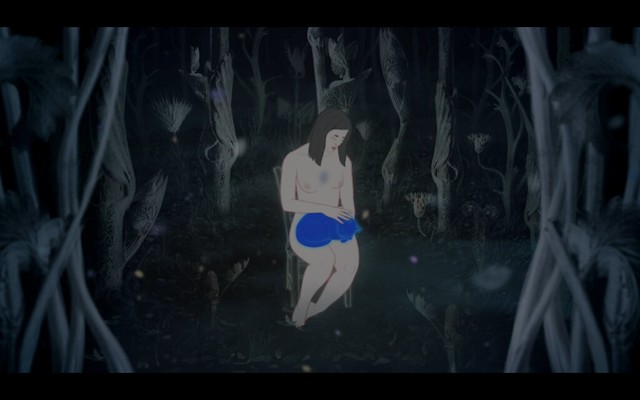
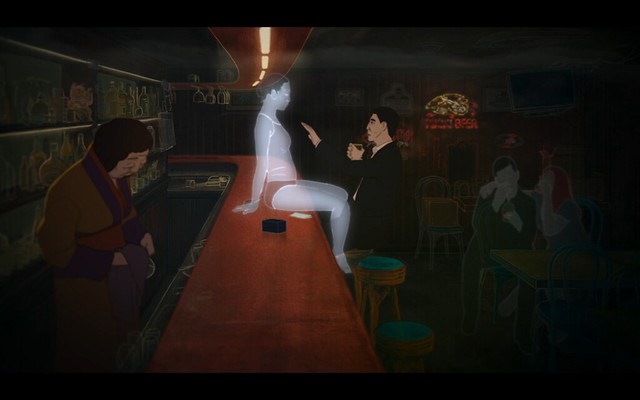
Artistry in Death Does Not Exist by Canadian-French animator Félix Dufour-Laperriére's is unique and striking. Unlike the multiple animation techniques he deployed in his last film Archipelago (2021), that included some live action sequences and still photos, Death features simply drawn - outlines of the facial features and bodies without any discernible details, except for hairstyles - characters in monochrome (uniformly yellow, green in different tones, etc), and nature and buildings with some other muted colors just to distinguish from one another. There's an elegance in his minimalist aesthetics, and it all serves to showcase the inner turmoil of Hélène and its time bending, dream-like narrative.

The most visually exciting parts are the statues of wolves in the greenhouse of the industrialist's mansion that starts the film with, as their snarling facial expressiones change in the lighting from different angles and and the sequences of cataclysmic event, as Hélène imagines the nature - the waves of vegetation taking over the human civilization, which reminded me of a ferocity and fluidity of many nature themed Miyazaki films.

As the ghost of Manon and Hélène's younger self push Hélène toward the second chance at participating in the assassination and in turn saving the young man she loves, Death Does Not Exist reverts back to the scene of a crime multiple times, with Hélène being still not sure if her action is the right thing to do.

The philosophical implication of a young idealistic woman in the face of violence and remorse at its center, Death Does Not Exist explores hefty subjects in an intriguing and unique way.

Wednesday, September 6, 2023

Cinematic Vs Literal

Blind Willow, Sleeping Woman (2022) - Földes Screen Shot 2023-09-02 at 10.28.08 AM Screen Shot 2023-09-02 at 10.28.51 AM Screen Shot 2023-09-02 at 10.52.26 AM Screen Shot 2023-09-02 at 11.15.47 AM Screen Shot 2023-09-02 at 11.19.54 AM Screen Shot 2023-09-02 at 11.23.05 AM Screen Shot 2023-09-02 at 11.45.56 AM Screen Shot 2023-09-02 at 11.47.40 AM Based on several stories written by famed Japanese author Haruki Murakami from 3 different short story volumes, the animated feature Blind Willow, Sleeping Woman has the same qualities of Murakami's droning writing style. It has some fantastical, lyrical moments, like a giant talking frog, flies from a willow tree burrowing into a woman's ear or giant fish swimming in the ceiling of a love hotel, but it doesn't really justify why full on animation project is called for, for the Murakami style of writing and its wordiness. It's especially challenging considering the stories, however carefully selected to be interweaved, are very much literal adaptations, unlike the recent masterpieces by international auteurs who more freely, adventurously adapted the essence of Murakami far better - Burning by Lee Chang-dong and Drive My Car by Rusuke Hamaguchi, respectively.

Because of their literalness, the animated stories in Blind Willow accentuates the somnambulistic nature of Murakami's prose. The wife of one of the main characters who one day just packs up and leaves, leaving a note saying, "Living with you was like living with a chunk of air," encapsulates my feeling of watching the film and perhaps how I become regarding Murakami's writing over all in general.

It's not only Murakami's forever oblique prose that gets to me, but his women characters, over the years, bug me as well. They are there to be served only as objects of male desires and only to have casually sex with them or talk about sex in very frank manners. I mean, come on man, who asks, how sex with your wife was or why would they divulge intimate information about having sex while sounding alarm of a bear attack in the woods, to a total stranger? Women, in his writings, seems incapable of communicating with his male protagonists other than through sex.

From what I understand, Blind Willow, Sleeping Women was first wholey filmed in live action, capturing the movement of actors in 'play acting', then animated and heads are added and character expressions, animated. I can't quite decide if they are racist caricatures of Asian faces or just plain weird with their features exaggerated. While I appreciate that they are not illustrated in cute anime style, I can't help wondering over the filmmakers' decision-making in depicting what they see as authentic 'Japanese' faces.

I think the film being done in animation to display the surrealistic qualities of the author's writing robs of our imagination in this case. If the unreachable distances between man and woman, emptiness of modern world, 'searching one's self' in droning prose on paper that goes on for hundreds of pages sounds shallow and boring, they are boring in animation as well, unfortunately.

Wednesday, December 1, 2021

Animation as a Buffer

Flee (2021) - Rasmussen FLEE_still_2_Amin_carpet_copyright_FinalCutforReal Jonas Poher Rasmussen's animated documentary, Flee, chronicles harrowing journey of Amin Nawabi (pseudonym used for protection and privacy), an Afghan war refugee to the West, as he recalls his traumatic childhood experiences.


Rasmussen, a Danish radio-documentarian, teaming up with Copenhagen based animation studio, Sun Creature Studios, concocts layered, delicate, personal story that is as haunting and powerful as any live action narratives and documentaries about war and refugee crisis in the last couple of years - Fire at Sea, Human Flow, The Load, Quo Vadis, Ida and Limbo.


Flee owes a lot to Ari Folman's groundbreaking auto-biographical animated documentary, Waltz with Bashir, about Sabra and Shatila Massacre and Marjane Satrapi's Persepolis, from the perspective of her Iranian upbringing. Like with Bashir and Persepolis, Flee uses animation to elucidate one's memory. But if the former are culled from directors' own life experiences, subjects who were willing to express themselves as artists in a specific medium, the latter is using the medium to give a distance from its introverted subject: Rasmussen thought in telling a story of his shy, refugee friend since middle school, using animation was a good way to provide him a buffer and anonymity. With muted colors, simply but functionally rendered style only the Scandinavians can offer (overseen by animation director Kenneth Ladekjær, characters storyboarded by Simon Rouby then animated by Gilles Cuelier), balances out perfectly with a very heavy subject. Flee draws on highly subjective and personal memories of war, using both figurative and more abstract style to depict them.


Flee is about a young Afghan boy, Amin, who liked to run around in his sister's dress, embroiled in Afghan conflict in the late 80s - Taliban's take-over the country as Soviet troops retreated. Amin's father who was an intellectual and deemed a threat to Taliban, one day got arrested and disappeared, and his aging mother and siblings had to flee the country and to go to the West.


Some of Amin's traumatic memories and secrets were never revealed to anyone before - especially about his family and him being gay. It all comes out in the interviews his friend Rasmussen conducts, a casual interviewing method where subjects are lying down, like in a therapy session. So the preliminary interviews with Amin stayed intact in the film, with the subject's real voice. Flee moves freely in and out of those interviews making temporal leaps as Amin recalls his painful memories and at times, memories that are hard to articulate in words.

Amin's mother and his siblings took a plane out of Kabul on the eve of Taliban takeover and landed in Moscow, the only destination that accepted their tourist visa. This is the time where Soviet Union dissolved and was in complete chaos. Corrupt cops were shaking anyone for money and abusing its frightened citizens.


Amin's oldest brother, then living in Sweden, arranged an apartment for them to stay and sent money for them to get the smugglers to cross the border to the West. The smugglers turn out to be the worst people in the world, as bad as corrupt Russian cops. Their words took roots in Amin's brain forever: "When you get to your destination, tell them you don't have a family that they are all dead." This was the only sure way to get a refugee status. And this is what Amin would later tell anyone, even to his closest friends.


Two sisters went first, trapped in shipping containers for months with sixty other people off the coast of Sweden in the Baltic Sea. The experience was so traumatizing, they can't even speak about it to this day. Marooned in Russia with threats from cops to deport them back to Afghanistan, Amin, his older brother and his mom takes off again, leaving their fate in the hands of vicious, inhumane smugglers. After crossing the snowy border and a boat ride, witnessing human miseries everywhere, they get captured by the Estonian coastguards and end in a refugee camp where nothing works. Time stand still, after many months, they are given two choices - either rot in Estonian refugee camp forever or back to Moscow.


Flee is accompanied by some 80s and early 90s news reel footage of post-USSR world, of the horrendous human suffering in captured refugee boats, refugee camps and it reminds us once again, how the West and its media devoted too little time and attention to the humanitarian crises at hand, same as today.


Marooned what seems to be forever in Moscow, it lends some time for some tender moments as Amin discovers his sexuality, however repressed his was, accompanied by the opening of the first ever McDonald's in Moscow and its creepy celebration with the real news footage.


After many years in Moscow, they decide that it will be Amin who should be first to go: this time, with the more expensive smugglers route. Leaving behind his mother and older brother, Amin is instructed by the smuggler that he has to rip off his fake Russian passport as soon as he gets to the West and declare his family dead. He finally gets to Copenhagen- a wrong destination, but the Western city in a Western country nonetheless. 


There are many touching moments, but I teared up when young Amin asks the attending doctor in Copenhagen if he could get a medicine to cure his attraction to men. Coming out as gay to his supposedly conservative Afghan family later on is another tender, heartbreaking scene that really struck me.


Flee is an intimate, compelling account of a refugee story and a beautiful coming of age story told in a friendly, easier to digest way, via animation. But it's an important reminder that there are thousands of stories like Amin's and refugee crisis hasn't really ever stopped, if not vastly intensified with the whole world in sociopolitical crises for the past decades.

Thursday, May 14, 2015

Cobain Remembered Expansively/Expensively

Kurt Cobain: Montage of Heck (2015) - Morgen
 photo bbcb2109-0173-41e5-9c19-a049f100ed66_zpszwnw0vif.jpg
It's been more than 20 years since the death of Kurt Cobain. Crazy. And here I thought Montage of Heck is too soon. Then again, I remember watching the unwatchable doc called Kurt & Courtney where its director interjected every five minutes, "The song I just described here I can't play because Courtney Love people didn't grant me the rights to it." With an unprecedented access (with blessing of Love and everyone else), Brett Morgen paints almost a complete picture of the life of Kurt Cobain. Like many others and being in Seattle around the time when grunge happened, I too, took to the music. It wasn't the thrift shop flannels or sulking teen angst but Cobain's tortured voice that stood out among the rest and made an impression on me. Where were you the moment you heard the news that Cobain passed on? I was in college in Boston at that time. Many of us are bummed for many months.

With audio tapes, home movies, drawings, journals and beautifully animated sequences, Morgen charts mostly familiar territories - loner kid from broken home, unloved and angry, grows up to be anti-social punk rocker who couldn't handle his sudden stardom. But it's done so beautifully. His drawings come alive, and his agonized writings get accentuated. And I find the faults in its beauty. Nothing can be as dramatic as the life Cobain led and how he exited, for sure. But the slick filmmaking plays up to that with dimmed lighting and introspective framing. The whole thing feels like the director fell on a pile of money to make a documentary about the grungiest musician ever lived.

Friday, May 2, 2014

New York African Film Festival Reflects Ever Evolving Continent

In its 21st Edition, New York African Film Festival is a month long celebration of the continent's best of the best with staggering 40+ films slated in its lineup. They will be showing in three different cultural venues throughout the city. The festival presents a unique selection of contemporary and classic African films, running the gamut from features, shorts, and documentaries to animation and experimental films.

At Film Society of Lincoln Center, in celebration of the centenary of Nigeria's independence, the series kicks off with Nollywood dark comedy Confusion Na Wa by Kenneth Gyang. Centerpiece film is the much-anticipated Half of a Yellow Sun, directed and adapted by Biyi Bandele and starring Thandie Newton, Chiwetel Ejiofor, and Anika Noni Rose. The sweeping 1986 epic Sarraounia is selected as the closing night film.

The series runs May 7 - 13 at FSLC, moves to Harlem's Maysles Cinema May 15 - 18, then ends up at Brooklyn Music Academy (BAM) May 23 - 26. For tickets and more information, please visit African Film Festival Inc.'s website.


Here are 5 great films I had a privilege to preview for the festival:

Grigris (dir. Mahamat-Saleh Haroun, Chad)
 photo 9cc19208-7f4c-41cf-bd1d-b9189e7010c7_zps02527411.jpg
Despite his deformed right leg, Soulemane (Soulemane Démé), known as Grigris, kills on the dance floor every night. But petty cash he garners on the dance floor is not enough to subsist a living when his stepfahter gets hospitalized and can't work as a neighbor's jack of all trades. Short on cash for medical bills, Grigris gets entangled with oil smuggling operation, headed by shady, ruthless businessman Moussa (Cyril Guei). He also develops a relationship with Mimi (anaïs Monory), a cute prostitute who frequents the disco, after developing photos for her modeling career. Things go bad when Grigris crosses Moussa to cover the medical bills. He and Mimi have to flee the city and settle in with Mimi's relatives in the countryside.

Mahamat-Saleh Haroun's Grigris is bustling with energy. The colors and sound of the capitol of Chad, N'Djamena - the people, livestock, disco and nightlife have a look and feel of any medium sized metropolis. Démé, in his first acting role, possesses immense physical presence and quiet intensity, as a good man down on his luck, trying to get by in a dog eat dog world. The plot seem predictable at first but it takes an unexpected turn which sets apart Grigris from other urban noir type films.

Grigris is a winner of Technical Achievement Award at the last year's Cannes. Film Movement has picked it up and is releasing it on VOD on May 30.


Aya of Yop City (dir. Maguerite Abouet, Clément Obrerie, Ivory Coast)
 photo 7bc06062-0d15-4f78-95eb-8b59b075a6cf_zpsa60f79db.jpg
Maguerite Abouet and Clément Obrerie's popular graphic novel series Aya of Yop City becomes an animated feature. This semi-biographical story is based on Abouet growing up in the booming 70s in Yopougon, Ivory Coast. Beautifully drawn with colorful characters, Yop City reflects the issues of Ivorians in that era - women's rights, infidelity, family and community. Abouet doesn't let the French colonial past and its influence on Ivorians slide either - girls still swoon over suave rich men from Paris.

Just like Percepolis before it, we get to experience growing up in another country far away from us through Aya and her friends and realize that their trials and tribulations are not that different than ours. The film is funny and immensely likeable and relatable.

Partly because it's based on one of the series of books, nothing really gets resolved and nothing is ever clear cut in Aya of Yop City, just like in real life.


Mugabe: Villain or Hero? (dir. Roy Agyemang, Zimbabwe)
 photo 6fa934d2-3baf-4810-b43c-e22040f7ef22_zpsbcc4938a.jpg
What starts out as a simple pursuit of scoring an interview with Robert Mugabe, the Zimbabwean president of struggling African nation under crippling economic sanctions by the West, becomes a full blown, 3-year chronicle of a nation still reeling from colonialism.

Mugabe, yet another figure vilified by the West as a gross human rights violator and a ruthless dictator is seen from a different perspective by British based filmmaker of Ghanaian descent, Roy Agyemang, whose idea of post-colonial pan-Africanism has been indoctrinated by his parents at an early age, wants to find out the truth about the man himself.

Agyemang arrives in the southern African nation where things are dire, 2007- its inflation so high, the country became the first nation to print a trillion currency bank note. The breakfast cost 5 million Zimbabwean currency and three months later, it cost 356 million. The doc gives a detailed yet digestible history of the country's colonial past. Formerly known as the republic of Rhodesia, Zimbabwe was the last British colony in Africa to gain independence. Mugabe, a guerrilla fighter for independence became its president in 1980, agreeing not to touch land owned by white farmers for ten years with Thatcher's gov, in the Lanchaster Agreement. When Tony Blair's Labor Party came into power, it annulled the agreement and stopped paying for the land owned by the whites. Mugabe, a man of principal and staunch nationalist, began forcibly taking back the lands. The violence ensued and outraged British government and rest of the West started demonizing Mugabe and imposing sanctions on his people.

The documentary observes the bitter 2008 presidential election, where Mugabe battles the West friendly Morgan Tsvangirai. Tsvangirai won the majority of votes but did not meet the 50 percent threshold. Frustrated, Tsvangirai contested the results, accused the Mugabe government of rampant intimidation and election tampering. He then withdrew from the runoff in protest and fearing for his life, took refuge in the Netherlands embassy. Later on, mediated by then South African president, Thabo Mbeki, Mugabe and Tsvangarai sign a historical power sharing agreement for better future for Zimbabwe.

Sure, Agyemang is a full time convert by the end of the film, swept up by Mugabe's affability and infectious pan-Africanism. But the film is not exactly a whitewash- he questions Mugabe regime's extreme secrecy and illustrates ensuing violence just after the country gained independence in 1980 in series of well researched clips. He is also critical of the Western hypocrisy wherein Mugabe was once the toast of town- knighted by the Queen, nominated for Nobel Peace prize, the shining example of post colonial Africa, then turns on a dime and makes him the African Hitler.

The film's structured like Roger and Me, where a filmmaker never gets to interview its high and mighty subject one on one. But by the time the interview actually happens after three years, we are comfortably acquainted with the subject and history, it feels like an afterthought.

The film is a must see for understanding the state of Africa now. After years of 'economical terrorism' by way of IMF & World Bank perpetrated by the West, resource rich Africa seems finally finding its footing with self-determination for better future.


Afronauts (dir. Frances Bodomo, Zambia)
 photo 8538edf1-8f75-480a-a4a8-7f98ff7590fe_zpsc00beeb1.jpg
Talented new director Frances Bodomo's beautiful short, Afronauts, is not some dreamed up story of a first African astronaut. It is based on the true story of Zambia's attempted space program which actually took place in 1968.

Peppered with magic realism, Bodomo's poetic interpretation of the historical event is cinema's myth-making at its finest.


Kwaku Ananse (dir. Akosua Adoma Owusu, Ghana)
 photo ede8d89a-d565-40ad-ae96-854c02c4b792_zps5b0b9ba4.jpg
A fashionable young woman with an American accent comes back to Ghana to attend her father's funeral. She has an ambivalent feeling about this home coming. He had another wife and a child in Ghana. During the ceremonious funeral with a spider shaped coffin, she walks off and into the forest as if in trance. There she finds all the wisdom that her father gathered over the years.

Putting the popular West African traditional folklore of the not-so-wise spiderman (you heard right, spiderman) within a contemporary setting, director/writer Owusu creates a dreamlike netherworld full of beauty and transcendence.

Tuesday, January 14, 2014

Avatars

The Congress (2013) - FolmanImage
Image
Image
Image
Image
Image
Image
Image
Ari Folman (Waltz with Bashir) returns with a trippy new live action/animation feature. The selling point of this highly ambitious parody on stardom and movie industry, loosely based on Stanislaw Lem's The Futurological Congress, is first and foremost its dazzling animation. The look of The Congress is decidedly retro - a combination of Astro Boy, Fantastic Planet, Betty Boop on acid.

The story concerns Robin Wright, a middle aged former actress who lives in a airplane hangar with her two kids, Sarah and Aaron. Hollywood had tired of her because she's been a 'difficult' actress all her career. Her long time agent Al (Harvey Keitel) visits her with one last offer which seems to be the norm for the aging actors in the business ('Keanu has done it!') - total body scanning. Once she is scanned completely into the computer system, she will never be able to work again. But her computer generated younger self, forever at age 33-34, will star in whatever studio demands. She will be handsomely rewarded. Aaron having some sort of sensory debilitating disease and half-threat from the ruthless Miramount studio head Jeff (Danny Huston), Robin reluctantly agrees to the deal.

Twenty years later, she visits Miramount again to attend the animated world of Congress, where they announce sensory altering drugs where people can drink the portion of the celebrities of their choosing and become like their idols until the drug wears off. By now Robin's computer generated self is a mega action babe and no one recognizes her old self except for Dylan (voiced by John Hamm), an animator/scan artist who has been in love with her since her 'retirement'. She opposes the drug that suppresses individualism and promotes hiding behind mask in public and pays the consequences. Then there is an animated revolution...

Folman's take on our technology imbued society where people wear masks/live through avatars is an overly ambitious project, so much so its narrative structure has visible cracks everywhere. Yet by the end, you are so dazzled by its colors and style, you find yourself standing dazed, covered in its electric rainbow mist, asking what just happened.

Friday, December 20, 2013

Life as Art as Life

An Oversimplification of Her Beauty (2012) - Nance
 photo c201fff6-b964-44b7-921d-9bf49c760012_zps47a4f6df.png
 photo 6608910d-1ec4-43f7-800e-b18cae527f27_zpsf226711f.png
 photo 6f356daf-df3b-4fde-ab61-63c3e23b7725_zps37b13d40.png
 photo 2b81b376-89da-4c80-9c5c-6a847c8ae5ab_zpsc852a030.png
 photo 6fa140b3-b466-415b-893c-74deaaf38e34_zps6e925e9a.png
 photo fb786d17-20a4-495c-a4e1-f1db10fdb9b8_zps6d6f9639.png
 photo 7cb1e646-ecee-4f8e-a9c2-de5cb5113a06_zps4b3db5a7.png
 photo 24b1d49a-1eaf-4015-81f4-2f4cefc32d27_zpsb420b5b2.png
 photo 1c3bb276-e47c-4d86-b7e8-f618ee5d5527_zps0e33f0c1.png
 photo d7a68e36-9a66-4ae7-a7bf-ec6a25d2fbef_zps58302419.png
Gotta say that I admired Terence Nance's film more than I enjoyed it. There is no doubt that Nance is talented- who wrote, directed, did an animation and music all by himself. It's rare to find someone so original and graceful in his ability to express himself visually. One can also tell that this project is a true labor of love: there are more than a dozen animation styles applied here- stop motion, water color, drawings, whatsit...all achingly beautiful. It also takes a form of movie-within-a-movie, starting with a short How Would You Feel which dates back 2006. This on-going autobiographical examination on relationship is in part his train of thoughts, part her train of thoughts, part documentary, part reflection of those thoughts, endlessly repeating like a mobius strip.

The thing is, you have to drown out Nance's neverending monologue after a while and just give in to the visual aspect, because its narrative doesn't lead you anywhere. The project started out as a short and it should've remain as a short. He is a undeniably super talented guy in an obsessive relationship, but not a storyteller.

Saturday, September 28, 2013

The Wind Rises...We Must Live

The Wind Rises (2013) - Miyazaki
 photo 189dfc7d-d0a6-413e-8e05-ef456e421ebd_zpsf16dc1b9.jpg
'Follow your dream' is the theme of The Wind Rises, the latest, decidedly grownups oriented film by master Hayao Miyazaki. The setting is different too. It's the 1920s-30s Japan: The Great Kanto Earthquakes, The Great Depression, unemployment, poverty and tuberculosis. It's also politically very pointy. From early on, we see a boy's tranquil dreams of flying get overshadowed by ominous war planes adorned with Nazi crosses and Italian flags. There are talks of thought police following engineers. Based on the real life character who ended up designing the Zero fighter plane, the main character Jiro grows up to be an idealistic engineer who dreams of creating a beautiful aeroplane in the midst of national turmoil. But as usual, he is as generous and selfless and heroic as any other Miyazaki protagonists. There is a love story there too, albeit a sad one. Jiro and Nahoko meet during the fateful earthquake and fate would have it, meet up again later on. Nahoko is suffering from tuberculosis and frequents a sanitarium to recuperate.

We all know Miyazaki's completely capable of creating exciting battle scenes. It seems he greatly strains himself from portraying any kind of man-made violence in The Wind Rises. There is a poignant scene where Jiro walks through the graveyard of wrecked planes: the horror of broken dreams. Some of the stylistic choices and especially innovative sound design separates the film from his previous ones too. Mostly the color palette of The Wind Rises is more like sunny impressionist paintings. The title comes from Paul Valéry's poem and characters quote it in French. The complete line is: "The wind is rising...we must attempt to live." The country still reeling from The Great Eastern Japan Earthquake, Miyazaki at once finds parallels in the past and also don't shy away from criticizing Japan's military ambitions. It's definitely the saddest Miyazaki movie I've ever seen. As he announced his retirement, The Wind Rises is a fitting finale of the one whose remarkable carrier not only serves him the title of a master filmmaker, but a true humanist.

The Wind Rises plays part of this year's New York Film Festival. Please go to FSLC website for tickets and showtimes.

Monday, September 26, 2011

Cabinet of Curiosities

Through the Weeping Glass: On the Consolations of Life Everlasting (Limbos & Afterbreezes in the Mütter Museum) (2011) - Brothers Quay
Photobucket
Photobucket
Stephen and Timothy Quay's Through the Weeping Glass: On the Consolations of Life Everlasting (Limbos & Afterbreezes in the Mütter Museum) was shown at The Museum of Modern Art over the weekend (Sept. 24th), with the brothers in attendance as part of limited 3-city tour (Philadelphia, LA and New York). It had a world premiere at The College of Physicians of Philadelphia on Sept. 22nd and will be shown at Cary Grant Theater, Sony Pictures Studios, LA, hosted by The Museum of Jurassic Technology on Sept. 27th. Subsequent to the premiere screenings, the film will be available for purchase on DVD with an accompanying booklet.


When I first heard about the Brothers Quay Mütter Museum project, I couldn't think of any filmmaker who's more fitting. Situated in The College of Physicians of Philadelphia, Mütter Museum hosts medical oddities, anatomical and pathological specimens, medical equipments and grand volumes of medical books. It's literally a cabinet of curiosities; a perfect playground for visionaries like Brothers Quay. Known for their Eastern European influenced, breathtakingly beautiful, found object stop motion animation shorts in the early 90s and the two gorgeous, feature length literary adaptations- Institute Benjamenta, or This Dream That One Calls Human Life (1995, from Robert Walser's Jacob von Gunten) and Piano Tuner of Earthquakes (2005, from Adolfo Bioys Casares' The Invention of Morel, of which, Alain Renais' Last Year at Marienbad was also loosely based on), Through the Weeping Glass is the London based (from Philadelphia originally) twin filmmakers' first American project.


The film opens with a young woman visiting a skeleton on display. The skeleton belongs to Harry Eastlack, a young man died of rare disease called Fibrodysplasia Ossificants Progressiva, where cartilage in your bones ossifies and you slowly become immobile. We are told by the narrator (narrated by Derek Jacobi) that young Harry could only move his lips when he died. The young woman is his sister, looking at a skeleton through a two way mirror, showcasing stunning visual sequences.


The brothers make use of the museum's many artifacts: the flip human anatomy books, photos, the skulls and fetuses in jars. But their approach is not of the morbid fascination of a teenager, but a compassionate one. They are aware that there are stories behind each skeleton, each body. The film ends with the story of famed conjoined twins Chang and Eng Bunker as we see the plaster cast of their bodies and their preserved shared liver.


Shot on HD video and lasting mere 31 minutes, Through the Weeping Glass is not quite up to par with their previous films. Starting as animators working mostly in miniature, their strength always has been their visual precision and impeccable craftmanship in creating painstakingly detailed netherworld. Even with the 35mm transfer from digital (thanks to MoMA), their visual elegance suffers greatly here. It is revealed through the Q & A session and following the 'making of' documentary that there was no funding available for shooting 35mm for them in a long while. So they resorted to using a small DSLR camera. Shooting in the narrow corridors and limited space of the museum also posed many challenges.


Next year, MoMA is planning the Brothers Quay retrospective, chronicling all of their works including their sculptures and drawings. Hopefully it will garner more interest in their works and make funds available for their future endeavor.

Friday, May 20, 2011

Ode to Tati

The Illusionist (2010) - Chomet
Photobucket
Photobucket
Photobucket
Photobucket
Silvain Chomet (Triplets of belleville) pays gentle tribute to Jacques Tati and it's beautiful to look at. With no discernible dialog, The Illusionist tells a simple story of an aging magician traveling to Scotland. On his way to Edinburgh, he makes an impression on a country girl and unbeknownst him, she tags along for the ride.


I always thought Tati's material is better suited for animation. Just like other Tati films, it's about changing times. His vaudevillian humor and Chaplinesque sight gags surrounding klutzy M. Hulot never really appealed to me. But in The Illusionist, things are decidedly subdued and nostalgic. The animation is beautifully done though, conveying melancholic mood of the yesteryear. And there is that undeniable Tati's gooey humanistic touch. It resembles Satoshi Kon's warm hearted anime Tokyo Godfathers, more so than Chaplin's The Kid.

Monday, November 29, 2010

All Dogs Go To Heaven

Plague Dogs (1982) - Rosen
Photobucket
Photobucket
Photobucket
Photobucket
Photobucket
Photobucket
A black retriever named Rowf and a fox terrier, Snitter escape from a top secret laboratory in a mountainous English town by the lake. After many water endurance test where many fellow lab dogs drown, Rowf has issues with water. Snitter has been subjected to brain surgery and has a hole in his skull and also has a lousy luck with humans (his masters die). To avoid starvation, they stalk sheep with the help of a snarky fox named Todd. The body count rises. The towns people are after them, the labcoats are after them. Soon the Defense Ministry is called in with paratroopers to smoke the dogs out and destroy them for fear of them carrying bubonic plague.

No less devastating than Rosen's Watership Down, Plague Dogs is nevertheless beautifully drawn animation with a strong anti-animal lab testing message. The ending will break your heart.