Showing posts with label Biopic. Show all posts

Tuesday, March 18, 2025

Tango Lesson

Being Maria (2024) - Palud Being MariaFrench film industry's going through a full #MeToo reckoning with the case of Christophe Ruggia, a director convicted of sexual abuse of actress Adèle Haenel when she was underage. Staple names in French cinema, such as directors Jacques Doillon and Beonoît Jacquot have also been accused of rape and sexual offenses, and actor Gerard Depardieu is facing a trial for rape. In this climate, Jessica Palud's Being Maria revisits Bernardo Bertolucci's controversial film ]Last Tango in Paris and tells the untold story from the perspective of its co-star Maria Schneider and the film's life-long effect on the actress. Schneider, star of many memorable films such as Michelangelo Antonioni's Passenger, Jacques Rivette's Merry-Go-Round, later became an outspoken activist against sexism in the French film industry.

Anamaria Vartolomei (Happening, Empire, Mickey 17), plays Schneider, a young, unknown actress chosen by Bertolucci (Giuseppe Marggio), to star opposite Marlon Brando (Matt Dillon) in sexually charged Last Tango, at age 19. Growing up with a single mother who has very low opinion on men and the entertainment industry - Maria's deadbeat father, Gelin (Yvan Attal) is an actor. Against her mother's wishes with her teenage rebellious spirit, Maria seeks advice from Gelin and way in the film industry. It was the 70s and if you are an established auteur like Bertolucci (who had directed Conformist two years prior), it was 'anything goes' for art. The premise of the film is two strangers meeting by chance and carrying out a strictly physical relationship, baring their bodies and souls to each other. There will be a lot of nudity, so it will be controversial, Bertolucci warns. But you get to work with Brando and your career will be launched. Maria knows what she is signing up for.

At first she finds her experience pleasant and finds Brando gentle. But it's the infamous "butter" scene, an improvised simulated sex scene involving butter, that really breaks Maria. After the scene, she felt violated and humiliated by both Bertolucci and Brando, who never told her what their intentions were for the scene beforehand and never apologized. Her shock and tears captured on screen were real.

Now 60 years old, Matt Dillon has gravitas and hulking physicality to play the Hollywood acting legend Brando. He moves and speaks with confidence and ease with a glimpse of a dark side and arrogance.

Schneider is reprimanded by her manager for speaking out about the incident during the press tour after the film's release. Soon afterwards, she becomes a heroin addict and finds herself branded as 'difficult to work with', by refusing to do a nude scene in most of the roles she is offered. Surely there must be projects that she doesn't have to go topless. Again, this is French film industry in the 70s and 80s where women's roles are limited ('either saints or harlots' Schneider says with a sigh) and her reputation being in Last Tango precedes her. She befriends a college student Noor (Céleste Brunnquell) who is writing her dissertation on women's roles in films and the two become involved. And it is Noor who sees Maria through her drug addiction.

It is understandable that Vartolomei was chosen to play Schneider, even though there's no real physical resemblance. In Happening, she played Anne, a high school student in need of abortion which was still illegal in the 60s France. With all the conservative swing in Europe and especially in France, the film and her performance became a lightning rod for the feminist activism. And she does a great job portraying a principled young Schneider, who saw injustices in French film industry run by men, for men, long before #MeToo caught up with it. Being Maria is a scathing rebuke to unchecked sexism that dominated the film industry for way too long, and a well-deserved portrayal of trailblazing actress/activist.

Thursday, April 13, 2017

Quiet Riot

A Quiet Passion (2016) - Davies
a quiet passion
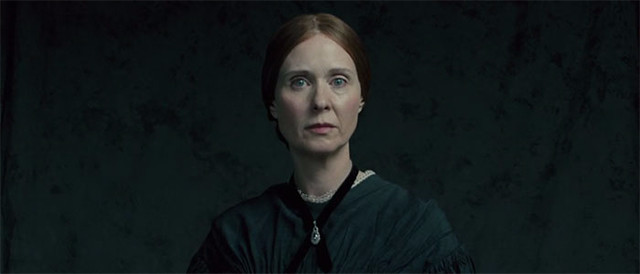
Just like many artists, Emily Dickinson never saw fame nor recognition as a poet in her lifetime. Her poetry and letters were only read and appreciated posthumously, after her death in 1886. Many of her admirers of her work say, not only her intimate poems touched them, but also with unusual punctuation and dashes, her style was ahead of its time. One of her ardent admirers happens to be Terence Davies (Long Day Closes, Deep Blue Sea) one of the greatest living British filmmakers. The nationality of his female subject might be different here, but there are a lot of common themes coursing through A Quiet Passion which his past films also bear - family, struggling within a strict social norm, independence and freedom, isolation and depression.

Born in a wealthy, respected family in Amherst, MA with loving parents and supportive siblings, Emily (played by Emma Bell as younger, then Cynthia Nixon as older Dickinson) grows up to be an honest, smart young woman who can think for herself. She is seen first as a young woman in Mount Holyoke Seminary school, defying the wishes of her teacher with her logical defense to be indecisive in either accepting or denying god. But being a woman of the 19th Century, Emily struggles from early on with her self image, patriarchy, conservative, puritanical society, sexism, the thought of death and immortality.

Davies, an ardent reader of Dickinson's poetry, composed a truly beautiful script here, imagining much of the film's dialog that lends the full view of the complicated poet and the great Cynthia Nixon personifies her in flesh and blood. Even though Dickinson lived most of her adult life in isolation, through her letters and 1,800 unpublished poems, and as we see in the film, she led a quite passionate inner life.

Unlike many fathers in Davies' other films who terrorize the working class families and women, Edward Dickinson, played here beautifully by Keith Carradine, is a learned, dignified man who is a main stable force for Emily to depend upon. Strict but humble, it is his dignity and sense of right and wrong that deeply affects Emily's upbringing. She strikes up a friendship with free spirited Ms. Buffam (amusingly played by Catherine Baily) whose acerbic wit matches her own. They talk about being friends forever but both know that when the time comes, more extroverted Buffam would marry and settle and move away. And she does.

Dickinson briefly romances a married pastor but the bitter experience turns her more into isolation. After their parents' death, Emily becomes more embittered with life, she isolates herself even further, wearing only white and communicates her thoughts mostly in letters. Her devout younger sister Vinnie (Jennifer Ehle) becomes her only source of checks and balances against Emily becoming a bitter, defeated person.

Death and immortality were her big themes in her writing as she was weary of attaching herself to anyone and always worried about everyone close to her leaving. Calling herself nobody, she was aware that her writing wouldn't be recognized by anyone in her lifetime.

Davies succeeds in showing a complicated woman bound by tradition and societal rules. But however tragic and lonely her life was, he also shows us that Dickinson lived the way she wanted to, that it was her own choosing, that she was a thoroughly modern woman, defining the world the only way she knew how. A Quiet Passion is another masterpiece from Davies.

Dustin Chang is a freelance writer. His musings and opinions on everything cinema can be found at www.dustinchang.com

Thursday, March 31, 2016

Do not fear mistakes. There are none.

Miles Ahead (2015) - Cheadle
 photo f086320b-96b1-468e-a402-241f71b9a061_zpsenhauinq.jpg
Doing a biopic on a legend is always a challenge. Doing justice to the subject it is portraying, even more so, especially when it's on someone like Miles Davis. It's rather surprising that there wasn't a movie or two made about Davis already, given his status as one of the most influential musicians America has ever produced. Don Cheadle, one of the most gifted, underrated actors of his generation, was approached by the Davis Estate (son Erin Davis and nephew Vince Wilburn) to take on the challenge and with their blessings, goes on to tell the story the way he wanted and ended up directing and co-writing and starring. He even raised money through crowdfunding. Cheadle succeeds in making an energetic, entertaining cinematic ode to a true legend.

I can't think of any album that is more perfect than Kind of Blue. Its melodic, incredibly elegant musical arrangement was a revelation when complex, virtuosic solo oriented be-bop dominated the jazz scene when the album came out in 1959. His extremely emotive trumpet playing had no equal and is still instantly recognizable. It was my staple background music in my college dorm room and I have to admit, the album got me laid many times. Even though Miles Davis was responsible for putting jazz on the higher echelons in the music world with improvisation that influenced countless other jazz greats, Davis didn't want to be pigeonholed as a 'jazz' musician. He moved on to exploring other sounds, always trailblazing in things to come. Jazz purists turned their back on his music in his later years and stuck to Birth of the Cool, 'Round About Midnight, Kind of Blue and Sketches of Spain, but In a Silent Way (1969) is a great album, so is Tutu (1986), so is Doo-Bop (1991). Along with David Bowie, Davis was one of the true innovators and musical geniuses of the 20th century.

With the phrase, "It's all about improvisation," starts Miles Ahead, a very unusual biopic on one of the most iconic musicians ever lived. It's set in 1979, at the end of Davis's 5 year seclusion (around 1975 to 80) while battling with drug & alcohol abuse, various health ailments and Columbia Records after the success of Bitches' Brew during his jazz fusion period. Blending elements of fiction and the musician's real life stories, the film is in part a love story and part genius artist struggling with his demons and part a buddy action comedy that can easily be titled as Ride Along with Miles Motherfucking Davis.

Ewan McGregor plays a fictional Rolling Stone Journalist named Dave Brill. Out of extreme personal interest as a fan, he longs to hear Davis (Don Cheadle)'s demo tape that supposedly contains yet another breakthrough masterwork the musician has been toiling away in his Upper Westside apartment during those missing years. But as it turns out, he isn't the only one who wants to get a hand on that tape. Columbia Records execs are holding Davis's payments because he is contractually obligated to turn in any new materials in order to get paid. Throw in a shyster producer Harper (Michael Stuhlbarg) and his drug addled trumpet protégé Junior (LaKeith Stanfield, Short Term 12, Straight Outta Compton) into the mix and we got an unforgettable night out with the ill-tempered, crazy little man with a wild jerry curls and a raspy voice in colorful silk pajamas. Through the course of the day, the duo goes from his basement/studio for impromptu boxing lessons, to the ringside, to a Columbia University dorm room (to score some high-end cocaine), to wild car chases in the city that ends in gunfights.

But it's the memories his first wife, Frances Taylor (luminous Emayatzy Corinealdi), that haunts the famous musician. In inter-cutting flashbacks shot on super 16mm film, we see suave Davis courting Frances, then an ingenue classical dancer, who goes on to give up her career to be a stay-at-home wife for him. She is a constant reminder of his happier (and tumultuous) times as she graced herself on the cover of his 1961 album, Someday My Prince Will Come Along which he somehow finds everywhere he goes. Cheadle and co-writer Steven Baigelman don't shy away from Davis's drug addled violent behavior. The couple's fight scene that lands both of them on the floor littered with shattered glasses is brutal and appropriately explains why Frances left him for good.

Miles Ahead doesn't play out like the work of a first time director. Shot on HD and film, frenetic editing, and some of the best syncopating transition shots in any movie of recent years, the film demonstrates Cheadle's cinematic flair. The film also showcases Cheadle's dexterity as a performer who can turn on the heat. He is completely at ease as the enigmatic musician, actually playing trumpet in many of the musical scenes himself. My favorite scene in the film is that of Davis working on a recording session with legendary jazz pianist, composer Gil Evans (Jeffrey Grover): it captures Davis's creative process in a natural, intimate setting among other musicians. It's so lived in, it feels like you are watching a documentary.

The fiction part of Miles Ahead, however entertaining it is, is a pulp. It doesn't resemble the incredible smoothness and sophistication of Kind of Blue. But in the spirit of jazz improvisation, Cheadle has the right attitude- the film is bustling with energy and crackling with wry humor. I remember Davis's appearance in a Miami Vice episode, playing a pimp in a flamboyant red garb. He really didn't give a fuck what anyone thought. Miles Ahead is definitely something Davis would have enjoyed watching, since he was never a classicist anyway.

Sunday, October 4, 2015

Giving Another Dick Billionaire a Pass

Steve Jobs (2015) - Boyle
 photo e979fe0b-6e41-46c1-a3ba-6d2b037ccd9d_zpszkaed6bo.png
The first question is: do we really need another Steve Jobs movie? Then, what merits does the life of the billionnaire co-founder of Apple have, to prompt 3 movies about him within 2 years? Yes, Apple product is cool, but what else is there to talk about?

I have to admit, that I've been an Apple user all my adult life. It's not because of brand loyalty, but because I inherited a Mac Classic II from my ex-girlfriend in college. Since then I rarely used PC other than some odd office jobs I've briefly held. I was too young to have seen the famous 1984 Apple commercial and has never been a good consumer who would grow feeling of attachment with inanimate objects, to be honest.

The new Steve Jobs movie, called Steve Jobs, is based on Walter Isaacson's biography, scripted by Aaron Sorkin and directed by Danny Boyle, is as exciting as a production of a High School play. This ill conceived film stars Michael Fassbender as Jobs, an innovator of series of Apple products, Kate Winslet (in her annoying Polish accent) as his trusty long time marketing director Joanna Hoffman and Seth Rogen as Steve Wozniak as the disgruntled engineer and co-founder of Apple. For the next breezy two hours, we go from one launching event (the launch of the original Macintosh computer in 1984) to another (NeXT in 1988) to another (iMac in 1998), signifying 3 phases in Jobs's career.

It is Seth Rogen who steals the show as Wozniak though. Forever not credited by ungrateful Jobs for creating Apple II which was bread and butter for the company for a long time, he is the only one who show some real emotions in the film, demanding Jobs to mention him and his team in all three launching events. His cuddly presence also balances out the dead-eyed, angular Fassbender and their antiseptic surroundings. Jeff Daniels cakewalks through the screen as John Sculley, a Pepsi executive turned CEO of Apple who fired jobs from Apple but was apparently a father figure for Jobs.

No one disputes Sorkin's penchant for snappy dialog and just like in The Social Network, Steve Jobs is full of it. So much so, you wonder, if casting these esteemed actors were really necessary, when they are just mouthing the great Sorkin dialog when there is so little drama. In The Social Network, however artificial Fincher's filmmaking generally is, there was movement, fluidity, breath and scope. Jobs, boxed in convention halls and other indoor spaces, one can't escape the feeling of watching a play.

So meat of the story is this: whatever chips he has on his shoulders, Jobs wouldn't recognize Lisa (played by Makenzie Moss and Perla Haney-Jardine, respectively) as his daughter. There is 28 percent of all man in the country can be her father, according to his algorithm). Her no-good mom Chrisann Brennan (Katherine Waterston) keeps asking him for money. He is also ruthless and egotistical leader who is never wrong. Would he find his way to admit that he is not perfect?

This trend of 'giving a billionaire dicks a pass in life because they are only human and have flaws' storyline is getting on my nerves. Sorkin hit it big with the young, hip demographic (under 25, white, college educated) with The Social Network but his HBO series The Newsroom was only viewed and appreciated by my mother-in-law. His street cred is gone. Steve Jobs is a massive waste of talent and money and Danny Boyle is not the director who is up to the challenge of making gold out of nothing, which Steve Jobs is.