Showing posts with label Carla Simón. Show all posts

Wednesday, June 24, 2026

Family Secrets

Romería (2025) - Simón Romeria In Catalan filmmaker Carla Simón's new film, Romería, the focus is, once again, her family history, just like her debut, Summer 1993 (2017). This autobiographical film tells a story of Marina (Llucía Garcia), an 18 year old orphan, traveling to the Northwestern port city of Vigo, to reconnect with her paternal family. The year is 2004. She hopes to gain recognition as a legitimate daughter of her dead father on paper, so she can get a scholarship to study film. Navigating knotty family relations with her mother's diary as a guide, Marina learns the truth about her deceased parents and how they were treated by the family when they were alive.

Marina is greeted by her uncle Lois, his wife and three sons who live on a houseboat. She would be staying with them while visiting Vigo. Nuno (Mitch Martin), one of Lois's sons, being around the same age as Marina, becomes close. After meeting various aunts and uncles and cousins, Marina discovers many discrepancies in their stories about her parents and what she was told growing up and also her mother's diary. For instance, Lois tells her that her parents lived in an apartment in Playa Samil, a beach overlooking the isle of Cie, but her mother's diary indicates that they lived in the nearby isle of Toralla, and she finds out that her father died in 1992, not in 1987 like she was told when she was growing up.

Marina grows closer to uncle Iago (Alberto Garcia), a motorcycle riding, black sheep of the family, as he reminds of them of Marina's father. She gets a cold reception from her grandmother while her grandfather gives her an envelope full of cash for her studies. She refuses, but relents when he persists. She is disappointed to learn that her grandparents kept her sick father in the house, isolated, away from prying eyes, after he contracted AIDS and dying. Iago explains that back then, it was a taboo subject and people hid their sick family members in order to save face.

Marina sneaks out of the houseboat one night with the help of Nino and sneaks into her grandparents' house to return the cash envelope. Then Marina takes a rowboat to visit Toralla, where her parents once lived.

Now we are introduced to her parents in the 80s, played by Garcia and Martino, playing double roles, living their carefree, bohemian life on the beach. It becomes increasingly clear that they were both heroin addicts and Iago was in the scene as well, but survived but Marina's parents didn't.

Romería is a pretty film, despite its heavy subject. Shot by the great French cinematographer Hélène Louvart (La Chimera, Never Rarely Sometimes Always, The Beaches of Agnés), the film captures the sunkissed Atlantic coast of Vigo, as well as naturally lit interiors. The dream-like sequence in Toralla, where young lovers (Marina's parents) spend their carefree days is gorgeous to look at. The camera adores luminous LIucia Garcia, who is in every scene, often in her red dress with her cute bangs, walking around with her little digital camera.

But Romeria is a little too precious and picture-perfect for me to fully embrace. The film's visual beauty undercuts its serious subjects - The heroin addiction and AIDS crisis in the 80s and the society's collective shameful response to it. Romería is Simón's personal reconstruction of the incidents that ultimately robbed her childhood. But as with Summer 1993, it feels like a heavily sanitized version of recounting a family history from a doe-eyed, little goody two-shoes innocent child's point of view.

Romerîa opens in theaters June 26 in New York and July 1 in Los Angeles. National rollout to follow.

Thursday, May 24, 2018

Tale of Childhood, Tragedy and Love in the 90s

Summer 1993 (2018) - Carla Simón
summer1993
Catalan director Carla Simón's first feature, Summer 1993, is a touching autobiographical film about the AIDS crisis in the 90s seen through a child's eye.

Subtly drawn and quietly devastating, Simón creates a delicate children's film that is not really a children's film, but a memoir of that specific decade in a country that was and is still very religious. It also benefits from stunning lead performance by young Laia Artigas, who plays a 6-year old city girl, Frida, who lost her mother to the epidemic but too young to understand the social stigma it carries.

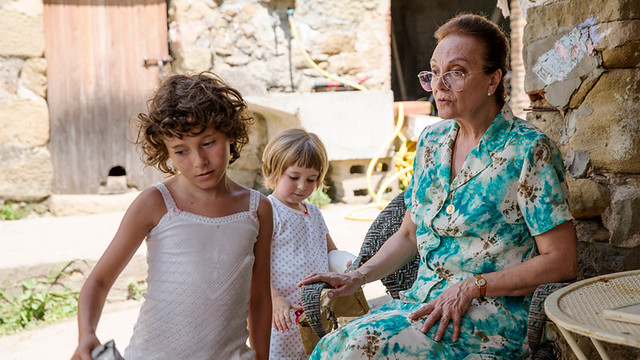
It starts with Frida leaving her Barcelona home where she lived with her extended family. She is to live with her uncle Esteve and his wife Marga and their 3-year old daughter, Anna, in an idyllic country home. The apartment in the city will be rented out. The sun-drenched countryside is a big change for Frida. But her new family - new mom and dad are loving and understanding, plus she now has a new playmate, Anna.

But she doesn't understand why she is being subject to series of tests in the hospital and other parents freaking out and grabbing their kids around her in the playground when she scrapes her knee and bleeds, and why Marga wears rubber gloves tending her wounds.

Spoiled rotten in her life in the city, sullen Frida is very hard to please. She acts out in ways she doesn't quite understand herself. Good-natured Esteve and Marga do their best, but it seems pretty obvious that the spoiled city girl is a bad influence on Anna. Tired of having a problem child in their household, they argue.

Taught by her grandma, Frida say prayers daily for her mom and leaves things (that she stole from Marga's closet) at an altar of Virgin Mary near the house. Constant visit from her unconditionally loving grandparents and other relatives doesn't help Esteve and Marga's situation, as they spoil the girl to no end and she throws tantrum every time they visit. To make things worse, Frida leaves Anna in the forest and lies to Marga her whereabouts. It is a harmless child’s play, but Anna ends up with a cast on her arms.

After clean bill of health declared by the doctor, Marga lets her guard down a bit, and young Frida soon eases into the country living calling Esteve and Marga mom and dad. But sometimes she falls into fits of melancholy.

The word AIDS or HIV is never uttered in the film. Grown ups in the film obviously have some understanding of what's going on and they speak in hushed tones in front of oblivious Frida. She is a child indelibly marked by tragedy, a product of a specific decade that was marred forever by devastating disease that swept the world.

Handheld, sun-drenched photography provides intimacy and warmth and contrasts our moody heroine and subject matter. It's an incredibly difficult role to play for a child and bright eyed, wild haired Artigas is a revelation. Carefully put together and wonderfully acted, Summer 1993 is a beautiful film not only to reflect on the fearful period of 90s and the generation it affected but also highlights unconditional love of the tight-knit family overcoming tragedy.

SUMMER 1993 opens in New York and Los Angeles on Friday, May 25, with a national rollout to follow. Please visit Oscilloscope Laboratory for mor information.

Dustin Chang is a freelance writer. His musings and opinions on all things cinema and beyond can be found at www.dustinchang.com