Showing posts with label History. Show all posts

Friday, November 22, 2024

This is No Communist Speaking, This is an Angry Black Man Speaking

Soundtrack to a Coup d'Etat (2024) - Grimonprez Screen Shot 2024-11-22 at 11.11.16 AM Screen Shot 2024-11-22 at 11.17.56 AM Screen Shot 2024-11-22 at 11.15.31 AM Screen Shot 2024-11-22 at 11.19.15 AMScreen Shot 2024-11-22 at 11.16.27 AM Screen Shot 2024-11-22 at 11.14.29 AM Screen Shot 2024-11-22 at 11.28.23 AM Screen Shot 2024-11-22 at 11.13.08 AM Screen Shot 2024-11-22 at 11.13.58 AM Screen Shot 2024-11-22 at 11.18.24 AM Screen Shot 2024-11-22 at 11.20.24 AM Screen Shot 2024-11-22 at 11.20.32 AM Once upon a time, there was a hope and solidarity enough to counter the First World (The US and Europe): when the UN assembly was more democratic, in part, because of a bloc of newly independent African and Asian countries had votes and power to oppose the First World hegemony- This is when Castro, Nehru, Khrushchev, Malcolm X, Shukarno, Nasser, Tito hung out together in New York. The year was 1960 and The Belgian Congo was seeking independence. Belgian filmmaker Johan Grimonprez creates a comprehensive intersectional picture of post-colonial, Cold War world with American Civil Rights Movement, Black Nationalism and jazz in 2-hour-30-minute runtime. It's quite a lot for a historical documentary. But believe you me, it's worth it.

Jazz, that unique American music genre, was in its hay days in the 1960 with bebop (with Dizzy Gillespie widely credited as origin of this style) dominating the scene with the greats like - Max Roach, Miles Davis, Thelonius Monk, John Coltrane, Duke Ellington, Gillespie, Art Blakey, Melba Liston and singers such as Nina Simone, Abbey Lincoln... There are just too many to name all here. So how does Grimonprez pick and choose for this film? His decision is a wise one - include them all. First and foremost, with title cards closely resembling Blue Note album covers, jazz takes center stage with many musicians stating their political views in their interviews and music. Patrice Lumumba of the Congo and Kwame Nkrumah of newly independent Ghana and their desire to create the United States of Africa resonated deeply with Malcolm X, Black Nationalists and many musicians in the States.

It was an exciting time but also a dangerous time, especially for Lumumba, who had many admirers including Khrushchev and Castro. For Belgians who reluctantly gave the Congo their independence, the riches of the minerals in the Southern region of Katanga was too much to give up. Here Grimonprez connects the dots with the history of exploits of the region that continues to this day - from uranium to make atomic bombs that fell on Hiroshima and Nagasaki, to cobalt and nickel to make batteries for Tesla and iphones with gross human rights violations. With so much corporate interests at stake, the Belgians, British, the CIA and even the UN - at the time Secretary General Dag Hammarskjöld favoring and arming different factions to eliminate Lumumba. There's a funny bit about the US State dept. sending Louis Armstrong as a cultural ambassador to Africa and the Congo to snoop around what's going on there. Armstrong apparently later found out the CIA's real motivation and threatened to give up his US citizenship and move to Ghana.

The film builds up to the assassination of Lumumba. There is plenty of historical footage of Lumumba and his close associates including his speechwriter/political activist Andrée Blouin, Khruchshev, and enemies, mercenaries, diplomats, government officials all accompanied by jazz greats.

There are some modern documentary pitfalls in the film - obvious visual metaphors like an elephant being clumsily transported by the whites and Chubby smiling Khruchshev banging on the table over and over again, whitewashing his brutal oppression and invasion of Hungary, but Soundtrack to a Coup d'Etat is a comprehensive look at the turning point in history - a glimmer of hope for the third world what it aspired and what it could have been - and how it was quickly snubbed out by the colonialist, imperialist, capitalist power that threw African continent into a turmoil with its tragic consequences still playing out all over the continent. During the Cold War, the US and Europe were seeing the world in dichotomy, quick to accuse voicing injustice as a communist activity. And how it became the prevalent mantra of the public even now. Boppers knew. Malcolm X knew. People protesting the European’s and CIA's roles in Lumumba's death in Harlem knew. Soundtrack to a Coup d'Etat is a tremendous film and certainly one of the best of 2024.

Thursday, December 15, 2016

Poetic License

Neruda (2016) - Larrain
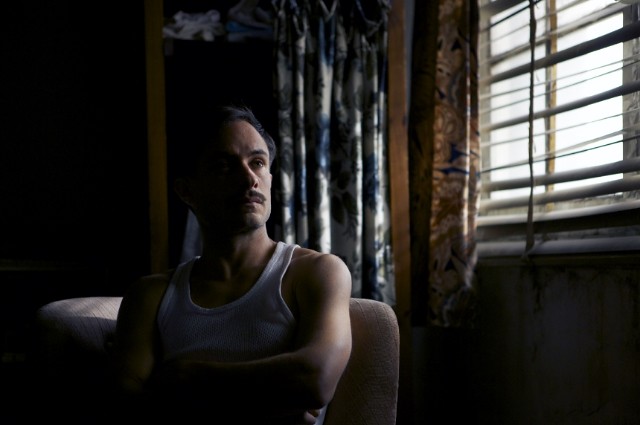
Neruda - Gael García Bernal
Despite its title, Neruda is not a typical biopic about the famed Nobel laureate and Chiléan national treasure Pablo Neruda, though it does feature the poet (adroitly played by Luis Gnecco) on the lam. But the film is more to do with the power of his poetry or, dare I say with a straight face, the transcendent power of art.

Neruda has all the ingredients of an 'award winning' film. Unlike all the heavy handed, self-important and mostly boring award winners, however, it floats around like a cloud while retaining all the artistry, elegance and poignancy without missing a beat. Immensely watchable and wildly entertaining, Neruda, along with his other release of the season Jackie, proves that Pablo Larrain has emerged as one of the major talents in contemporary cinema.

Neruda starts with a voice-over of a police prefect, speaking disdainfully about then senator Neruda. 'That fat communist,' he calls the poet. He is revealed later as inspector Oscar Peluchonneau (Gael Garcia Bernal). The year is 1948: Chilé elected Gabriel Gonzalez Videla a couple of years before, but Gonzalez betrays his radical left upbringing and starts hunting down his former communist friends, including Neruda, once his ardent supporter. Surrounded by his admirers and comrades-in-arms and his rich aristocratic Argentine wife Delia (Mercedes Moran) in tow, Neruda goes 'underground.'

Not willing to leave his beloved country nor give up his bourgeois tendencies -- visiting his beloved whorehouses and throwing wild parties whenever he can -- Neruda exposes himself to dangers of being captured and jailed, while Delia suffers quietly, locked in various safe houses. So begins the very loose game of cat-and-mouse between Peluchonneau and Neruda.

The hard as nails inspector has many close calls of crossing paths with the fugitive but the fat, bald man always sneaks away, always leaving the same detective novel for Peluchonneau to pick up. As the film progresses in its dreamlike, at times surrealistic way, both we and the inspector himself begin to wonder if he were a creation of the mind of the poet? Is he a mere supporting character in an unfolding narrative?

Larrain and writer Guillermo Calderón (Violetta Went to Heaven, The Club), with the help of fantastic acting from the entire cast, expertly move the focus from the famous historical figure to his art. Neruda is seen as a womanizing bourgeoisie, a so-called champaigne commie. But it's his beautiful poetry that captured the heart of the working class. Everywhere he goes, people ask him to recite his poems. From a drag queen in a whorehouse to a street urchin, to strikers and political prisoners, his poetry gives them a voice.

Sergio Armstrong (Young and Wild, No)'s fluid camerawork-- 360 degree long takes, plenty of anamorphic lens flares and full of light-- owns the film's borderline dreamstate quality. Shot digitally but with one 35mm anamorphic lens to have that old timey film look (more grains, soft edges), Neruda is definitely one of the most beautifully shot films in recent years that beckons to be seen on a big screen.

As Peluchonneau tracks down Neruda to the snowy Andes, the film takes another one of its many unexpected turns and becomes a metaphysical road movie - that it's not Neruda the person the inspector is after, rather, it's an idea of Neruda: a mirage or something unattainable, like his poetry, as it leaves your mouth and becomes something intangible but unequivocally meaningful.

Treading boundaries of reality in a free form that is unquestionably cinematic, Larrain achieves something very special with Neruda. It's a beautifully crafted film that feels completely effortless and airy. It is clever, playful and fluid yet not too showy, emotionally resonant yet not corny. It's a political treatise, yet it doesn't take itself too seriously. But it doesn't make light of the persecution and people's suffering either. Neruda is a great achievement in cinematic art form.

Neruda opens in the US on Friday, December 16.

Wednesday, June 12, 2013

Korean Film Archive on Youtube

Look at all these cool posters!!
 photo movieposter-9_zps287da779.jpg photo movieposter-8_zps3b436a8e.jpg
 photo movieposter-7_zps3bafa7c5.jpg photo movieposter-6_zpsc23a45e0.jpg
 photo movieposter-4_zps0de01cd9.jpg photo movieposter-3_zps87f12122.jpg
 photo movieposter-2_zpscaf156d3.jpg photo movieposter-1_zps654b5d13.jpg
 photo movieposter_zps35985026.jpg photo movieposter-10_zps517b1517.jpg

I'm sure you noticed as of late, I've been in a Korean movie watching kick! Growing up in Korea, I've never really watched Korean films. Even after Korean film renaissance began around mid 90s, I was very slow to catch up with the rapid ascension of the Korean cinema and the country's reputation as one of the leading film producing countries in the world. I've seen my share of it now, joining many K-cinephiles, enjoying steady diet of current crop of Korean actioners/thrillers/policiers, etc. But I've neglected the classic Korean films of the yesteryears and been curious about them ever since I watched Madam Freedom (1956) a couple years back. Then I recently stumbled on to this: Korean Film Archive. It boasts 71 Korean classics (mainly from the 60s through early 90s), decent qualities with a decent subtitle options (CC button). Most of them not available anywhere neither on disc format nor streaming. I've watched Black Republic the other day and will check out many more in the days to come. Granted many of them are 80s skinflicks (Military dictatorship haydays under Pres. Chun Doo-hwan who promoted 3Ss- Sex, Screen, Sports to keep the citizens occupied) with amusing titles like The Ball Shot by a Midget, Parrot Cried with Its Body and Does Cuckoo Cry at Night?

But if you are like me, curious about Korean films prior to mid-90s, please visit the site and check them out yourselves.

Saturday, June 1, 2013

Film as History

City of Sadness (1989) - Hou
Image
Image
Image
Image
Image
Hou quietly observes a prominent Lin family in a mountain town as it breaks apart during turbulent times in Taiwan after WWII. Handsomely photographed static interior shots accompanied by naturalistic performances, City of Sadness looks and feels like Ozu. Sung Young Chen is great as boisterous eldest son, so as Jack Kao as the middle child who suffers from PTD who were drafted to fight in a Japanese army and later is tortured by Kuomintang as a collaborator. Young Tony Leung also shines as the youngest, sensitive, deaf (because Leung couldn't speak Taiwanese, I found out, but it works him being as a slient witness) brother of the family. It's he and his long time family friend and later wife Hinomi (Xin Shu Fen) who bear witness to the changing times.

I had a very little knowledge of Taiwanese history going in City of Sadness: didn't know about their 51 year Japanese Occupation (compared to Korea being under 30 year occupation, and we still hold grudges) and the rather unique colonial past (as the first Japanese colony since 1894, taking cues from the Brits, the Japs governed them differently at first and to this day, I hear Taiwanese don't have too much adversarial feelings toward Japs as the rest of Asia do) , didn't know about their diverse ethnic groups, culture and languages, didn't know about Kuomintang's atrocities after the WWII against its own people. It is rather wrong to base your knowledge of a certain people's history solely on one mere film, but knowing Hou and his detached yet humanistic approach, I'd take his film over any dry history textbooks.