Showing posts with label Korea. Show all posts

Tuesday, October 6, 2026

Multi-Takes

The Day She Returns (2025) - Hong Screen Shot 2026-09-05 at 8.13.57 AM Hong Sang-soo, prolific as ever, presents at this year's NYFF again with two films. And I can't keep up with him! For Hong, with his small camcorder with minimal crew, sketching out one slight narrative after another. It seems filmmaking has become as natural to him as breathing or drinking Soju. More and more I watch his films, he seems to draw his inspirations from anywhere, however trivial and small they might be to others.

The Day She Returns, Hong's 34th feature, is about an actress coming out of a long hiatus and giving interviews to various journalists throughout the day, doing a press junket. It is a common practice to promote a film that filmmakers and actors perform, during a film festival or prior to film's release to the general public, which film writers like me are familiar with. A press junket maintains its own small ecosystem populated by filmmakers, their handlers, journalists and PR company folks, where we encounter same faces, same questions and answers over and over again.

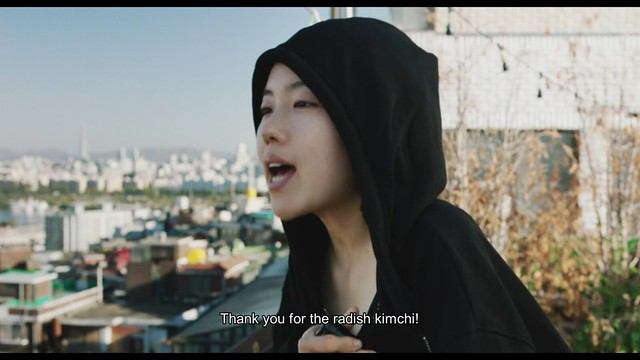
Song Seon-mi (Hong's frequent collaborator, recently seen in Hong's Walk Up (2022)), plays Jeong-su, an actress making a comeback after a divorce, starring in a small indie movie by a young rising filmmaker. It's a press day and she is giving three interviews back to back, taking a smoke break in between, in a small German restaurant by the window.

As each interview by young adoring journalists progresses, Jeong-su reveals not only her acting career and the project, but also about her personal life. But her divorce is still a touchy subject. The short interviews in these press junkets are in themselves a delicate ritual - there's an awkward introduction and nervousness, once the niceties are settled, you get to talk about the project and other things, then invariably concludes with the 'advice for the younger generation' question.

If we learned anything from Hong Sang-soo Multiverse- a career spanning retrospective series, a few years back, is his penchant for exploring the double, triple, multi-takes of the same situations. In The Day She Returns, Hong uses the press junket to emphasize these multi-takes, that there are infinite, variable takes and angles of one object, situation, place or person in life.

Jeong-su is personable and very open to all interviewers and dying for a beer (the restaurant is known for its draft beer). She approaches the subject of ordering beer to all interviewers and all of them first politely declines. But she finds success with the second interviewer, a young woman who doesn't quite understand what the film means. Doesn't matter, there's a tall glass of cold beer in front of her. The drinking loosens Jeong-su up and she talks about her divorce and her ex, somewhat bitterly, which she regrets later and asks the interviewer not to publish the part about her divorce talk, in order to respect the privacy and reputation of her ex-husband.

During Jeong-su's three interviews, with similar yet slightly varied questions and answers, Hong delights us with the humorous formulaic nature of press interviews (oh we journalists think our questions are so clever and unique!), delicate human interactions (one more personable than the other), giving a bullshit generic wisdom of the elders that they themselves don't believe in - when asked about giving an advice to the younger generation, she gives the same answers to all young interviewers, "Love yourself first!" and the folly of believing that a short interview can reveal the truth about the subject.

During the third interview, Jeong-su reveals that she is still taking acting lessons from a renowned acting coach with a unique technique. After the interview, she hurries off to her acting lesson. Her acting coach (Oh Yeon-su) wants her to reenact the interviews she did with the help of an assistant Junhee (Park Mi-so, another Hong regular), playing the generic version of three interviewers. So we are watching yet another take of the same situations with varying degrees. Only this time, Jeong-su doesn't remember any details of what she talked about in those interviews.

The Day She Returns is yet another delightful, humorous and delicate slice of life film from Hong, one of the most unique filmmakers working today. May his multiverse continue in perpetuity.

The Day She Returns plays on 10/6 and 10/8 at NYFF.

Sunday, September 27, 2026

Class Divide

Possible Love (2026) - Lee Possible Love_NYFF64_01 Possible Love was originally conceived as one of the feature remakes of Krzysztof Kieslowski's Dekalog series. I am happy to report that the acclaimed Korean director Lee Chang-dong opted not to just redo the Ten Commandments-inspired classic, but wrote (with co-writer Oh Jung-mi) and directed something far richer and more nuanced than its mere original concept.

Talking about novelistic films, with the running time close to three hours, it might not be narratively as explosive as Burning, which Lee directed eight years ago, but Possible Love is just as layered, and more refined and complex, when delving into class divide and human conditions. It's surely one of the finest films of the year and yet another masterpiece by the Korean master.

Possible Love starts with a quote, "Thou Shalt Not Covet," just like the 10th Episode of Dekalog. But as it plays out, one can immediately recognize that the film is definitely all Lee Chang-dong through and through.

We are at the funeral of a worker who was laid off from a giant manufacturing firm, due to the company restructuring two years before. It turns out that he committed suicide. One of his colleagues, who was also the victim of downsizing along with hundreds of others, and now suffering from depression, is Ho-seok (Sul Kyung-gu of Lee's Peppermint Candy).

The memorial service is being videotaped by Ye-ji (Cho Yeo-jeoung, Parasite). There is a bit of scuffle, as Ho-seok deems taping of a somber occasion and grieving families more than a little abrasive. But he is later assured by his wife Mi-ok (Jeon Do-yeon, Secret Sunshine), that Ye-ji is a documentarian making a film about the state of the labor movement.

Ho-seok's blank stares and never-smiling face tells a story of his tragic case. He is a broken man both physically and mentally, after the violent government crackdown of the sit-in striking workers at the manufacturing plant, where he worked as a welder. He was physically assaulted and was hospitalized from his injuries. In the end, the strike failed and the company ended up laying off many of its workforce.

As Mi-ok explains matter of factly to Ye-ji, there are the 'dead-ers' and the 'live-ers', as the outcome of the company restructuring -- the ones who were fired from their jobs are like zombies, defeated and traumatized, while those who were spared and retained their jobs, get to keep on living. Well-meaning Ye-ji is determined to make a documentary that represents the lives of working people, and Ho-seok would be her main star. She just needs to convince him to be in front of the camera, and a personable Mi-ok could be her ticket.

As the two women become friendly, they talk about their lives and their husbands. We get to know how the couples got together. Through their conversations, Mi-ok finds Ye-ji's tall and handsome husband Sang-woo (Zo In-sung) is from an incredibly wealthy family and Ye-ji's endeavors and, indeed, everything she does in life is provided by him. Sang-woo is the hedge fund manager type, who handles big transactions while on the phone in English, dealing in different time zones. It is hard to read his inner thoughts, but his stealthy exterior, good posture, and mannerisms are impaccable.

One of the funnier bits, and there are many, takes place in a restaurant with four of them together. During dinner, Mi-ok tells Sang-woo that he reminds her of Steve Jobs, to everyone’s amusement. It's not the physical similarities but the confidence he exudes, she explains.

After dinner, on the way home in their Porche, while talking about Ye-ji's filmmaking endeavor, Sang-woo says he admires her 'method acting' as she ingratiates herself into the lives of the working class. Hs observation is sincere, rather than condescending, and Ye-jin takes it as a compliment. She responds that she wants to 'love' these people.

There are several instances where Mi-ok notices expensive clothes and items Ye-ji wears. She tells Ye-ji to refrain from wearing them while showing up to do interviews with the workers and their families. It's not because she is envious, but she is embarrassed for her and knows it is not a good look for someone making a documentary about the proletariat. Ye-ji gets the message.

Lee's dense and nuanced script brings out all four characters and makes them three dimensional. Every small interaction, glance and gesture highlights the differences in the two couple's relationships and underlying tension. All four actors are superb. But it's Jeon Do-yeon who shines the brightest in the role of Mi-ok, who supports her broken husband unconditionally, while keeping him from losing his dignity. This means strictly enforcing no drinking in public and making scenes as he used to. Her Mi-ok is trying to hold the family together in the harsh world for her husband and their son, while always putting up a sunny disposition. She is so good at imbuing all this.

Ye-ji invites Mi-ok's family to Sang-woo's summer mansion by the sea, endowed with a private beach and a caretaker, to spend their summer vacation together. Ye-ji is also hoping that she finally gets an on-camera interview with Ho-seok while there, too. To everyone's surprise, Ho-seok agrees to go, because perhaps it’s time for him to let go of his trauma.

During their stay at the gigantic, opulent mansion, run by a silent, smiling man who turns out to be Sang-woo’s childhood playmate (a former caretaker’s kid), Mi-ok mentions the mansion is like from the novels that she never read.

Tension between two couples boils over as Ho-seok has an emotional breakdown and Mi-ok finds out that Ye-ji’s been monitoring their every movement in the mansion.

The title of the film might suggest that love is possible between different economic classes. Or, it might mean love and understanding for the proletariat are possible. Combined with "Thou Shalt Not Covet," in the context of exploitation of the labor in the capitalist society and haves and have nots, Lee leaves us with a lot to ponder.

Sunday, November 23, 2025

Life/Work/Death

No Other Choice (2025) - Park Screen Shot 2025-11-23 at 8.50.00 AM Screen Shot 2025-11-23 at 8.50.21 AM Screen Shot 2025-11-23 at 7.11.18 AM Screen Shot 2025-11-23 at 8.51.13 AM Screen Shot 2025-11-23 at 8.53.12 AM Screen Shot 2025-11-23 at 8.52.37 AM Screen Shot 2025-11-23 at 8.53.33 AM Screen Shot 2025-11-23 at 8.57.46 AM Screen Shot 2025-11-23 at 8.18.03 AM Screen Shot 2025-11-23 at 8.40.05 AM Mansu (Lee Byunghun), a 25 year veteran in a paper mill company with a big house in the countryside with a loving family - wife Miri (Son Yejin), teenage son, ten year old autistic daughter and two golden retrievers affectionately named after his children, just got laid off. Just before he was laid off, he was planning union activities with his subordinates. The only thing he has known in his adult life was the paper mills and he has no prospects other than that industry and with the mortgage company repossessing the house in three months, the clock is ticking for Mansu to get another job.

Taking the cue from his stress, Miri restructures the household in order - no more outlandish meals, no more tennis lessons, no more Netflix, dogs to her parents house, downsize the 2 big cars to one small one and put the house on the market. Mansu refuses to sell the house since it's the one he grew up in and bought it with his own money. And especially, the potential buyer is a sleazy local electronic shop owner who is a dad of his son's best friend. Three months, Mansu tells Miri.

Mansu does research on his competitors just in case Moon Paper, a big paper company, is in need of hiring another manager. He narrows down the potential competitors to two and devises a plan to eliminate them.

No Other Choice says a lot about salaryman life in Korea where you are defined by your work, where your life is completely tied to your job and the job defines you. In Mansu's elaborate scheme - spying on his competition at home and work in order to get a chance to kill them, exposes that they are in the same boat as he is: the grueling unemployment life- the daily humiliation, temptation of alcohol and drugs, suspicion of spouse infidelity, etc. They are the mirror images of himself! But Mansu, trapped in the cruel rat race in the capitalist system, has no other choice but to pursue his plan to save his family from poverty.

As usual, Park Chanwook is a first and foremost visual stylist. There's more visual ideas in No Other Choice than most Hollywood releases in a year combined. Lee, with his model like angular face twitching as a stressed middle aged man, is tremendous as Mansu, the stressed out salaryman. Son, as a practical wife who loves her man, no matter what, is fetching in her coy performance.

No Other Choice touches upon a lot of modern society's illness with satirical humor. There's dying manufacturing industries, automation and A.I. taking over human labor, deforestation and autism. I do not want to compare Park's movies to others, but the head of the family losing his job as a subject, is done before much more realistically in Tokyo Sonata by Kiyoshi Kurosawa. I mention this because there's also a theme of music and gifted child involved. But it's Park Chanwook movie. So it has to be fantastical and much more artificial, therefore less emotionally resonant. It's superb entertainment but boy is it stressful.

Sunday, July 6, 2025

Drinking Test

What Does That Nature Say to You (2025) - Hong Screen Shot 2025-07-06 at 7.01.42 AM Screen Shot 2025-07-06 at 7.33.16 AM Screen Shot 2025-07-06 at 7.53.40 AM Screen Shot 2025-07-06 at 8.32.51 AM Donghwa (Ha Seongguk), a thirty-something poet drops off his girlfriend Junhee (Kang Soyi) to her parents' house outside Seoul in his used old car that he loves. And the clunky blue car is the one that her father (Kwon Haehyo) notices, along with his facial hair. Maybe out of politeness, Dongwha and the father carries on an awkward conversation about the rural house that the father built for his now deceased mother, which is equipped with a chicken coop, a cozy private shack, and the impressive landscaping behind the house all the way up to the top of the hill with a majestic view. All is well and the father invites him to stay for dinner. Donghwa seems to be enamoured with the beautiful surroundings and Junhee's parents' DIY house. Whenever he finds an inspiration for his poetry, he jots it down in his little notebook that he carries everywhere.

Dongwha, Junhee and her reclusive older sister (Park Miso) who might be suffering from depression, have lunch at a local restaurant by the river. Junhee's sister is not sure if Dongwha, a son of a famous TV defense attorney, working as a photographer at weddings, is as self-reliant and immaterialistic as he professes to be.

Junhee's mom (Cho Yunhee), who is also a published poet, lays out a chicken feast for the possible future son-in-law for dinner. And the conversation naturally turns interrogative. After a bit of Korean rice wine is consumed, by the encouragement of mom, Dongwha recites his terrible and naive poetry about night blooming flowers, eliciting polite responses. But it's the sister's niggling questions about his rich and famous father and whether he is truly self-reliant that sets Donghwa off. And the dinner ends in drunken outbursts and Dongwha passing out on the dinner table.

At night at his shack, the dad and mom assess Dongwha, just as any prospective in-law would - but not in definitive terms: He obviously has some deep seeded issues with his father. Junhee loves him now, but with life experience she will figure it out if they are gonna be good together. They laugh about him bombing the 'liquor test'- and if that was the dad's real intention, which he denies vehemently.

Dongwha is seen walking around at night on the hills, looking at flowers lit up by his cell phone, then tripping and falling, hurting himself.

With What Does That Nature Say to You, Hong Sangsoo sketches out another slice of life effortlessly: The awkward, funny interactions among the characters ring true as usual. The youthful idealism fades when we face the real world and responsibilities. The pursuit of truth and beauty is admirable, but it's not cute anymore when you are 35 and without a steady job. You can't guise it with junk cars, facial hair and actively not wearing glasses because you want to see the world a little bit fuzzy (a dig on Hong's own late style where things are intentionally out of focus) as your aesthetic.

Hong, as usual, is showing his cynicism toward young artistic types. It's probably because he went through that phase himself and now can look back and have a laugh.

Wednesday, October 9, 2024

If I Fall from Grace

By the Stream (2024) - Hong By the Stream Clocking at 111 minutes, Hong Sangsoo's new film, By the Stream, is perhaps the most busily plotted and the most sinewy among his recent output. It touches on many of Hong's preoccupations and reflexive filmmaking, along with the recent surge of the Korean feminist movement.

It concerns a disgraced actor, now a small bookstore owner Siyeon (Kwon Hyeho) in Kangwon province, being invited to stage a play in the year end festival in a women's university in Seoul, by his niece Jeonim (Kim Minhee) that he hadn't seen for years. It turns out that he is a last minute replacement, because the young director who was in charge of the production was dismissed because he slept with 3 of the cast members. The actor sees this opportunity as a kind of redeemable occasion which would rekindle his passion for art as he felt when he first started his career, which happens to be at the same university long ago.

Jeonim, in her early 40s, is living a quiet, uneventful life as a textile artist and working at the university. She is first seen sketching in her notebook by the steam in earth colored Fall attire. It was the university's department chair Jeong (Cho Yunhee) who gave her the job and trusted her and became a big sister figure in her life. It turns out Jeong is a big fan of Siyeon as an actor and really wanted to meet him. After a couple of drinking occasions and some grilled eels, the actor and Jeong get along swimmingly and that makes Jeonim a little uneasy and jealous. In the meantime, with new materials that Siyeon wrote, the 4-female play team rehearses their play under his guidance. The young women are eager and full of optimism in their expression of joy and outlook- the way only not-yet-jaded-by-life young people say and behave.

Jeonim confronts the young director (Ha Seongguk) who was let go, when he comes back into the university campus to talk to one of the girls he professed his love for. His remorseless behavior and demands to get his job back and his material being staged receives Jeonim's contempt and anger. Her reaction is almost feral.

When the young man makes a second appearance to propose to one of the girls, Siyeon steps in and has a talk with the young man. We don't get to see what's being said.

Hong leaves a lot of threads messy and untidy, unlike Jeonim's textile patterns with intricate designs. What really happened to Siyeon the actor? What made Jeonim content with her life? Why did their play receive poorly and why did the dean of the school want to talk to Siyeon? It Doesn't matter. Hong's characters interactions are delicious as always. It's a change of pace from his minimalist work with his last couple of outings, even the Isabelle Huppert starring A Traveler's Needs that came out this year as well.

Tuesday, July 30, 2024

Live Life Truthfully

A Traveler's Needs (2024) - Hong Screen Shot 2024-07-29 at 9.21.02 AM Screen Shot 2024-07-29 at 9.31.03 AM Screen Shot 2024-07-29 at 9.53.17 AM Screen Shot 2024-07-29 at 10.11.44 AM Screen Shot 2024-07-29 at 10.17.15 AM It is hard to quantify Hong's films, and I am not talking about him making two or three films of the year as he has been for the last decade or so. It's not that what Hong does need to be measured by the likes of me, but as someone who watched vast swaths of his films, with my ADHD triggered rating system toward a director's filmography going, I can't help myself ranking which of his films are better, more impactful than others in my head. and I am happy to say that A Traveler's Needs, his new film starring indomitable Isabelle Huppert, is one of his best films.

A Traveler's Needs concerns Iris (Huppert), a French woman living in Korea. She started giving French lessons to two Korean women recently. Her method seems interesting: she writes down a custom-made phrase on wads of index cards she carries in her bag for each person she is tutoring. Eager to please the foreign woman, Korean women play musical instruments in front of her. She asks each of them how they feel when they play. And they both in turn give generic answers which turn out to be identical. Iris pushes harder - but how do you really feel? Then she writes down her French phrases for them.

All the Hong signatures are present - a subtle comedy based on repetition, copious amounts of alcohol consumption - in this film, the choice is Makguli, a milky Korean rice wine.

The third act concerns a young man, Seong-guk who shares his flat with Iris. It turns out that he met her in a park, sitting there alone, playing a flute badly without a care in the world. It is revealed that she didn't have any means for living, so he suggested tutoring French which she has no prior experience in. Seong-guk's estranged mom stops by unexpectedly and chastises her son for living with some foreign woman. He explains that Iris lives her life truthfully. Mom wants him to ask her about her background. She doesn't want this mysterious foreign woman taking her naive son for a ride.

A Traveler's Needs have much in common with Wim Wenders's Perfect Days. These protagonists are people of very limited means and ambitions. They just float around living life as truthfully as they can. Never looking backwards but always forward. There's some sort of universality here - Wenders directing in Japan seeing the world through the eyes of Koji Yakusho and Hong directing and seeing the world through Huppert's eyes. Gentle, living by the moment, enjoying the surroundings - nature, sleeping, drinking, small human interactions.

I see that Iris can be the continuation of a character Huppert played in Mia Hansen-Løve's L'avenir/Things to Come (2016), a professor losing her job and marriage, trying to find the footing in the world for the first time in a long time as an aging woman. It is not difficult to imagine her character taking off to some foreign land and keep on living like that.

Huppert is marvelous as Iris. The best scene is perhaps her flirting with Kwon Hye-ho's character: obviously there's an attraction between them. She touches him on the shoulder and winks at him, then giggles like a schoolgirl. He is spellbound obviously.

A Traveler's Needs is up there in Hong canon and one of my favorite films of the year for sure. Here is my review for Things to Come

Monday, July 1, 2024

WKW Facsimile

Motel Cactus (1997) - Park Screen Shot 2024-07-01 at 8.40.57 AM Screen Shot 2024-07-01 at 8.42.18 AM Screen Shot 2024-07-01 at 8.51.10 AM Screen Shot 2024-07-01 at 8.55.16 AM Screen Shot 2024-07-01 at 8.59.14 AM Screen Shot 2024-07-01 at 9.10.07 AM Screen Shot 2024-07-01 at 9.14.53 AM Screen Shot 2024-07-01 at 12.23.50 PM Screen Shot 2024-07-01 at 12.24.28 PM Screen Shot 2024-07-01 at 12.30.44 PM Screen Shot 2024-07-01 at 12.33.35 PM Screen Shot 2024-07-01 at 12.34.00 PM Before Korean cinema was a thing, the popularity and influence of Wong Kar-Wai in Korean cinema loomed large. The year wa 1997s, this Bong Joonho scripted (he also served as an AD), Chris Doyle shot film is a wall-to-wall facsimile curio of WKW aesthetics. It loosely tells 4 different stories of young loves in one location - a conveniently large, primary colored seedy love hotel room for Doyle to run around and document the trysts of young lovers up close and personal with wide lenses. It's all asthete and nothing else. But all so pretty.

Sunday, August 27, 2023

Rat in a Cage

The Housemaid (1960) - Kim Screen Shot 2023-08-25 at 12.48.19 PM Screen Shot 2023-08-25 at 12.50.48 PM Screen Shot 2023-08-25 at 1.46.10 PM Screen Shot 2023-08-25 at 2.39.38 PM Screen Shot 2023-08-25 at 2.43.25 PM Screen Shot 2023-08-25 at 2.56.27 PM Screen Shot 2023-08-25 at 2.57.54 PM Screen Shot 2023-08-25 at 3.00.24 PM Screen Shot 2023-08-25 at 3.05.00 PM Mainly taking place in a two-story house, Kim Ki-young's The Housemaid is a high on cringe, yet effective melodrama that says a lot about rapidly changing capitalist society. Based on a real life news clip, it tells of an aspiring middle-class family trying to move up in the ladder, at all cost. Studious Kim (Kim Jin-kyu) is a music teacher who conducts a choir composed of a gaggle of gossipy female mill workers (incentives provided by the factory). In order to renovate his newly bought house, Kim actively pursues anyone for private lessons. Because he is a suave, good looking man, there are a lot of adoring workers who want his attention. But he is a married family man, a straight shooter. So when he discovers a love letter planted by one of the adoring girls, he straight up reports to the management, and the girl gets suspended and she later commits suicide. But it is Ms. Cho, the dead girl's best friend, who is in love with him as she takes private lessons to be closer to him.

In the meantime, Kim's seamstress wife's health is failing and will be in need of a housemaid to do house chores and take care of their two growing young children- a hyperactive boy Changsoon and a crippled older sister Aesoon. Ms. Cho introduces Ms. Kwak (Ko Seon-ae), a wide eyed young woman from the factory for the job. She becomes increasingly unstable and throws herself on Kim, then he and his family become the hostage of her threats of going to the authorities. Kim and his family, afraid of losing their aspiring petit bourgeoisie existence, gets trapped in living hell.

The lower class and middle class fighting for the scraps in vertical hierarchy is pronounced more subtly. Knowing Cho is in love with Kim, Kwak naturally wants what Cho has. It's not lust she's after. She just wants what others have, because that's what a consumerist capitalist is supposed to do. The premise might resemble some cheesy 90s psychosexual thriller but its presentation is nothing but - Kim' style is very much indebted to Hitchcock - constant tracking shots, use of space and even POV of water glass containing rat poison.

Bong Joonho apparently is a big fan of the film and took inspiration from it to make his award winning Parasite. But whereas his film (and his films in general) feels highly superficial, too overwrought and heavy on unsubtle symbolism, The Housemaid is bustling with raw energy and plays out like a neo-realist melodrama. Yes, the two-story house and a constantly featured wooden stairs are symbols of a rising middle class's upward mobility. But more than anything, it says a lot about people living under constant pressure of losing everything in a capitalist society. It is their fear which even overcomes murder(s). If you were moved by family devotion and sacrifice in Parasite, the murders and depravity toward children in The Housemade will shock you.

Is it the puffy tail that makes all the difference between a rat and a squirrel? You might have achieved the goal of becoming petit-bourgeoisie by having a pet squirrel, but you will always have rat poison hidden away in the cupboard. The Housemaid pokes at these conundrums of living in a rapidly developing capitalist society.

Friday, April 28, 2023

Missiles

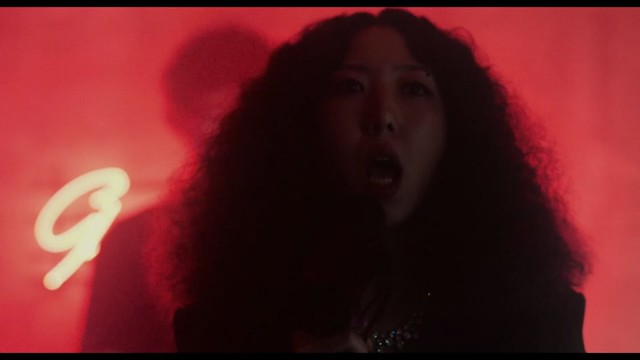
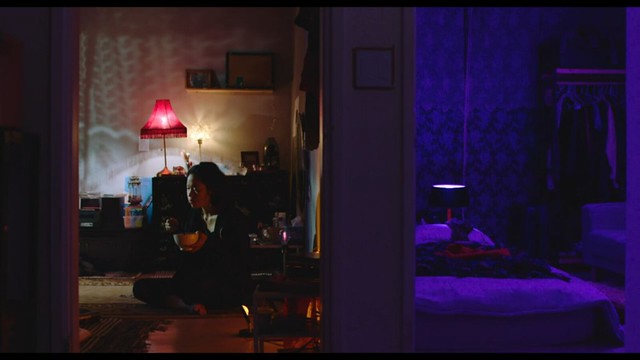
Return to Seoul (2022) - Chou Screen Shot 2023-04-27 at 10.33.45 PM Screen Shot 2023-04-27 at 8.43.26 PM Screen Shot 2023-04-27 at 9.19.29 PM Screen Shot 2023-04-27 at 10.35.35 PM Screen Shot 2023-04-27 at 9.39.04 PM Screen Shot 2023-04-27 at 9.39.49 PM Screen Shot 2023-04-27 at 9.44.51 PM Screen Shot 2023-04-27 at 9.43.55 PM Screen Shot 2023-04-27 at 10.36.29 PMScreen Shot 2023-04-27 at 9.50.02 PM Screen Shot 2023-04-27 at 9.53.38 PM Screen Shot 2023-04-27 at 10.37.15 PM Freddie (Park Ji-min) is a young Korean born French woman in Seoul. She is staying at a hostel for couple of weeks. She is outgoing, impulsive and makes mousy Tena (Guka Han), whom she just met at the hostel and has been acting as Freddie's interpreter, very uncomfortable. It is slowly revealed that Freddie lied to her French parents to come to Korea to find her biological parents. Through the adoption agency, she gets a prompt that her father is willing to meet her. But no words from her mother. He lives in Gunsan a port city in the South West Korea, with his new family. And their encounter is pretty typical and cringey - Father and his family are extremely apologetic and eager to reconnect. Father insists that she relocate to Korea permanently and live with him. He will even find her a good Korean man to marry! It's all guilty conscience, over compensation and pure sentimentality. Freddie, irked by the experience and regretting her impulsive decisions, cuts the trip short and comes back to Seoul. But her father won't stop drunk texting her, apologizing and demanding. She has to put a stop to it.

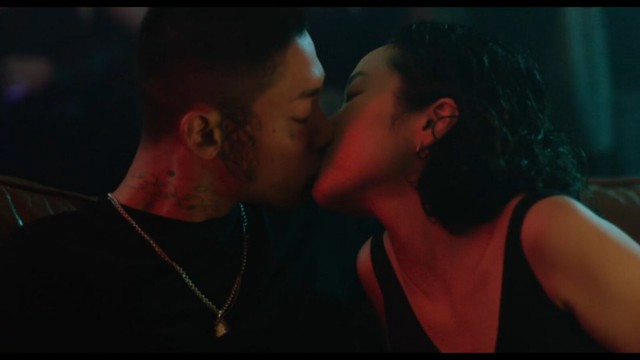
Two years later, and still living in Seoul, Freddie, now 27, is working for a French company while having amorous relationship with an underground tattoo artist and having wild parties. She meets an older French arms dealer too through a dating app. She has picked up some Korean as well. But there is always a sad side to her in quiet moments.

Another five years pass by. Freddie is a smartly dressed arms dealer now, selling missiles to the Korean National Defence Force. More confident now, she can bring her French boyfriend to meet with her father. She can even let her doe eyed father touch her scars on her collarbone who got in a trip to Thailand. Her mother finally contacts her through the agency. And we can guess that this has been the reason why she stayed in Seoul for the last 7 years, away from her French family and friends. The reunion is a tearful one.

Park's performance is a revelation. She makes Freddie a strong willed, fascinating young woman in search of herself. Her magnetic presence makes her always watchable. Seeing from the perspective of an adoptee and a modern woman in a still very patriarchal society, Return to Seoul is a visceral journey toward self-discovery and finding identity. The quiet ending reminds me a lot of Drive My Car. Return to Seoul has that novelistic quality about it that I liked a lot.