Showing posts with label Liao Fan. Show all posts

Sunday, September 29, 2019

Tropical Noir

Wild Goose Lake (2019) - Diao
Wild Goose Lake
The follow up to Black Coal, Thin Ice, Diao Yinan's blistering noir that put him on the international cinema map, Wild Goose Lake is another stylish noir/policier. If Black Coal Thin Ice was a cold noir with its wintry setting, Wild Goose Lake is the opposite- its subtropical setting and constant rain provide the film soaked with atmosphere and vivid colors under flickering fluorescent lights. And it's a beauty, thanks to Diao's regular cinematographer Dong Jingsong. Along with recent Long Day's Journey into Night, Wild Goose Lake continues the tradition of 'Tropical Noir' of Wong Kar-Wai's work.

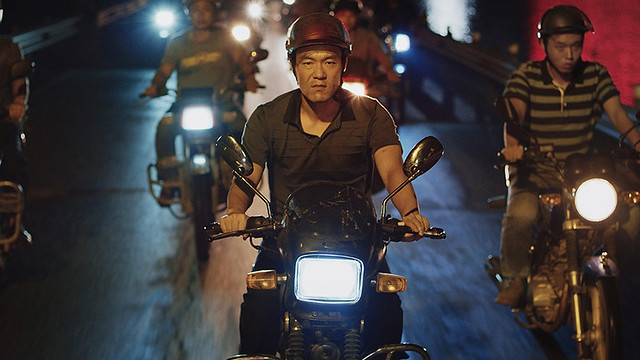
It starts out with a large gathering of motorbike stealing street gangs in the basement of a hotel. While divvying up the territories, a scuffle breaks out among rival gangs. When the dust is settled, a thin truce is made between the Crazy Cat Brothers and Zhou Zenong (Hu Ge). But unbeknownst Zhou's gang, the rising Crazy Cat Brothers made a deal behind the scenes to take over Zhou's territory, starting the same night. Zhou's gang gets attacked, and Zhou becomes a subject of a manhunt after he accidentally kills a cop while on the run.

Police Chief (Fan Liao of Ash is Purist White, Black Coal Thin Ice) organizes a large tactical unit near Wild Goose Lake to scour the erea and apprehend Zhou. Wearing civilian clothes, these cops are stationed in every nooks and crannies on the street, always watching every movement of extremely busy and crowded tourist town. But Zhou remains elusive. He gets help from Aiai (Kwei Lun-Mei), a 'bathing beauty'- a euphemism for lakeside prostitutes, who was sent by Zhou's gang. But now Zhou has large reward money on his head, he wants to turn himself in in custody of his estranged wife, Shujun (Regina Wan), so she can get the reward money. Things get messy of course, since everyone has his/her own agenda.

The police chief's relentless pursuit yields many close calls with Zhou. On motor bikes and on foot, its frenetic, large scale chase scenes in the squalid living quarters of densely populated suburban sprawl provide some of the most thrilling moments in the film. There are also some kinetic, almost cartoonish violences happening here and there: there's a sudden decapitation on a motorbike and one involving an umbrella. I laughed out loud at its Takashi Miike level inventiveness.

The film also showcases the changing China: from the emergence of middle class and its subculture - 'bathing beauties' with their wide brimmed straw hats, lessons in which motorbikes are more valuable and easier to steal, to the rigid police state with CCTV in every corner and sheer precision of its well trained tactical force in action. Attention to detail and controlled chaos Diao manages in the film is nothing short of astounding.

Wild Goose Lake is a good looking film to be sure and well acted, especially Hu Ge, with his soulful long-face and Kwei Lun-Mei as unlikely femme fatale. Yet it is not as taut as Black Coal Thin Ice. It sets up the motion nicely, but it doesn't have a momentum to follow through its 113 minute running time. Watch it for its beauty. Watch it for atmosphere. The film is still well worth the ticket.

Friday, September 28, 2018

Jia Zhangke's Ash is Purest White is an Epic Melodrama at Its Finest

Ash is Purest White (2018) - Jia
Screen Shot 2018-09-22 at 10.22.58 AM
An epic melodrama spanning 17 years, Jia Zhangke's new film, Ash is Purest White, harkens back to the Chinese auteur's earlier films. I say this not just because it mostly takes place in Shangxi province (the director's home province where he made 3 of his early films), but also because he abandons the episodic/omnibus storytelling of Touch of Sin and Mountains May Depart, two of his last films. Instead, he concentrates on a long and arduous relationship between Qiao (Zhao Tao, Jia's long time partner in crime) and Bin (Liao Fan of Black Coal Thin Ice). Ash can be seen as the compendium of 48-year-old auteur's filmography and its 144 minute running time can feel like a slog at certain points. But it's one of those films that gains strength and poignancy over time and certainly is the future classic in the making. It's definitely his most mature film to date.

The film starts in Datong, the nothernmost area of the director's home province Shangxi. The year is 2001. Qiao is seen in full frame video shot footage instructing dance moves in a dance hall. With her bangs and youthful looks, this footage might as well be from Unknown Pleasures (which came out in 2001). She enters the majong parlor, and it's in 1:85 aspect ratio (they used several different formats for varying degrees of success). She is the squeeze of a local low level mob Bin, who runs a majong parlor. It's a dangerous business and there are competing younger mob factions ready to take him and his men down when given an opportunity. Times are a changing.

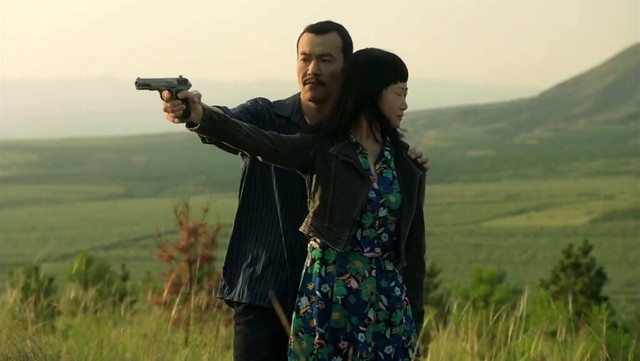
Bin brings Qiao to a field which saw volcanic activity thousands years ago, to teach her how to shoot a hand gun. It's an unregistered, illegal gun he acquired. The Chow Yun Fat-starring Hong Kong action movies had a bad influence on Bin and the rest of his generation. He mentions that the ashes from the volcanic eruption is the purest white, foreshadowing the rapid change in China, where anything old is demolished, buried or drowned for the new generation. A clean slate. A new beginning where no regrets, no tears, no sentimentality are allowed.

After a hit on Bin's crew sees him fatally attacked, Qiao fires the said illegal gun to save his life and is sent to jail for 5 years. Now it's 2006, and Qiao is out of jail and looking for Bin. He never visited her in jail and has moved to a town near Three Gorges dam. So this is where the road movie of Qiao starts: she meets various characters on the road/river with the rapidly changing nation in the background. The technology has changed appropriately, the fancy office buildings go up, all sorts of business ventures spring up. But people, the flood of people, trying to eke out the living with the changing times and circumstances, remain the same.

Bin, with a new girlfriend, refuses to see Qiao. Heart broken and with nowhere else to go but back to Datong, she almost agrees to go with a new venture capitalist whom she meets on the train, to the west. Decisions we make in our lives, good or bad, would lead to a different life than where we are right now. But how much can we deviate from our natural instincts, our traits, our character?

It's the New Year, 2018. Qiao finds Bin back in her life in Datong. He's had a stroke due to excessive drinking and is now a wheelchair bound. Qiao, who never married, silently takes care of him. He throws a fit sometimes, reliving his jianghu (underground gang) days in his head. She doesn't let him go off though. Is he ever going to change?

Ash is Purest White is a full-on (un)sentimental melodrama in epic scale. It's perhaps Jia's most down to earth, character study work. The long stretch in the middle gains more poignancy as the film goes along and afterwords. Some people reinvent themselves along with the changing times and some people don't. Some things in them though, remain the same. Jia expertly juxtaposes these conundrums, reflecting the soul of a changing nation. Ash is the Purest White is a deep and poignant masterpiece from a seasoned filmmaker.


Friday, December 19, 2014

Cold-Hearted

Black Coal, Thin Ice (2014) - Diao
 photo 7821ff77-9151-43a1-8e5d-da12957f5b63_zps881bfbf9.png
 photo dccf732f-d7b0-4511-8c43-9f8de113c177_zpseb94d9ff.png
 photo 1b43dd95-c238-496d-a7c3-193aac4b7a4c_zps1a7d3d2c.png
 photo 92ccb7e8-a220-47cb-8365-b25b5082c6f1_zps95649856.png
 photo 6a3ac60c-4a5b-4e24-8ed3-ed3fd8ebd10c_zps98e5150c.png
 photo 8dfeeffb-10f5-4e18-a306-3cc10d30b115_zps8d34f414.png
 photo d024f4e8-bb1f-4385-9de3-7a6758295ee2_zps17458172.png
 photo d706a35d-cee1-49f5-be10-32b48d0db000_zps08b8b24e.png
 photo f6f383cc-d814-4c0f-ac24-f17d3395bd77_zpsc1cfec13.png
 photo c2fe555f-f6c3-4b50-b1ef-4ba5ac8cc797_zpsac51ab18.png
Black Coal, Thin Ice is a strong, gritty policier that pulls you right in. It features one of the coldest movie protagonists, even in noir standards. The year is 1999. Liao Fan plays 'stached police officer Zhang, whose wife is filing for divorce. He gets injured while investigating what seemes to be serial killings- body parts found in various coal processing plants all over. Then five years go by in a brilliant transition shot. Zhang, now a drunkard, works as a security guard for some factory. Again, body parts are found scattered and it rekindles Zhang's interests in the case and springs him up to investigate on his own. There is a mousy woman (Gwei Lun Mei) working at a laundromat who holds the key to all the murders. As he gets close to the woman, he finds out that her husband, presumed dead as one of the victims from 1999, is still alive and might have faked his death (DNA testing wasn't available back then). Zhang coerces her to give him up. He is just very good at what he does. He is not brutish and doesn't necessarily use violence. But his heart is colder than Nothern China in winter. His environs - grim, cold, joyless and perverted, reflect his character.

The film's almost theatrical lighting scheme (yellow, green, red and purple) doesn't give the film any warmth or slickness, rather it accentuates Zhang's hollow existence. Only in the dance sequence he lends any kind of emotion for the audience. The greatness of this sad/funny dance number is about the same as Denis Lavant's in the ending sequence of Beau Travail. Diao's China, the Beijing Olympics still 4 years away, is still very much provincial ("Who brought in a horse in my apartment?"), yet fast changing and cold-hearted. More dynamic than Lou Ye's Mystery or Jia's Touch of Sin, Black Coal, Thin Ice announces the arrival of another major auteur in Chinese cinema. I gotta track down Diao Yinan's two other films ASAP.