Showing posts with label Sandra Hüller. Show all posts

Sunday, October 4, 2026

Unrealized Utopia

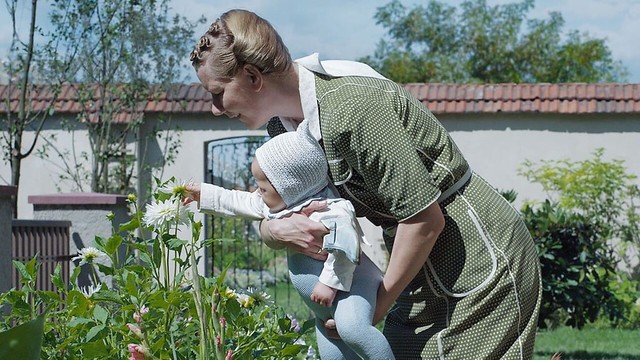
Fatherland (2026) - Pawlikowski 1949 Thomas Mann, a Nobel Laureate (Death in Venice, Magic Mountain) and staunchly anti-fascist, reflected famously on the split German soul in a wartime broadcast, articulating the collective tragedy and responsibility of the German cultural conscience in 1945.

Pawel Pawlikowski sketches out Mann's historic return to divided Germany in 1949, after having fled Hitler's Nazism in 1933. Mann (played by veteran German actor Hanns Zischler), accompanied by his daughter/assistant Erika (Sandra Hüller), reluctantly comes back to Allied-occupied Germany, to receive a Goethe prize in literature, first in Frankfurt, then in USSR-occupied Weimar on a road trip, in Fatherland.

We first see Klaus (August Diehl, Inglorious Bastards, Hidden Life), a troubled son of Thomas, and Erika talking on the phone, discussing whether he would join their famous father for the occasion. Klaus, like Erika, an anti-fascist activist, and an author in his own right (Mephisto), is not sure; like both Thomas and Erika, Klaus swore off setting foot on Germany ever again after Hitler's takeover. But Erika tells him that she hopes to see him again. 'It's always been me and you against the world,' he says with a hint of bitterness.

Thomas and Erika find themselves surrounded by not only admirers who see Mann as the guiding light and voice of reason in New Germany, but also by old fascists who were collaborators of Hitler's regime, and are still very much in charge. The father/daughter Mann team spares no one when it comes to old Nazi guards asking favors, in front of everyone. 'The future faces of Germany,' Erika tells Thomas with much disdain. A reporter asks what Mann thinks is better for Germany, the capitalist American side or the collectivism of the communist USSR side. Mann replies that perhaps the combination of both sides would be better for Germany's future.

The news of Klaus' drug overdose death comes as a shock while still in Frankfurt. Visibly shaken, Erika doubts if the road trip to Weimar should be continued. But Thomas assures her that all the arrangements are made and taken care of by Michael, Erika and Klaus's younger brother, so they can continue their journey to Weimar.

In the usual Pawlikowski fashion, clocking in at 82 minutes, Fatherland is a taut, compact film, with brisk pacing and economical editing, with not much fat in the simple narrative storytelling. Yet with its full frame, crisp monochrome cinematography, which favors lots of headroom and ceiling spaces, the images imbue much more weighted meaning.

Klaus's death might as well have to do with his homosexuality and communist leanings living in exile, where his tendencies were not welcome. In fact, all of Mann's children lived in exile, first in California, then some ended up in Switzerland, including Thomas. They were all brought up anti-fascist and led a bohemian lifestyle - we see Erika openly flirting with a femaie AP reporter in the beginning of the film. And none of them came back to Germany to live out their remaining lives.

Watching Fatherland made me realize the origins of the main theme of the recent movement of German cinema, known as Berlin School. Filmmakers like Christian Petzold, Angela Schanelec and Ulrich Köhler, grapple with the unrealized utopia of unified Germany. In their films, the yearning for what could have been, but never materialized, haunts their characters' every move. And I realize they owe it all to Thomas Mann.

Mann, whose idea of Germany's future (and all of Europe by extension, which was cruelly divided by Cold War for the next 40 years) is made clear when he visits Weimar and is welcomed by Johannes (David Striesow), a propagandist for the USSR-occupied East Germany, as he refused to be the cultural minister, even though the title would be in name only and he doesn't have to do anything. For him, neither rampant capitalism and opulance of the West (safeguarded by nazis) nor Soviet led communism of the East are the answers for the future of Germany.

An emotional confrontation with Erika erupts, as she accuses her father of engaging in self-centered aggrandizement of his fame while his son has only recently died.

When the quiet ending rolls around, Pawlikowski presents a beautiful and moving moment with the father and daughter, both without a country, sitting together in a pew, contemplating the uncertain future of the country they love, in a bombed-out church where organ repairmen are playing Bach.

Fatherland is a film with hefty subject, conveyed with visual grace and succinct editing, with beautiful, subtle performances by both Zischler and Hüller.

Saturday, September 26, 2026

Rose by Any Other Name

Rose (2026) - Schleinzer Rose_NYFF64_01 Rose is a candid presentation of a woman's place in society in the 17th century Europe. Avoiding the pitfalls of period dramas with the similar subject matter, where things often get overly melodramatic and didactic, Markus Schleinzer opts for more matter-of-fact approach, depicting harsh prospecting lives of the pastoral Europe after the 30 Year War.

Sandra Hüller plays a mysterious disfigured war veteran returning to a rural village to claim a long neglected farmland. No one remembers the descendants of the property and it's in such disrepair, they don't make much of the stranger taking over the land. It turns out 'the soldier' is a woman and has been pretending to be a man all her life, for the freedom it grants in the world at the time. The soldier, with his bravery- defending other members of the community from a vicious bear attack, and deligent work ethics, gains the trust of the village still steeped in rigid Protestant beliefs and patriarchy, where siring an heir means more than anything. To expand the farmstead and to gain access to the neigbhoring creek, Rose agrees to marry Suzanna, a neighbor's daughter.

Under the pretense of 'protecting the purity', the couple don't consummate their usual marital duties and concentrate on the daily, back breaking work. They acquire some servants to help out at the stead. Things get touchy when the sexual needs are not met and the pressure to have an offspring gets dire. And by some miracle, Suzanna is pregnant and the family affords peace and tranquility for a while. But when Rose is stung by bees while doing a bee keeping duty and faints, her secret gets revealed.

Markus Schleinzer presents a story of a woman pretending to be a man, during the time when religious and societal restrictions for women were tantamount, with direct, clear eyed vision of a woman trying to find her place in the man’s world and yearning to be free. Thankfully Schleinzer spares us the depiction of unnecessary graphic violence and torture. A crisp monochrome image by Austrian cinematographer Gerald Kerkletz (Walden), often lit by candlelights, adds to the serene and somber mood of the film.

But the star of the film is, of course, Hüller. Time and time again, Hüller shows how multifaceted, gifted an actress she really is. In a role with make-up (a nasty scar from gunshot wound) that covers half of her face, she still manages to communicate the range of subtle emotions of a person living with a big secret and even bigger, untold backstory. Caro Braun, who plays Suzanna is also great starting out as a naive young woman who is married off by her father without a single consideration, then later becomes a confidante of Rose and co-conspirator in pursuing their freedom together.

As two women get found out their secret and an angry village mop gathers for a big confrontation, Rose gives a passionate plea, of what matters the most - a good, contributing member of the community and a great neighbor and friend, or a person who just has manhood between his legs? As the tragic ending rolls around, Rose becomes Renée Falconetti from Dreyer’s Passion of Joan of Arc, complete with the straw weaved throne on her head.

Quietly devastating and deeply moving, Rose presents the hypocrisy of its time and unforgiving nature of rigid patriarchal society without ever being too sentimental or preachy.

Monday, October 2, 2023

Dissection of a Marriage

Anatomie d'une chute (2023) - Triet anatomy-of-a-fall-duo A fallen death of a husband in a troubled marriage in a small town in French Alpes and a following indictment and trial of his foreign wife is what constitutes Justine Triet's Palme d'Or winning courtroom drama. It's a modern marriage maginified under a microscope, revealing the nitty-gritty life of a young couple as their power dynamic plays out in the courtroom for all to see.

Triet, with only 3 feature films under her belt, all of them comedies, shows her tight handling of a material (co-written with her partner Arthur Harari). But the real star here is Sandra Hüller (Toni Erdmann), a German actress whom Triet collaborated in her previous feature, Sybil. With the film's natural dialog and believable setup, Hüller manages to build a sympathetic character, a successful writer, a foreigner, a mom to a blind boy, trapped in a mountain town with a husband who has an inferiority complex.

At first, the police rules his fall from the attic window as a suicide. There were no witnesses. But there were some forensic evidence casting enough doubt that it might have been a murder. Sandra (Hüller) gets indicted and the case goes to trial. With her lawyer Renzi (Swann Arlaud) who was a college friend who was in love with her, Sandra defends herself from a vicious procecuter who accuses her of ill-tempered and violent woman who couldn't stand her loser husband.

As the trial plays out, it's revealing that there's prejudice against Sandra, a foreign woman, in a place where her husband grew up and had community. The film becomes less of a murder mystery but a procecution of a woman in the eyes of judging public. The unrelenting media blitz surrounding the trial and everyone painting her as an unfaithful harlot who blamed her husband for his own shortcomings.

Anatomie d'une chute paints a complex picture of a marriage where no one particular party is to blame. It's people's pre-ordered hate that makes one party more at fault and not the others. The real life isn't that black and white, especially when children are involved. Even the court decisions in family court can't ever paint the complete picture. Triet is very good at showing these nuiances and balancing all the points. The reenactment of the couple's violent argument recorded by the deceased as a material for his book, Triet skillfully cuts away to the courtroom, leaving us to guess who's throwing glasses and who's hitting who. Moral muck, guilt, ambiguity are bread and butter of every day life. Their son Daniel grows increasingly uncomfortable around Sandra as she tries to shield him from all the ugliness of the grownups - the money problems, dad's depression and taking anti-depressants, her own infidelity, etc. But he ends up becoming a pivotal witness to testify.

Well tuned and balanced, Anatomie d'une chute is a revealing film about this day and age where patriarchy and everyday sexism is slowly losing its grip on our society (or lets hope). Sandra Hüller again, is fast becoming the heroine we need in this social climate. Also, Triet, as with Sybil, examines the nature of art and literature- the art immitating life, plagiarism and even autofiction in a very captivating way.

Sunday, October 1, 2023

The Zone of Unsubtlety

The Zone of Interest (2023) - Glazer The Zone of Interest The film starts with a family, a father fishing in the creek with his children. It's peaceful and there's nothing that suggests that he is an SS commandant in charge of operations at the Auschwitz concentration camp. Maybe not nothing, since he has the buzzcut that is most severe as far as cinema memories go, he has to be a nazi. It turns out Rudolf Höss (Christian Friedel of Amour Fou, White Ribbon, Babylon Berlin) is indeed a commandant of the Auschwitz concentration camp. He and his wife Hedwig (Sandra Hüller) and his Aryan children live in a brick and mortar house with a perfectly manicured vegetable and fruit garden, overlooking a barbed wire fence and a very active furnace of the camp. For Heddy, who hated city life, the place is a dream come true, more space, a garden, extensive supply of servants (from the camp), material goods (fur coats and jewelry, also collected from the camp), and fresh air(!) for the children. She touts proudly that she is known as the queen of Auschwitz in her social circle.

The Zone of Interest features great sound design and score. Low rumble of industrial machination (furnace) is always heard, so as frequent muffled screams and gunfires while they dine, sleep and play in the garden. Glazer doesn't let you forget that these banalities of evil are built on power and dominence, that they are not naive people shielded from what's going on just over the fence. They were consciously aware of what they were doing the whole time.

There are some striking sequences, like Höss hurriedly getting his children out of water when a sudden flow of ashes and bones flashfloods the creek they were frolicking in. The swanky garden party features active furnace spewing human ashes in the background just over the fence. And cutting between the past and present days at the end is also very powerful. But as a feature length film, the premise already has overstayed its welcome within thirty minutes of the film.

The miscalculation of the filmmaker here is that obvious visual metaphor doesn't quite work in a serious feature film, especially one about the holocaust. The point Glazer is making, the characters' willful blindness and absurdity and evilness of it, serves much better in shorts. I kept thinking of one of Roy Andersson's masterful absurdist short skits where he balances humor and tragedy perfectly.

The Zone of Interest is an obvious misfire from Glazer. Maybe his craftmanship is more suited for shorts and music videos after all.

Wednesday, December 21, 2016

Interview: Maren Ade, Sandra Hüller and Peter Simonischek on Making Toni Erdmann

MV5BYWJlYmZkYjQtYTNhZi00MTdlLThjZTUtMTM0ZDc2MTAxZmQ2XkEyXkFqcGdeQXVyNDkzNTM2ODg@._V1_SX1777_CR0,0,1777,999_AL_
Toni Erdmann, a German dramedy about father-daughter relationship that won rave reviews at Cannes this year is coming out in theaters on Christmas day here in the States. This exceptionally written and acted film is director Maren Ade's third feature. It's a perfect holiday movie, packed with full of surprises and uproariously funny moments. I've never had a this much fun at the movies in a long time. It is definitely my favorite film of the year.

I had a pleasure of talking to three principals from the film- writer/director Maren Ade (Everyone Else), Actress Sandra Hüller (Requiem) and Peter Simonischek (October, November) when they were in town for New York Film Fest this October. They were a raucous team- speaking over one another and finishing each other's sentences. There lively demeanor, comradery and bad jokes filled the cold hotel room in Upper Eastside with laughter and joy.


My first question is for Maren. It’s been quite a while since your last film. Everyone Else/Alle Anderen came out in 2008. How come it took a long time for you to do another film?

Maren Ade: I didn’t spent all of the time doing Toni Erdmann, but let’s say about 5 years or so. It took a while to write it and to research it. It’s also pretty long. And I became a mother and had two children in between. I know it’s actually it’s not a good excuse. (laughs) 


But I really worked a lot for this. It’s just a film that had so many different topics…for me it was a big luxury because I never had to leave a certain phase of happiness doing it. I mean, only thing that would bother me sometimes is that it’s ‘always the same thing’ over and over. It takes time to shoot and edit and do all these different things but at the end, preparing for Cannes, I couldn’t even look at it anymore.

How long was the process for you guys?

Sandra Hüller: About a year.


Peter Simonischek: Yeah about a year, maybe a little longer.

MA: Yeah we started casting in May and we started shooting in June the next year.

It’s funny because from my limited knowledge of both of your work, you’ve done some serious stuff. I’ve seen October, November with you Peter and of course, Requiem with you Sandra. So it was a complete surprise for me to see you in very comedic performances.


PS: I’m more of a theater actor. I don’t have an impressive film career per se. I didn’t do horrible, shitty things--

(Sandra and Maren start to laugh)

But I did things like TV series 20 years ago. The thing is, there are not many opportunities - there are not many good roles or directors…and everything must fit. In a small country like Austria, there are not many opportunities…

MA: But you did comedies in theater, no?

PS: Yes. 


SH: He is much more familiar to comedy than I am.

PS: Yes, I did a lot of comedies too. When I went in to theater fifty years ago, I never thought of doing TV or film, I just wanted to go on stage. Maybe I did 5 or 6 good films but the rest is middle measure. Maybe two or three bad ones.

How was the casting process? How did you end up with these two?


MA: It’s a father-daughter dynamics and I believe in casting very much also. I obviously only invite actors who are good first. But often it’s very important how the constellation is, even when two people are just seating next to each other, a story comes in your mind. So sometimes it's really about suitability. Sandra and Peter were the last combination I tried but I knew right away that I would cast. They had different partners before. I was very excited to bring them together. Actually even before you two met, I thought it would be a good constellation.

SH: That’s not what she told me. It took like 3 or 4 weeks.

MA: No.

SH: Yeah yeah, you took a lot of time to decide.

MA: No it was not that long.

SH: Ah ok.

MA: I swear to you it wasn’t more than 3 to 4 days

SH: Let’s not fight.

MA: Ok. Between the first casting and the next one it took some time but--

SH: But not after we got on board--

MA: yeah.

What did you guys first think about the script when you guys first read it?

PS: After I read it, I said, "my god what’s this?"

(everyone laughs)

I thought jeez, this is wonderful and so crazy and so great. It’s so extravagant and out of the ordinary. I was very curious who the writer was. I am at this big theater and others had read the script and then they called me. Everyone was like, “Did you read this?” “Oh god it’s great, let’s do this!”

Everyone who read the script was elec-- how do you say it? Electrified? So I took the invitation for the casting. It’s not usual for my generation of actors doing auditions like that like everyone else because of our age and so on but it was never a problem for me. I had some bad experience in theater working over agreement without auditioning. Horrible. I’ll never do that again.

SH: We also needed to find out whether we could work together.

MA: Yeah that was very important.

SH: Also because it was such a long shoot (3 month) for a German film.


MA: It’s not always clear that two actors who can get along together and what kind of performance can they get out of each other. I mean--

PS: It was the very very first lucky experience for me. You (Maren) and you (Sandra). It was absolutely fantastic. It would’ve been very very sad after the first casting together and then if you said to me ,”I’m sorry Peter but it won’t work”. I was very disciplined with my emotions and said to myself, “she will tell me, maybe or not.”

How about you sandra?

SH: Well… no I wanted to work with Maren for few years. I did an audition for the last film she did but I didn’t get it. But I really wanted to work with her. When I read Toni, I knew it was a good script and really enjoyed it but thought I couldn’t do it. it was too complicated and the whole business world was so strange to me. But then we had a conversation and we started the casting process and then I learned some things about Ines that was really interesting to me. It was a big challenge to shoot such a long time and I was doing theater and I had a child who was three at the time and I know you said it was an excuse but--

MA: I know!

SH: It was a really difficult situation in my private life. So I wasn’t really sure but we found out that we worked very well together and we’d probably have a good time together for three months.

Ines is a very cold and business like. And the things she talks about in business jargons I didn’t really get. Was there a lot of research involved?

SH: Maren did a lot of research. I knew nothing of that world. I’d find it interesting to meet those people of my generation who’d do these things. In the beginning, I’d create a map like you’d do in school with the CEO on top, like a tree. I was never interested in that world before. Now I think I can read the economy section of the newspaper.

(Peter claps loudly, another laughter from everyone)

It was important for me that the film really spends some time in the work environment because it was so important to Ines which is basically her life. We all spend our lifetime with our work and in films it’s often so reduced. Usually it’s boring and hard to find a story there. So it took us a while to find a project I can take over from a consultant that we met and we transformed it to fit the story better. It was necessary for me to have an example that really existed.

Was it difficult for you to play that part of Ines?

SH: Yes it was because it was really far away from my own experiences. You can attach yourself to a character in an emotional way. But almost in every scene she makes decisions that I wouldn’t have made. I’m much more sentimental than she is. I had to learn how to skip some of the impulses I have in the first place. But I liked that. I learned a lot from her. Sometimes it’s best not to do what you feel like to do and sometimes it’s better.

Yeah, I had to read a lot and had to watch some movies about this kind of business. Really. there are some really nice documentaries, like Work Hard Play Hard and stuff, where you can see the same kind of body language that they all have that doesn’t say anything about their personal lives. It’s really crazy but also interesting to find out.

It was interesting to me. For me, the movie is about people putting on some sort of a mask to function in the society: Ines has a very cold façade because she has to present herself like that in that environment in order to survive and Winfried is confronting her with another façade which is snaggle toothed Toni. Because she has a role that she needs to play and it’s not natural, so the father is putting on the mask himself to kind of offset that.

It is interesting that there is also a generational gap that’s going on, not only the German society but in general, that there is a rift between the hard working, go getter type of Ines’s generation and kind of happy go lucky of Winfried generation. I am wondering if that was intentional take on your part?

MA: For me he is a typical post war generation who was very political and who was fighting a lot for human values and raise their children with that in mind. They had a kind of hostile relationship with the generation before them. They believed in the free world, world without borders and also economy without borders. And now it ended up with globalization where rich is really rich and poor's really poor. But he lost Ines to that world that he preached. She has all those values that her dad taught her but she is using it in a different way in her business world. She is independent, she is determined but still curious about other things if she’s given a chance.

For me it was the feeling that I have that in my generation that things became so complicated, we don't know who to blame, who’s responsible and for what. It’s complicated to tell who’s a friend and who’s an enemy- there are so many angles on everything.

It's like the father stands for the system of values that is almost like an island that is slowly sinking. We are not allowed to see things like that anymore. It was much simpler back then.

I don’t want to give an answer to the question. It’s just something I felt when I was writing and reflecting on my thoughts.

It’s not like the father is teaching her how to live but it’s more like father reminding her what’s already inside her - that the fun part is already inside her. I thought the turning point for Ines to show her funny side is not in the Whitney Houston scene (even though that is a fantastic scene) but even way before that when she is having sex with her lover. That her father brought out something in her with the unfortunate pastry incident.

SH: 'The Pastry Incident'. I’m gonna write that down!

I never saw it as teaching. I’m still too close to Ines, I don’t know. But they are fighting with each other actually. It was a challenge for both of them. When they are sitting in the kitchen in the beginning of the film, she asks him, “What are you gonna do with your life, except playing with whoopie cushions?" or whatever. So it was an invitation for him to think about what he wants to do with the rest of his retired life. And he comes up with this character and he can do anything, like a superhero. I don’t know. So It’s not that she is only learning from him. I think it’s both ways.

MA: I think it’s also got to do with deciding what is happening by accident and what is on purpose. His purpose was to be close to his daughter. He was at a dead end and he didn’t know how to communicate with her. So if you had asked Winfried- this is always a question that I ask myself, if I could really get an answer from the character, He would’ve said, “Yeah I didn't know. I just went in the bar and I thought we maybe could talk again and she comes in the limosine and we’ll have some fun with my Ines and that's how it would end.

PS: "The flight was cheap."

MA: "The flight was cheap. I missed the flight back!!" (laughs)

He is also giving that answer at the end. He doesn’t believe in what he did before. He doesn’t even know what he gave her. He doesn’t even understand what the outcome of that naked party was. I mean he still has the feeling that he owes her an answer to that.

Was it difficult for you to play basically two characters?

PS: It was one gig to play two.

MA: Actually you play a bad actor. And that’s a good thing. That's some thing you said during the production that you are playing one character.

PS: Sure. One person. Winfried. He disguise himself as Toni to be funny and risky. It is a very courageous thing to do for a person who is not an actor. Not bad. But not only in the shop where nobody knows him but he acts in front of colleagues of Ines and also in front of her boss. Not bad. "But this is not your daughter." Pfffw.

MA: It was really interesting to direct that because it’s forcusing on what good acting is - is it not real enough or good enough or bad enough, or good-bad acting, you know?

SH: It must’ve been really tough for Peter because if you look at his personal journey- he is Elvis and…everybody else all at the same time. Winfried wasn’t really allowed to do that.

PH: There were a lot of possibilities for sure.

MA: We did go, some times, the full way, really going overboard. And then we would pull back.

I see.


PS: Shopping center (starts to laugh to himself, shaking his head)

MA/SH: Yeah.

SH: In there Peter played very American version of Toni. The Texas version.

(They all laugh)

PS: You see, really, it was a lot of fun.

Why Romania?


MA: Why Romania?

Yeah, why Romania? And did you guys enjoy shooting there?

MA: Umm, yeah it was very nice place and we had very good team there. It suited to the story because there are a lot of multinational companies in Romania. After the end of communism, there was a big sellout and everyone was trying to get something out of the country. I was interested in this hierarchies of German companies in Romania.

**
I don’t want to make a comparison but there is a Romanian movie the is out playing at the festival as well. Bacalaureat/Graduation. I haven’t seen it yet but From what I hear movie also deals with father-daughter relationship.

MA: Yeah I want to see it.

If it was a Hollywood film, it would’ve ended when father and daughter embrace each other in the park.

SH: Yeah tell me how would that look like?

MA: who plays who?

Probably like, the late Robin Williams and I don’t know Kate Mara or someone like that. They would hug and that would be the end of the film. But this doesn’t end that way. It goes on. I found that interesting. Did you want to make a point that the life goes on, that it’s not a big life-changing, revelatory experience and everyone becomes happy and whatnot?

MA: I don’t believe so much in big transformations or 'you have to get over yourself' or something. I mean they are possible but not for a film. The time frame of the film is too small. You know what, this is such an obvious moment to put the credits. I did try it, just as a joke. I knew I would never end a movie like that but just to prove that it is really wrong, I did it. It was so stupid. It would been so disappointing because it’s simply not true.

SH: That’s what its about? It’s about hugging in the park in Bucharest?


MA: I also like that he is really struggling in the (Kukeri) coustume and she doesn’t see that. And he is alone. Because that’s not the end of the story. If it doesn’t end like that, in Hollywood films, they would meet 20 years later.

SH: They are all old and say to each other that they can share the secret then.

Toni Erdmann opens Christmas Day in New York and Los Angeles.


**Got a chance to see Christian Mungiu's Bacalaureat after this interview. It's another great film from Mungiu, sharply observing ordinary Romanians dealing with the country's monstrous bureaucratic system. But it's a very different film than Toni Erdmann. Although the film has a father-daughter relationship, their similarities remains on a very superficial level.

Thursday, October 6, 2016

Masks We Wear: Why Toni Erdman is the Best Film of the Year

Toni Erdmann (2016) - Ade
 photo 5e208ddf-77fd-4ca8-85c0-3e0b2e170d6e_zpsq5vuyxua.jpg
Hollywood would have made a terrible film out of the premise of Toni Erdmann- starring the late Robin Williams and Kate Mara perhaps as goofy clownish father trying to teach his uptight, humorless grownup daughter to not take life too seriously and enjoy the moment or something. He would die and there would be a funeral and it would be a tearjerker and Mara does something goofy and... the end. It would've been a comedy that is best described by its tagline, "It's the 'Take Your Father to Work' Day!"

Toni Erdmann, even with its 2 1/2hrs running time, like the practical joke prone father character's favorite word choice, "spontaneously", is full of surprises that makes you laugh at every turn. Winfried (Peter Simonischeck) and Ines (Sandra Hüller) are very real and their interaction funny and touching. But it's not daddy nostalgia type movie. It's the first film I've seen that takes the father daughter relationship between two adults: one person putting on a ridiculous persona to mirror another playing the role of icy queen in the corporate world. That's why birthday scene works so well. But Ines's unraveling, or loosening up a little comes in even earlier in another ridiculous scene involving a naughty pastries. Even in its most riotous moments, involving, ehm, Whitney Houston song, it's not nostalgia but making an ass out of yourself/letting your hair down once in a while. It goes the same way with the prolonged ending- grown ups don't change drastically. Letting your hair down once is not going to change your life. In this sense, Erdmann doesn't have a happy ending. Ade doesn't end her film in Where the Wild Things Are style. She is too smart and mature for that. But it's not a sad movie either. We live out lives hoping that we are making some kind of impact on people you expect the same from others on you. That is what we hope for anyway. Toni Erdmann deserves all the accolades. It's amazingly acted, best written film I've seen this year.