Showing posts with label mubi. Show all posts

Tuesday, August 30, 2022

American Family Portrait, Textured

The Cathedral (2021) - D'Ambrose The Cathedral Ricky D'Ambrose, a micro-budget indie filmmaker whose initial series of shorts gained acclaim on the international festival circuit -- including Berlinale and New Directors/New Films -- made his feature-length film debut with Notes on an Appearance in 2017.

The Cathedral, his astute, semi-autobiographical follow up, premiered at Venice last year, then screened at Sundance earlier this year. The film paints a picture of an American family and its two decades of slow dissolution, with the culturally and politically volatile climate of the 80s and 90s in the U.S. as a backdrop, observed through the eyes of young Jesse Damrosch. It showcases the same minimalistic approach to filmmaking that D'Ambrose embraced while making shorts over the years: static shots, slow zoom-ins, and fragmented images, consisting of stills, old TV commercials, and archival news footage, with "narration" provided by voice-overs and diegetic sound.

Jesse Damrosch recounts how his parents, Richard (Brian d'Arcy James) and Lydia (Monica Barbaro), met, and then dramatizes how their uneasy union unraveled over time, partly due to Richard's volatile relationship with Lydia's family, the Orkin's. Their story is just like many other middle-class, suburban American families: money problems, death in the family, resentment and gossip, the divorce of one's parents and growing apart. We see birthday celebrations, the communion, funerals, family dynamics -- stepparents and extended families bickering over taking care of aging parents, and so forth -- all dryly narrated by an anonymous female voice.

The film also comments on changing times. Richard inherits a printing business from his dad, then struggling with the emergence of digital technology.

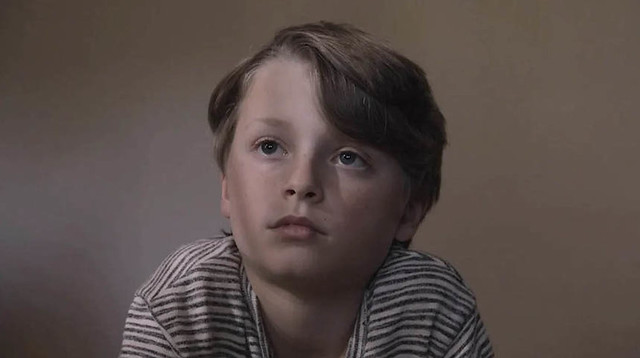
Time swiftly passes, jumping from the Reagan through the Clinton and Bush eras, covering the AIDS crisis, scandals, natural and man-made disasters, wars, and terrorism, all witnessed and heard by Jesse, a clear-eyed chap who's often seen staring yonder in various ages. D'Ambrose omits most of his own personal experiences. So there are no scenes of teenage rebellion, no mention of any friends, no love interests, no time of joy or disappointments.

In a way, the film is both autobiographical and not at the same time. It's like he is at the center of it all but also the fly on the wall. It acknowledges the political and cultural climate D'Ambrose (and by proxy, Jesse) and his generation are subjected to, without any prejudice or judgment.

What we are left with, are lingering small details, like the patterns on old furniture upholstery or how the light hit on the parts of his father's apartment or the metal ticking sound of an old radiator.

D'Ambrose's economical aesthetics and sensibilities have a lot in common with contemporary indie filmmakers across the globe. I see resemblance in the works of Dan Sallitt, Matìas Piñeiros, Bas Devos, and Ramon and Silvan Zürcher. His use of interior spaces in his chamber pieces is very much reminiscent of Chantal Akerman's.

Yet, with his even-keeled observations and dense layering of world events mixing with his own childhood memories, The Cathedral feels very much universal and personal at the same time, as it plays out like an emotionally unencumbered version of Richard Linklater's Boyhood, akin to Terence Davies' work.

The Cathedral establishes D'Ambrose as one of the major American voices in indie cinema, in tune with other contemporary filmmakers in the global indie scene embracing minimalist aesthetics with a keen observational eye on the world we live in. I welcome it.

The films opens on September 2, 2022 for one week engagement at Film at Lincoln Center in New York, then begins streaming exclusively via Mubi.

Thursday, March 3, 2022

Life Restricted

Great Freedom (2021) - Meise GreatFreedom It's almost unthinkable now, in a free, democratic society that Paragraph 175, a provision of the German criminal law that criminalized homosexual act, existed more than a century and was only abolished in 1994. Austrian director Sebastian Meise tells the injustices done under such law and concentrates on a character with the camera firmly stationed behind the prison walls most of the time. Great Freedom again showcases the immense talent of its star Franz Rogowski, an actor best known for recent string of films by Christian Petzold - Transit, Undine, whose quiet demeanor and soulful stares communicate with the audience way better than wordy dialog. His portrayal of Hans, who frequents prison for just being who he is and living his life, once again proves that he is one the best working actors out there.

The film starts with surveillance camera footage of seedy men's bathroom where homosexual sex acts are taking place. Hans (Rogowski) is seen taking part in that footage. It is documented that German police engaged in surveillance program in public places to 'weed out' illegal activities in the SC and SC extensively. As Hans is arrested and thrown in jail and his casual self-deprecating exchange with the long term convict Viktor (Georg Friedrich) that this isn't the first time Hans was in prison. The year is 1968.

After trying to protect a young gay man in a prison yard fight, Hans is thrown into a solitary confinement. This also seems like a reoccurring theme. Meise uses these solitary confinement and release from it as a temporal jump points to the past and back, highlighting the longevity and persistence of Paragraph 175. Hans is seen being liberated from a concentration camp by Allied Forces only to be transferred to another prison to serve his remainder of his sentence for performing homosexual acts.

It's this prison where he meets Viktor for the first time. Viktor, a convicted murderer serving a long sentence and an innate homophobe, first acts violently at the news that his new bunkmate is a homosexual. But over time, his hostility and aggression softens and takes a younger, sensitive bunkmate under his arm. Being an amateur tattooist, he even offers to cover Hans's concentration camp numbers on his arm.

Hans can't help himself for falling in love with younger, vulnerable gay men being sent to prison. And they are always the target of prejudices and violence in a prison environment. Against Viktor's warning, Hans keep getting involved in fights while protecting his lovers and keeps getting thrown into an unbearable solitary confinement.

With the simple date titles, we go back and forth between three time periods. Over 3 decades, the law stays the same, Hans keeps coming back to prison. Meise puts a soft touch on these transitions rather than actor's physical transformations, accentuating that time passes differently from the inside the prison wall. The moon landing on TV doesn't have the same effect there as outside. The world keeps evolving, but the unjust, inhumane law is still prevalent. Rogowski's performance adapts to the passing of time, his silent expression and dancer trained body language showcases from nervousness to volatility to resignation.

Friedrich, a veteran German actor, is also fantastic as Viktor, serves as a witness to the injustice done to his fellow inmate and friend, while contemplating his misdeeds as a young man; his sad and weathered face reflecting our humanity.

As the talk of the reformation of the law, Hans finally gets a chance to be free. Would it be the last time he and Viktor will see each other?

Great Freedom beautifully illustrates about genuine human connection while examining the injustices done to generations of people who were persecuted just for being who they are. The film is also a great reminder, along with the recent films like Audrey Diwan's Happening, that the rights we have gained (fairly recently) are not to be taken for granted, especially the world is experiencing great fascistic conservative pushback from the right.

Great Freedom opens in New York on 3/4 and Los Angeles on 3/11. National rollout will follow. Please check Mubi website for rollout dates.