Showing posts with label Bertrand Bonello. Show all posts

Friday, October 6, 2023

Overhanging Dread

The Beast (2023) - Bonello la-bete-the-beast With arresting visuals and seductive filmmaking, Bonello has been chronicling our troubled 21st century like no other, with a string of films that are pretty, but not too pretty: House of Tolerance (sex workers rights), Nocturama (aimless angst of youth), Zombie Child (haunted by colonialism). and most recently Coma (Covid-19 lockdown). This time, Bonello is freely adapting Henry James's turn-of-the-century novella, The Beast of the Jungle, which tells of two would-be lovers forever beset by a sense of doom always hovering over them. It is a good parallel he is drawing with the state of things here and now.

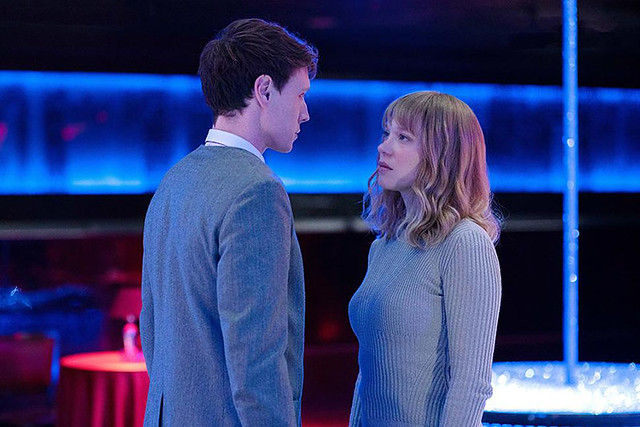
The dawn of the 20th century was an exciting time, both socially and politically. And the possibilities with the advancement in science and medicine were endless, at least for the citizens of the first world. But there was also volatility in every corner of the street. Violence, disease, extreme wealth and poverty and uncertainties everywhere. Bonello taps on that anxiety with The Beast, a beast of a film, with these hefty ideas swirling around and stylized to perfection, also greatly helped by mesmerizing performances by Léa Seydoux and George MacKay. This timeline-jumbled, massive film is set in three distinctive time periods (1904, 2014 and 2044); Bonello effortlessly shifts from one point to another.

We first see Gabrielle (Seydoux), an actor playing a scene against a greenscreen on a soundstage. The off-stage direction tells her she is supposed to be afraid of some monster that will be filled in later, with a close-up of her frightened eyes dotting side to side. The only prop she has is a small knife she takes up to protect herself. When the invisible monster appears, she shrieks, and we are presented with an ugly digital smear along with the title sequence. Then we jump into 1904, which plays out like a typical Victorian-era period film. In beautiful dresses and constant close-ups, Seydoux has never been more radiant as Gabrielle, a married, upper-class woman living in Paris with the thought of impending doom.

She meets a British man, Louis (MacKay), whose life is entwined across time with that of Gabrielle's. He hears her feelings of omen and swears to protect her from it when it happens. And it does happen when the city floods, making historical connections with the 'flood of the century of 1910,' which submerged Paris for weeks.

In 2044, it's AI that rules the world, and the humans will need to undergo a medical procedure to cleans their DNA of any generational trauma, in order to be more productive members of society. It's their emotions that hamper whatever work they do. Gabrielle has reservations about the procedure. Wouldn't it erase what makes her herself? Yet, she can't get quite get rid of the sense of doom she has had since she was a child. Bonello is suggesting that this angst is what makes us human. Something that we have to carry around all the time. The melancholy and pessimism are ingrained in us, considering the world is hurtling toward ecological disaster. and its speed and ferocity are only accelerating.

A doll is an recurring theme throughout. Gabrielle's husband is an owner of a doll factory. The production is in transition from porcelain to silicon to be current with the times. Louis asks if all dolls have their own expressions, and she demonstrates their neutral face by freezing herself with a blank expression for several minutes for our amusement. Indeed, you can't deny Seydoux's porcelain beauty in her close ups. It goes the same with MacKay's pale face, in his period costumes. The doll factory also provides some spectacularly beautiful sequences when it catches fire during the flood, and the would-be lovers are forced to escape by swimming underwater for the exit. Then there is Kelly, played by Guslagie Malanda from Saint Omer, a doll assigned to help Gabrielle to better acquaint with the AI-dominant future. Then there's a Chucky-inspired talking doll in the Los Angeles part of the film.

Now we are back in 2014, and the images are mostly shot with crude cellphone-video aesthetics. Gabrielle is an actress in LA, milling about taking auditions for modeling and acting jobs. Louis is now a 30-year-old incel spouting YouTube manifestos and planning to kill all the girls who rejected him. It's interesting that Bonello is connecting the bowed celibacy of Victorian era to the incels of the YouTube age here, perhaps making fun of the seriousness and self-importance in both eras. With an opulent LA glass house with security monitors, the cat and mouse game playing and replaying out, the film is definitely in Haneke's Funny Games territory.

This is the thing - the images and sequences in The Beast often reminds us of the best of cinema, culled from, namely, Haneke, Lynch and Resnais. Bonello is certainly aware of the facsimile of images or sequences or even feelings. Watching it, my thoughts immediately connected with the debate in the art community about AI's takeover amid rising authenticity and copyright issues.

Back to the future, just like Last Year at Marienbad, These two would-be lovers find each other across time, again and again. Humans go to time specific theme clubs to mingle in 2044. One day it's 1972, another day it's the 1980s, another day it's 1963, and so on, accompanied by great music from those decades, trapped in generational trauma and memories of past lives, helpless to their fate to never be together.

The Beast is perhaps the most ambitious, seductive film that Bonello has ever done, filled with ideas to the brim. It also features the career-best performance by Seydoux. It's my frontrunner for the best film of the year.

Friday, May 12, 2023

Gen-Ziety

Coma (2022) - Bonello Screen Shot 2023-05-12 at 1.31.16 PM Screen Shot 2023-05-12 at 1.43.39 PM Screen Shot 2023-05-12 at 1.44.45 PM Screen Shot 2023-05-12 at 1.59.28 PM Screen Shot 2023-05-12 at 2.01.13 PM Screen Shot 2023-05-12 at 3.40.38 PM Screen Shot 2023-05-12 at 3.39.38 PM We still don't know the full effects of the last two and a half years of Covid-19 pandemic as it plays out in front of our eyes. WHO declares it is over but who knows? Who do we trust anymore? The economic impacts, the long term mental and physical health concerns and all that, we just don't know. We didn't even have enough time to grieve for those we lost. Bertrand Bonello, perhaps one of the best chroniclers of our crazy hyper capitalist society after Olivier Assayas, comes up with the best Covid lockdown era movie yet with Coma, a slim, multi-media father-to-daughter straight talk. And it's great.

The film concentrates on a button-nosed teenager (Louise Labéque, from Bonello's Zombie Child), as she spends most of her time in her room during the lockdown alone. Most of the time, she is glued to her computer or phone. Her constant companion is an internet celebrity Patricia Coma (Julia Faure) who exudes certain authority as she dictates every aspect of her viewer's life during lockdown - cooking lessons, language lessons, daily advices, etc. Coma also sells Simon color pattern memory gizmo called the Revelator that our teen girl is addicted to. And for some reason, however elaborate its blinking buttons game gets, she always wins. It's because she subconsciously knows what comes up next, Coma says. It's the sign that no one has free will as everything is predetermined.

Then there are her Barbie dolls and the doll house that coming back to life in stop motion animation - it plays out like some daytime soap scenarios, repeating the lines of our teen girl's, or anything that's on the news, like Trump courting Kim Jung-un, obviously a manifestation of the girl's regurgitatating what she watches and hear.

It's only in dreams that the teen girl is free. Shot in day for night, the dream takes place in a dangerous and dark forest where everyone's face is smoothed over and constant screams are heard from nearby. She encounters and interacts with dead people in her life there in the forest, including a friend who just got killed, by some home invader, while talking in a google hangout.

Bonello also uses rightfully hallucinatory clips from Henry-Georges Clouzot's Inferno, also Deluze's television lecture where he (or rather the close-up of his mouth, somewhat menacingly and cynically) says he wishes us not to be in the dreams of others, especially in a teenage girl's because it will frighten us.

From 9/11 to Iraq War to major economic crisis in 2008, to global warming then now to the pandemic, the Generation Z has been through a lot in their short semi-adult life. With its crazy kaleidoscopic images and sounds, the short film is an amalgam of what the short-attention-span generation has been going through psychologically and emotionally during the lockdown. But more than anything, Coma is a compassionate love letter from Bonello to his daughter Anna who just turned 18, and to her generation. We do not know what the future will bring. He ends with spectacularly frightening images of natural diasters- giant ice shelf melting off, abalanches and volcanic eruptions- some anthropocene and some not, either cases we have no control over anyway. Coma is more like Bonello saying, "Sorry kids, but at least I understand what you are going through, but the sun rises again tomorrow."

Tuesday, October 1, 2019

Warning White Colonialists: Don't Mess with Voodoo

Zombi Child (2019) - Bonello
Zombi Child
Bertrand Bonello, a director of such sensual films as House of Pleasures, Saint Laurent and pointy, up to date social critique Nocturama, dabbles here in Zombie movie genre and turns it into cautionary tale in the post-colonial, multi-ethnic France.

It's an interesting investigation that is more in line with Jacques Tourneur's I Walk with a Zombie and Serpent and the Rainbow of Haitian voodoo than the current crop of zombie themed films and TV shows where chemical, nuclear or disease has been the cause of making the dead come alive and gorging human flesh.

The film cuts back and forth between 1962 and present day. The past portion of the film takes place in Haiti. A man named Clairvius Narcisse (Mackenson Bijou) is fallen into a voodoo spell by his brother and declared dead. A huge, elaborate funeral is performed where he is buried alive. Then he is dug up by zombie traders who put him in the field with other zombie-fied men to work in a sugar cane plantation as a sort of slave labor force. You see, zombies are just normal people, who has fallen into a spell (brought on by psychotropic powder that causes neuro-paralysis) who appears dead for a while, with their memories erased.

Fanny (Louis Labeque), is a student in an all-girl prep school in an idyllic woodsy setting. It's a very liberal school for only chosen few whose parents are deemed as important in French meritocracy. She is deeply in love with her boyfriend and writes letters to him everyday. Her reading those letters accompany the daily school activities as the girls take classes, play sports in a gym, and gossip. There is a new black girl Méllisa (Wislanda Louimat) and Fanny and her small, all white sorority want to have her as a member. Méllisa obliges to go through a test at night in the school's library. She is asked to reveal her most important secret. She says her aunt is a mambo, a voodoo priestess. Wow, that's cool. She is in.

Things take a drastic turn when Fanny receives devastating news from Pablo. He is breaking up with her. Suffering from a broken heart, she appears at the doorstep of Méllisa's aunt's house, asking to perform a voodoo magic. She wants to become Pablo or something like that. She will pay for the ritual.

Bonello, forever sensualist, presents some beautiful, lyrical shots of Narcisse the zombie standing erect motionlessly, looking afar in the fields, in ancient ruins. It is pretty evident that he takes much of the lyricism from I Walk with a Zombie.

Fanny's silly school girl story aside, Zombi Child digs deeper into hasty western appropriation of everything non-european, non-anglo American culture. It disregards the cultural, historical, ethnographical significance of the origins of a zombie in exchange for sensationalism. Narcisse’s journey back home is more interesting than Fanny’s story here.

Monday, December 26, 2016

Blowing off Steam

Nocturama (2016) - Bonello
la-rentree-tres-politique-du-cinema-francais-ok-thomas-r,M366202
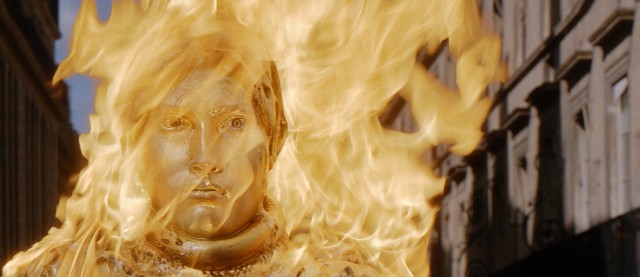
Breakfast Club meets Dawn of the Dead. Bonello's controversy seeking cinematic stunt is all looks and no substance. First half is unbelievably tense, almost silent film as a group of twenty-something Parisians orchestrate terror attacks and an assassination of political and economical targets (head of HSBC France, a big glass office building, Ministry of Interior and the gold statue of Jean d'Arc). After most of them successfully retreat to their meeting point - a large lux department store, things slow down significantly. As they have to hole up the night. A bit hesitant at first, then they try on brand name clothes and drink wine while dancing to bad rap and electronica while avoiding the news on the big screen TVs. Are they avoiding their inevitable doom or are they that clueless?

Adele Haenel makes a cameo, to deliver the line Nocturama is build upon, in the middle of the film as a girl on a bike in the middle of the night, as David, one of the babyfaced terrorist sneaks out of the department store out of boredom to smoke a cigarette, runs into her and talks to her. "It had to happen. And now it did."

In the wake of the Berlin terror attack and the assassination of Russian Ambassador in Turkey, Haenel's statement surely reflects the mood and tension of not just France but the whole European continent. It's the anger and frustrations being bottled up not only in immigrants but every single Parisians, Bonello tells us, as he fuzzes up these young people's motivations or directions. But then again, Nocturama is just an abashedly entertaining, slick moviemaking. I wish Bonello reflecting the mood and violence on the street in this movie is the extent of bottled up anger and blowing off steam are true and the extent of it. If only. But we all know that the world we are living in now is much darker and much more sinister place, unfortunately.

Friday, July 13, 2012

Intoxication

House of Tolerance/L'Apollonide: Souvenier de la maison close (2011) - Bonello
L'Apollonide
Bertrand Bonello's film opens in 'the twilight of 19th century' in a high class brothel (L'Apollonide). Sumptuously photographed with plenty of beautiful nude bodies, House of Tolerance dangerously meddles in soft-core porn territory. But as the it progresses in its hazy and unhurried elegance, you are totally sold on the glimpse into this dream world. The images are not really arousing but rather arresting. Except for one scene where girls enjoy their time off together on the lakeside picnic, the film solely takes place in the lavishing whorehouse. Even though they seek financial independence and freedom in a rigid society, they are bound to the place. They dream of getting out one day but everyone knows it's impossible. Some are hopelessly in love with their regular client and pay the ultimate price. These exquisite creatures include Algerian (Hafsia Herzi), Caca (Jasmine Trinca), Léa (Adele Haenel), The Jewess/Laughing Girl (Alice Barnole) and Julie (Céline Sallette). The aftermath of watching this hypnotic film is not unlike being intoxicated (the girls do consume a lot of champagne in the film). Whether the director is advocating to make prostitution legal (as it seems, with his use of modern music segue-ing into modern day finale), so making the world's oldest profession somewhat safer doesn't really interest me. I'm just worried that I will have a hangover from this tomorrow morning.