Showing posts with label Finland. Show all posts

Friday, January 19, 2024

Warm Bodies

Fallen Leaves (2023) - Kaurismaki Screen Shot 2024-01-19 at 3.45.23 PM Screen Shot 2024-01-19 at 12.08.29 PM Screen Shot 2024-01-19 at 12.15.43 PM Screen Shot 2024-01-19 at 12.37.38 PM Screen Shot 2024-01-19 at 12.54.18 PM Screen Shot 2024-01-19 at 3.49.23 PM Screen Shot 2024-01-19 at 12.50.27 PM Screen Shot 2024-01-19 at 1.00.47 PM Aki Kaurismaki's micro romance Fallen Leaves isn't revolutionary or anything, but it nevertheless succeeds in warming your heart. It concerns two lonely working class Helsinkians crossing paths and falling for each other in that driest, most deadpan Kaurismaki way possible. And as usual with his recent films (Le Havre and The Other Side of Hope), the state of the world (Russian invasion of Ukraine just began at the time the film was being made), is always on the airwaves reminding us how f'd up the world around us is.

Ansa (Alma Pöysti) is first seen stocking the shelves in a grocery store under the watchful eyes of a bulldog-like security guard. She sometimes takes expired food home and also gives away expired items to others. Her daily routine is pretty monotonous and uneventful. Holappa (Jussi Vatanen) is a construction worker who is constantly drinking at the job. He drinks because he is depressed. He is depressed because he drinks. They first exchange glances in a karaoke bar, accompanying their more sociable friends. But they are not talkative types. Then they meet again on the street. They go out for coffee, then to movies. They watch Jim Jarmusch's zombie comedy The Dead Don't Die. She gives him her phone number which he immediately loses. They lose their jobs for stealing and drinking. They go through one low wage menial jobs to another. After waiting at the movies, he meets her again and she invites him for dinner. This time he puts her address in his wallet. Dinner goes well. But losing many family members to alcohol, she can't allow someone with drinking problems in her life.

I'm glad Kaurismaki is getting a lot of accolades for this film, but Fallen Leaves is not too different from any other of his deadpan comedies. While his fellow deadpan comedy comrade Jarmusch is delving into zombie genre, Kaurismaki is making romance. While sad songs punctuate and homages to many great romantic films where two would be lovers are separated and need to find their ways to one another play out, the Finnish master makes room in our darkest times for us to smile, even for a short while.

Tuesday, January 11, 2022

Little Human Connections

Hytti nro 6 (2021) - Kuosmanen compartment 2 Compartment 1 compartment 6 compartment 3 compartment 4 Compartment 5 A Finnish student (Seidi Haarla) is traveling alone from Moscow to see the 10,000 year old petroglyphs in the Arctic north in Russia, after her Russian professor/lover, Irina backs out of the trip. Last night in Moscow gives and impression that Irina, the worldly older woman tightly wrapped our shy and awkward heroine around her fingers. She is taking a crowded Russian railroad all the way to Murmansk, a small town near the Finnish border. Her bunkmate happens to be Ljoha (Yuriy Borisov), a brusk, blue color worker heading to the same destination for work in the mines. It's a big change for our unnamed Heroine, after hanging out in Irina's intellectual circle of friends in her fabulous flat full of antiques, books, music, meaningful conversations and laughter. She has to quell the sexual advances and lewd jokes from Ljoha. She contemplates quitting the trip and go back to Bourgie bossoms of Irina, but the thought of appearing weak in front of her mentor/lover is too much to bear.

Even though they are very different, this little Russian man’s presence slowly warms up to our heroine. A sort of traveling companion camaraderie develops in an impossibly small train compartment. The train stops overnight in a small town on the way to Murmansk, Ljoha invites her to his babushka (grandma? Aunt?)'s house. She experiences unexpected companionship and human warmth, sharing strong drinks and listening to the old woman's stories. They almost miss the train as they oversleep the next morning.

When our heroine helps out a fellow Finnish traveler who doesn't speak the language, by inviting him to their shared compartment 6, Ljoha is obviously unhappy and jealous. The hipster traveler with a guitar is everything Ljoha is not. She asks (in Finnish) the traveler if he ever feels lonely, and he says that everyone's alone.

Compartment No.6 has everything I love about cinema - Wanderlust, human connection, loneliness, trains, cold weather. Juho Kuosmanen, working from a novel by Rosa Liksom, finds a delicate balance in chiseling out beautiful moments of human connections without unnecessary backstories or dramatics. It's a little romance without all the fuss and stylings, but only warmth and silent understanding.

As the saying goes, it's the journey, not the destination. Our heroine gets stuck in the small town in a foreign land without any guide. It's winter and there is no one to take her to see the petroglyphs. She might have overestimated her relationship with Irina since she is not that helpful with her conundrum. It's only Ljoha who is crazy enough to arrange the snowy, supposedly dangerous trip without any hesitation. They climb on the wrecked ship in the blizzard after seeing not very impressive 10,000 year old scrawls on the rocks. They talk about Titanic. "Why? Are we about to die?" "No, Rose survives." "Well, she dies later." Yes everyone is alone and everyone dies. But what matters is the little moments of human connections and feeling the warmth of other human beings along the way and Compartment No. 6 captures them beautifully. Haarla and Borisov's guileless performances are also aces. Loved it.

Thursday, October 5, 2017

Syrian Refugee Crisis Aki Kaurismaki Style

The Other Side of Hope (2017) - Aki Kaurismaki
Screen Shot 2017-09-08 at 6.22.09 AM
I find it odd that no major filmmakers are tacking the Syrian refugee crisis. Estimated 5 million people fled the war torn country since 2012 and the number easily doubles when you add up internally displaced refugees. I find it doubly odd that it is Aki Kaurismaki, the Finnish master of deadpan comedy taking on the topical subject. First it was his French language film Le Havre, which dealt with immigration. With The Other Side of Hope, Kaurismaki lends a hand, with his light touch, on Aleppo, without sacrificing the seriousness of the situation. Surprisingly, the result is an affecting, optimistic look at human kindness and decency. It also turns out to be one of his finest films.

There are two strands of narrative at the start of the film. One about a Syrian refugee and the other, an aging, troubled traveling salesman figuring out his life. Somewhere their paths cross. Khaled (Sherwan Haji) is first seen emerging from the mountain of coal in a cargo ship docked at a Helsinki harbor. As he seeks an asylum as a Syrian refugee from Aleppo at a police station, the unsympathetic police puts him in a waiting facility to be processed. There he meets an Iraqi refugee who's been in Finland for a while and seems to know the way around. Khaled is desperately looking for his sister who was separated on their way out of Syria. He likes Finland and wants to get a job and settle down. But first, he needs to not get deported. His Iraqi friend gives him some pointers, "Don't look so glum. Be cheerful. They deport sad looking ones."

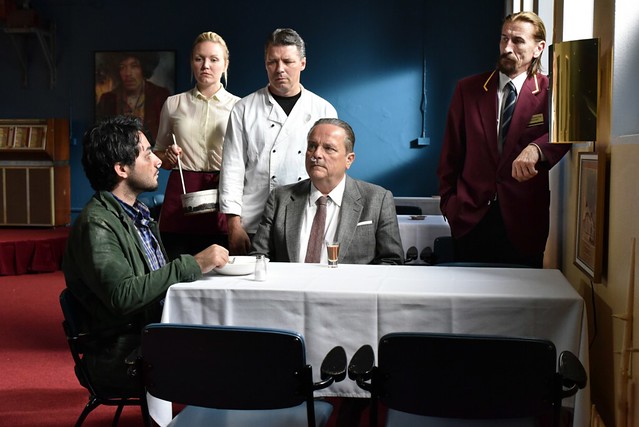
Wikstrom (Sakari Kuosmanen), a middle-aged traveling man's shirt salesman, walks out on his wife, and embarks on a restaurant business with the money he won at a gambling table. It's a little dumpy restaurant/bar called Golden Pint. The owner seems very eager to get out the dodge, and leaves three disgruntled employees behind- a doorman, a waitress and a cook for Wikstrom to deal with.

In the mean time, Khaled flees from the refugee facility after judge deems that his situation is not dire enough and decides to deport him back to Aleppo. Khaled gets into a fistfight with Wikstrom at a parking lot where he was sleeping. And Wikstrom decides to hire him for his restaurant.

There are many Kaurismaki comedic moments and sight gags throughout the film. His brand of minimalist comedy is truly unique.His cultural references are all mixed up and wrong- Kati Outinen, one of Kaurismaki's regular, plays Wikstrom's client who says "I'm going to Mexico and dance Hula Hula." and Golden Pint crudely changes to Sushi restaurants to attract more customers, serving a spoonful of wasabi on each sushi. When they run out of fish, they use salted herring. It is priceless to see the defeat on the crew's faces as the customers leave in droves.

Khaled is pursued by Finnish nazis with nationalist slogans on their jacket. Kaurismaki encapsulates them in one utterance near the end of the film, showing that nazis, in any country, are ignorant assholes and absolutely need to be eradicated.

Extremely silly and endlessly charming, The Other Side of Hope reminds us that the complicated world we are living in doesn't need to be complicated. Through the Kaurismakian glass, the world is filled with decent people and it remains a hopeful place as long as people help each other out.

The Other Side of Hope plays as part of NYFF 2017 at Film Society of Lincoln Center on 10/5 and 10/10. Please visit FSLC website for tickets and more information.

Sunday, June 17, 2012

Challenged Finnish Punk

The Punk Syndrome (2012) - Passi, Kärkkäinen
thepunksyndrome-1
Pertti, Toni, Kari and Sami can really put on a great show. They are the members of very popular punk group in Finland, Pertti Kurikan Nimipäivät (Pertti Kurikka's Name Day). As Kari sings in his guttural voice about the greatness of coffee, their shared disgust for pedicure, politicians and living in group homes, it's hard to resist but to rock out to their catchy tunes. But it's extra hard for these kick ass punk rockers to keep everything together, for they are mentally challenged. They have to, among other things, concentrate on not missing the cue to start playing, watch out for falling pants, try not to soil themselves on stage and remember  taking back their instruments after the show.

They all have very distinctive personalities, so they collide more often than not. Pertti is the composer and lyricist, guitarist and has a peculiar tendency to closely examine people's clothes (for seams). He knows how the babies are made. Emotionally volatile Kari is in love and wants to marry his long time girlfriend. Bossy Sami is deeply involved in politics and living in the same group home as Kari. They get on each other's nerves. Young Toni wants to move out of his parents' and vie for beautiful Liisa's affection in a group home. 

Punk Syndrome presents Pertti Kurikka's Name Day just as they are. Directors J-P Passi and Jukka Karrkkainen wisely decide not to jump in and explain things for us. It's a great slice of life doc about these strong personalities, as they struggle to keep it together everyday. We see their blemishes and shortcomings as well as their genuine love for the music and their all too humanness. Ironically, punk is a fitting music for these outsiders who wants to be accepted and loved. And they rock!


For tickets and more information, please check Silverdoc website.

Thursday, June 9, 2011

Splatter from The North Pole

Play God (2010) - Nikki
Photobucket
[Play God plays as part of DocPoint NYC, a program of 47 films hosted by its New York partners: The Museum of Modern Art (MoMA), Scandinavia House, 92YTribeca, UnionDocs and the Tribeca Film Institute, on June 10th at 7pm]

A successful Helsinki based commercial director, Teemu Nikki looks back on his failed attempt at making the first Finnish splatter movie, Play God. This 38 minute, behind-the-scene, inside look at filmmaking gone awry doc is sort of 'making of' featurette on a movie that never happened.


There have been quite a few documentaries in the past that highlighted the trials and tribulations of filmmaking. Burden of Dreams: Making of Fitzcarraldo and more recently Best Worst Movie: Making of Troll 2, immediately come to mind. Keith Fulton and Louis Pepe's Lost in La Mancha chronicled the disintegration of Terry Gilliam's Don Quixote. However entertaining that documentary was, it depressed a lot of burgeoning filmmakers including myself. I mean, what chance did we have if no one was willing to finance a Gilliam movie? The process of the making Play God documented here seems like a therapy for the director- to be rid of the omen that's been gnawing at him for several years. And he seems to have a sense of humor about the whole experience.


Growing up with the steady diet of splatter films on VHS, Nikki's foray into filmmaking is akin to that of many American indie filmmakers. Seeing homemade footage of Nikki and his Finnish compatriots making their own brand of splatter movies with their dad's video camera in their backyard reminded me of how universal the film geekdom is.


Play God, a shoot'em-up chop'em-up superhero movie in epic proportions (Sci-Fi backdrop, large number of extras, battle scenes and a chainsaw wielding Evil Santa) with an incomprehensible storyline and the puzzling English dialog, was all enthusiasm and not much else. Nikki's plan was simple: shoot the first 20 minutes of the film, show it to the possible investors who would then naturally be blown away by its brilliance and would dole out the money to make the rest of the film, then off to a successful career in Hollywood.


With extremely bad weather conditions (minus 40 Celsius degrees) and everything else going wrong, the production of the movie hit the wall from day one and never really got off the ground. The cast and crew, all Nikki's friends and family members, just as enthusiastic but all novices in filmmaking, faced some very treacherous working conditions. Without the script and direction to guide them while working hard for free, they slowly lost faith in Nikki. Then people started turning on each other. Yes, it can be frustrating when you're not able to cut Evil Santa in half with a chainsaw. But stop crying forgodssakes!


Interviewing various cast and crew members, Nikki faces some biting criticisms from his friends and family face to face. The movie didn't happen. The project was way too ambitious to pull off. And he blamed everyone but himself. Thankfully, the doc is also filled with plenty of awesome footage from Play God. There are definitely times in the film that you wonder whether it is a mocumentary or real. It is a playful, funny as hell and endearing documentary. And by the slick look of the trailer Nikki finally made, Play God could've been really an awesome splatter movie. I am hoping that Hollywood will take notice of now 'mature and competent' Teemu Nikki, and actually help him make Play God for real, starring, Mickey Rourke perhaps.


For tickets and more information please visit MoMA Presents: DocPoint