Showing posts with label Ukraine. Show all posts

Monday, May 18, 2026

Tower to Power

The Wizard of the Kremlin (2025) - Assayas Screen Shot 2026-05-17 at 7.58.01 AM Based on a fictional account by Giuliano Da Empoli, Olivier Assayas, the one of the most astute observers of our ever evolving, complex world, takes on Putin's Russia in recent history, with the star studded international cast. The result is perhaps short on the satisfying narrative, but a fascinating history lesson nonetheless.

The film starts with an American journalist, Rowland (Jeffrey Wright), visiting Vadim Baranov (Paul Dano), a former spin doctor of Putin living in isolation in the suburbs of Moscow. Baranov pulls out a yarn of the chaotic, exciting days after the dissolution of the Soviet Union. As a young man eager to prove himself, Baranov moves into the city filled with other young people, eager to take advantage of the anything-goes, wild-west of the Yeltsin era Russia. While others are busy making money and signaling the dawn of the future oligarchs, Baranov chooses art in avant-garde theater. There, he meets a punk performance artist Ksenia (Alicia Vikander) whom he would have a long off/on relationship with. His work in art leads him to TV and communications and works up the ladder and becomes a producer of a recently privatized national TV station, with the help of Berezovsky (Will Keen), a reigning spin doctor with political connections. The Chechen war was going badly and the Russian public was in need of change.

There's a funny bit about Yeltsin's sagging popularity and his alcoholism and in order to make him more 'presidential' on TV for his reelection, they have to tie him to the chair in order not have have him fall asleep at the desk and slow down the teleprompter speed.

Since Yeltzin is a goner, Berezovsky bets on a former KGB head, young & athletic Vladimir Putin (Jude Law) to be his successor. And this is where things get interesting. Putin, a disciplined former intelligence officer and spy, unlike other politicians in Russia, is not interested in money and wants to have no interference in government from newly minted oligarchs. And he hates the frivolity of TV and spins. Admirer of Stalin, he wants absolute power. While Ksenia moves from one billionaire to another, Baranov becomes a trusted counsel for Putin after his verticality of power speech, pushing his strongman image as what is needed in Russia.

Dano, in his puff dough face and forever smug, fits the role of Baranov, who observes the world with forever cynicism and insincerity. When asked about why he stayed so long by Putin's side, he admits that he is addicted to power. Law is scary as Putin, a one-track minded former intelligence officer and spy, who detests moneyed people and the west. Someone who wants to wield power in a geopolitical game in the new era.

Tom Sturridge shows up as Dimitri Sidorov, a flashy, hedonistic oligarch in the making, of whom Ksenia falls for.

There are tons of films about Russia's recent history, but Assayas makes a somewhat concise overview of how Putin's Russia came about. He juxtaposes the real threat of the strongman who does play by western capitalist standards. Baranov, who was fashioned after Vladislav Surkov, a spin doctor who served Putin in his aggressive pursuit of Crimea and then Ukraine. Obviously, these are villains. But aren't they as villainous as Europe and the US? As Rawland asks about the invasion of Ukraine and violence Baranov orchestrated, overseen by Putin, Baranov counters with all the villainy the West has been inflicting to the world at large. Aren't we as culpable as Putin - Venezuela, Cuba, Iraq and Iran?

Narratively The Wizard loses steam on the way to its fatalistic, unsatisfying ending. But again, Assayas accomplishes deciphering the complicated recent history and reflects on where we find ourselves, at this chaotic, morally ugly present.

Friday, January 19, 2024

Warm Bodies

Fallen Leaves (2023) - Kaurismaki Screen Shot 2024-01-19 at 3.45.23 PM Screen Shot 2024-01-19 at 12.08.29 PM Screen Shot 2024-01-19 at 12.15.43 PM Screen Shot 2024-01-19 at 12.37.38 PM Screen Shot 2024-01-19 at 12.54.18 PM Screen Shot 2024-01-19 at 3.49.23 PM Screen Shot 2024-01-19 at 12.50.27 PM Screen Shot 2024-01-19 at 1.00.47 PM Aki Kaurismaki's micro romance Fallen Leaves isn't revolutionary or anything, but it nevertheless succeeds in warming your heart. It concerns two lonely working class Helsinkians crossing paths and falling for each other in that driest, most deadpan Kaurismaki way possible. And as usual with his recent films (Le Havre and The Other Side of Hope), the state of the world (Russian invasion of Ukraine just began at the time the film was being made), is always on the airwaves reminding us how f'd up the world around us is.

Ansa (Alma Pöysti) is first seen stocking the shelves in a grocery store under the watchful eyes of a bulldog-like security guard. She sometimes takes expired food home and also gives away expired items to others. Her daily routine is pretty monotonous and uneventful. Holappa (Jussi Vatanen) is a construction worker who is constantly drinking at the job. He drinks because he is depressed. He is depressed because he drinks. They first exchange glances in a karaoke bar, accompanying their more sociable friends. But they are not talkative types. Then they meet again on the street. They go out for coffee, then to movies. They watch Jim Jarmusch's zombie comedy The Dead Don't Die. She gives him her phone number which he immediately loses. They lose their jobs for stealing and drinking. They go through one low wage menial jobs to another. After waiting at the movies, he meets her again and she invites him for dinner. This time he puts her address in his wallet. Dinner goes well. But losing many family members to alcohol, she can't allow someone with drinking problems in her life.

I'm glad Kaurismaki is getting a lot of accolades for this film, but Fallen Leaves is not too different from any other of his deadpan comedies. While his fellow deadpan comedy comrade Jarmusch is delving into zombie genre, Kaurismaki is making romance. While sad songs punctuate and homages to many great romantic films where two would be lovers are separated and need to find their ways to one another play out, the Finnish master makes room in our darkest times for us to smile, even for a short while.

Saturday, September 11, 2021

War Trauma in a Box

Reflection (2021) - Vasyanovych Screen Shot 2021-09-13 at 10.36.22 AM Call it a silver lining in the midst of unrelenting global pandemic, that we are blessed with not one but two Valentyn Vasyanovych's films this year. Atlantis, after winning Orizzonti (Best Film) at Berlinale 2019 and being included in the late edition of New Directors/New Films in 2020, the film saw a brief streaming release through New York's Metrograph early this year. With his new film Reflection, having a world Premiere at Venice just now, we get to witness the major new voice in the world cinema emerging. Mark my word: Vasyanovych is a real deal. He will be regarded as a new master with the release of his each new film in the future. His almost surrealist formalist approach to filmmaking is akin to the works of Swedish master Roy Andersson sans humor combined with the gravitas and emotional punch of Andrey Zvyagintsev. Reflection, a sort of companion piece to Atlantis, is a truly impactful and impressive filmmaking.

Just like Atlantis, Reflection is only composed of wide, static long takes - the camera only moves when necessary with no cutaways or coverage. There are about 27 shots all together in its two-hour running time. We do not see close ups of actors faces, unless they come closer to the camera. The depth and isolation of its characters, without many words uttered, are all told visually.

The film starts with an absurd scene: Serhiy (Roman Lutskyi), a surgeon, is meeting up with his ex-wife Olha (Nadiya Levchenko) and their teenage daughter Polina (Nika Myslytska) and Olha's new beau, Andriy (Andriy Rymaruk of Atlantis), a soldier, in what seems to be a large industrial indoor playpen. But Polina is suiting up in white HAZMAT suit before disappearing behind the giant glass window. It turns out that playpen is a large indoor paintball court. The teenagers in groups are shooting paintballs at each other while parents outside watch them while talking about the war in Donbas, the south-eastern Ukraine, as the glass window is slowly but surely adorned with bubblegum colored paintball shots. The year is 2014, at the start of the Russo-Ukrainian War.

The next scene is Serhiy in the hospital operating table tending to the badly wounded soldier coming from the front line. But it is too late. He bled out.

The film is divided in two: the war and its aftermath. Serhiy voluntarily joins the war effort, then being captured and tortured by Russian troops. Since he is a surgeon, deemed by Russians to be useful, he is spared and given an assisting role in checking and determining if the tortured Ukraine captives are dying or not. There he encounters Andriy, who is almost dead after a power drill torture session.

The power lies in its long takes and imposing compositions. Vasyanovych possesses an impressive eye for architecture and symmetry, In Atlantis, it was industrial wasteland and outdoor scenes that were the main draw. In Reflection, its oppressive, bunker like industrial indoor spaces the director/cinematographer utilizes for creating dread - whether it's the hospital operating table, torture chamber, portable furnace Russians use to cremate their victims and a pigeon crashing into a high-rise apartment window.

The first half, showing horror of war is relentlessly bleak and dark. The second half concerns Serhiy, thoroughly traumatized by the war experience, trying to get a grip on life where everything is pretty normal. Andriy is regarded as missing in action where no one can find his body; guilt stricken Serhiy has to deal with Olha and Polina. Polina, being a teenager and affected by Andriy's absence, become distant and withdrawn while Serhiy tries to overcompensate it with gifts and horseback riding lessons.

If Atlantis was dealing with fictional scenario of the future ecological devastation and human toll from the prolonged war, Reflection using gray landscapes and claustrophobic interiors, delves into the psychological damage of on-going conflict and threat from the neighboring ominous superpower. Sly metaphors, like dead pigeon, makeshift pyre, ravenous stray dogs are all present. But as with Atlantis, there is a glimmer of hope in Reflection. This time, it's not the love between a man and a woman, but that of father and daughter. Known to use non-actors in his films, Vasyanovych uses his own daughter to play Polina. She in turn, gives a great performance in long takes, engaging in religious and spiritual discussion with Lutskyi who plays her father. Her innocence shines through in a dreadful industrial, monochrome winter Ukraine landscape. Daring in its cinematic language, and unflinching in its presentation of the present, Reflection makes you impossible to ignore the state of the on-going conflict in that part of the world.

Thursday, January 21, 2021

Love on the Frozen Land

Atlantis (2019) - Vasyanovych Screen Shot 2021-01-19 at 4.02.35 PM Screen Shot 2021-01-19 at 4.12.02 PM Screen Shot 2021-01-19 at 4.01.14 PM Screen Shot 2021-01-19 at 3.59.59 PM Screen Shot 2021-01-19 at 3.59.17 PM Screen Shot 2021-01-19 at 4.10.51 PM Screen Shot 2021-01-19 at 4.06.39 PM The pitfall of political filmmaking in general, in my view, both fiction and non-fiction, is its didacticism that turns people off, however well intentioned and informative it might be. Without fail, these films come across as snobbish and classicist. It is doubly difficult as we live in an era where irony is dead and satire is getting harder and harder to pull off when the real world already feels like a grotesque satire of itself. 

Good filmmakers know how to use genre filmmaking in order to tell a topical, timely and socially relevant stories. In the recent surge of those films - Bacurau and Transit come to mind, filmmakers brought down sci-fi closed to home - political/economic instability & ecological devastation into a revenge thriller against first world, and a fascist takeover (history repeating itself) into an identity crisis, directly referencing the current state of Brazil and Germany/Europe respectively. These sci-fi genre tropes gave the filmmakers a lot of freedom to reflect on the current state of affairs while giving themselves a bit of distance to play around and even have some fun, while regarding them as if they are mere sci-fi and works of imagination, not socio-political realist films.

Writer/director/cinematographer Valentyn Vasyanovych (who lensed The Tribe) is one of those good filmmakers. And his stunning new film, Atlantis, proves that a science fiction can be both visually arresting and also socio-politically relevant to the present. In this case, it concerns his home country of Ukraine.

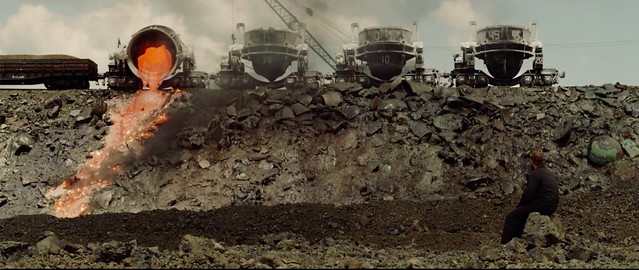
The subtitle in the beginning says it's the year 2025, a mere 4 years in the future. The Ukraine-Russian war seems to be over but wintry industrial landscape suggests that the war devastated the ecosystem and made a large swath of its land uninhabitable. The human toll both physically and emotionally is even greater, as we are introduced two PTSD ailing former soldiers whose sleepless nights are spent on driving around and shooting at makeshift targets planted on frozen tundra. The steel mill they both work at is taken over by multi-national corporation: an English-speaking figurehead on a giant screen talks of the bright future while pumping up Soviet style propaganda reminiscent of 1984. Many are fired from the job because of the automation of labor.

After his PTSD buddy's fiery suicide T2 style into the furnace at the steal mill, Sergiy (Andriy Rymaruk) moves on and gets a job as a water tanker driver - water became scarce since the bombardment and landmines planted during the war contaminated much of the country's water supply. On the road, he meets Katya (Liudmyla Bileka), a volunteer for a humanitarian group which identify the war dead by digging them up from half-frozen, muddy mass graves. It's a gruesome process, but it will give a lot of people closures, she says.

Talk of homeland takes a center stage. Ukraine might appear to be an unforgiving, desolate wasteland now, but where else would its inhabitants live? Sergiy is offered to work for an international organization and go abroad by a woman he rescued from a landmine wreckage. He says resolutely, "This is my home. Where could I go?"

The visual symmetry in wide ratio shot Atlantis is awe-inspiring. The industrial landscapes and machinery, as well as decay of abandoned houses (think of decay porn of Detroit, but doubling here as the war aftermath) have common with Ed Burtynsky's photographic documentations of the late stages of capitalist society - Manufactured Landscapes (2006), Anthroposcene (2018) and other documentaries that focuses on ecological devastation and human footprints on earth. Charting the country's recent history with human elements, Vasyanovych also finds common spirits with Jia Zhangke, the master chronicler of China and its people.

Vasyanovych unsubtly comments on Russian expansionism as seen in the annexation of Crimea in 2014 and Western commerce influence, but the film is not without hope. Working with non actors (Rymaruk is a former soldier, Bileka is a medic), the director imbues real life experiences within their fictional characters to give sense of connection, sense of national identity. The bare bone romance between Sergiy and Katya with the cold and unforgiving backdrop hints at the glimmer of hope, human resilience and connection despite dire circumstances. It's there, even if we are only able to detect it through infrared camera footage.Atlantis marks the arrival of the first great film of 2021.
Please visit Metrograph for virtual tickets. The film opens on 1/22.

Saturday, May 9, 2015

No Subtitles Necessary

The Tribe (2014) - Slaboshpitsky
 photo ac3309c7-ed7d-4a50-873b-11ec58a56ed9_zpslh2ihygt.jpg
Miroslave Slaboshpitsky literally 'shows' that basic human emotions doesn't need translations. A silent film comprised only of highly choreographed long, wide steadicam shots, the Tribe is technically brilliant. Bleak, dehumanizing setting - a deaf school doubling as lowly criminals' den ripe with violence, theft and prostitution, is not particularly interesting though. Yes it is a cool concept to have a film entirely in sign language without subtitles. Violence, love and revenge- all easily understandable but what else is there? Everyone in the film is a stock figure, even the good natured boy in the beginning who falls into 'the tribe'. He is nothing but a schoolboy crushing on a blonde who is used as a truck stop whore. And I'm sick and tired of this type of schoolboy macho filmmaking.

I really don't see any merit or intelligence beyond the initial concept of The Tribe. I just hope Slaboshpitsky comes up with something for the next film to prove me wrong.