Showing posts with label NYFF 2017. Show all posts

Thursday, October 26, 2017

"Let It Happen." Alan Gomis Talks about His New Film, Félicité

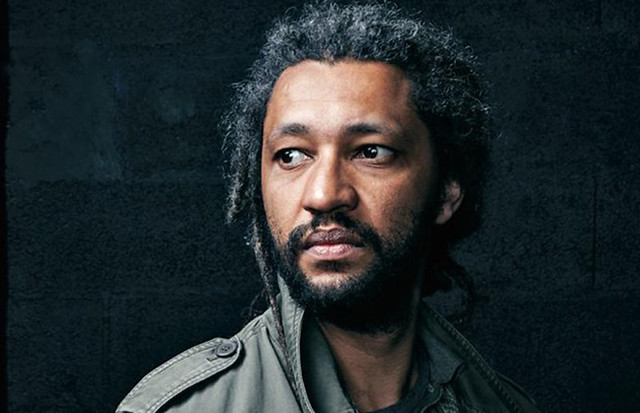
Gomis
After winning Grand Jury Prize at Berlin early this year, Alain Gomis's Félicité played as part of the slim but always robust Main Slate at New York Film Festival. Featuring great Véro Tshanda Beya Mputu as the title role, a single mother and a singer struggling to survive in the bustling streets of Kinshasa while trying to find love, Félicité is a structurally daring, vibrant, sensual and hopeful African film that you don't get to experience often. For me it was one of the highlights of the festival.

Gomis, a Senegalese director, was in town for the festival and I was lucky enough to have a chat with him about doing a film in Congo for the first time, the state of African cinema, his relationship with his generous and talented collaborators and on his method/non method- letting things take its own course. Even though suffering from a cold, Gomis was very generous and open with his answers.

And I am very happy that the film was announced Senegal's official entry for the Oscars and is getting a theatrical run here in the States starting 10/26 at Quad Cinema in NY.

The music seems to be the heart of the film. I heard that you are a big fan of The Kasai All-stars and the whole project began with them in mind. So if you can tell me about that a bit?

I’ve heard their music a few years before, introduced by a girl I know. It was through their album called Congotronics- several music groups from Kinshasa, playing the music called ‘Tradi-moderne’ in French, a mix of traditional Congolese music and modern stuff. Most of it is traditional music but the fact it’s played in the city of Kinshasa, it’s mixed with electric guitars and… they made this music that is perfect embodiment of life in a big African city. It’s really connected to cosmogony and transcendental music, so it’s steeped in tradition but mixing with the urban way of life. So it was perfect for me to start the project with this music to portray the urban African life.

With your previous films, it was Dakar and now it's Kinshasa. These cities themselves become very important characters in your films.

It’s always interesting to see the effect of the city on its people, and conversely, how they change it. How we are played by the city and how we influence it. Africa has a very small cinema industry. And there is this need for the symbiotic relationship with cinema and the society itself to present the life on the street.

Most of the time the films are coming from the outside which is a big problem because you identify yourself with the culture that is not yours. Of course it’s cool to have relationship with the rest of the world but you also need to have access to yourself. So it’s also important to me to try to portray what it’s like there. It is part of my mission in a way.

I talked with Ousmane Cisse when he was here presenting Timbuktu. And he told me how hard it was for him to finance his films. Is it the same way with you? How did the funding for Félicité come about?

It is not easy, but it’s getting better. This film if very concretely funded by Senegalese Production Fund which was set up in 2013. We had a French production company and post-production is done in Belgium. We had some Lebanese co-production too, German, Gabonese…

Wow.


So yes, we try to get money from here and there and everywhere. But the good part of it is that I had total freedom. Because if you had one financial partner, they have much more influence on you and what you are doing. (laughs) Having little here and there, you have more freedom.

It was really interesting to see the film in distinctly two parts. The first part is like a social docu-drama in terms of pacing and everything. And the second half, the tempo slows down a lot and it’s a love story between Tabu and Félicité. I liked that a lot. Is the pacing of the film connected to the music?

Yes. First I wanted to have easy entrance to the movie. I wanted to have a simple drama structure for everybody to be able to get into it easily. And then coming in to the heart of the movie which is Félicité’s journey of falling flat on her face then coming back up. But that part of the film is not something to tell but something to live, something to experience.

So yes, its inspired by musical structure. I think that’s the relationship that I have with music and I assume everybody else too. You listen to music and you start to cry and you don’t know why. Just like a concert, like a space between the stage and the listeners, I wanted to build a relationship between the screen and the audience.

I really appreciate the handheld photography by the great Celine Bozon in the streets of Kinshasa. How was the working relationship with her?

It was a first time working with her for me. It was like love at first sight! It was an incredible relationship. She was so devoted to the film and the filmmaking. She has no fear. She is completely into creating sensations I was looking for.

It was also my first time having relationship through books. Just last week, she sent me this book and I was reading it on the plane on the way here. It’s a book about the art of archery. This relationship is like not to interfere with your sensation with your gesture in a way. We’d have incredible conversations – not about the frame or contrast, just trying to be more direct as possible. She suggested using the headphones, so she had a headphone set and I had a microphone. We had dialog during the takes, to find a good angle or sometime she would be just proposing something and I just try to say few words and she answers. sometimes it would be contrary…. The film was a true collaboration.

We have built a crew to shoot on the streets and interact with people. So we come several weeks before, talking to people. Some of them became part of the crew also while shooting. We had no boundaries. Someone was getting in the frame and it was possible. It wasn't like a traditional 'film set'.

Somewhere you mentioned that you were influenced by Yasujiro ozu. Can you elaborate on that?

I remember I was watching this film, it was a shock. I can't remember the English title of it.... It was... I Was Born But... Taking place in Tokyo about these two kids. The thing is, these kids were really me. They are trying to fit in their new surroundings, trying to fit in. I especially loved the relationship between them and their fathers. It was really shocking to me because it was an old film, black and white and a silent film at that. But it was me! That’s what cinema is for me. You can find that intimacy in a film that is made long ago on the otherside of the world. Cinema is creating that common space. The film really had a big influence on me.

I can see that in your films. Just watched Aujourd'hui. It’s very contemplative and very quiet, compared with other contemporary African cinema I’ve seen. You have a very distinctive style and approach. You possess this quiet sensitivity I admire.

Thank you.

How did you find the main actress, Véro Tshanda Beya Mputu?

She came in the audition. I’ve seen a lot of actors in theater and other auditions and so on. But this was an open casting- it was open to everybody. She came to it by chance because her friend told her to try it. She came in and I see her and I had the character in mind and she was quite different from Félicité I imagined. So OK, 'let’s try her in the part of the nurse', I thought. But she was so powerful in her performance and presence. So concrete, even when she remain silent, she had this energy that kept going through her. So I asked her to come back.

So we had these interactions for 6 months, I wanted her to come back and forth and we continued to build a character together during that time. At the end, I had to accept her as the character which meant I had to follow her. All these things- Vero, the language I didn’t speak, the fact that I didn’t know Kinshasa- what I had to do was to…just let the film happen. It was me just trying to hear, not dictate, not “this is the story I want to tell!” I had to accept the fact that it’s not about me.

It’s telling that the film has its own flow that I really like. It feels organic and natural to me.

Is it common to have kind of an open relationship between Tabu and Félicité in modern African city?

For sure. I mean, in this time of economic pressure, the traditional sense of family is blown. We have young girls with children and everything like that is absolutely new. The film was my interrogation on what it means to be a couple. It was about accepting the freedom of the other person and of yourself. 'What part of the freedom am I giving up to be a couple?' I wanted to show these kind of new situations in urban African life and ask the audiences what would they give up.


Saturday, October 7, 2017

Claire Denis Does Hong Sang-soo?

Un beau soleil intérieur (2017) - Denis
Screen Shot 2017-09-28 at 6.18.13 AM
I think Claire Denis has been hanging out with Hong Sang-soo a little too much because I never expected her to do a wordy romantic comedy! And the result is delightful! It boasts the best rolling end credit of any movie ever.

Let the Sun Shine In concerns middle aged divorcée painter Isabelle (radiant Juliette Binoche). The film starts with her having sex with her regular lover, Vincent (Xavier Beauvois), a portly, pompous banker with terrible bedside manner. Some off-handed comment he says makes her cry. In fact, our disheveled heroine cries a lot, out of loneliness, in bed at night alone. Vincent is a married man and constantly says he won't ever leave his wife and family. He just want to bang her regularly is all.

Then there is a brooding stage actor (Nicolas Duvauchelle) Isabelle hits up on at the bar. They are about to work professionally together. But she is very anxious to know if he's interested in her as much as she is in him. But he rambles on about his acting, his identity whatev, finishing what seems to be his 15th beer. After hilarious and super awkward exchange in the car, Isabelle pretty much passive-aggressively makes him to 'come up for coffee' and stay the night. The next day, she is super happy about what happened but he's not. He's full of regret.

Then there is François (Laurent Grévill), Isabelle's ex, whom she has a 10 year old daughter with. She constantly regrets that she left him. He sometimes comes over and they screw. But they say some hurtful things to each other. They go their separate ways unhappy.

Always on the verge of tears, she confesses to her friend that she is deathly afraid that she'd pass the age to meet the love of her life, that she'd live the rest of her life alone and die alone. Easily swayed by other's opinions, whoever she meets, she asks for advice and second guess herself if she's doing the right thing.

Frustrated with her current relationship arrangement, Isabelle takes a trip to the countryside with her art circle acquaintances where they are invited to a little art festival. While taking a walk with the group, their pompousity and forced social niceties become too much for her and she blows up on everyone. Yet she finds herself in the arms of a soulful country bumpkin on the dance floor. Would that fling last?

We've all been there. The relationship is a fickle business and there are no easy answers. As you grow older, the need for companionship grows. Loneliness is a terrible thing. In a rom-com setting, Isabelle embodies a middle aged woman in the city dealing with these issues perfectly. With co-writer Christine Angot, Denis wrote a very funny script and created a very funny character that is unlike anything she created previously. The only comparable film she made would be Friday Night (2002). But that was a mood piece more than anything else with little dialog.

Since it's shot by the great Agnes Godard, Let the Sun Shine In is filled with gorgeous close-ups. As the arresting images unfold with jazzy soundtrack (by Stuart Staples of Tindersticks), you are safely in Denis territory. And the familiar faces show up - Alex Descas plays one of Isabelle's lover to be (there is a lot of potential), Valeria Bruni Tedeschi briefly shows up too.

The biggest suprise, figuratively and literally, is the appearance of Gerard Depardieu as a fortune teller who's motives are suspect. His long, meandering exchange with Isabelle got hearty laugh from me.

After a couple of very dark films (White Material and Bastards), Denis is trying something different. Let the Sun Shine In feels much looser and lighter than her other films but it still retains all of her visual language and style. With her announced English Sci-fi project with Robert Pattison, I welcome this change. Someone please give this woman a best director prize already!

Let the Sun Shine In plays as part of NYFF 2017 at Film Society of Lincoln Center on 10/7 and 10/8. Please visit FSLC website for tickets and more information.

Agnès Varda's Faces Places is a Perfect Antidote for This Ugly, Ugly World

Faces Places (2017) - Varda
Screen Shot 2017-10-07 at 8.44.56 AM
You really gotta give it to Agnes Varda: at 89, our pint sized grand dame of French New Wave is still incredibly open, generous and always searching (into both past and present). In doing so she inadvertently raises some interesting questions when it comes to what constitutes public art and what's personal without bombarding us with schoolmaster rhetoric. There are also a lot of reflections in Faces Places on impermanence of human existence, art and mortality.

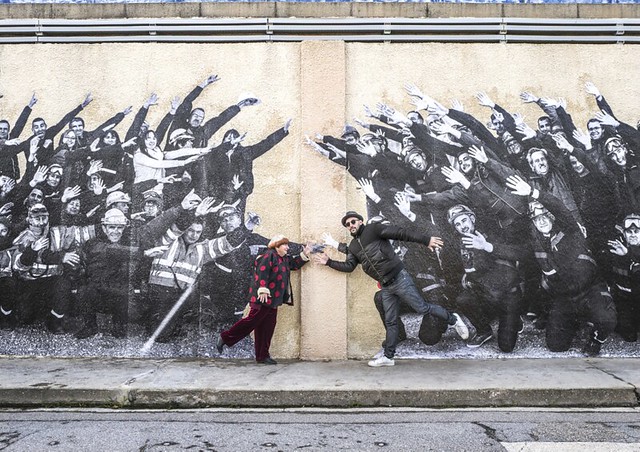
Varda, always keen on meeting new people and discover new things, pairs up with a 33 year old wheat pasting street artist known as JR. Together, they take a road trip to the northern French coastal towns. There they meet various working class people and their families - a postman, cafe owners, butchers, factory workers,miners, longshoremen, goat farmers and they take their pictures, print them out from the side of JR's portable printer/van and wheat paste them on the large public spaces, relate to the subject's environment.

The conversation is not always one sided- Varda doesn't have to exert herself into every story. She's fucking Agnes Varda. Things naturally come out. She's visited many many places and full of memories and mementos. In turn, JR is a jovial and energetic, and very good with dealing with elderly people (he lives with his grandma). Lanky with sunglasses glued to his face, JR reminds her of Godard and this train of thoughts plays out near the end, for better or worse.

It's not a typical light and fluffy travelogue of the rich and famous that would end up in travel channel. It's more about ordinary people. In this day and age, Varda believes in face to face human contact and genuine friendship. Except for some corny intros, Faces and Places feels very improvised and light and ultimately very touching and beautiful without trying so hard.

So they arranged the meeting with Godard. When they get there, the reclusive director and long time friend is not home. He scribbled a cryptic message with a marker on the window that upset's Varda almost to her tears. "If he tried to hurt me, he succeeded. That rat bastard!" One sentence is about the death of Jacques Demy, her husband, the other is a jab at the very same film she is making now, suggesting Faces Places is a fluffy travelogue of the bourgeoisie.

So there you have it. Godard has always been an innovative, genius filmmaker, brilliant researcher and historian, but an extremely cynical one who has long lost the ability to see the brighter side of humanity. Varda is totally opposite - completely open, transparent in what she sees and does and incredibly giving and sharing with her being. Which do we need more in this ugly world right now?

Faces and Places is a perfect antidote for the grim reports on the news these days. Please go see it.

Friday, October 6, 2017

Don't Deserve Love

On the Beach at Night Alone (2017) - Hong
on the beach1
on the beach2
on the beach3
on the beach
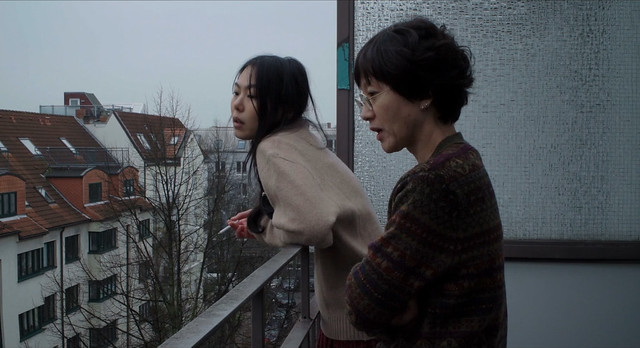
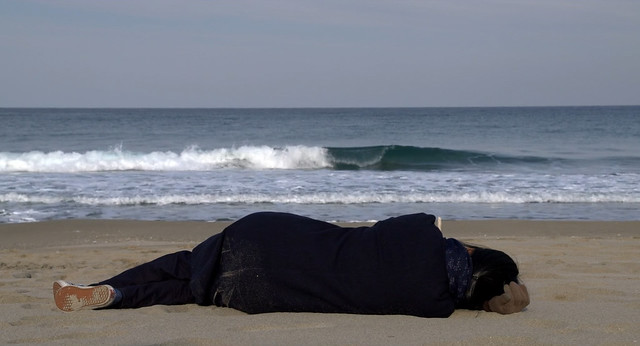
The first part of the film, simply titled 1, starts with Young hee (Kim Min hee), a pretty Korean actress, in care of an older female friend in Hamburg in winter, pining for a married director she's been having an affair with. She keeps saying he might or might not come for her but she won't wait for him forever because being in love with him hurts so much. It seems she tried to get away from the publicized affair and is very much enjoying her anonymity and tranquil surroundings in another country.

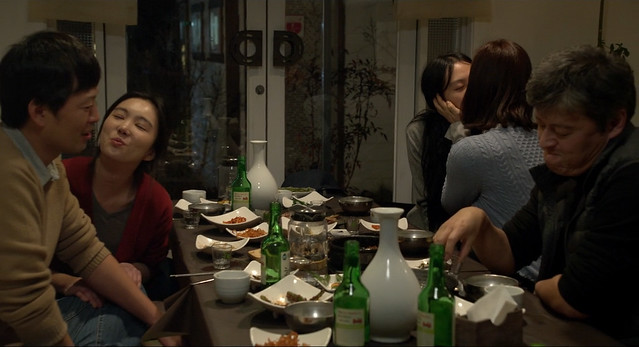
In part 2, Young hee is back in Korea, in the coastal town of Kangrung, the same one seen in Hong's Power of Kangwon Province, in winter. It's a favorite spot a Seoulite can think of when they run away- the farthest, the most distant, remote place one can think of, near the sea. She is seeing some friends. The affair is over and the true colors come out over couple of drinks at the restaurant.

On the Beach reflects Hong's own much publicized affair with Kim in real life. We get to see from Kim Min hee's side mostly through Young hee- after couple of drinks, as she lashes out to others at the table how undeserving everybody is of love, that how her affair is anybody's business. A moments later she declares she'd rather do without men and go lesbo, starts kissing her kind, older confidant. Her heart's not in it, because she still misses him terribly.

In a later part of the film, the director in question, played by Hong regular Mun Seung gun, recite the passage from a book he tries to give her that describes the agony and ecstasy of their final embrace. He breaks down and cries, as she steely stares at him.

I was looking at Hong's films all wrong. As I see more of his, I realize that I don't need to compare him to anyone who might or might not have influenced him. His is very much his own and original. He has a sense of humor about portraying human vagaries. He's playful in his own small way and puts much trusts in his actors. He might be lazy about 'presentation' - unlike the title, Young hee doesn't end up on the beach at night. It's daytime, dusk at best. For a night time shoot, it would cost too much and too much of a hassle to arrange. But it doesn't matter to tell his story which is still simple and direct and real.

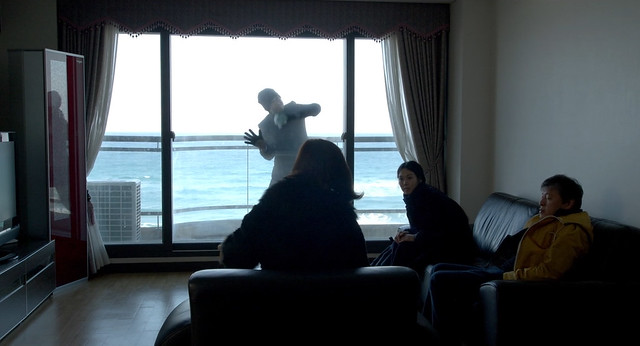
Love and break up is a painful business. Hong shows how it is under the scrutinizing eyes of the public, physically manifested here as a stranger in jarring surrealist moments - first in Hamburg, asking Young hee what time it is, then as a window washer in the second one. They are minor characters, but they are widely visible, but soundly being avoided and ignored yet their presence felt. For a Hong film, even though it has many funny moments, the over all mood of On the Beach is bitter and sad.

Thursday, October 5, 2017

Syrian Refugee Crisis Aki Kaurismaki Style

The Other Side of Hope (2017) - Aki Kaurismaki
Screen Shot 2017-09-08 at 6.22.09 AM
I find it odd that no major filmmakers are tacking the Syrian refugee crisis. Estimated 5 million people fled the war torn country since 2012 and the number easily doubles when you add up internally displaced refugees. I find it doubly odd that it is Aki Kaurismaki, the Finnish master of deadpan comedy taking on the topical subject. First it was his French language film Le Havre, which dealt with immigration. With The Other Side of Hope, Kaurismaki lends a hand, with his light touch, on Aleppo, without sacrificing the seriousness of the situation. Surprisingly, the result is an affecting, optimistic look at human kindness and decency. It also turns out to be one of his finest films.

There are two strands of narrative at the start of the film. One about a Syrian refugee and the other, an aging, troubled traveling salesman figuring out his life. Somewhere their paths cross. Khaled (Sherwan Haji) is first seen emerging from the mountain of coal in a cargo ship docked at a Helsinki harbor. As he seeks an asylum as a Syrian refugee from Aleppo at a police station, the unsympathetic police puts him in a waiting facility to be processed. There he meets an Iraqi refugee who's been in Finland for a while and seems to know the way around. Khaled is desperately looking for his sister who was separated on their way out of Syria. He likes Finland and wants to get a job and settle down. But first, he needs to not get deported. His Iraqi friend gives him some pointers, "Don't look so glum. Be cheerful. They deport sad looking ones."

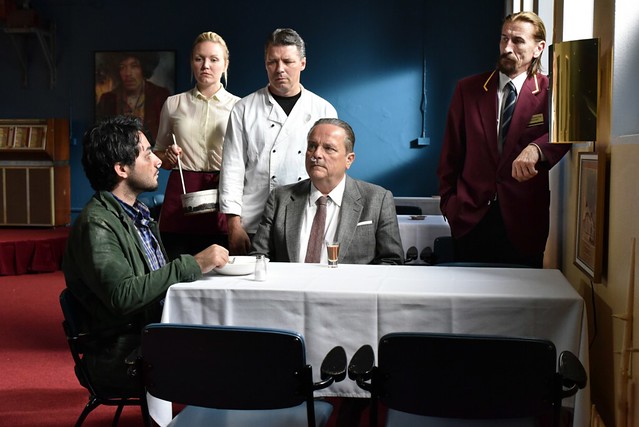
Wikstrom (Sakari Kuosmanen), a middle-aged traveling man's shirt salesman, walks out on his wife, and embarks on a restaurant business with the money he won at a gambling table. It's a little dumpy restaurant/bar called Golden Pint. The owner seems very eager to get out the dodge, and leaves three disgruntled employees behind- a doorman, a waitress and a cook for Wikstrom to deal with.

In the mean time, Khaled flees from the refugee facility after judge deems that his situation is not dire enough and decides to deport him back to Aleppo. Khaled gets into a fistfight with Wikstrom at a parking lot where he was sleeping. And Wikstrom decides to hire him for his restaurant.

There are many Kaurismaki comedic moments and sight gags throughout the film. His brand of minimalist comedy is truly unique.His cultural references are all mixed up and wrong- Kati Outinen, one of Kaurismaki's regular, plays Wikstrom's client who says "I'm going to Mexico and dance Hula Hula." and Golden Pint crudely changes to Sushi restaurants to attract more customers, serving a spoonful of wasabi on each sushi. When they run out of fish, they use salted herring. It is priceless to see the defeat on the crew's faces as the customers leave in droves.

Khaled is pursued by Finnish nazis with nationalist slogans on their jacket. Kaurismaki encapsulates them in one utterance near the end of the film, showing that nazis, in any country, are ignorant assholes and absolutely need to be eradicated.

Extremely silly and endlessly charming, The Other Side of Hope reminds us that the complicated world we are living in doesn't need to be complicated. Through the Kaurismakian glass, the world is filled with decent people and it remains a hopeful place as long as people help each other out.

The Other Side of Hope plays as part of NYFF 2017 at Film Society of Lincoln Center on 10/5 and 10/10. Please visit FSLC website for tickets and more information.

Repressed No More

Thelma (2017) - Trier
thelma_a35_kayawilkins_eiliharboe_copyrightmotlysas
Joachim Trier's new offering starts out rather ominously - Norwegian Liam Neeson named Trond (Henrik Rafaelson) goes out hunting with his young daughter Thelma in the snowy woods. But when they spot a deer, unbeknownst to the little girl, Liam Neeson dad aims his rifle at her. The tension builds up, but at the end, he can't do it. So we know, there must be something terribly wrong with our Thelma.

Now Thelma is a mousy, good Christian girl attending college in the city. Except for unusually nosy parents, seen calling everyday to check on her, She leads a very normal life as a Freshman at college. There are little vices around at every corner - the boys, alcohol and weed, the usual stuff. She has to fend off these temptations with daily prayers and atone her sinful thoughts. Thelma has an episode of a violent seizure at the school library. She doesn't remember having one when she was growing up and fear of being called back home, she hides the fact from her parents. This episode introduces her to Anja (Kaya Wilkins), a dark beauty who came first to her aid. They fast become friends.

Weird things are happening around Thelma. Her dreams have become more vivid and she can't distinguish if they are hallucinations or her will to make happen. As she falls deeply in love with Anja, her seizure episodes also increases. Through the remnants of her medical history, she finds out that her conditions might be hereditary and her parents have been hiding things from her.

Trier and his writing partner Eskil Vogt wrote a beautiful script once again, this time applying their skill and grace to their first genre film - a Sci-fi thriller. But Thelma is much more than that. Instead of going the route of a typical teen superhero flick, Trier and Vogt portray being an adolescent in its truest form - frightening sexuality: massive confusion where you can't trust your feelings nor your body and the terror of being in love for the first time. Added here is a big middle finger to organized religion, combined with some show-stopping imagery that trier has ever created in his short but fruitful filmography- especially the snake scene and the underwater pool/lake scenes.

Eili Harboe does a phenomenal job as a supremely confused young woman whose power has been repressed for so long. She gives achingly vulnerable performance as Thelma.

Thelma is first and foremost, a love story. It will make a handsome double feature with The Witch as a kind of female empowerment anthem. But instead of being cynical, something to fear and gaze at, girrrl power in Thelma is a sweet, positive and dare I say, life affirming affair.

Wednesday, October 4, 2017

A Glimpse of the Life of a Modern Woman in Kinshasa

Félicité (2017) - Gomis
felicite
Senegalese-French director Alain Gomis's Félicité is a great patchwork of elements that are full of contradictions and contrasts. And it's beautiful, energetic and refreshing. It's about a singer in an outdoor bar, also a single mom, played by enigmatic Véro Tshanda Beya Mputu, trying to survive day-to-day life in Kinsasha, Democratic Republic of Congo. Strong willed and free spirited, she is a modern woman who doesn't need a man by her side. But life throws curve balls at her when least expected and keeps her on her toes.

As with Gomis's previous films that took place in Dakar, Senegal and its streets, the sight and sound of bustling city of Kinsasha become as much a character in the film.

First half of the film plays out like a docu-drama of the Dardenne Brothers- after a motorcycle accident, Samo, unresponsive teenage son of Félicité ends up in a hospital with a broken leg. Running against time, Félicité frantically runs across town to gather money for her son's operation by any means necessary. It means involving police to people who owe her money, swallowing her pride and asking her ex and family members for help and going door-to-door in super rich neighborhood and begging for money while making a scene.

In the latter part of the film, the tempo changes dramatically and things slow down significantly. And it concerns Félicité's on/off romance with Tabu (Papi Mpaka), a local drunkard and blowhard with a great heart. It's the budding formation of modern family in Kinshasa. Contrasting the frenetic first half, the second half is full of laughter, hope and optimism.

Félicité is a melding of many conflicting elements. There are documentary-like naturalism (thanks to handheld cinematography of a veteran DP, Celine Bozon, sister of French director Serge Bozon) mixed in with recurring beautiful dream sequence in the woods in near darkness. There is local music (featuring the Kasai Allstars) rubbing shoulders with Kinshasa Symphonic Orchestra playing classical pieces by Arvo Pärt. Félicité's strong willed, modern woman meets Tabu's womanizer and drunkard, accept each other and continue their amicable relationship.

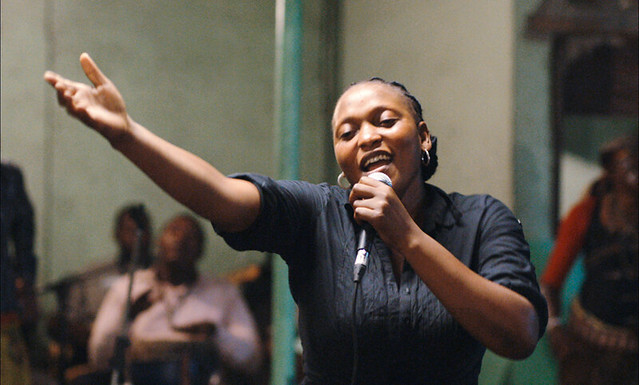
It's the music that is at the heart of the film. Sang by earthy, smoky voiced Muambuyi, the lead singer of the Kasai Allstars, Mputu's Félicité comes to life whenever she's on stage. The "Congotronics" is an infectious, eclectic music that represents many different ethnic groups that consist the region. Arvo Pärt's somber music fills in for somber moments but it fits surprisingly well in the film.

The running joke that takes up much of the screen time is Tabu's epic struggle with Félicité's dying fridge. It's an impetus for their budding romance and also provides glimpse of the earthly concerns of Kinsasha's everyday life, as Tabu scans the bustling outdoor market for spare parts - the dirt road, pan handlers, dancing traffic signal cop, pickpockets, etc. It's a dizzing display of what it's like living in such a place and also a testament of human resilience.

Mputu ‘s broad, beautiful face with her steely gaze is the bedrock of the film. Even when things get dire, the film never succumbs to cheap sentimentalism. Papi Mpaka’s naturalistic performance also helps the cause.

Félicité is not another downbeat film about Africa steeped in miserablist tendencies. Gomis and company don't lose the sight of happiness in the daily lives of its ordinary citizens. There is much humanism and culture and joy to be had in Félicité and I am grateful for it.

Friday, September 29, 2017

Pure Magic

The Florida Project (2017) - Baker
TFP-cover
Sean Baker, a director of much praised iphone shot movie Tangerine, digs deeper into the flip side of American Dream with The Florida Project, starring kids and featuring the lives of kids on Route 192, under the shadow of Disney World. As with Tangerine, Baker uses mostly untrained non-actors to portray people on the skid and just have them run with the materials they were given. The result is stunning work of authenticity, brimming with humor, heartache and much humanism.

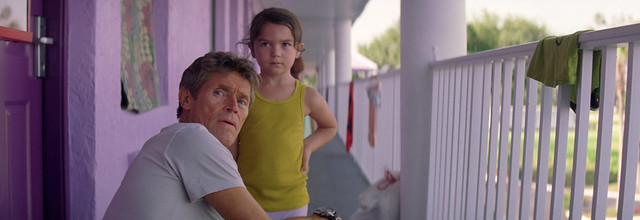
Moonie (Brooklynn Prince), a six year old girl living in the pink motel called Magic Castle with her young, tattooed irresponsible, daisy dukes wearing mom, Hally (Bria Vinaite). Moonie and her friend Scooty are always up to no good and wrecking havoc - spitting on neighbor's car from the balcony, starting fire in an abandoned house, panhandling tourist for ice cream money, etc., much to chagrin of the good-hearted motel manager Bobby (Willem Defoe). It doesn't really help that Hally is a real fuck-up. Always facing eviction for whatever violations against the motel policy and late for rent, she panhandles, steals, even prostitutes herself to make the rent.

The fake happiness of tourist subculture surrounding Disney World sharply contrasts with the pure joy and innocence of childhood captured by Baker. While kids are having fun, the adults in the film have to deal with depravity, submission, humiliation and consequences of being parents. Kids can have fights one day and make up next day as if nothing happened. Adult life is more complicated than that. With Hally, you couldn't picture a more stereotypical welfare mom. But she is also a loving mom, always trying to protect Moonie from the world and make the best out of ugliness of their surroundings.

But the film's about the kids being kids, always curious, always screaming and yelling, running across the various balconies and up and down the stairs of colorful motels, all named similar to Disney attractions - Future Land, Alibaba, Magic Castle and so on, and the nearby grassy swamp full of empty houses. It's beautifully captured verité style in mostly 35mm by Mexican DP Alexis Zabe (Silent Light, Post Tenebras Lux).

The performances by three kids – Brooklynn Prince, Valeria Cotto (Jancey) and Christopher Rivera (Scooty) are so natural and so untamed, it makes you wonder how on earth Baker ever managed to bring them out. Firebrand newcomer Vinaite is also great, easily topping Riley Keough's portrayal of white trash skank in American Honey (which will make a handsome double feature as Flipside of American Dream). But the range these kids have, especially Prince who seems to convey range of emotions on cue, is astounding.

There is so much joy and happiness of childhood in The Florida Project. For almost two hours running time, we spend our time invested with Moonie and her friends' (mis)adventures. As Hally digs herself a hole time and time again, and as the inevitable finally catches up with her and her daughter, we deeply feel for Moonie and her well-being. We know it's not a documentary because there is unmistakable face of Willem Dafoe trying to pass as a real person (and he does because he is a great actor), Caleb Landry Jones shows up for a moment too. We know it's a make-believe and that everything is going to be all right. But the final moment of the film, taking place in the real Magic Kingdom, shot on shaky iphone, really got me emotionally. It is, shall we say, pure magic.

The Florida Project plays as part of NYFF 2017 at Film Society of Lincoln Center on 10/1 and 10/3. Please visit FSLC website for tickets and more info.

Thursday, September 28, 2017

Skooled

Mrs. Hyde (2017) - Bozon
973045
Serge Bozon's idiosyncratic WWI musical comedy La France impressed me when I watched it some years ago. In it, he demystified war heroics and masculinity with his deadpan humor. In Mrs. Hyde, in his peculiar way, Bozon takes jabs at the failing education system where intelligence is willfully ignored and pent up rage and anger simmers just below the surface.

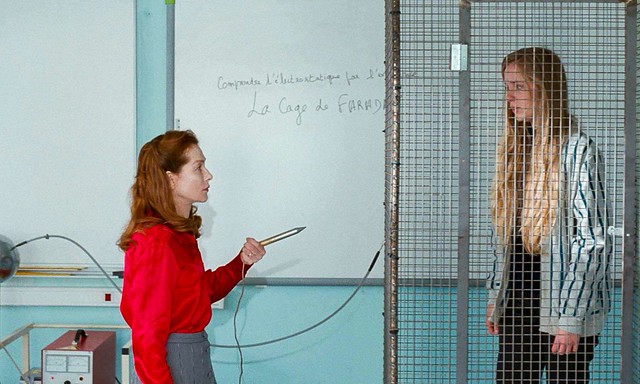
The indomitable Isabelle Huppert plays Marie Géquil, a soft spoken, extremely ineffective Physics teacher in a rough suburban school where most of her students in her vocational class are comprised of rowdy, uninterested students of color. They incessantly make fun of her and scold her and have zero respect. But always good natured, Marie tries to get through to them, especially Malik (Adda Senani), her worst tormentor who's handicapped and relies on crutches for walking, even though no one give him the light of day. At home, she is greeted by Pierre (Sergio Garcia), a supportive, teddy bearish, stay-home husband who cooks elaborate meals and plays music for her but doesn't quite understand what she goes through day after day.

She takes solace in her laboratory in a trailer in the school lot after hours where she deals with complicated blinking machines and math equations. One day she is hit by a lightening in the trailer and becomes an occasional red-glowing night crawler.

Things change after the incident. Having more confidence in herself (as the energy visibly moves through her vain), she finally gets through Malik, despite objections of favoritism by do-good students (two white girls who always talk in unison in class). With the laws of reflection, not only she shows the path from Point A to Point B, she shows him how to stop and think. But despite the breakthrough, Malik still wants to belong to a street rap group consists of dropouts. In her sleep walking glowing form, Marie ends up frying one of the rappers in front of Malik one night.

I can watch Isabelle Huppert picking her nose for two hours no problem. She's done comedies before, but in Mrs. Hyde, her performance is completely against her type and it's still mesmerizing watch. Romain Duris, playing smarmy, self-loving, small time principal here represents, along with an uppity 35-year old teacher-in-training, the clueless establishment.

I didn't expect a biting, timely social commentary from Bozon and from Mrs.Hyde. Unlike Robert Louis Stevenson's Jekyll and Hyde, Bozon's two faced, mild mannered school teacher parable has a lot more to do with the society we live in - which lacks self-determination, individual thoughts, and honestly, is more and more very much anti-intellectual. Dangerous Mind it's not. The film shows us that we have responsibility to teach our new generation faced with a lot of problems and distractions to stop and think for themselves. That they can't rely on a savior ('white savior syndrome' that is prevalent in popular culture) because that will eventually burn you. I was mildly and pleasantly surprised by the audacity of Bozon's moral lessons that digs deeper while maintaining his brand of deadpan comedy on the surface.

Mrs. Hyde is a social commentary that packs a punch wrapped in a screwball comedy form. Highly recommended.

Mrs. Hyde plays as part of NYFF 2017 at Film Society of Lincoln Center on 9/29 and 10/1. Please visit FSLC website for tickets and more info.