Showing posts with label Viggo Mortensen. Show all posts

Thursday, October 12, 2023

Native Americans Take Flight

Eureka (2023) - Alonso Eureka Argentine filmmaker, Lisandro Alonso, breaks 9-year silence with Eureka, after Viggo Mortensen starring meta-western Jauja. In an episodic structure, the film freely contemplates the state of indigenous people of the vast American continents, the past and present, as well as their uneasy relationship with cinema. It's perhaps his most expansive and ambitious film to date. He digs deep into the distorted representation and history, the effect of colonialism and the influence of Western culture that displaces the natives who are left out of place and out of time. Using his minimalist, elemental way of filmmaking, combined with Deleuzean look at time-image non-linear approach and Native American spirituality, Eureka is a deeply contemplative, perplexing film.

The first segment is a black and white western in full frame, starring Viggo Mortensen and Chiara Mastroianni. With coverages, combining wide and close-up shots, this is very much like a conventional filmmaking, not like Alonso's other works that utilize uninterrupted long takes and wide shots. Also, it's a rehash of Jauja's themes - looking for a daughter kidnapped by natives in the wild west, which the director intentionally appropriated from John Ford Western, The Searchers. The gunslinger named Murphy (Mortensen), tracks down where his daughter's kept in a small-town sheriff’s office. With the help of El Coronel (Mastroianni), he makes his way in with his vengeful guns blazing, to confront the captor of his daughter. But it is the daughter, the same daughter from Jauja (Dutch actress Wilber Malling Agger reviving her role), now all grown up, who turns a gun on him.

It turns out, the first part is movie within a movie, playing out on TV in a household in the Sioux reservation in South Dakota. More of a background noise for a Native American cop Alaina (Alaina Clifford) and her young basketball coach niece Sadie (Sadie Lapointe) as they get ready for their work. Alaina is taking her night shifts patrolling the neighborhood. Snowstorm is about to hit the area and she has to stop in, as her dispatcher send her to the origins of one distress call after another.

In a documentary style, we see the devastation of the Native American population living in the reservation - poverty, violence, incarceration and alcohol and drug use are everyday occurrence and Alaina being a good cop, she attends her job dutifully. Shot in a documentary style, the prolonged segment is as real as it gets. While white folks are playing out The Searchers fantasy for a century, the Natives are struggling with the bleak reality they inherited.

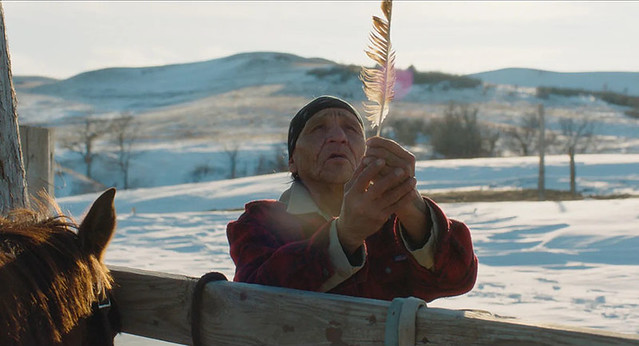
Mastroianni makes another appearance as a French actress researching the reservation life for a film who got stranded in a storm. She is our interlocutor, El Coronel, an unwitting bridge to the natives from as far back as Cortez days. Sadie visits her young cousin in jail, then goes to her grandfather's trailer. Grandfather tells her, "Time does not exist. It's a human invention." She says she is ready to go away. Her grandfather gives her an herbal tea which will make her sleep and wake up in another life. Say bye to everyone you know. He says. Lapointe, just like many of Alonso's non-actors, shines, as a young woman, who wholly embodies the terrible fate befallen to Native Americans in the 21st century.

Uncharacteristically for Alonso, we are presented with beautiful transition dissolves into the next segment, which takes place in Brazilian Amazon jungle, where a small tribe of peaceful natives who sit around and talk about their dreams. Their clothes and an old-style soda can tell us that this takes place in the past, during the Amazon's gold-rush days of the 1970s. A fight breaks out of their tranquil existence as jealousy between two men over a woman which results in stabbing and the stabber fleeing the village. The man then joins the gold-rush prospecting party nearby. El Coronel makes a third appearance, this time as a white man in charge of the prospecting operation. He is a typical middleman who would do anything for money. El Coronel tells the man that he doesn't belong there and would help him to get out of there.

With such a strong and engaging middle part with Alaina and Sadie, the third part of the film doesn't quite gel with the rest of the film. But overall, Eureka is always a fascinating watch with full of ideas swimming around your head long after you leave the theater.

Tuesday, May 31, 2022

Its Soul Got Sucked Out

Crimes of the Future (2022) - Cronenberg Crimes of the Future Hardly reinventing the wheel, but with Crimes of the Future, David Cronenberg reiterates his usual theme strongly- inadequacy of human bodies and our soulless society. Crimes might lack his usual titilation and shock value, but it's still quite potent in making those points, more so than his better films over the years, namely - Dead Ringers, Crash, Cosmopolis and even Dangerous Methods.

Crimes of the Future presages with a disturbing beginning where a mother murders her own child after the young boy starts chomping at the plastic garbage bin in their bathroom. It's the indescript near future where human bodies evolved to a point that they don't feel pain or in needs of anticeptics when the knives cut into them. Saul Tenser (Viggo Mortensen) is a performance artist. He and his partner, a former surgeon Caprice (Léa Seydoux) performs a sort of live autopsy on Saul's torso. It's Saul's ability to will a new organ that serves no function to his body and Caprice's tattooing and removing the organs that make them the superstars of this seemingly still unlawful and underground art form.

Saul, always shrouded in veils and hunched over, is physically not well. Either his mutations made him always brittle and ill, or his performances left him looking like a MS sufferer; he spends most of his time in the aide of a cocoon like bed hanging from the ceiling - a true cronenbergian contraption that looks like an upside down cockroach and a skeletal chair that helps him feed.

Their registering the new organs at the very literally named Organ Registy Office, a dreamy, Kafkaesque reimagining of what 'institution' looks like, connects the pair to a nebbish bureaucratic hottie Timlin (Kristen Stewart in a very comical performance), who breathlessly praises Tenser's artistry. Surgery is new sex, she declares. The dead child's father, who's also training his body to the effects of poison, approaches the pair and offers his son's body for the performance. Do they perform the live autopsy of the boy in front of the live audience or no?

Watching Crimes of the Future immediately reminded me of the famed painting by Rembrandt - The Anatomy Lesson of Dr. Nicolaes Tulp. In it, spectators surround a recently deceased corpse and Dr. Tulp is explaining the denuded musculature of the corpse's left forearm. Yet, the spectators' attention is not with the corpse but elsewhere and they are not even noticing the inaccurate arm (it's the right hand depicted instead of the left). Rembrandt was commenting on the inadequacy of seeking knowledge and truth in the human body in the Age of Enlightenment. And this is the point Cronenberg has been making all his career- our futile quests for answers in what makes us humans, in our bodies which are the most personal, tangible things that each of us possesses, and not finding it there. And pursuing so hard to find something in all the blood and guts, you lose sight of whatever the humanity that's left in us. In a way, Cronenberg is going back to the basics - to the flesh after more cerebral musings in searching for the soul (Dangerous Methods, Cosmopolis). Crimes of the Future is less kitschy and much less over the top parody like History of Violence or Maps to the Stars. And its general mood is closer to Spider and Dead Ringers. But nonetheless it's undeniably Cronenbergian and great.

Saturday, November 22, 2014

Existential Road Trip

Jauja (2014) - Alonso
 photo dce9a72e-52ea-4444-abc3-0e0ba978c502_zpsc9cb8f6b.png
 photo 47db91b7-a8af-49b8-81a1-4bdb6edf533c_zpsa7c16741.png
 photo c24a6b26-f887-4f72-b7d3-123767f5e121_zpscdd58f9e.png
 photo 83b0111e-baca-4f56-a253-31c3b11fd93c_zpsec223779.png
 photo 479ef141-71a0-49ad-9991-329144a0bad8_zpsd6b7ba1f.png
 photo 026c0521-5a39-4787-8dd7-753e401d9905_zps96967417.png
 photo 6f8d441e-2f9a-4f6e-917e-2e114a8322a3_zpsc10d3e1a.png
 photo 9726db17-a52b-405f-a153-c367c47a028d_zps550f5864.png
Loved it! Director/writer Lisandro Alonso along with co-writer Fabian Casas's take on western genre doesn't catch (small) fire until mid-point and turns The Searchers storyline into something that resembles more of a Conrad/Herzogian, existential road trip. Static long takes and 4:3 aspect ratio with round edges betray its supposed genre and picturesque landscapes. Nevertheless, Jauja is a gorgeous, seductive trip. Alonso's formalist, minimalist approach can be challenging but it's a worthwhile trip as it morphs into something much more adventurous and rewarding. There is hardly any music in its 1 hr 50 min running time and no close-ups. Viggo Mortensen's great as skulking Danish captain (of engineering team?), lost in the new, unforgiving surroundings. Stooped and lean and anxious, he wears the burden of all European men on his weathered face. The missing daughter is a macguffin of the story then resurfaces again as something else. Is this unreachable destination, the earthly paradise called Jauja, all but a dream of a 15 year old European girl? Daring in its style and structure, Jauja is everything I look for in cinema right now.

Friday, November 25, 2011

Neurotics

A Dangerous Method (2011) - Cronenberg
Photobucket
A big disappointment. Based on a play and script by Christopher Hampton, A Dangerous Method feels more like a stuffy stage play than a Cronenberg film. The problem with Hampton's script is that it fixates on the drama of three main characters - Freud, Jung and Sabina Spielrein, there is no room for historical background of the early 20th century, characters fantasies or anything else. It is nice to see Viggo Mortensen stretching his acting ability a bit while buried in suit, pipe, fake nose and dark contacts, stubbornly professing human sexuality as the root of all psychological problems. Michael Fassbender is adequate as young Jung, a family man, thrown into exercising 'talking therapy' on Spielrein and then moving into hanky pankies. Keira Knightley has no range or physique to do a sexually dysfunctional young woman justice (to her credit, she does an amazing human barracuda impression unintentionally).

I wished that at least some of the dream talks among them would materialize on screen, to give some Cronenberg touch- especially Jung's dream of a horse suspended in the air and a heavy log placed in the way and keeps the horse advancing forward and Freud suggests, "the log is, perhaps, your penis?" No luck. Berg keeps everything too classy.

Only interesting part is when Hampton and Berg treating Freud as a neurotic Jew trapped in a society where everyone's poised to tear him down when given a chance. Hence, his unflinching stubbornness in his theories. This is a masterpiece theater with a brief nudity of a skinny flat chested girl. Thumbs down.