Showing posts with label Arnaud Desplechin. Show all posts

Wednesday, March 2, 2022

Rendez-Vous with French Cinema 2022 Preview

The 27th edition of celebrating the best of contemporary French cinema offers a star studded 23 film line up. And after going all virtual last year due to the pandemic, this year's Rendez-Vous is back at the beloved Walter Reade Theater, Film at Lincoln Center, NY. The festival runs 3/3 - 3/13.

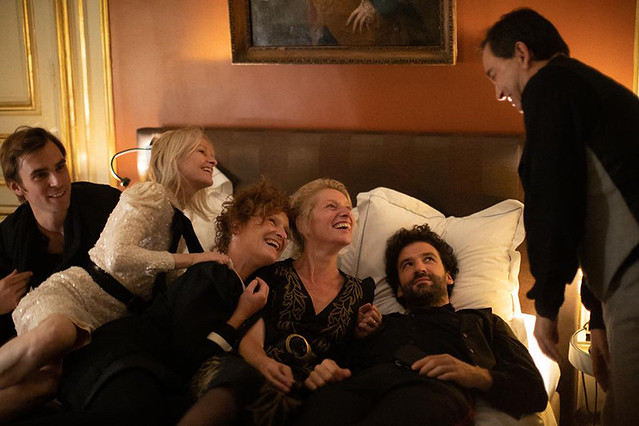
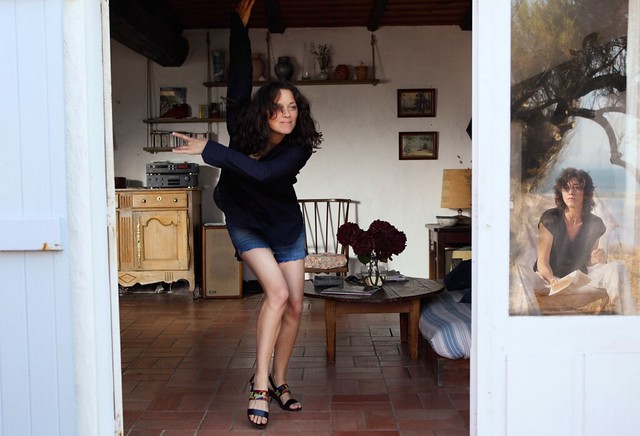
Opening night film is a highly anticipated Berlinale winner, Claire Denis's Juliette Binoche and Vincent Lindon drama, Fire. Other notables include Mathieu Amalric's Hold Me Tight with Vicky Krieps as a grieving French housewife, Jacques Audiard's contemporary romance Paris, 13th District, Christophe Honoré's stage adaptation of Proust going awry during Covid-19 in Guermantes, Arnaud Desplechin's adaptation of Philip Roth's Deception, starring Léa Seydoux.

For showtimes and tickets, please visit FLC website.

Here are some notable films I was able to sample:

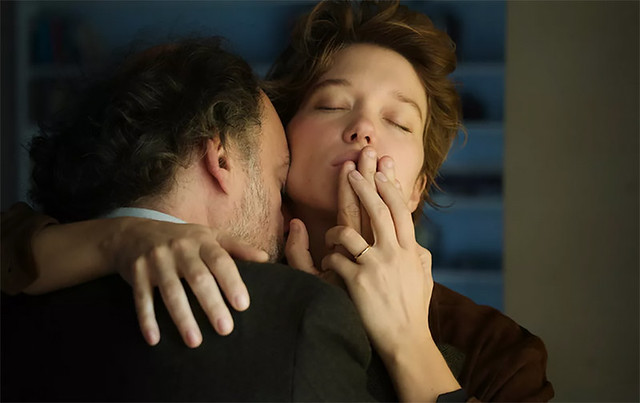
Deception - Arnaud Desplechin Deception Tackling on Philip Roth's autofiction, Arnaud Desplechin's Deception showcases Léa Seydoux's talent and charisma once again (they collaborated in his last effort Oh, Mercy, where she played a poor working class girl mired in crime).

Here Seydoux plays a sophisticated Londonite whose unhappy marriage drives her into the arms of Philip Roth(Denis Podalydès), a London based American writer, also stuck in loveless marriage. In his London flat, they talk and make love. He jots down his thoughts about her in his trusty notebook for keepsake. They break up many times yet have a strong hold on each other and can't let it go completely. His wife suspects and accuses him of having an affair and he defends himself by saying that Seydoux character is just that, a character, a manifestation of a writer's imagination run amok. As usual for a Desplechin film, Deception is wordy and performance driven. And despite the setting and the characters nationalities, with the usual neurosis and everything, Deception is decidedly and predictably Desplechin and very French.

Hold Me Tight - Mathieu Amalric Hold Me Tight I've said many times that Mathieu Amalric is not only a great actor but great director as well. Yet again, he proves it with Serre moi fort/Hold Me Tight.

It starts out with Clarisse (Vicky Krieps) sneaking out of the house in the middle of the night, driving away in an old car, leaving behind her loving family - Marc, her hunky husband and two adorable children, Lucie and Paul. She tells herself that after a while they will not miss her. She is never coming back and they will have to accept the fact. But why is she running away? What is she running from?

Then the film becomes something else entirely. Krieps gives a gut wrenching performance in a film about grieving and letting go that is so portent and heartfelt than any other film I've seen in a long time. Constantly going back and forth with her and her family, feeling the absence of one another yet articulating the connection in a very ingenious way, Amalric perhaps makes the most heartfelt film as a writer/director.

Guermantes - Christophe Honoré guermantes The planned stage play of Guermantes, based on Proust's third volume of In Search of Lost Time (appropriate title for our pandemic times), is getting canceled, because of Covid. Director Christophe Honoré and a large cast of mostly theater actors, who's been rehearsing the play together for months, are devastated by the news. So they have two choices, stop the project, admit the defeat and go home, or continue to rehearse without a guarantee that the show will ever be staged in the future. After much debate, they continue their rehearsal.

So starts this delightful, communal film of actors and a novice theater director rehearsing the Proust's labyrinthine texts while making the Théâtre Marigny and its lovely garden their home- sleeping, eating, singing together and make the best out of the world wide pandemic.

Unlike the play they are enacting which lacks many of the characters back story due to it being a chapter in a 7 volume book, Honoré explores many of the actors backstory and their lives, making the film much more than a mere documented rehearsal. It's obviously scripted cinematically playful and shot beautifully on film, by frequent collaborator Rémy Chevrin. A delightful salvo of a film that shows a power and resiliency of art in the pandemic era.

Paris, 13th District - Jacques Audiard PARIS 13TH DISTRICT Les Olympiads, the high-rise residential buildings named after the cities that hosted Olympics over the years, is a middle income housing built in the 70s, located in ethnically diverse 13th District in Paris. Audiard, known for his well crafted thrillers and highly emotive characters, tries his hands at a modern romance film with his sleek, staccato style, shot on beautiful black and white.

Webcam, dating apps and decidedly young attractive actors give Paris, 13th District, a fresh, vibrant look at the lives of young, ethnically diverse Parisians of today.

Breakthrough performance here is definitely Lucie Zhang as Emilie, a Taiwanese descent millennial looking for love while living off in her grandma's apartment in Chinatown, located in the 13th District. Zhang's uninhibited performance is contrasted by Noémie Merlant (Portrait of the Lady on Fire) as Nora, a 30 something Bourdeaux transplant running away from the grip of her husband to find herself in the city. Their lives cross paths through handsome Camille, played by Makita Samba, a public school teacher whose self-assured but arrogant demeanor both attracts and repels women. Co-written by Céline Sciamma, Paris, 13th District weaves a seductive, fresh tale of modern romance.

Monday, September 30, 2019

Desplechin's Law and Order Episode

Oh Mercy! (2019) - Desplechin
oh mercy
Roubaix, a little northern French town near Belgian border, is where Arnaud Desplechin's new film, Oh Mercy! takes place. It happens to be the director's hometown. He didn't have good things to say about Roubaix in Ismael's Ghost, his last film. He described it as the poorest, crime-ridden rathole, the city in decline. But when I interviewed him, he told me that he is making a film about its townsfolk in the next film. As a result, Oh Mercy! is Desplechin's episode of Law and Order with some compelling acting by two of France's leading actresses - Léa Seydoux and Sarah Forestier.

Narrated by a well meaning young cop Louis(Antoine Reinartz) who was just transferred from another town, Oh Mercy!'s trajectory is just as erratic and unexpected as many of Desplechin's past work. And it's delightful. Anchored by Chief Daoud (great Roschdy Zem), the police precinct tries to keep law and order where drug abuses, runaway cases, disorderly conduct, break-ins, false accusations based on racism are daily occurrence. The town is in bad shape with years of neglect and its mostly immigrant population barely getting by. Born in Algeria, but Daoud has been living in Roubaix most of his life. He knows the streets and he knows its people. He never raises his voice when questioning or interrogating suspects. He is firm yet deeply cares about what's happening in the lives of his townsfolk.

The film follows multiple threads at first, in real Desplechin fashion. Only in mid-way we revisit the one of the threads involving two young women which takes over the rest of the film. Claude (Lea Seydoux) and Marie (Sarah Forestier), two druggy friends living in a dangerously under-occupied, decrepit building in a neighborhood where you don't want to go out at night. They called the police before for breaking and entering, which Louis couldn't solve. It is most likely the girls lied, trying to get others in trouble. This time though, they report someone breaking into another apartment in their building. And the Daoud team finds an old woman strangled to death in a burglary-gone-wrong situation. All the usual suspects threads lead them to nowhere. And there's something that doesn't really add up in two girls' testimonies.

Louis, who has slight feelings for Claude, struggles to keep his temper in check when interviewing her. He knows she's lying. Marie, who is withdrawn and extremely shy, with her deer in the headlight expression leaves everything up to Claude when testimonies are concerned. They will need to interrogate the girls separately. It will be a she said, she said situation. Someone's gonna crack and spill the beans.

Seydoux and Forestier are great in their very unglamorous roles playing petite criminelles. But it's Roschdy Zem deserves an award for this. The sordid story is nothing to brag home about. There are millions stories like this we see on TV every night. But it's Desplechin's so very human portrait of these characters that is the heart of the film. There are several compelling scenes in the film but the one most stuck with me is Daoud's cool observation of the girls' relationship that sums up their entire history. He tells Claude what he sees - A pretty girl who was popular in school. But she finds out she can't really get what she wants or want others to get it for her in real life. Time in a town like Roubaix wasn't kind to her. She is stuck with her childhood friend who still worships her. They live in a day to day life in a squalor. It's a bad relationship. She knows it all to be true.

Oh Mercy! is certainly different from any other Desplechin film I watched over the years. But it's any less intriguing. The love he has for his hometown and its inhabitants are undoubtedly palpable. Desplechin is a master storyteller and humanist. Oh Mercy! is a very moving experience.

Thursday, March 29, 2018

Arnaud Desplechin on Ismael's Ghosts

Screen Shot 2018-03-28 at 11.26.25 PM
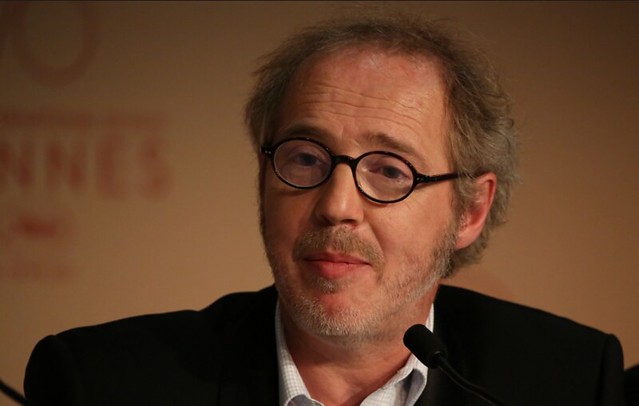
Arnaud Desplechin was in town for his new film Ismael's Ghosts opening stateside and I jumped on the opportunity to interview him again because I adored the film. Desplechin, as usual, is just as unpredictable and sprawling as his films in person. He loves to talk. And his enthusiasm for his love of cinema and his actors are infectious. Here is how it went this time:

So there are two cuts of the film. I’ve only seen the director’s cut. Can you tell me about the differences of the two? Are you happier that only the director’s cut is released in the States?

The thing which happened in France is that because I’m French, we could afford two versions of the film at the same time. So we had what I called the ‘strange’ version and we had director’s cut. So at the (Cannes) festival we showed the Director’s Cut and in the cinema we released the shortened French version. After that I just remembered that this line from Larry Gross, you know Larry Gross? He is a screenwriter and a film critic. He asked me what the meaning of the short version was, and he told me in a very patronizing way and I loved it: “My dear Arnaud, in terms of storytelling, this French version is a complete non-sense.” (Laughs) I’m not good at cursing. So all I could say was that we don’t have the trapanese in Tel Aviv and that there is no explanation why Ismael saying that his brother’s dead (which is a deeper problem). But he is alive again in the later part of the picture as he makes an appearance on the Skype chat. So you miss all that part. So I can say that French version was more focused on the love triangle. It’s like a popular fiction which is more sentimental and the other, longer version is more cerebral.

It’s the first time you have a protagonist who is a film director. Was this intentional?

I had one character already who was an artist in my films. He was in Kings and Queen. He was a violinist. It was an humble profession. For me, to make someone a violinist was a very transgressive thing to do because I feel much more comfortable with a doctor or a scientist or whatever to give to the character. But this time I told myself, I reached an age where I can say ‘screw it we will see what happens when I give a character a job of film director'. When I said that, my producer was not too happy, “come on, not the film director!” In my defense, film director is a humble one. Ismael never says that he’s a director. He’s just a humble filmmaker. Translated from French, film director is more like Film Builder (realisateur). It’s not really a word, the concept doesn’t exist in terms of filmmaking. The director in the film is Henry Bloom, the…cineaste as we say in French.

Ismael loves his job. You can see him struggling when not directing in the attic. Zwy (played by Hippolyte Giradot), the producer, the number guy, is the real director in that sense.

You are saying it’s not a self-reflexive movie just because the main character is a director?

Like Ismael Vuillard in Kings and Queen, who shares the same name as in this film, they are artists who are going too far. They are overdoing anything they are doing. They are both gross, insulting… ah (laughs) Ismael is the type of the director I would love to be because he allows himself to do everything I forbid to do myself. For Matthieu, he loved to be Ismael, he kept saying, “how can he do that? I’d never dare!” It’s something you think about doing but never dare to do it, like shooting your producer! (Laughs) That’s why we loved this character. He’s our little devil for Mathieu and I.


Thing I’ve wondered about is your fascination with espionage thrillers as they appear in your films.

My first feature Le Sentinelle was already a spy film. Even in My Golden Days, there is a elements of a spy film. I’ve always been interested in that kind of topics. I’m a big fan of Jean Le Carré, Robert Ludlum and even John Grisham. The title Ismael’s Ghosts, not to quote Norman Mailer, but as an homage, Harlot’s Ghost, which is a spy novel.

But I knew at the very beginning that I wanted to depict that this director would escape to the spy world while writing alone in the attic. That you will only have bits and pieces of the life of diplomat. And you will never know if he is a spy or a total idiot. You will never have the answer. It was a tribute to Broadway Danny Rose where you have bits and pieces of life and the agency of Broadway Danny Rose but you won’t have the whole story. So I knew that why he is writing about his brother being a spy because he is daydreaming about a man who disappear to the other part of the world.

But I still didn’t have the character of Ismael and I didn’t have a idea of a proper film. He is escaping but why is he escaping? I finally thought when I realized that his wife being disappeared for twenty years, him being a widower and her appearing again has a lot to do with his escape. Then I had the movie which was a movie in two parts - one part in the island with two women and the other in the attic.

Ismael, the same name as the one in Kings and Queen, and Daedalus again. this time Ivan.

I had to! Come on. What kind of names could I give? One of my character is inventing Daedalus for sure.

Not only three main actors, all of whom are wonderful, but I really enjoyed other great actors in this film - Hippolyte Giradot, Alba Rohrbacher and was good to see Catherine Mouchet. How was the casting process?

It’s a long process. It’s not the same as casting the main actors. But for Alba, it was a piece of cake. Because I had two monsters of French screen - Charlotte and Marion. I was thinking who could survive between these two such huge movie stars. I had to go with someone not French. But Alba is not only an incredible actress, she has such an incredible face, a face in a classical painting. She could be the wife of Louis or she could be the fiancee of Ismael. Ismael doesn’t have to settle with a ‘young newcomer’ you know? So avoiding the cliché of an old director dating a young woman, we have Alba, with her ageless, beautiful face like in a classical Italian painting! I was a huge fan of her work and that’s how I decided on her.

Catherine Mouchet, even the part was small, it was important for me to introduce her in the role because it was a key moment of transition from a comical scene where Ismael is tied to the bed to a pure melodrama. For that I needed to have a strong, well known face to have that jump from two different tones. It was also a tribute to her career. She has such an amazing face so I didn’t want to have just any doctor, but I wanted to have Catherine Mouchet!

And Hippolyte Giradot, I mean, we are good friends and he was great in Kings and Queen as a drug addict. In this film, when Mathieu is madness, Hippolyte is the reason. His character Zwy, is my favorite inside joke. Zwy Schomel - the name is so ultra Jewish. There are so many consonants no one could pronounce or spell his name, it was hilarious. Hippolyte is not Jewish and nor am I. We are both Catholics but we were educated by this Sephardic North African guy the ways of the Jews. We three were very close. So that element was kind of homage to this person, Pierre, we knew. I knew a bit about Ashkenazi community but when I arrived in Paris, I met Pierre and learned a lot about Sephardic Jews. Hippolyte knew the guy all his life, he knew his ways, so he created Zwy in Pierre’s image. It’s nice. Zwy says, ‘we are too old for this shit’, it reflects us, Hippolyte and I, getting old.

There are a lot of moving shots, zooming shots and intense orange colors. Especially the scene with Mathieu and Alba. Your cinematographer’s Irina Lubtchansky.

She is the daughter of William Lubtchansky (DP of countless French New Wave films including films by Agnes Varda, Jean Luc-Godard, Jacques Rivette and Philippe Garrel).

How did you and Irina go about creating the film’s look?

I don’t know how to say in America (talks to the interpreter), oh, a gel, in front of the lamps. It’s commonly known as the 'Storaro gel’. It’s a very specific one and the most expensive one you can have. Producers hate it when you want the Stroraro gel but I wanted to use it in that bedroom scene with Alba and Mathieu. Because you don’t know if its a dream or real. I wanted to add something magical in that scene so Irina and I both decided to go for the ‘Storaro gel’.

We used the same gel for the sunset in the beach house. It’s where Charlotte against the tree asking, “Do I sleep like a nun?” I was not supposed to shoot the scene that way, not at all. I had a totally different plan. We started with the emotion of that scene and i was sitting beside Irina and we had a long lens- it was supposed to be still and the reverse after that. It was pretty elaborate you know. But the performance she was giving to me was so intense that I took the zoom and started to move in without stopping. I was absorbing the scene brought on by Charlotte’s performance. We finished it that close (gesturing about a foot). So we did it. It was not the first take, it was 6th or 7th. I went to Charlotte and said, “This is it. you gave me everything you have. The scene is done.” It was never planned that way. Sometimes your actress and actors, mainly in my case, actresses, give me everything they have in their faces and I can’t stop capturing it. A face is such an amazing landscape, she really swallows the cinema at that moment.

There is a element of lost love and the love triangle that resonate to the romantics in me but the subplot of Jewish guilt/the survivor’s guilt, portrayed here by the great Laszlo Szabo really touched me. I’ve recently watched Memoir of War/La douleur by Emmanuel Finkel, based on the writing of Marguerite Duras. The pain of losing someone is so great that you lose the sense of self. Is it something you were exploring?

First of all, I love La douleur, I love the book and I love the film. All the actors are astonishing, every part of the film is astonishing. That is a very specific loss when you don't have the body to bury. It’s an endless one. I can mention a chapter in Sabbath’s Theater, the Philip Roth novel where the main character, when he was young marries this woman. Then she disappears. Its the war and you don't know if she is dead or not. She could be dead.

You have this father who is unable to moan her. So the suffering is always vivid. It is starting to be not as vivid as before for Ismael, because he just met Charlotte. Suddenly there is a second chance. For her dad, he is too old for that. There is guilt. If someone dies, someone dies. If someone disappears, it’s because of you. As Carlotta was saying, “You were too heavy,” She had a heavy father, so she had to escape to her fate. So there is a guilt in the character of Henry Bloom.

Carlotta comes back to her father on his deathbed. But there is no chance for her and Ismael getting back together is there?

I don't think so. Marion and I were discussing the script and trying different things. I think I just discovered something in the editing room, something Marion did without warning me and perhaps without knowing what she was doing: is that Carlotta the character is back on the island where she used to go with Ismael when she was young, she thinks, “I want my husband back.” It’s that simple. She is devilish, She is deliciously devilish with the dance scene with Bob Dylan song and everything. Then Ismael disappears. You realize that the second part of the movie, she doesn’t come back to get her husband, she goes back to her father. It seems to me that Marion plays a little devil in the first movement and she plays the second movement as a saint. I remember Pascal the producer saying to me after the first screening of a rough cut, “It’s strange that Marion has two faces,” and I thought that was the definition of great performance. I didn’t realized that when I was writing it, but Marion offered me that with her performance. I am really overwhelmed when I think about it.

Tell me if I am wrong but how I see the film is that in order to move on when you are in a rut artistically, you need a push from the ghost of the past.

Yeah yeah in a way. How can you run if you are stuck between Gainsbourg and Cotillard? But he does. He is running to his hometown and daydreaming about his film rather than actually making it. As he buys live hens to get eggs for breakfast, he has no love life any longer. (laughs) So he can just focus on his work.

Tell me a little about Roubaix, your hometown. You are very harsh on describing the town in the film. Is it as ugly as you say?

It’s the worst. My next film will be totally different. It will be about Roubaix. It’s about the social tolls of the town. It’s the poorest town in France. Where you have the most immigration population, mainly Algerians. One third of the population is wearing the veil, as you’ve seen that funny scene with Hippolyte in town. The first terrorist attack was in Roubaix during the Yugoslavian War. There was a riot and police was storming the houses with firehoses. It was really ugly. It's a really violent city.

The way I am painting it- more sweet and gentle, I’m trying to see the beauty of this ancient city. But it’s a nightmare as I’ve shown in that train ride scene. It’s my… what is that wonderful Canadian movie called...

My Winnipeg?

Yes, it’s like My Winnipeg. But the town is less richer than Winnipeg. 60 percent of the population is unemployed which creates violence. And there is no solution. All these people there are trapped in the merciless system. But I still have great tenderness for the city. I think it’s still beautiful and there are beautiful people living there. I have absolute anger and love for the city at the same time.

I’d love to see that movie. Very much looking forward to it.

Ismael's Ghosts is playing in New York's Quad Cinema and FSLC. The film will open in Los Angeles on 4/6. Please visit Magnolia Pictures Website for info on national rollout.
Thursday, March 22, 2018

Creative Process Can Use Some Help from Ghosts of the Past

Ismael's Ghosts (2017) - Desplechin
Screen Shot 2018-03-11 at 11.08.01 AM
Could Ismael's Ghosts be seen as Desplechin's 8 1/2? is the question that kept coming up in my head while watching the film. At 58, Arnaud Desplechin lends a deeply personal, metaphysical insight to inner struggles of a creative mind, even more so than in My Golden Days. In his usual sprawling ways, Desplechin goes on explaining the difficulties of filmmaking process and throws in the Jewish guilt/survivor's remorse: What do you do when your loved one, long presumed dead but never forgotten, comes back to your life? This quandary is one of the ghosts that our protagonist has to reckon with.

With multiple flashbacks and movie within a movie, Ismael's Ghosts tells a story of Ismael (Mathieu Amalric), a boorish movie director. While struggling with his The Man Who Knew Too Much style, Hitchcockian cold war spy movie project based on his suave (but estranged) diplomat brother Ivan (Louis Garrel), starring Garrel, Ismael falls for timid but supportive, loving Astrophysicist Sylvia (Charlotte Gainsbourg). He has been maintaining a good relationship with Henri Bloom (Laszlo Szabo) the father of his missing wife Carlotta (Marion Cortillard) as they share the same grief and loss.

The movie is narrated by Sylvia. Intimidated by this charismatic movie director at first, but charmed by his broken 'widower' side of him, she falls in love. But the reappearance of Carlotta (Marion Cortillard), a long declared absent wife of a Ismael, tests their relationship. Walked out of her marriage at 20, Carlotta manifests herself some twenty years later at the Ismael's childhood beach house where he comes to write. No explanation is good enough for Ismael, furious with Carlotta for sabotaging his life, first by disappearing and now coming back, he resents her greatly. Unable to compete with magnetic Carlotta, Sylvia calls it quits and goes back to her telescope at an observatory up in the mountains.

After sleeping with Carlotta, Ismael flees to his home town of Robaix. All broken up and melancholy, with mixed up memories and emotions brought on by Carlotta, he becomes a hermit. With the production of his spy movie's future uncertain, the company sends in his friend/line producer (Hippolyte Giradot) to convince Ismael to finish the movie. In that chaos, the director finds his inspiration flowing once again, helped by the ghosts of his pasts so to speak.

In the meantime, Carlotta visits Henri and her presence freaks him out and sends him to a hospital. For everyone who loved her, the impact of her disappearing was too great and deep, her presence is not welcome but painful reminder of their loss. As similarly themed recent movie A Memoir of War based on Marguerite Duras' book tells us, the pain of losing someone and no sense of closure is too great that even the eventual return can't remedy its wounds.

Desplechin deals with a lot of complicated thoughts and emotions on screen, acted out by three very good actors on the top of their game. And as usual, his writing is excellent. His preoccupation with an international spy in the name of Dedalus is still there, this time Ivan, not his alter ego, Paul. Deliciously self-reflexive and touching, Ismael's Ghosts is another great testament of Desplechin's unique talent as a film enthusiast and a great writer.

Ismael's Ghosts opens theatrically at The Quad and Film Society of Lincoln Center on March 23rd in New York

Friday, March 18, 2016

Adolescent in Spirit: Arnaud Desplechin Interview

Desplechin
Arnaud Desplechin's magnificent new film, My Golden Days, opens theatrically today at FSLC in New York. It was preceded by a week long 8-film retrospective. I was lucky enough to snag an interview on the eve of the film's theatrical release with Desplechin who's known for his slightly amplified, messy, life-like stories.

Our conversation topic went from his new film, to his muse Mathieu Amalric, to other directors work he admire. It was a great experience talking to another cinephile who also happens to be a director of my favorite film of the year so far.

First of all, congratulations for winning the Best Director award at this year’s Cesár.

Arnaud Desplechin: Oh yes. I was happy. I was very happy with that.

I watched MY GOLDEN DAYS the other day and I have to tell you. It’s one of my favorite movies this year so far. It’s really fantastic.

Thank you so much.

So we saw Paul (Dedalus) and Esther characters some twenty years ago in your film, MY SEX LIFE (OR HOW I GOT INTO AN ARGUMENT). What’s the reason behind bringing them back again after all these years?

Actually I didn’t start with the idea of writing a prequel or whatever of Paul and Esther. I started with this couple with different names. In My Sex Life, the guy was already a Parisian and the girl was from the countryside you know. Then I realized that in My Goden Days, there are four characters who have to fit together and again I thought of My Sex Life. I talked with Mathieu (Amalric), “Twenty years ago, you and I regarded Paul as a sort of a hero, so if My Golden Days is going to be a prequel of some sort, you might have to go back and resume playing that character” and Mathieu said, “ No, I wouldn't be able to make the film.”

Because things have changed since then. Mathieu is a big movie star now and he wouldn’t be able to go back and play the same character the way he did. You know back then, he wasn’t an actor. He was a technician. He didn’t plan to be an actor. So in order to go back to the character, he had to find new ways to portray - the idiosyncrasies Paul had, the difficult relationships he had with his mother, how her death made deep impact on him dealing with women. You know the fact Paul was much more cautious and shy than Esther who seems solid as a rock. I thought it would be interesting to see the birth of their love.

MY GOLDEN DAYS can’t be an autobiography since the characters are about ten years younger than you. So is it loosely autobiographical or is it pure fiction?

I can see it as both. On one hand I am older than the characters, more than ten years. But I liked the idea of making a period piece. I wanted to set it during the fall of the Berlin walls, 1989. There was still the feeling of Cold War time and how we thought of Russia and all of that ended up there.

You know I’ve been a cinephile since I was ten. We cinephiles lead a very boring life. I don’t share the expanses of experience that Paul had. He is much more adventurous throughout his whole life. On the other hand, I tried to give a sense of autobiography. I like to share the feeling the characters are experiencing.

It’s funny because I could phrase it that way - I am asking actors on set not to just give me their acting craft. I’m sure their craft is wonderful and I expect that because I respect the art of acting. But I am asking them to give me the feeling of intimacy, something… the feelings that come out when they are speaking as themselves. So I’m just trying to be a good actor amongst good actors. I am trying to give you the feeling that the film is autobiographical.

I have to comment amazing performances by newcomers Quentin Dolmaire as Paul and Lou Roy-Lecollinet as Esther. I had a chance to interview Mathieu Amalric for BLUE ROOM last year. He says he owes everything to you. What is your method for actors that they say such things about your directing?

I would say Mathieu is too generous. I owe him a lot. There is a scene in My Golden Days where Paul writes a very long letter to his friend saying that he hopes he was good for Esther. I loved the words that was written and my friend (Julie Peyr of Parisienne) was helping me on the script and she was asking me how I would film that scene. Mathieu would come and we would find out the solution! I wouldn’t dare to write such long lines but he would come and help me. I owe him so much.

I don’t know about my method. But I know one thing and I am quite proud of it. I talked with Quentin before the shoot. I never behave like a teacher. When I did My Sex Life with Mathieu, we just had dialog, just simple ordinary dialog.

The only trick, if you can call it that, I have is even though I am a terrible actor, but I tried to act in front of them. So if we don’t find a solution, I’m not afraid to make a fool of myself by acting in front of them, rightly or wrongly. They see you are ridiculous. It encourages them to be ridiculous as well.

I loved where grown up Paul going off on his old friend and his wife at the end. It was such an impolite thing to do as a grownup to a friend you haven’t seen for twenty years. And that’s why I loved it. I loved Paul at that moment, his imperfections, his passion, his resolute behavior that he’s never going to forgive his friend as long as he lives.

Without Mathieu that scene wouldn’t have been possible. Absolutely not. Being serious and being humorous at the same time. It’s serious and funny at the same time. During the scene there was a wonderful moment I realized because when Paul was 19, he was behaving like he was 55. He was too reasonable, cautious, wise… and when he finally became an old man, he behaves like he is an adolescent! That’s what I love about the scene. Paul is a fool, full of rage and anger.

Do you share the same sentiment if you were in the same predicament?

(laughs) What I share with Paul is the idea to save certain things from the past- not forget it but save it. Obviously there is a price to pay if you save the past. You have to move to another chapter of your life somehow. But you also should be faithful to your younger self.

I couldn’t shake off the film’s melancholic mood. You can totally feel Paul’s heart being broken as he drifted apart from Esther. The differences in this film from something like Fellini’s 8 1/2 is that it’s so truthful to life that we never grow up and we still act like children sometimes. That life is not really a fantasy.

But now you’ve grown older and you made about 9 to 10 films, do you consider this film as your 8 1/2?


What is it?

The Fellini film?

Oh Huit et demi. Funny you mention that film. I just finished writing a script and I was so happy and full of excitement. I was discovering new writing process and et cetera, and for the first time in my life that my main character is a film director!

That’s so funny!

It's always difficult to do because with that kind of character, it could be obnoxious. I think I found a way. Mathieu told me one day that the best European actor we ever had was Marcello Mastroianni. An actor who was not afraid of being ridiculous and so beautiful at the same time. I think Mathieu has learned something from Mastroianni for sure.

He is your Mastroianni.

Oh yeah. He is not Jean-Pierre Leaud. He is definitely Mastroianni.

Speaking of Jean-Pierre and Truffaut, back in 2005 when you came to Brooklyn, you showed double bill of MISSISSIPPI MERMAID and THE ROYAL TENNENBAUMS instead of your movies when asked about your retrospective. Your cinephilia is well known. This year you are here for your real retrospective. What would you have shown in place of your films if you had a chance?

Funny you ask me that question. I was supposed to present a double feature at Metrograph but because of my schedule, I had to cancel it. I was going to show Frances Ha by Noah Baumbach which I adore and The Earrings of Madame de… by Ophüls. Both heroines with no full names.

That would’ve been really excellent!

You showed your admiration for Wes Anderson and Tarantino. Who are some of your favorite contemporary directors nowadays?


Right now a lot of them for sure. One of the best directors alive is Jia Zhangke, of course. I didn’t get a chance to see his new film (Mountains May Depart) but I am seeing it tomorrow. I really have a high hopes for it because I heard about it a lot and I just couldn’t see it because of my schedule.

It's fantastic!

I am also very interested in seeing the new Scorsese series Vinyl. I heard a lot of good things about that and I can’t wait to see it.

I’m really happy that you have a very strong, mature generation of filmmakers working here in America. You've always had Hollywood but today you have Tarantino - I loved Hateful Eight, Paul Thomas Anderson, who is so fascinating, and you have Noah Baumbach, whose films I love. You have a very solid generation of directors, Wes Anderson being one of them.

That’s a great affirmation of American cinema from a reputable cinephile as yourself. One film I really loved last year was EDEN by Mia Hansen-love.

She has a new one out: L’avenir. The one that was in Berlin?

The one with Isabelle Huppert?

Yeah the one with Huppert. I haven’t seen it yet.

Me neither but I am dying to. I really loved EDEN. When I was watching MY GOLDEN DAYS--

Eden is a great film. A great film.

I can see the correlation with your film and EDEN.

I love that you mention her because she is the most important talent today. She stands alone in a way in France. She is so peculiar and singular…I was not lucky enough to catch her art in previous films before but after I watched Eden…oh I love that movie! Now I know I am a fan.

What’s the name of your new script?

Ismael and the Ghosts.

And it’s going to be Mathieu who’s going to be playing the director?

Oh I don’t know. I don’t write scripts with particular actors in mind anymore. I try not to do new projects with actors I already worked with. But I love him so perhaps he will be in it.

It’s been really honor to talk to you. As a fellow cinephile, you are an inspiration to me with your enthusiasm and your filmmaking. I loved JIMMY P and hope you make another film in the States. It will be fascinating.

Thank you. It will happen one way or another.

Thursday, March 17, 2016

Wounded Heart, Haunting Memories

Les trois souvenirs de ma jeunesse/My Golden Days (2015) - Desplechin
 photo 4f438fca-c7fd-479f-b1d0-3a5d8cafaf5b_zpslrstlbwn.jpg
Paul Dedalus, a character last seen in Arnaud Desplechin's playful romantic comedy, Comment je me suis disputé... (Ma vie sexualle), reemerges to guide us through intensely vivid, intimate memories of his life as a young man. Trois Souvenirs has very little in common other than some names of the characters and the time frame. It is also interesting to note that it's not quite an autobiographical film since Desplechin, now in his mid 50s, is making film about people slightly younger than his age (in 1989, he was 29 years old not 19). But in its melancholic tone and sense of regret, and 10 films after since his debut in 1991, the film has the feel of aging artist searching for a defining moment(s) in his youth. And it's a beauty to behold.

The film's unwieldiness and varying tone settles after 1/3rd way in and it becomes a heartbreaking, long drawn love affair of Paul and Esther(mainly played by newcomers Quentin Dolmaire and Lou Roy-Lecollinet). Desplechin knows how first love affects people- how it makes people certain way for the rest of their lives. We see Dedalus as a kid who was traumatized by an overbearing, crazy mother who commits suicide, as a teen who resolutely gets involved in pseudo political espionage act to help a total stranger escape from dire situations in the former Communist Russia on a school trip there --the episode that catapulted now grown up Paul (Mathieu Amalric) to revisit his past, and as a chain smoking, competent petit-intellectual whose life gets rattled by a long beautiful/torturous relationship with a beautiful girl, Esther (Roy-Lecollinet).

All the characters, even the minor ones, are so well drawn and beautifully acted by Desplechin's young cast. Utterly believable and charming in its sincerity, Trois Souvenirs puts any bombastic films looking back at one's life to shame. Perhaps the most heartbreaking part is Paul, now grown up anthropologist, getting a letter from Kovalki, one of his childhood friends who slept with Esther in his absence, asking for her address. Months later, he then runs into him at a concert, now a married man, Kovalki asks him about the letter. Now supposedly all grown up, yet still keeping all the bottled up feelings for those heartbreaks and memories, Paul blows up on his old friend and his wife. Childish and self-centered one might say. But Desplechin knows all too well that it's our abilities to remember that makes us human. Easily one of the best films I've seen this year so far.

Wednesday, November 25, 2015

Therapy

Jimmy P.:Psychotherapy of a Plains Indian (2013) - Desplechin
 photo 506dc721-08f7-4102-b10f-bd1933a5829d_zpsgdwkwljx.jpg
Jimmy P is an odd movie. Even though it lets us know that it's a true story and takes place in the U.S. 1948, it wears its cultural, racial, political contexts very thinly- not actively ignores their importance but rather, it is seemingly uninterested in them. What's left is two leisurely hours of Jimmy Picard (Hulking, understated Benicio Del Toro), a somewhat shellshocked WWII veteran Indian from Montana and Georges (always great Mathieu Amalric), an enthusiastic anthropologist/therapist of an unknown European origin. They meet in Topeka, Kansas, where the veteran hospital is located. It is slowly revealed that Jimmy has some repressed sexual issues with women and suffering from a guilty conscience of abandoning many women in his life. Georges also has a bit of a back story and seems to have a complicated love relationship with a sophisticated married lady friend (Gina McKee). But it's mostly about Jimmy and Georges talking. As the title suggests, it's a psychotherapy session of a Plains Indian so his constant headache and seeing blinding bursts of white spots would go away. But its literal presentation is never clinical nor fairytale like. The performances, nuanced and subtle, make the characters and interactions human. Jimmy P is not a gripping drama and you never quite get too close enough to the characters, but there is a sense of peace and tranquility to the film that I really dig. Great directors don't need to have their signature 'style' or whatever. They can tackle any subject and should be able to produce something that is completely different from one another. Desplechin surprises me in that respect. And I respect that.