Showing posts with label Nagisa Oshima. Show all posts

Sunday, July 28, 2024

A Case Against Capital Punishment and Institutional Racism

Death by Hanging (1968) - Oshima Screen Shot 2024-07-27 at 10.02.55 AMScreen Shot 2024-07-27 at 10.03.52 AM Screen Shot 2024-07-26 at 11.05.09 AM Screen Shot 2024-07-26 at 10.57.14 AM Screen Shot 2024-07-27 at 9.30.12 AM Screen Shot 2024-07-26 at 10.43.59 AM Screen Shot 2024-07-27 at 9.32.31 AM Screen Shot 2024-07-27 at 9.52.35 AM Screen Shot 2024-07-27 at 9.53.09 AM Screen Shot 2024-07-27 at 9.53.46 AM Screen Shot 2024-07-27 at 9.58.28 AM Nagisa Oshima's resolute condemnation of capital punishment and institutional racism is laid out in Death by Hanging, based on a real life case of Ri Chin'u, an ethnic Korean who murdered 2 Japanese school girls in 1958. The film concerns the botched execution of a young ethnic Korean man, known only as R (Yung-do Yoon) where he doesn't die from hanging and losing his memories and Japanese state officials' attempt to make him realize his crimes again, as they can't execute a man who doesn't recognize his guilt. In the process of proving R his guilt, the film exposes the state violence and Japanese colonialist past and asks pointed questions where executioners themselves are guilty and whether they have the authority to kill the accused.

After the hanging and R survives, the officials, consisting of a military general, a catholic priest, an education officer, a hangman, a prosecutor, debate the legality of attempting another execution. To their displeasure, R became conscious but doesn't remember who he is or what he has done. In order to execute him again, they have to make R conscious of his guilt. In a series of bizarre and darkly comical reenactments by themselves, the film becomes a Brechtian experimental theater, first within the confines of a staged death chamber where hanging takes place which Oshima narrates in detail in the beginning like a documentarian. After several failed attempts to get R recognize his crimes and him being Korean living in Japan as ethnic minority, the officials have to delve into his ethnicity and background, thus digging up the dreadful conditions of the lives of ethnic minorities living under the institutionalized racism day in and day out. Their grotesque caricatures of Koreans are carried out in reenactment and their superiority complex as colonizers is pronounced.

R's sister (played by Oshima's wife, Akiko Koyama) manifests in front of the officials, who one by one sees her, as she tries to convince R as a nationalistic communist of North Korea, but fails to convince him. She ends up being hanged by the officials. R finally accepts being himself but refuses to acknowledge his crimes because the murderous imperial Japanese power has no legitimacy to impose capital punishment on anyone. The prosecutor finally tells him that if he doesn't feel guilty of his crime, he can leave. Upon opening the door, the bright light from outside overtakes R and he realizes he has no prospects in Japanese society as an ethnic Korean and chooses to be hanged the second time.

Death by Hanging is a complex film, questioning the legitimacy of capital punishment, especially by Japanese government considering all the atrocities committed during the war and occupation of much of the South East Asia, Osmhima, a long time advocate of rights of ethnic Koreans living in Japan, is unafraid of exposing the hypocrisy of the state.

Sunday, April 19, 2015

Just a Boy

Boy (1969) - Oshima
 photo 340c0e1f-972f-4796-bc72-2040d194849b_zpsns4basbc.png
A strong condemnation of Japanese war generation and their impact on post-war Japan. A swindler family - an invalid war vet father, much younger step mother who was a cabaret dancer, a 3 year old baby and boy, our unnamed protagonist, ekes out a living faking hit & run on unwitting drivers. Their 'work' takes them up and down the Japan's coastline. Their job is sometimes successful but always dangerous. It's usually mother who throws herself - albeit skillfully, into incoming cars (driven by rich and preferably women drivers), but boy slowly masters the craft with a little bit of bruising here and there.

Oshima makes it clear that it's belligerent father who robs the childhood out of boy. After all, he is just a 10 year old boy who imagines he is an alien from Andromeda. But this being Oshima film, he is observed with no sentimentality. He doesn't do anything adorable or mean or something meaningful. He just observes and reacts like any 10 year old boy would. He isn't naive or wise. He is just a boy. It's mother, even though she's not his real mother, is still full of sentimentality and melancholy in that motherly way.

It's no 400 Blows for sure. Oshima's penchant for playing with the medium is minimized here also. Some abrupt monochrome sequences pop up and great use of widescreen to accentuate boy's isolation but that's about it. It's the most straight forward film in this Japanese New Wave period by Oshima.

Boy tries to run away in many occasions but always comes back, yearning for that 'normal family life'. The most poignant scenes in the film are boy running away and sleeping on the rocks near the ocean, singing quietly himself to sleep and him destroying the snowman made of the red boot of a dead girl and a wrist watch his stepmother bought him.

You can see the lineage of Japan's often emasculated, souless baby boomers in countless contemporary Japanese films in Boy as we read the future of what's to come in boy's face.

Tuesday, December 25, 2012

Sex and Fury

Sing a Song of Sex (1967) - OshimaImage
Image
Image
Image
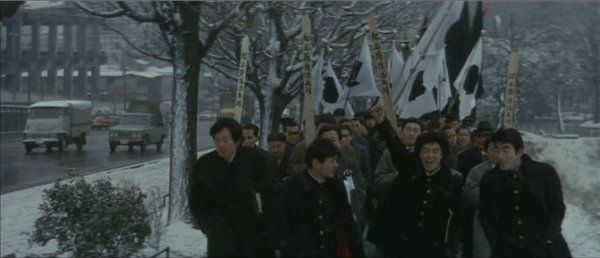
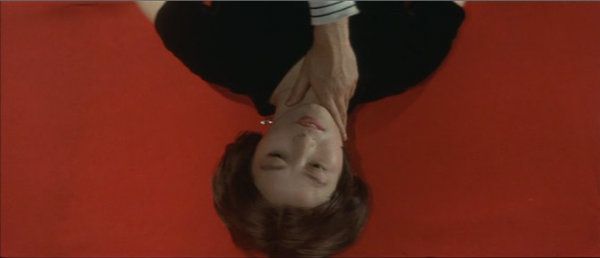
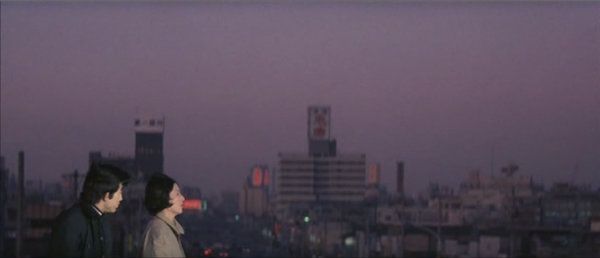
It's 1967. High School students are finishing their college entrance exam. Four friends have only one thing their puny minds - sex. A girl who sat at a desk #469 in exam becomes an obsession. After the night of drinking with a hunky teacher and some girls, learning dirty sex songs and fantasizing about raping #469, they find their teacher dead in the morning in what appears to be an accidental death. With the help of the dead teacher's girlfriend, they confront #469.

Oshima's provocative film takes place in the background of flurry of political activities, shot in beautiful anarmorphic - a march against National Foundation day, petition drive against Vietnam War and singalong of protest songs in English. As one of the boys, Nakamura, faults his passivity for the death of their teacher who preferred bawdy songs of the working people rather than songs of nationalistic fervor, the film equates boys' pent up sexual desire to the political action. Further condemning and destroying the myth of the rise of Japanese Nationalism, it ends with the reenactment of the fantasy rape (the boys couldn't go through with it even in fantasy because they wouldn't know how) with the speech about how Japan's first emperor was of Korean ancestry. Complex and fiercely political, Sing a Song of Sex has a real bite to it.

Sing a Song of Sex plays part of MoMA Presents: ATG and Japanese Underground Cinema, 1960-1986.

Tuesday, October 5, 2010

Culture Crash

Merry Christmas Mr. Lawrence (1983) - Oshima
Photobucket
I remember watching this as a teenager on VHS. It was cool to see David Bowie buried up to his neck in the ground. I didn't fully understand what it was about though. Now Criterion put out a swanky 2 disc set of Mr. Lawrence, I decided to revisit it.

Oshima examines the dynamics among military machismo, homosexuality, beauty, sadism and generosity in the lush green setting of WWII Japanese internment camp in Java. Bowie is the case of perfect casting here as an object of desire. Young Ryuichi Sakamoto(also did a synth heavy score for the film) is also memorable as stoic Japanese officer who gets undone by a mere pair of kisses on the cheeks. But the standout is undoubtedly cherubic Takeshi Kitano as sgt. Hara. He is likable, terrifying and all too human all at once.

There are some odd choices, like flashback sequences with maj. Collier(Bowie) and his little brother - guilt of leaving his brother to the school bullies scarred him. Not a bad exposition but it's an awkward fit to put in the later part of the film. The swelling music gets irritating at times too. Oshima drives home the message that there are no right side in the war a bit too often. But he doesn't lose the sight on human desire and goodness of human heart. I really like this film.