Full disclosure: I've regarded Bruno Dumont as one of the most exciting figures in current cinema ever since I saw his debut Humanité (1999). His Bressonian approach to human conditions and faith in somber, beautifully tragic stories spoke to me and touched me like no other contemporary filmmaker's work ever have. Then it was his foray into comedies, starting with his TV mini series Li'l Quinquin (2014) that my enthusiasm started to wain a little. I just couldn't buy into his new world filled with odd looking characters and their slapstick antics. Then last year's star studded Slackbay really rubbed me the wrong way. I really had problems with the film's grotesque over-the-topness of its characters.
So when I heard his new project was a musical comedy about Joan of Arc, I was more than skeptical. It was hard for me to bridge the gap between intellectually understanding what the director was doing and actually enjoying his comedies.
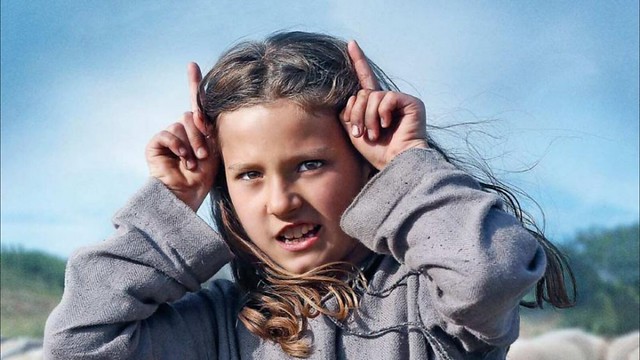
I watched Jeannette: The Childhood of Joan of Arc early this year and was still on the fence about how I felt about it. I thought talking to Dumont would help me to accept the direction he was going. And it did. Borrowing the texts from Charles Péguy's The Mysteries of the Charity of Joan of Arc, Jeannette is a singular cinematic experience, completely in tune with his rather serious, somber masterpieces. I'd recommend seeing it in theaters to get the full experience of his unique, direct approach to cinema.
Jeannette: The Childhood of Joan of Arc opens 4/13.
I have to tell you that I am a big fan.
He makes a cross with his fingers.
No seriously.
Help! (laughs)
It does make sense that you would tackle Joan of arc story since you have made films about pure faith before. But I never would’ve thought it would be a musical comedy. Did you conceive the film as musical to begin with?
Yes of course. I would never have conceived doing Péguy without music because Péguy without music is inconceivable. I like musical comedies very much. I was looking for a subject that needed that balance, that needed the music. I was looking for a text that would be pertinent to use music.
Some texts don’t need music because they are very clear as they are. Péguy is a complicated, complex writer and my hope was that music would give access to him. That we don’t have to give up on Péguy because he is too hard to get into. It’s like we don’t throw away a rose because it has thorns- the idea is to keep the thorns but somehow pacify things with music.
So in most musical plays, they mostly turn to poets to complete their work so there is nice relationship, one could even call it, a friendship between poetry and music. A companionship.
There is a repetitive rhythmic quality almost like Philip Glass in the text when they sing.
Absolutely you are right.
Why portray the childhood of Joan?
Once I had the music and the rhythm, I needed the subject. Joan of Arc is major French myth. But the fact is the subject is secondary, since we have the music. So the subject should be not too complicated. Joan of Arc is very well known. I needed to combine that with this new kind of experience in cinema. It happens that her childhood is not very well known that Péguy brings us luckily for us. So we have a known element Joan of Arc and not too well known – her childhood. So combining all these things together, I wanted to make something interesting. It’s more like a composer looking for a book for his next opera. But for me the subject herself was not that important.
One could not think of Joan of Arc story without the close ups of Renée Jeanne Falconetti in Dreyer’s The Passion of Joan of Arc. Is there any correlation between your Jeannette and Dreyer’s Jeanne?
Not immediately. The fact that I was dealing with the childhood, it created sharp break. So I didn’t have to deal with this major figure of Dreyer, who is always lurking around. The fact I am dealing with the nine year-old, means that I am, perhaps naively, cutting that influence.
Tell me about the work you’ve done for this movie with the choreographer Philippe Decouflé.
Dance is a way of expressing Péguy’s mysticism- it’s the way of embodying it. So for example, the little girl would say to me, “I don’t understand this part.” Then, I would say, “ Well, then dance.” Dance becomes another way of expressing the inexpressible. There are a lot we don’t understand in Péguy's texts. What we have in there is the rhythm, and that’s where the correspondence is.
Like the headbanging. There is not explanation for that. It’s a form of expressing grace. In a Heavy Metal concert, there is that absolute grace in that energy. So when we came to the part we didn’t understand, we’d go, “Girls, go ahead. Headbang!”
What we are looking for is harmony. It’s the dance, the shots, in the editing… it’s the effigy of harmony, whether it’s in the words, in the movements. It’s the formal thing that is an absolute quest and the meaning doesn’t matter. We are looking for beauty, we are looking for the shots to be happy between themselves.
So it doesn’t really matter to you whether they are real singers or not. Or they sing well.
They shouldn’t be real singers. It mustn’t be sung well. There is something inhuman, something false about perfection. We need the flaws in the little girl. You know she has to go down so she can go up. She has to sing badly, so that when she sings well, it’s something special. It’s not interesting to hear someone sing well all the time.
It’s like listening to the record and listening to the concert. It’s powerful to hear a singer in concert because you hear the flaws in their voices. It has to be a live spectacle, live sound. Records in perfect dolby sound, I don’t listen to them anymore. It’s boring. My cinema is live.
How did you cast the young actresses? What quality were you looking for?
I was looking for the heart of Joan of arc. The part was an effigy of all little girls. I was looking for the process from sowing to blossoming of all the hearts of little girls. It’s an extraordinary thing. If you put a little girl in Péguy’s texts, you just watch her grow. You water her a little bit and she blossoms.
She is intelligent, gracious and peculiar – she was herself. She had her own ways and when you put some Péguy, then you really hear Joan of arc.
It’s the contrary to idealization. It’s not believing in the idea of Joan of Arc but making a regular little girl and it’s the regularity that will take us to the thing I am looking for.
So you didn’t have to convince them about what Joan of Arc has decide to do? That she wanted to save the damned? that she wanted to be more savoir than jesus?
Yes. She did learn the texts. She had questions and we accompanied her. But the real questions were them as a musical interpreter- how they are going to sing. She was more interested in how to sing than what the text means.
Nicolas Leclaire, who plays Jeannette’s uncle, how did you find him? He is hilarious.
One of the main criteria for our casting was looking for someone who could sing, obviously. So I met this young man who’s a rapper. The music composer didn’t want him. He said, “What do I do with him? He’s a rapper.”
We took in what’s beautiful and marvelous about him. He was a bit off. But we accepted that and took that quality in him in. He was touching and also funny which is rare. He is never ridiculous. He has his own poetry and musicality. He couldn’t sing and only rapped. But we took that in and he was extraordinary. There was something very audacious about us taking Nicolas in, who didn’t fit at all in what we were trying to do. He had his own dance practices and our choreographer found a way to integrate him.
He was a counterweight to Peguy’s over seriousness and that’s where we found the balance.
Speaking of overseriousness, I am a big fan of your serious dramas. I haven’t gotten accustomed to your comedies yet. (Dumont laughs)
I think I understand what you are doing with these comedic films since P’tit Quinquin, that these are just a flipside of a coin to your more austere dramas that they are always on the verge of becoming comedies. Would you plan to do more comedies or are you going back to serious dramas?
I find balance in tragicomedies but not in outright comedies. I needed to go off from tragedy. I wanted to find balance. And I find it in tragicomedy. It’s like the presence of the uncle in Jeannette. Because Jeannette is too heavy. It becomes too pontificating. It’s just like what you find in the paintings of Bosch and Brueghel – you have these grotesque images but inside them there are humorous bits.
I think you can really express deep thoughts and feelings in comedies. You can go really profound in ways you can’t do in dramas. Funny is deep, rich and surprising. What counts is to surprise the viewer.