Showing posts with label Jordan Peele. Show all posts

Tuesday, July 26, 2022

Representation and Survival

Nope (2022) - Peele Nope With his third feature, adroitly titled genre mashup, Nope, Jordan Peele is fast becoming the new original voice in American cinema dominated by sequels and franchises. And using the power of cinema - visual (under)represenation in more ways than one, he incapsulates historical, institutional injustices. It also counters the industry which preaches the most liberal tendencies, but seldom practices, especially in casting. With wit and humor, Peele is obliterating the notion that a message film, a Black message film to be precise, has to be always literal. The 90's Spike Lees of the world don't have the same appeal to the tik tok, BLM generation of now.

The Haywoods owns a California horse ranch, which has been supplying horses for Hollywood productions and commercial shoots for decades. After the old Otis Haywood (Keith David) dies in a freak accident (hit by random debris raining down from the sky - happens to be an old Indian Head penny), the less sociable Jr, OJ (Daniel Kaluuya) reluctantly takes over the business with his small time LA schmoozer sister Emerald (Keke Palmer). It would be hard to give up and sell all the beautiful horses and move on. There is a pride involved as a black owned business which is woven into the birth of cinema - the unnamed black jockey in Eadweard Muybridge's short moving picture of Man Riding a Horse in the early days of cinema was a fictional Haywood, an ancestor to OJ and Emerald.

There is another thread that Peele starts the movie with: Gordy's Home, a cheesy 90s sitcom featuring a chimp named Gordy. Things went horribly wrong when Gordy went on a killing spree on set and young Asian American co-star Ricky 'Jupe' Park (Steven Yeun) was spared. It was the friendly gesture, a fist bump, that saved the young Ricky. Now Ricky runs a UFO themed Western show near the Haywood ranch which supplies it with horses.

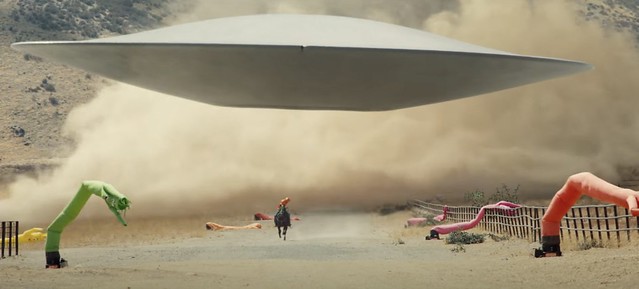
After some weird happenings - electronics, phones and power cutting on and off randomly around their ranch, OJ and Emerald suspect that there is an alien entity hiding in the static cloud nearby mountain range. They enroll the help of a nerdy CCTV installer, Angel (Brandon Perea) and a grizzled cinematographer (Michael Wincott) who's armed with a handcranked camera (to be immune to electrical storms), to record the Alien sighting and go 'Oprah' with it.

Nope is actually very much like a Spike Lee joint, packed to the brim with ideas and messages, but in a simple, breatheable, cinematic symbolist way. It has little to do with character development or backstory or the classic structure. Things go haywire with unexpected twists and turns. Its references range from Roy Rogers, Close Encounters, Phenomena, 90s TV sitcoms, reality TV, tabloids, even to Akira, not to mention all the other clever pop culture references. It speaks volumes about the notions of the untamed west, nostalgia, colonization, captivity and spectacle. And the gaze: one of the many brilliant moments comes in when OJ understands not to look at the predator in the eye, like many traffic stops POC faces everyday. Loved the unconventional design of the entity as well as hilarious use of the air balloon modeled on Steven Yeun as a weapon. There are many more details I am forgetting to mention here. Engaging, playful and original, Nope is one of the best films of 2022.

Sunday, August 29, 2021

Man in the Mirror

Candyman (2021) - DaCosta Candyman Nia DaCosta's Candyman pays a great deal of tribute to Bernard Rose's 1992 cult classic and builds upon it for the BLM era with much more agency. She and co-writer/producer Jordan Peele acknowledge the progresses the African Americans have made in the US over decades but also remind us that we still live in a white society and it is important not to forget the past.

The original Candyman was based on a short story by Clive Barker, taking place in East London housing projects. It was brilliantly transposed to Cabrini Green, a real urban housing project in Chicago and based on real-life urban legend mixed with America's racial history. As a horror film, Candyman’s violence and carnage were brutal and gruesome that only Barker could dream of. Some of the film's detractors pointed out that its gothic interracial love story only amplified the stereotypical black male and blond white female trope. But it was the 90s and the class/racial inequalities were addressed only in a skindeep level.

The new Candyman starts with an affluent couple Brianna (Teyonah Parris) and Anthony (Yahya Abdul-Marteen II) in Chicago. They just moved in to a luxury glass skyscraper apartment in downtown. Brianna is an ambitious social climber in the art scene and Anthony, a promising artist. But Anthony is in a rut, unable to get an inspiration for a new piece and the deadline for upcoming group exhibition is approaching. By chance, he hears about Cabrini Green, a projects complex that his luxury building and many others around it have gentrified out of its existence. Then he hears about the legend of Candyman. He is also stung by a bee on his hand while taking pictures in the remnants of Cabrini Green. And the wound is not healing but spreading throughout the half of his body.

Anthony's new art - a bathroom mirror and gruesome paintings inside it with the instructions to summon Candyman, doesn't make a splash at first. But curiosity of white audience in a dare keeps body count rise and so does his viability in the art market.

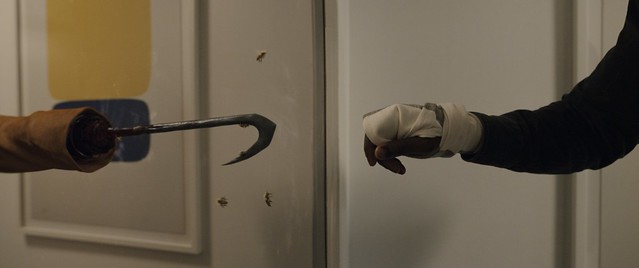
Writing is sharp and current. One can detect Peele's clever Gen X cultural references throughout. Dacosta and Peele do things right in first introducing Candyman as a creepy man in a yellow jacket with a hook as a hand who gave away candies with razorblades inside them in the 70s, not the original Candyman played by charismatic Tony Todd, suggesting that Candyman is actually Candymen throughout America's ugly racial history, going back before the emancipation. And the film suggests the brutalization and demonization of Black males, from Emmett Till to George Floyd and beyond continues to this day. It was also very telling that the film starts with the logos of the company reversed, like in the mirror. What Anthony is seeing in the mirror is not an affluent and successful African American male today, but a man with his hands cut off with a hook shoved in its place, stung and burned alive centuries ago.

Candyman is a great film and emblemizes the saying that there is no black horror because black history is already a horror.

Sunday, March 24, 2019

Shallow Us

Us (2019) - Peele
us-hands-across-america-1553123723
Jordan Peele's follow up to Get Out is not what I expected. It is still cartoonish in its horror tropes with pop culture references, but it's far more sophisticated than the no justice, no peace poverty porn of the 90s gangsta movies. While the inner city/rural poverty and systematic racism of the powers that be vastly remains in America, it is also true that so called middle class in this country can afford material goods and convenience of the smart phones and cable TV.

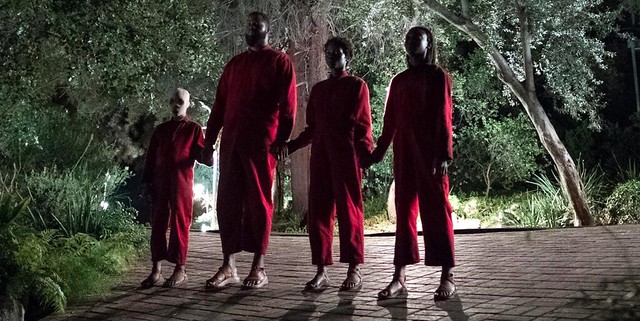
Peele, a comedian with his middle class upbringing and films that reflects post-Obama cool nerd sensibility, puts the middle class, African-American Wilson family at the film's center. The film clues you in with the title card in the beginning, saying that there are vast network of underground tunnels in America. It segues into 1986 when MJ still ruled and Hands Across America campaign (one of those celebrity fed kumbaya session to end poverty campaign) adorned the TV tube (if it was We Are the World instead, Us would've been a very different movie).

It's present day. Adelaide (Lupita Nyong'o) and her goofy husband Gabe (Winston Duke) and their two children Zora and Jason start their Summer vacation at their Summer home near Santa Cruz. Adelaide is uneasy about jogging through her childhood memory - she got lost in a Santa Cruz pier in 86', ended up in a haunted house attraction and saw her double in the mirror room. She tells her husband that the experience haunted her whole life and believes her double is still out their to get her. Soon after that, a heavily back-lit family in the manner of Hands Across America style appears at their front yard. And Us becomes a home invasion movie with the doppelgangers trying to kill the Wilsons.

It turns out only Adelaide's double can speak, albeit stuttering, out of breath fashion, telling her that it is a reckoning long in the making. After they manage to get away, they find their friends, more affluent white family, also had been attacked and murdered by their doubles. The spotty TV signal tells that it's a nationwide phenom. This is where Us fails to be more relevant.

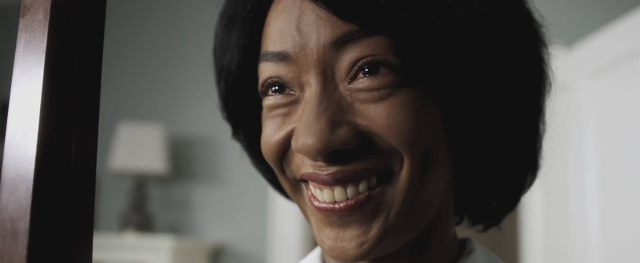
Smart and quick witted, Peele knows when he needs to be obvious - title Us also doubles as US, as above so below/mirror image concept, a guy holding Jeremiah 11:11 sign, NWA's Fuck da Police blasts from Alexa like device (Police is 14 minutes away) in a pivotal moment, and when to be subtle - ok, not really. There are clever moments like Adelaide telling her white friends that black people don't have time to do frivolous shit (I forget what the conversation was about), suggesting the larger context that black movies can't afford melodramas because that would be a luxury. Or Gabe impulsively buy a used boat which is named B-yacht'chy. Also liked that Peele didn't overlit his actors, especially Nyong'o whose very dark complexion gives her more time to act with her expressive eyes.

But I don't believe allegory and horror genre are enough to tell the whole story of racial AND economic injustice in this country. And I don't think whatever the elevation the genre has been garnering as high art, it can't express the corruption of humanity by capitalism wholely.

I always thought if there was a shake up in social order in this country, it would be borne out of the racial injustices, not the economic one. Have we passed that stage of overcoming racism already? Is it really possible that Bernie's populism has a real chance to win because he combines that rare racial, cultural social class divide? Or am I just still a pessimistic old man overly cautious? Us isn't a masterpiece. Peele taps into the zeitgeist and makes it entertaining, but his films still stays as a Twilight Zone level, safe entertainment.

Monday, March 27, 2017

Collective Hypnosis

Get Out (2017) - Peele
getoutic
It's a long overdue to point out and verbalize awkward race relations in this country. The Obama presidency was supposed to be a pivoting moment to usher us into more harmonious, color-blind society (or so we wished). Now we find out that the racism and bigotry hasn't diminished since the Civil Rights era by one iota, but now with the hate-filled orange blob as our prez, that show of racism and bigotry is more out in the open than ever before - just over last week, I saw a news that a white man from North Carolina came up to New York to kill black men.

Get Out seems to be coming out at the right time and place to visualize this awkward, shaky race relationship almost at a tipping point of all out civil war we have got going. Success of it at the box office is completely justified. This is not some Wayans Bros' buffoonery of the 90s. Jordan Peele is a little more sophisticated than that. He wisely taps into horror genre where he can be more subversive (more like Romero's Night of the Living Dead and less like Guess Who's Coming to Dinner) and get away with killing white people in various ways. His comedic sensibility helps too. Loved Peele rehashing the idea of a generation collectively hypnotized by TV screen (think of Halloween II, Poltergeist, They Live, Videodrome, etc). Definitely the scariest part of the movie is the scene pictured above.

Not perfect or complete by any means, but Get Out touches upon a lot of issues this country is suffering and give them a voice. Unfortunately, it remains urban/Northeast movie that would never make an impact in flyover states.