Showing posts with label adaptation. Show all posts

Tuesday, March 31, 2026

Existential Dread

The Stranger - Ozon Screen Shot 2026-02-17 at 10.03.11 AM François Ozon adapts Albert Camus's perennial work of the same name, set in the French colonial Algeria in the 1940s. It concerns a senseless murder of a young Arab man by an emotionally stunted French national, and the subsequent murder trial and conviction.

Ozon prefaces the film with the newsreel footage of Algeria under French colonialism, and how the Algerians are treated like second class citizens in their own country - excluded from restaurants, movie theaters, shops and public transports. Not in so many words, Ozon is suggesting that Meursault's ennui and senseless actions are deeply rooted in colonialism and injustices that were out in the open for everyone to see.

Presented in crisp black and white, the film tells about a low level company clerk, Meursault (Benjamin Voisin, seen in Ozon's Summer of 85') living in French occupied Algiers. He leads an uneventful, yet comfortable life - swimming at the beach, going to the movies and spending quiet time in his apartment, that is when he's allowed to- His rowdy neighbors Raymond (Pierre Lottin), a pimp who regularly beats his Algerian girlfriend, and an old timer Salamano (Denis Lavant) who has a love/hate relationship with his aging, barking dog.

The news of his mother's death at an old folks' rest home makes Meursault travel outside the city in sweltering heat. He is greeted by the staff of the facility, who are shocked by his dispassionate display of grief. He doesn't seem to be in mourning or sad. He refuses to look at the body, and leaves as soon as the funeral is over.

Back in Algiers, Meursault starts seeing Marie (Rebecca Marder), an old acquaintance who finds him attractive. After a while, she asks him if he loves her. He doesn't know. But she is not giving up. She wants to marry him, even though she finds his resigned attitude towards life a bit off-putting, to say the least. She thinks she can fix him.

Raymond complains that his Arab girlfriend's brother is after him and that he wants Meursault to 'back him up'. Raymond invites Meursault and Marie to his friend's cabin by the beach. But the Arab men follow them. Raymond is hurt during scuffle with them. With Raymond's gun, Meursault tracks Raymond's girlfriend's brother and shoots him on the beach.

The images by Manuel Dacosse (Evolution, The Strange Color of Your Body's Tears) are striking and memorable in their high contrast monochrome. The scene of a guillotine on the top of the hill has a feel of surrealist master Luís Buñuel's work and the sun-kissed, enigmatic images of Algiers resemble the work of Alain Robbe-Grillet.

Voisin does a terrific job embodying an empty man who swears off the existence of god and embraces life's meaninglessness. A great supporting cast includes Lavant, Marder and Swann Arlaud (hot lawyer from Anatomy of a Fall, plays a hot priest here).

The subtext to Ozon's very closely adapted The Stranger, based on the existentialist, absurdist classic, is that Meursault's self-imposed isolation and his atheistic world view are the symptoms of witnessing decades of inhumane colonialism and experiencing rootlessness, not as much by the German invasion of the greater Europe and WWII. His rootlessness is mentioned twice in the film - when Marie suggests that after they get married, they go back to France, he responds, 'but this is my home,' and when his boss at the firm gives him an opportunity to station him in their Paris office, he declines.

The Stranger subtly shows the entitlement of the occupiers living in a foreign land as if they are living in Paris and considering it as their home without a second thought. Some twenty years later, after The Stranger was written, with armed struggle against the French, Algeria finally earned their independence in 1962, ending more than a century of French Colonial rule. The film gives a deeper context of understanding Meursault's actions, based on France's racist colonial history.

Saturday, September 25, 2021

Sound and Fury

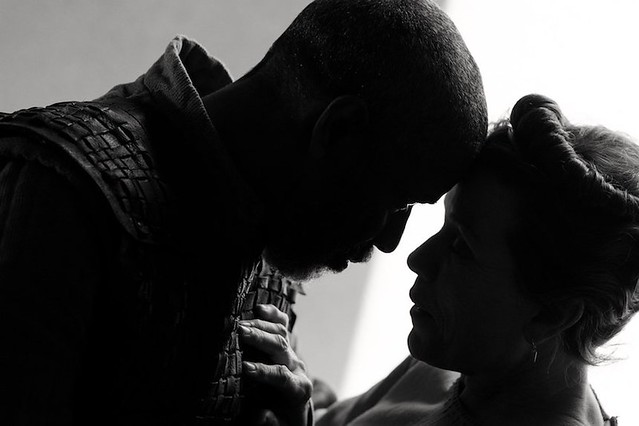
The Tragedy of Macbeth (2021) - Coen the-tragedy-of-macbeth-film With The Tragedy of Macbeth marks the solo outing of Joel Coen as a director, one half of the brothers team behind such classics as No Country for Old Men and A Serious Man. It stars indomitable Denzel Washington as the ambitious, murderous Scotsman and the great Frances McDormand (also the director's wife) as the Lady M. With a great ensemble of the British, Scottish, Irish and American actors, including Brendan Gleeson, Corey Hawkins, Bertie Carvel and Kathryn Hunter, I have to say, acting in this is fantastic.

But there have been many famous screen adaptations of the Shakespeare’s play before this reiteration. So the first question anyone would naturally ask is, is another adaptation of the famous Scottish play really necessary? Most recently we had a sexy, action packed version directed by Justin Kurzel and starring Michael Fassbender and Marion Cortillard that no one saw.

Macbeth and Banquo (Bertie Carvel) return after victorious battle over invading Norwegian forces, then encounters witches (?) in the forms of crows. They instill the ideas in the returning warriors that Macbeth will be king and Banquo's offspring will take over down the line. The rest of the film is predicated on that foretelling and Macbeth acting upon it. From the get-go, Lady Macbeth is all over the idea of killing off King Duncan (Gleeson). But after the deed is done and Macbeth assumes the throne, they get increasingly paranoid with guilt, with imaginary approaching heavy steps and bloodstains that never washes away. Sleep no more. Macbeth can never rest easily.

There is nothing wrong with Washington and McDomand's acting, eschewing the bard's juicy monologues with gusto and ease. His greying hair and beard and her wrinkles give their performances more edge, accentuating the aging couple's desperate last shot at glory. But it's Kathryn Hunter who steals the show. She portrays the manifestation of three witches. Her contortionist body movement and cadence of her gravelly voice in the beginning sets the uneasy tone of the whole film.

Shot in black and white in academy ratio, it is closer to filmed stage play than a cinematic adaptation. Its German expressionism inspired, minimalist set design and CGI fog and a murder of crows come across as cheap. And digital cinematography (nonetheless shot by usually great DP Bruno Delbonnel) looks extremely flat and surprisingly uninspired.

Unfortunately, there is nothing special about Coen's directing: there are no battle scenes, the weird vibe has been done much better both in Polanski's and Welles's version as well as in Kurosawa's Throne of Blood. It's as if Coen couldn't decide what direction he wanted to go and took the most boring, lazy route. The result is boring, flat adaptation with hodge-podge styles from other classic period pieces, as if Macbeth the film is wearing an ill-fitting suit.

Even any semblance of Coen-ness is only briefly found in the appearance of Stephen Root, a character actor and frequent collaborator of the brothers as Porter, a comic relief.

At best, The Tragedy of Macbeth feels like a vanity project where a director trying to please his wife a role she always wanted to play (for 15 years apparently). It also gives a clue to which Coen might be a Garfunkel of the duo.

Tuesday, March 22, 2011

I, Clonius

Never Let Me Go (2010) - Romanek

This allegorical tale of clone farm where kids raise up to be organ donors in a quaint school setting concerns three friends - Ruth, Tommy and Kathy. From early on, they know their fates are sealed and that they are just going through motions until their time comes. But it doesn't stop them from hoping that there is some kind of deferment for couples who are really in love, if they can prove that they have souls. Even Kathy (Carey Mulligan), the wisest of the bunch buys into this last thread of hope.

It was Kazuo Ishiguro's appropriation of this hope with young love that really spoke to me when I read the book. And it's carried out beautifully here by Mulligan, Keira Knightley and Andrew Garfield. It is Garfield's performance as wide-eyed, vulnerable Tommy that really shines.

I had a lot of reservations seeing this Ishiguro adaptation, but am surprised how much it moved me. The little girl narration that annoyed me so much in the book is all but gone. Alex Garland's script reduces it to the bare essential of the book - pain of growing up where you learn that love is not enough to save you. Charlotte Rampling as a cold Headmistress and Sally Hawkins as a conscientious teacher in their small roles are also great. Only quibble I had with the film is giving the dates in the beginning, making the film squarely set in made-up land which was unnecessary.