Monday, September 19, 2011

The Outsiders

Few of Us (1996) - Bartas
Photobucket
Photobucket
Photobucket
Photobucket
Photobucket
Photobucket
Photobucket
Photobucket
Photobucket
We are introduced to a vast wintry landscape below through the helicopter windshield. A young woman (Katerina Golubeva) is dropped off in the remote village where its inhabitants seem like the Eskimos in the far north. She shares a smoke with an old reindeer herder. There is a bit of magic realism with the bedroom overgrown with vegetation. But the welcome is short lived. At the gathering of the villagers at night, Kat watches their drunkenness in silence from one corner of the room. She sticks out like a sore thumb, since she is taller than everyone around her. Did she come to the place looking for acceptance or solace? After a knife fight with a couple of drunken local men, she flees the village on foot. No one helps her. Some even pretend not to notice her struggle.

Few of Us is no anthropological survey or gooey, touch-y feel-y travelogue where everyone gets along. It's a cold, unforgiving world for the Bartas' outsiders. Their loneliness is accentuated here with breathtaking scenery and the village's physical remoteness. The film is gorgeous as usual. Bartas holds the static shots for good 2-3 minutes, so they can come alive before your eyes . Again, his no dialog approach fits much better here with the isolation and sadness of the characters than other interloper films like Varda's Vagabond (which I love very much but now obviously not as much as this). I loved it. It surely becomes one of my favorites of all time!

Sunday, September 18, 2011

Fleeting Present, Free Future

The House/A Casa (1997) - Bartas
Photobucket
Photobucket
Photobucket
Photobucket
Photobucket
Except for the brief narration in the beginning, the film is wordless. A young man wakes up in a grand decrepit mansion. The house is inhabited by various people in many different rooms. There is no decipherable communication among them. They eat and drink together at the table under the grand chandelier. One room is occupied by a man who plays chess against himself, one filled with naked giggling children, one with an accordion player, and so on, and so on. Everywhere you look, it's a beautiful decay. The house is steeped in cold, damp melancholia.

A Casa is perhaps the most visually stunning film I've ever encountered. Time stands still in this mansion. Yet present is too fleeting: one can't be sure if it really exists. Its dreamlike visuals are neither nightmarish or overly pleasurable. There is something deeper at work here. I resisted the temptation of regarding each room as some type of metaphor and seeing the film as a Mathew Barney style slick moving art installation. Watching the film, one can still feel the dark days of the former Soviet rule lingering in those soulful faces. They speak thousand words with their stares. And no one captures Eastern European melancholy like Bartas. The film climaxes with the Christmas Supper scene and fireworks. I was in non-narrative film heaven. A truly rapturous experience.

Wednesday, September 14, 2011

Waiting for the Miracle

Lourdes (2009) - Hausner
Photobucket
Lourdes, a small town in the Southwest France, famous for the Virgin Mary apparition is the mecca for the handicapped or terminally ill pilgrims in the hopes of a miracle. A young wheelchair bound woman (Sylvie Testud) is one of them among others in one of the groups. She has multiple sclerosis. She can only move her neck and barely move her arms. You get from the small chats she has with the nurses and priests, she is a lonely woman and the pilgrimages are the only way to be out and about. She doesn't seem too religious.

Lourdes is a quiet film. There are no big show of emotions or a religious epiphany. But the film is in no way strictly procedural either nor is it straight out character study. With static shots and slow zoom-ins, Austrian Jessica Hausner's film creates both sense of security and limited mobility. When the supposed miracle happens, rather than the true jubilation, Hausner hints at uncertain future and only slightly points out the hypocrisy in true devotion- Why her and not me? I'm much more religious, and so on. Not quite sure what to make of this film. I didn't mind its understated approach and Testud's performance carries the human warmth, but it's quite underwhelming. Elina Löwensohn as the mother superior and Léa Seydoux as a frumpy nurse make up the supporting cast.

Monday, September 12, 2011

Jungfrau

Blonde Venus (1932) - Sternberg
Photobucket
Photobucket
Helen (Marlene Dietrich), a stage performer, first seen in racy skinny dipping scene with a bunch of other frauleins in a German town, is swept off her feet by an American scientist who marries her and relocate her to NY. They are not rich living in a small apartment but have adorable 5 year old son now. I guess back then being a scientist didn't pay for shit. Ned is diagnosed with the radium poisoning and in need of treatment. Helen volunteers to go back to the stage to make money, despite Ned's passive aggressive protests.

Blonde Venus gets weird as it becomes a road movie in the middle. Its very melodramatic material is accompanied by the glamor lighting suited for its angular star. There are three musical numbers, the standout being 'Hot Voodoo'- an overtly Rudyard Kippling racist minstrel show but you can get to see Dietrich in a gorilla suit. It's enjoyable until the end comes around, because you get to hate Ned's baseless moral grandstanding. Young Cary Grant makes an appearance as a millionaire homewrecker as well. Luminous Dietrich is much better than the material that is given to her.

Sunday, September 11, 2011

No Medicine for Melancholy

Melancholia (2011) - von Trier
Photobucket
A lot of people I know want to kick Lars von Trier in the balls if they were ever given a chance to do so. They think he is the biggest a**hole on the planet. That he is an arrogant, nihilistic artist constantly laughing at our expenses. His recent Hitler love at the Cannes didn't win him any favors either. Everything about him feels like a put-on, including his enfant terrible persona.


Personally I find his films to be quite simple, that there are no real depth or originality in them. Case in point, my favorites of his remain, to this day, to be Elements of Crime and Europa, both technical marvels from the cinematic filmmaking point of view. Over the years, he became one of the few filmmakers whose outside the movie set antics and their films are so entwined, I have a hard time separating them when reviewing. After watching two of his most recent, most 'personal' films to date and hearing about his crippling depression, I began to realize that he is indeed a hateful person and he's not faking any of it.


Accompanied by Wagner's Tristan und Isolde, Melancholia begins with an overture, which tells the audience what to expect. Shot in the same glossy way on the super speed camera as the beginning of Antichrist, visually it's both fantastic and frightening- as the planet Melancholia is fast approaching the earth, birds are dropping like rain, a horse falls to the ground under the darkening sky, all the earth dwelling insects take to the air and Kirsten Dunst in her white wedding dress, floats in the stream. von Trier continues with his exploration of his fears in Melancholia, another deeply personal film. This time, the anxiety comes from facing the end of the world.


The film is in two parts: simply titled Justine and Claire - the two sisters who have very different outlook on life. The film starts with the wedding reception of Justine (Dunst) in a gigantic castle by the lake. The bride and groom are late for their own wedding reception. At first, they appear to be a sweet young couple but soon afterward, we realize that Justine is feigning her smiles and happiness. Claire (Charlotte Gainsbourg) and her super rich husband John(Kiefer Sutherland), who arranged the wedding are getting visibly impatient with the non-cooperating bride. By the end of a long grueling reception, the unsuspecting, lovelorn-puppy groom (Alexander Skarsgård) isn't the only casualty of a heartbreak. And there is a planet small enough not to be threatening (yet), but visible to the naked eye in the sky.


The second part of the movie starts with the aftermath of the wedding. Justine, having failed at the attempt of getting out of her melancholic state by a marriage, is back to square one. She is an unresponsive, catatonic mess. It's Claire who takes an active mom role, taking care of her little sister. In the mean time, planet Melancholia from Scorpius Constellation is approaching closer to the earth by day. John, who knows about these matters tells concerned Claire that everything would be okay. That according to the calculations by all the leading scientists point to Melancholia squeaking by us and it would be a spectacular celestial show. Claire is not convinced. They have a young son and she wants him to have a future. Ironically, as the fateful day approaches, it's Justine who's calmer and more together than 'normal' Claire.


von Trier takes the visual cues mainly from the paintings of Caspar David Friedrich, a German Romanticism painter who's known for his 'gaze' paintings where you as a viewer complete the painting by observing a figure gazing into the landscape in front of him. The old Flemish painting of winter landscape and John Everett Millais's famous Ophelia are also recurring images. There is a scene in the castle library, where Justine frantically replaces all the open art books containing abstract paintings with the images of the aforementioned paintings and other classics, a futile attempt to place an order in her chaotic mind landscape.


I can see why so many great actors always flock to von Trier projects despite all the bad things he says about actors. These are hammy parts where you can exercise your craft. Dunst basically channels the melancholic director's outlook. Justine has hit the rock bottom. Her last attempt at happiness and normal life miserably failed. She's got nothing to lose. Therefore, impending doom of all humanity doesn't scare her. Gainsbourg is also great as maternal Claire, who loses her grip as the end approaches. Justine calmly informs Claire, "Don't you think I'm afraid of that stupid planet." Superb supporting cast includes Sutherland, Skarsgård, John Hurt as the jolly father of the sisters, Charlotte Rampling as the cynical mom whose world wary presence explains Justine's origin and Stellan Skarsgård as smarmy boss of the advertising firm Justine works for.


I'm not saying von Trier's dickishness is any way excusable on account of his deep depression. But I think I understand him better after seeing his latest movie. It's stark, nightmarish and without hope. As Justine says with conviction, "We are all alone in the universe. I know this." Therefore, there is no need for the empty human rituals like niceties and being polite. When it's all said and done, I have to admit, Melancholia is still an amazingly gripping movie going experience. Whether I like his films or not, I still find myself being a salivating lapdog every time he comes out with a new film. It might be the a**hole/sad clown side of me connecting with him.


*According to the interview came with the press kit, his new project is called Nymphomaniac and there's going to be a lot of self mutilating involved.

Friday, September 9, 2011

I Hate Kids

Gloria (1980) - Cassavetes
Photobucket
My goodness. Gena Rowlands chews up the screen and spits it back out in your face. Gloria is no nonsense middle aged broad up in the Bronx. When her neighbors, a mixed race family (headed by Buck Henry) gets wiped out by the mob, she is left with the only survivor, 6 year old boy with wild curly hair, Phil. And she hates kids (especially hates her neighbor's kids, she tells their mother once). Gloria has a shady mob connections from the past and many times throughout the film contemplates ditching the kid. But for some reason, she always ends up shooting her way out with the smartass Phil tightly attached on her waist. On the run, they change series of holdouts, showcasing sleazy NY in the late 70s. In true Cassavetes fashion, the dialog is nonchalant and action immediate. It's all Rowlands though. Not exactly a dog, but she is definitely not a typical Hollywood pretty. Can't see anyone else playing this role.

Monday, September 5, 2011

Fishbowl

La Face Cachée de la Lune/Far Side of the Moon (2003) - Lepage
Photobucket
Photobucket
Photobucket
Photobucket
The 60s Soviet-American space race plays a big part in Far Side of the Moon, a poignant drama about two brothers looking inward after their mother's death. Philip and Andre (both played by director Robert Lepage) are brothers who are polar opposites. Philip is a hopeless Ph.D candidate whose thesis on space race as human's ultimate narcissism just got rejected for the second time. He works as a telemarketer and is always broke. Andre is a gay, vain, successful TV weatherman. Even though he is older, klutzy Philip can't manage life's problems and chastised by Andre all the time. Philip is the type who makes life more complicated for himself. Jealousy and envy play the part in their relationship.

Ever since I watched Robert Lepage's visually striking Le Confessional, I've been dying to see another of his films. Adapting from his play, the renowned Canadian theater director showcases his visual artistry. Using archival footage of USSR astronauts, constant visual jokes with washing machines and a fishbowl and great transitions btwn past and present, Lepage examines the complex relationship of our desire to explore outside world and being reflective of ourselves. It's a touching and contemplative work that is personable and full of creativity. A great film.

Saturday, September 3, 2011

My Sharunas

Three Days (1991) - Bartas
Photobucket
Photobucket
Photobucket
Photobucket
Photobucket
Photobucket
It's a gray Lithuanian port town. Some young derelicts are trying to find a lodging (to sleep together?) but the town is full of groggy, unfriendly people. That's about it. Not many words are uttered and there is no music, other than the ones from the dance hall across the street. There are no distinguishable characters or names. Some unique faces here and there. It's also drama free. Decrepit lots, basements and cold, wet surroundings. Nevertheless Sharunas Bartas sees glimpses of beauty everywhere. It's in gestures, flickering lights, that uncontrollable, sad laughs of young Katerina Golubeva, the sight of a thousand years old blond street urchin smoking.

Unlike other films of this kind (Gus Van Sant's Death Trilogy comes to mind), Three Days feels deeper, that there is history behind this dreariness and quietude. It's not alienation nor loneliness I feel. It's a moment of awkwardness, a moment of kinship that counts. No words necessary. There is a scene right after they get kicked out of a lodging house. In the dark alleyway, Bartas camera first lingers on the three protags where baby Golubeva laughs hopelessly, then takes off to the side to show another vagrant eating an apple under the dim lights. We still hear her laugh but the camera remains on the old chum eating voraciously.

Bartas, where have you been all my life? R.I.P. Yekaterina, I'll miss you.

Monday, August 29, 2011

Tiananmen Love Story

Summer Palace (2006) - Lou
Photobucket
Spanning 15 years of the recent tumultuous Chinese history and the world over (from The Berlin Wall, Tiananmen Square, Hong Kong Handover to Iraq), Summer Palace tells a story of young love. It starts as Yu Hong (Hao Lei) from Tumen, a small town near Chinese-North Korean border, gets an acceptance letter from Beijing University. After settling into a cramped but lively dormitory life, she befriends Li Ti (Hu Lingling) and falls madly in love with Zhou Wei (Guo Xiaodong). Their relationship is rocky and full of drama and involves lots of screwing. Even though not overtly political, their youthful energy explodes at the Tiananmen Square and quickly dissipates. After finding out Zhou Wei having an affair with Li Ti, the heartbroken Yu Hong drops out of school and goes back home. Zhou Wei and Li Ti move to Germany with Li Ti's boyfriend who has connections.

Lou Ye, along with his cinematographer Hua Qing, captures intimate moments of the bustling youth scene during the pivotal moments in China. For the characters, their lives have been altered forever and they will never be able to duplicate their friendship, their love. It's Lou's homage to his generation which endured all these changes. A bit overlong, but very beautiful film.

Lady Issues

The City of Women (1980) - Fellini
In Pictures:
Photobucket
Photobucket
Photobucket
Photobucket
Photobucket
Photobucket
Fellini obviously has issues with women, so as von Trier. But when Fellini does it, it just comes out funnier and much more charming. It's just the way it is. Again, mindbogglingly creative, thoroughly exhausting.

Friday, August 26, 2011

Gold and Women

Alphaville (1965) - Godard
Photobucket
Photobucket
Photobucket
Lemmy Caution (Eddie Constantine), a hard-boiled spy from outland arrives in the Orwellian city of Alphaville, where people are controlled by a super computer named Alpha 60. The all the girls have numbers tattooed on their body and have no emotions. Words are disappearing every day and people get executed if they behave 'illogically'. Caution meets his predecessor Henry (Akim Tamiroff) who dies mysteriously after feeding him a bit of information on Prof. Von Braun (Howard Vernon) who invented the Death X-ray. Then he meets enchanting Natasha Von Braun (Anna Karina) who gets intrigued by the unpredictable outlander.

The setting is minimal. The 60s Paris doubles as the modern megalopolis. Godard's mash-up of noir and B-grade sci-fi films has its moments, especially the pool execution scene with the knife wielding synchronized swimmers. For a Godard film, it's surprisingly accessible, thanks in parts to constant narration by the gravelly voiced supercomputer. Yet it's a complex film. It's a satire on the advanced, soulless capitalist society and mainstream movies. It also examines the question 'what makes us human?' Caution is not your regular straight-up 'good' man. He says gold and women when asked about his desire at the interrogation. But he also reads surrealist poetry, so.... I didn't care for the 'love conquers all' ending (has a lot of similarities with Blade Runner) but it's an interesting little film nonetheless.

Saturday, August 20, 2011

Mod

Quadrophenia (1979) - Roddam
Photobucket
Jimmy (Phil Daniels) is a mod. He and his mod friends always don green long army coat, suits and ride crazy modified scooters, listening to the Who and the Kinks and such. They are always up to no good, roaming around and always on the lookout for scoring blues (amphetamines). Working as a mail room boy in some advertising agency and living under a stern working class father, Jimmy is all teen angst.

The rockers with their leather jackets and motorbikes listening to rock 'n' roll are Jimmy & the gang's enemies and they are always on each other's throats. The tensions btwn the gangs finally erupt when they converge in large numbers in Brighton during the Bank Holiday. The huge fight breaks out in the streets of the seaside town and it culminates into to a full blown riot. Amidst all the chaos, Jimmy sneaks into a quiet alley to make out with the girl, Steph (Leslie Ash) that he always had crush on. It's undoubtedly the best day of his life. Soon after he is arrested and detained.

Back home, Jimmy's life is in shambles- he gets kicked out of the house, loses his job, Steph is now with his best friend and his scooter gets destroyed in an accident. He goes back to Brighton to relive the excitement only to be more disillusioned.

The film features young Ray Winston as Jimmy's childhood friend now a rocker and Sting as the sharply dressed mod leader who makes fool of the British court system. Daniels is a typical 70's British youngster- gaunt face, gangly figure, crooked smile, mischievous eyes. I couldn't remember where I saw him before. It turns out he was Bela in The Bride, another movie featuring Sting!

I've never been a fan of the Who and Tommy never did much for me. But Quadrophenia is great. It's full of youthful energy and disillusionment only Brits could produce. I was fully appreciative of the Brit culture scene in the 70s.

Intimacy on Film

Bedways (2010) - Kahl
Bedways Is capturing real intimacy on film possible? Does it need to have real sex in order to achieve that? What's the difference between that and a porn then? RP Kahl ponders some of these questions with the graphic new film, Bedways. A raccoon eyed film director Nina (Miriam Mayet) enlists two young, good looking actors, Hans (Mathias Faust, looking like a hunky Jean-Pierre Léaud) and Marie (Laura Cooper) for her new project. There is no script or money for it yet. It's still in a rehearsal stage. Nina is exploring what the film is going to be. For seven days, she and the company discuss the process and have erotic moments with each other.

For me, if a film sets out to be 'about' real sex and intimacy, the result is always dismal. Only a good, balanced film that worked for me, featuring real sex was Winterbottom's 9 Songs. The subject of Bedways is a bit cliché now. Not as shocking or controversial as before. But I like Kahl's approach to the subject. Armed with a small HDV camera, Kahl documents an artist's creative process without being self referential or overly dramatic. In the end what Nina finds, is what she doesn't want- and that's pretty amiable thing to realize as an artist. Does Bedways work as a movie? Not really. It doesn't hurt that three principal characters are very attractive. As far as a film experiment goes, Bedways raises many same questions that I've been wondering about but doesn't really succeed in answering them. I give Kahl credits for trying though.

Thursday, August 18, 2011

Ugly Americans

Amigo (2010) - Sayles
Photobucket
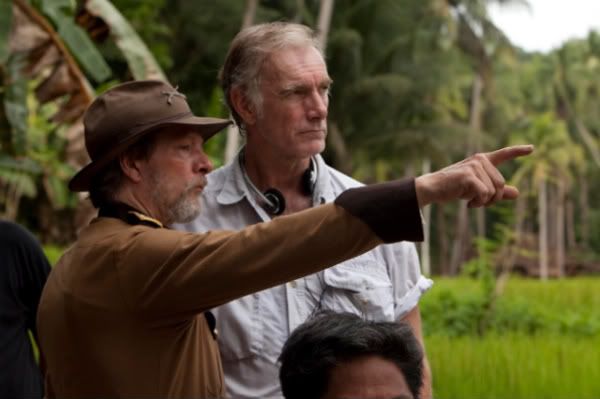
The year is 1900. The setting is a sleepy, small village in the Philippines. A group of American soldiers arrive to secure the area and rid of it any rogue elements. It's nothing new to the villagers of San Isidro. They've been under the Spanish rule, until recently. It's the same white people in different clothes (nice blue wool shirts and cream colored khaki pants, I might add). The man in charge of this barrio is Rafael (one of the biggest name in Filipino cinema, Joel Torre). He has a difficult task of pleasing both the occupying force and the rebels, in which his brother, Simon (Ronnie Razaro) and his young son are part of. Freed by the American soldiers, a Spanish priest (Yul Vazquez) becomes somewhat unreliable liaison for the occupying force. Lt. Compton (Garret Dillahunt) is an idealistic greenhorn who has to grapple with the band of unruly, uneducated, racist soldiers while trying to win hearts and minds of the villagers.

Did I lose any of you so far?
Raise your hand if you ever heard of the Philippine- American War.
Raise your hand if you knew that a million Filipinos were killed in that conflict.
Okay, I didn't either, and I was pretty good at World History in school back in the day.

John Sayles has spent his career portraying stories based on important, neglected American history on film, and giving voice to the voiceless. In Amigo, his 17th feature, one small piece of the American Imperialism is at work in the South East Asia at the turn of the 20th century. This film, lacking a lengthy introduction or postscript, is not put in context; in other words, it is not your neatly packaged, easily digestible Hollywood historical drama and might be a hard sell to the general movie-going audience. It places a lot of responsibility on the viewers to look further into this history. At the base level, this well written film works as a searing human drama not dissimilar to other films about people under occupation, caught in the crossfire. I can't think of another American writer/director working today who can write as beautifully as Sayles.

As usual, Sayles leaves no stone unturned. Telling the story of survival and death from multiple points of view, he examines naked racism, manifest destiny, the hypocrisy of religion, the spreading of American "democracy" abroad, loyalty, friendship and more. His attention to period detail is quite amazing in Amigo. With the production designer Rodell Cruz, Sayles built a village entirely from bamboo and shot on location with a mostly Filipino crew (and NO, this is not your Marcos-era exploitation film). There are 4 different languages spoken in the film- Tagalog, English, Cantonese and Spanish. He even finds time to highlight the Filipino culture in a religious festival scene and their national pastime, cockfighting.

Dillahunt as Lt. Compton is great as soft-spoken, learned soldier, who has the best intentions at heart and is beginning to doubt his mission. Chris Cooper chews up his limited screen time as a bigoted, bloodthirsty colonel with strong military conviction. But the real star of the film is soulful Torre as the man trying to do right by his people while being amigo to the oppressors and to the Insurrectos alike.

Sayles draws obvious parallels to America's present involvement in Iraq and Afghanistan with waterboarding (which originated from the Philippine-American War, called the "water cure") and the phrase 'winning hearts and minds'. The film beckons the viewer to find out more about these hidden American histories.

Amigo opens August 19th in select cities. For more information, please visit Variance Films.

Tuesday, August 16, 2011

Unjust: John Sayles Interview

Photobucket
Regarded by many as the godfather of the American independent cinema, John Sayles has always been the chronicler of the little known socio-political injustices in American history. The prolific writer/director/editor/author's latest projects are a 955 page novel, A Moment in the Sun (published by McSweeney's Books), and a self-financed feature film Amigo (his 17th) about the little known turn of the 20th century Philippine-American war. I was fortunate enough to attend a roundtable interview that took place last week.

Tall and muscular, Sayles gives you the hearty longshoreman vibe in person, but when he speaks, it is instantly clear that he is a gifted storyteller. It was his history professor side (albeit casual) presiding over his students, informing us at great length about this long forgotten, sordid chapter in American history. It turned out we didn't have to ask too many questions. His long answers encompassed everything we wanted to know and much more. As an admirer of his work, it was a captivating experience just to hear him speak. But the 45 minute interview felt way too short.

The following interview has been edited for structure, but not content.


So what prompted you to make a film about the Philippine-American war?

It started years ago when I was doing research for a novel I wrote called Los Gusanos which is about a long history between the US and Cuba and the Philippine-American War was mentioned somewhere. Even though I had many relatives and acquaintances living in the Philippines, I've never heard anyone mentioning it before. Then I asked many of my Filipino- American friends about this and they had no idea either. They were taught that the Philippines were occupied by Spain for 300 years and the Spaniards sold the country to the US for 200 million dollars, leaving out the fact that they had the Philippine Republic, they fought for their independence and there were half of a million to a million people killed during the struggle. I got suspicious about how this history disappeared and why, in both countries.

So what it led to me is this fascinating turning point (it's the crux of my new novel A Moment in the Sun, which came out a couple of month ago), of not so much in switching how we behaved but how we thought of ourselves: we went from people who thought, "Okay we are the champions of liberty. We are down there in Cuba and we are helping the Cuban people to overthrow this nasty dago Spanish Imperialists," and only months later, somehow we were saying, "It's great that we are in the Philippines killing Filipinos to take over the country, that we are proud card carrying Imperialists".

But if the issue was in Cuba, why go to the Philippines?


That was the question a lot of these soldiers had. When they got on the boat, they were thinking that they would be killing Spaniards. 'Where are the Philippines?" "Why am I here?" "Who are our enemies?" What happened was, the US declared war on Spain and it was one of the few wars that the younger generation was more gung-ho about it than the war weary older generation was. They grew up listening to their gramps and dads about the Civil War and their heroics. And these awful people were doing awful things and for them it was a perfect opportunity to prove themselves that they are as tough as their fathers. Most of the forces who were sent to Cuba (which lasted only a couple of weeks) and the first part of the Philippines excursion forces were volunteers. They didn't know where Guam, Puerto Rico or the Philippines were, only a quarter of those troops even got to Cuba. It was over pretty quickly and they were diverted to other Spanish colonies.

In Washington, the Expansionists and Imperialists were saying, "We need to get in on this world power game. The Philippines are on the way to China. Now we are the world players like the British and everybody else. We are involved in Boxer Rebellion in China and this is what we should be doing."

And the early 1900's were the most racist time in our history. It wasn't only the poor and uneducated people being racist. There were the professors spouting hate, taken from some German philosophers. Eugenics was big. Rudyard Kipling was writing an open letter to Americans saying that it's not just an economic opportunity at hand but it's Every White Christian's Duty to enlighten the savages.

Did you make Amigo knowing that it mirrors the current situation in the Middle East and our involvement?


That's not why I made this movie, but the comparison is quite unavoidable considering that we have been in an invading mode since 1812. Justifications for the wars can change over time, but a lot of it is the same today. It just has to be phrased differently, more politically correct. I didn't have to go out of my way to find something like waterboarding, (back then it was called 'water cure') or the phrase 'winning hearts and minds' which are all in this movie. Water cure was mentioned in the congressional record during this war and 'hearts and minds' traces back to Teddy Roosevelt.

My interests lie in what these American soldiers were thinking. Some of them just wanted to kill them n***ers or "googoos" (as the Filipinos were called at the time), some were wondering why they were there and wanted to go home, some sought cheap drinks and easy women in the exotic environment, all the while trying to figure out if this smiling amigo is a good amigo or a bad amigo. On the Filipinos side, many were like the mayor (played by Joel Torre) in the film who was caught between the American forces and the Filipino rebels. They had to decide if they want to be seen as a traitor or a patriot. The same story can work under the Nazi occupation of France, or the French occupation of Algeria or the French/Japanese/American occupation of Vietnam. The story of the Mayor of San Isidro is a universal one, just a different location.

How did you narrow it all down to Amigo?


It evolved from the script I wrote about 15 years ago based off of all the research I've done, called Sometime in the Sun. It takes place in North Carolina, Cuba and the Philippines. For a two-hour movie it was just too ambitious. Then about 7 years ago I said to myself, 'why don't I just expand it in to a novel?' So I started writing A Moment in the Sun. I went back to the Philippines to do more research and my editing associate Mario Ontal introduced me to the film industry there and to Joel Torre, who is one of the biggest names in Filipino movies. I knew that the film industry there was big since the Roger Corman days but I was very encouraged by the scale of some of Joel's movies with the moderate budget. With all the money I made working in Hollywood, I saw the possibility to do a movie entirely shot and edited in the Philippines. We also shot the movie on the Red camera.

Was it a conscious decision to shoot in digital?

It was an economically conscious decision. I shot the last couple of my movies on Super 16 to save money but digital technology is way better now than when it first came out. Prior to the shoot, I had a long discussion with my cinematographer Lee Meily on what it can do and what it can't. She had a lot of experience with digital cameras before and knew exactly what to do with it.

They've got good pool of talents there so the most of the cast and crew were Filipinos. We only brought a sound team from the States, since they don't use sync sound in the Philippines. Also, the movie had to be on a village level. We shot everything in one-mile radius in an island called Negro (where Torre and Ontal are from), doubling as a small village in Luzon (the main island). We bought the villagers' crops and used many of them as extras while Joel played ambassador role to the village. The only problem we had was great abundance of fighting cocks there crowing day and night. We had to relocate them for the shoot.

There is a cockfight scene in the movie. Were any of them hurt?


No. We used rubber instead of real metal spikes they usually put on those fighting cocks. They were merely 'sparring'.

Where did you base your characters on?


Chris (Cooper)'s character was based on someone very specific named 'Hell Roaring Jake Smith' who was famous for telling his subordinates, "I want you to make this place howling wilderness. The more you kill and burn, the more you will please me. And I want you to kill every one out of ten Filipinos who are capable of carrying arms," which meant anybody older than 10. So yes, we had some hard-ass characters like the Colonel who had bullet in his hip from the Civil War who were useful in that kind of military operation. The Mayor is based on hundreds of other mayors that I read about, who got killed by one side or the other. Garret Dillahunt's character (Lt. Compton) is very much based on the soldiers' letters to home, who might have liked the army life but had very mixed feelings about their mission. Garret asked me about the character. He asked if he could play a character who likes being in charge but doesn't really know where to lead them.

While you were down there and saw the possibility of doing things more economically, did you think about doing another Filipino movie?


With grand houses from the remnants of the old aristocracy in the tropical climate, I kept thinking Faulkner. It's very much like Georgia in the 30s with sugar canes instead of cotton. Maybe a Faulkner with all Filipino cast?

You write, direct and edit your own movies. Can you tell me how you maintain your objectivity to the materials?

I write books too. I write first, second and third draft. I also write scripts for other people to afford what I do, more often than not while working on my stuff at the same time. Frankly, I forget what I've done so quickly. I say, "What's this about? Oh Spanish civil war? 1930s? Okay here I am." (Everyone laughs) It's the same with the footage. Yes I do recognize what I shot. But I get objective pretty quickly. The other thing is I've always had this attitude that "here is your new universe. I don't care what you wrote. Here is what people did today (on set). You got 2 angles instead of 5? Let's find another way to tell the story."

How is Amigo being distributed?


The supportive mid-90s to early 2000 independent film environment doesn't exist anymore. Even the movies with big names don't get distributed and go directly to video. They don't want to take the gamble with dramas. It's either comedies or comic book superhero movies. The 30 plus weeks in the theater days are over. It's all about opening weekend where they recoup the money and the 2-3 weeks run at best. For smaller movies, studios can't take their chances. Even if they do put up the money to make it, they ask you to spend your money for the promotion and distribution. So I'm going back to what I did with couple of my first films. I made 12 prints of the film (10 on film and 2 digital) and hit 12 mainstream theaters throughout the country where there are large Filipino-American population. If it does well, then we will make more prints and art house theaters distribution will follow.

What are you working on right now?


I've worked on the script for the story of Julius and Ethel Rosenberg where they were accused of espionage and got executed in the 50's. I got to meet their sons and everything. I'm writing a lot for other people. Let's see, there is a script about Sacha Litvinenko, the Russian spy who was poisoned with polonium, adapting a book, Girls like Us about Carol King, Joni Mitchell and Carley Simon. There is a script about Spanish Civil War funded by an independent company but I don't know it is happening now. I was recently working on the script from the first 45 pages of the autobiography of Anthony Kiedis, which HBO stalled. There was a very nice miniseries treatment for Louis Armstrong that Charles Dutton was going to direct, but that also fell through. I'm writing one for myself about penal colony in Tasmania in the 1820s, who knows?

Amigo is distributed by Variance Films and opens in selected cities on August 19th. Please visit Variance Films website for more information.

Saturday, August 13, 2011

I don't know much about kissing

They Live by Night (1949) - Ray
Photobucket
It concerns young love between 23 year old jailbait Bowie (Farley Granger) and a lonely gas station attendant and a niece of an accomplice, Juliette (Cathy O'Donnell). Just broke out of a jail after serving 7 years for murder, Bowie is mixed up in with tough bank robbers Chickamaw and T-dub. After another heist where people are shot and fallen in love with Juliette in the safehouse, Bowie wants out. They get married at a bus stop chapel and get settled in a small cabin in the woods. But the sensational newspapers blow him out of proportion, making him a some kind of sleek gangster. And the tough guys wanting the third wheel, wouldn't leave him alone.

Ray's attention is on the two young people in love rather than on their impending doom. "I don't know too much about kissing. You will have to show me." The love sick kitten Juliette purrs. "I don't know much about it myself." Bowie replies in earnest. "We'll learn it together." she says. If this was said in any other film, it wouldn't have worked. But it's Nick Ray film. Fresh faced Granger and O'Donnell are perfect for the parts as young lovers who are basically children that the circumstances made them playing grown ups. Instead of coming off as naive, they are sullen and aware of the world they live in. They are just happy they found each other and want to be left alone. You instantly feel for these kids.

Even though it's regarded as the granddaddy of Bonnie and Clyde, Badlands and slew of other caper flicks, They Live by Night is a typical Nick Ray film first.
They Live by Night is a sentimental film. But you can feel that Ray's sentimentality comes from a genuine place, out of well drawn characters. I really loved it.

Friday, August 12, 2011

Float

L'Atalante (1934) - Vigo
Photobucket
A country girl, Juliette (Dita Parlo) marries a young skipper of a barge named L'Atalante on the Seine. They sail from one port to another along the river with a couple of shipmates- buffoonish, grizzled sailor Le père Jules (the great Michel Simon) who owns a dozen cats that seem to be always roaming around the ship and a kid. Juliette soon finds the life on the barge boring. Her eyes sparkle when she hear the news of docking in Paris.

It's a simple story beautifully told- young lovebirds, temptation of the City of Lights, jealousy, rash decisions and regret. The moving ship inevitably provides plenty of great cinematic visuals. There are many memorable scenes too- Le père Jules' cabin of curiousities, a street peddler's one man band act, and of course, the memorable under water scene. But my favorite scene is the newly weds sleepless night apart where Vigo goes back and forth with the simplest, yet very effective shadow play to tie them together.

I've heard a lot about L'Atalante's influence on my favorite film, Leos Carax's Les Amants du Pont-Neuf and now I can see why. A beautiful movie. I'll just go and put my head in the water bucket now.

Friday, August 5, 2011

The Box

Kiss Me Deadly (1955) - Aldrich
Photobucket
Photobucket
Craaazzzy movie. It starts out very strong with a woman only wearing trench coat running barefoot on the LA highway at night, then body stopping the car driven by a thick-headed PI, Mike Hammer (Ralph Meeker). Soon They are captured by a bunch of thugs and when Hammer comes to consciousness, he witnesses the woman being tortured to death. Next thing he remembers is their car being pushed off the cliff with him and the woman in it.

This cold war paranoia tinged 'whatsit' movie is so ridiculously hard edged, so hilariously brutal and so not PC, it kept me chuckling throughout. It's a archetypal pulpy noir: nothing is really explained here and it don't matter. It's still amazingly delicious. You can see its influence everywhere from Tarantino to Lynch. Hammer is no Marlowe or Spade. He is a vain, big, tough man who wouldn't hesitate to slap anyone around to get what he wants. There are lots of dames in this one and non of them are that pretty. The femme fatale of the movie is a waifish curious cat, Lily/Gabrielle (Gaby Rogers). You have to slog through the saggy middle but the payoff at the end is so grand, it made me laugh for the longest time.

Monday, August 1, 2011

Heap of Sand

The Hill (1965) - Lumet
Photobucket
It's a military prison in North Africa for deserters, thieves, troublemakers and weaklings of the British army. The place is tightly run by square jawed R.S.M. Wilson (Harry Andrews) who truly believes that good old discipline will make a soldier out of any man. The man-made sand hill in the middle of the camp is shown in a spectacular crane shot that opens the film. It's the crowning jewel of Wilson's legacy. Under his command, the prisoners would march up and down the hill under the unforgiving African sun until they pass out.

Enter a new batch of prisoners - Roberts (Sean Connery), King (Ossie Davis), Bartlett (Roy Kinnear), McGrath (Jack Watson) and Stevens (Alfred Lynch). After few scuffles, the new cellmates bond but are worried about weakling Stevens. It's the sadistic Staff Sergeant Williams (Ian Hendry) who's after Stevens and the gang. After grueling run on the hill wearing a gas mask, Stevens cracks and dies, sending out ripples through out the camp.

With Ray Rigby adapting from his own play, The Hill crackles with sharp dialog delivered by amazing actors including young, just-off-doing-Goldfinger Sean Connery playing a man who refused to fight in a suicide mission. The character actor Andrews is also great as a man drunken with power, Hendry is nurse Ratched worthy and Michael Redgrave as the sympathetic medical officer brings in humanism. But the star of the film is definitely Ossie Davis, who plays a whiskey drinking Jamaican man and steals every scene he is in. Oh god, he is a national treasure here, ready to be discovered by Nicolas Cage. One of my all time favorite performances by anyone.

The film is not bogged down by sentimentality or a big message. The mere notion of Military invokes 'leave you brain behind'/'no-common sense required' in my mind. Lumet doesn't have to try hard to make things anti-military. It's out there in the form of giant sand heap for all to see. He just shows that it doesn't have to be super serious or highly dramatic to make a point and he does it marvelously.

Friday, July 29, 2011

Gerry-Rigged

Gerry (2002) - Van Sant
Photobucket
If a film starts with Arvo Pärt's Spiegel im Spiegel, you know that shit's gonna go down and someone will die. It sets the tone. That's what happens in Gerry, but very slowly. We follow Casey Affleck and Matt Damon through a desert hiking trail and where they soon get lost. They totally gerried their directions. At first, with uneven visuals (mainly long takes but not the usual Harris Savides style), minimal dialogue and annoying moody score, I had a hard time getting into it. Once it settles in with the desert vistas and monotonous trekking, I was totally sold on its hypnotic nature. There is a funny ten minute marooned-on-the-rock scene that ends in totally ridiculous way.

Gerry is not an incisive character study, nor huffy survival tale, nor reflection on today's wayward youth. Van Sant keeps things deliberately obscure. It's challenging. Two characters are totally interchangeable. There is nothing really going on. Yet I couldn't keep my eyes off the screen. It's an interesting experiment that is only possible in cinematic terms. I liked it.