Leos Carax, once the wunderkind of French cinema, the heir apparent to the French New Wave, has made only five feature films in his almost 30 year career. He is roaring back to the scene with his fantastical new film
Holy Motors. His third feature,
Les Amants du Pont-Neuf, made some 20 years ago, happens to be my favorite film of all time, so my anticipation for the interview was extremely high, to say the least. I knew the interview wouldn't be easy, considering his bad boy status and reclusive persona. I had to prepare for it: no easy questions such as, the casting of Kylie Minogue and Eva Mendes, and nothing too gossipy about his tumultuous love affair with Juliette Binoche and Yekaterina (Katya) Golubeva (with whom he had a daughter and to whom the film is dedicated). It would've been ideal to have Carax all to myself and be a total fanboy. But I had to share the honor of interviewing this elusive director with three other journalists.
Deeply reflective of his rocky career, Carax turns out to be an ethereal sage of some sort. He almost inaudibly, almost incoherently, rambled on. It was all kinds of wonderful. As he often paused for a long time, searching for the right words and connections to describe his thoughts, I could see the glimpse of a gifted artist who's been fighting against his own demons rather than against the world. I just hope this new found artistic freedom and (hopefully) flexibility in funding with the success of
Holy Motors will help his future endeavors.
[The interview was originally set up for Carax and one of the stars from the film, the Brit pop icon Kylie Minogue, but because of scheduling conflict, Miss Minogue couldn't make it. Many thanks to my journalist compatriots: Steve Erickson and Hillary Weston.]
You've directed Denis Lavant over the course of three decades now, how has your process of working with him evolved over the years?
We don't talk much. I didn't know Denis in real life and we lived about 500 meters apart in Paris, we had mutual friends and went out to dinners together, and so on. But I was lucky. It was almost miraculous that I found him for my first feature (
Boy Meets Girl). I was looking for this boy (Carax's alter ego Alex) for a long time. We had to postpone the project looking for him. But I haven't used him in his full physical capacity. The film was quite static. So in my second feature (
Mauvais Sang), I finally got to use his physical talent. Then the third film (
Les Amants du Pont-Neuf) came along ... then, we didn't work together for 16 years until we made
Tokyo!
A few years ago. I discovered that he became a much better actor since then. Because at the time (of my Alex trilogy), he was great, but limited. Even ten years ago we couldn't have made
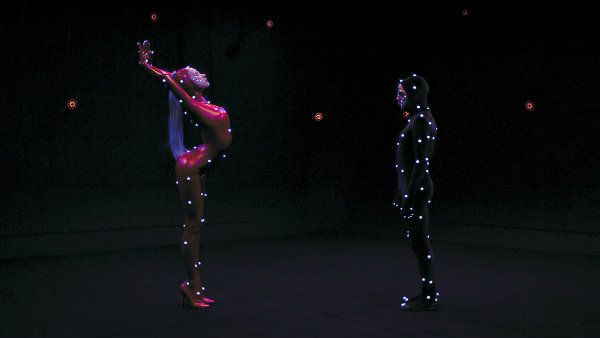
Holy Motors together. He could have played parts of it, I think, like the motion capture scene. But I don't think he could've pulled off a scene with a father and daughter or of him in a deathbed. I knew this much going in -- that the film would be shot in Paris with little money and it will be shot on digital and it would be with Denis and I would not watch dailies. Then I thought the two or three scenes I mentioned wouldn't be good. Still, I thought, "OK, let's try it." So I was very surprised with the results. I don't think now there is any role that he can't play.
Was there any initial scene that sparked to make this film?
....
I'd rather you said you had sort of an image of a theater full of people and you didn't know if they were sleeping or dead ...
I'm not a writer so I don't write script from A to Z. With every film, I have two, three images and feelings, then I try to edit this feelings and images together. There was obviously the limousine, which has been attracting me that I saw first in America and since then .... My neighborhood I live in Paris is a Chinese neighborhood and they use limousines for their wedding .... This I find strange because I find them morbid, more like coffins. But I was very intrigued by them. I thought they were great vehicles for today's fiction. They are like a virtual world. They want to be seen but you can't see inside them. People feel very protected inside. They play a role -- you don't buy them, you rent them, like a rented life. They are like avatars themselves. They are also very cinematic.
And I had this image of an old beggar, which is in the second scene of the film. I pass these gypsy beggars all the time. They are out there every day. They dress the same and their back completely bent. I thought, "how can anyone [be] more alone then them," "what life is left of them?" And so on. Then I was thinking about making a documentary about one of those women and me. We build this bridge between us and I'll try to relate to her and probably have to go to her home country to understand her story.... Then my fear was, if I start making this documentary, there will be no end and I might have to devote myself to this documentary forever. Even in fiction I have a hard time with the ending, how do you end a documentary? So I went completely opposite way. This woman would be played by an actor and I would play my words into his mouth. I guess I associated this role-playing limousine idea with this and put them together.
The last time I saw you was at the Q&A session of the TOKYO! screening here in New York. And you mentioned not getting any funding for any of your projects. You mentioned making HOLY MOTORS cheap and fast. And it's very different from the films you've done. It seems much more energetic and freer than anything you've done. Did the lack of funding play a big role in it being so different?
This movie was born out of rage, rage of not being able to make other projects, so it was imagined very fast. I think the whole idea came about in two weeks. If it seems stronger and freer, it's because it was put together very quickly I think. It was only in a few weeks the idea was conceived. It took us about a year to find the money. But it was shot very fast right after that.
Watching HOLY MOTORS, I couldn't help noticing your ambivalence toward cinema. If someone would've walked up to you and asked, "Should I devote my life to the movies?" what would you tell them?
Devotion is such a strong word. It's really a miracle that cinema exists. It has to be invented. No other art is an invention. In cinema, it needs machines. In French, it's "motor! (equivalent of camera roll!)" before director calls it. "Action!" I was around 16 years old when I discovered this island called cinema where I can see life and death from another perspective, from many different angles. I think every young person should be interested in that island. It's a beautiful place. I haven't made that many films so I don't really consider myself a filmmaker. It's really arrogant for me to say this but I do believe that I live on that island. It's worth living there.
Do you feel any kinship with other directors of your generation?
No. But I'm not looking for any. I started very young. I was a shy young man of 17 when I first came to Paris. I didn't know anyone. I was kind of a bluff -- I didn't study film, I've never been on a film set before, so when I was asking money for film, I was bluffing. I was proud of being alone. So I paid the price for this pride. It gave me strength but also it made me very isolated in the industry. I can't say it's good or bad but that's my story. I happened to be a director (sometimes) and happened to be born in France. But I don't really see myself as part of a certain generation in French cinema.
We are living in a virtual world. There are people living their lives without any real human connections. With the main character going in and out of the situations without any consequences, is that something you wanted to address in Holy Motors?
Yeah.... Actions, the notion of experience is what I was after.... I am interested in virtual reality. But it's something I don't want to impose upon someone, neither I want it being imposed upon me. The film is not against anything. It's about just a fighting for survival. I think we lack in courage. Not only as filmmakers but us as human beings. I think courage should be taught in school. [Everyone laughs.] Whether it's civics, politics, poetry, even physical... if we lose courage nothing is possible.
Did it take you a lot of courage to do this film? It's very personal, like your other films. It's always about Alex, your alter ego played by Denis Lavant. I saw your daughter's name in the credit. And that father and daughter scene, which was very poignant (and mean too). How close was that scene to the relationship with your daughter?
I wouldn't say there is any courage in my filmmaking business. I do what I can. It happens that Denis and I are about the same age. Although I don't know him well but I know he has three daughters. I have one, who appears in the beginning of the film. She's 8 years old. So, you use your fears and all the questions marks in to your film. You know the father and daughter relationship can be one of the most beautiful relationships, but at the same time it's also the basis for many horror stories. I mean a father can be a monster, very easily. That's my fear, being a monster. But it's got nothing do do with my actual relationship with my daughter, I hope.
What I admire about this film is that you have a rich understanding of the cinema's past. All the different genres that are considered dead -- musical, monster films, etc. -- are used and made in a such a new way. I was wondering what your relationship is like with the classic cinema?
What's strange is that I discovered the film at the same time as I started making films. It doesn't really happened that way for most of the people. Usually one comes first and the other later. It just happened to me that way. I watched a lot of films from 16-24. A lot of silent films, Hollywood films of course and the New Wave. But I stopped watching films after my second film. I thought I paid my dues for my love of the cinema and I needed to go my own way. People see lots of references in the film but I don't. I just live on this island called cinema. I just want it to be seen as it was imagined, not with some cinephile's hat on. Hopefully, this film is a success showing the experience of human life today and not come across as some new cinematic language invented. Cinema permits you to see things, like ghosts. And so, I don't care much about cinema's history.
Holy Motors garnered accolades in various film festivals this year and opens on Wednesday, Oct. 17 in New York City.