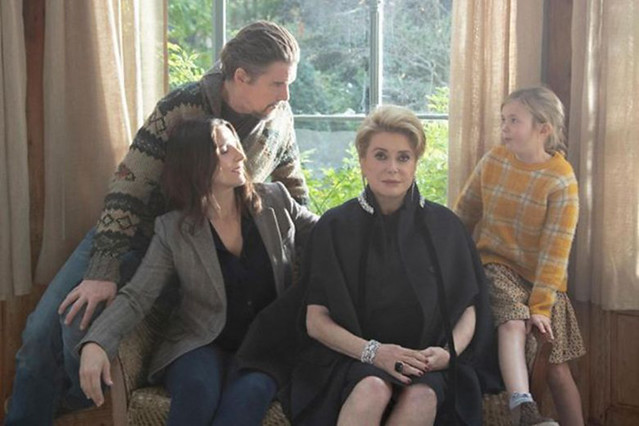
Born out of forever adventurous French actress Juliette Binoche's years of insistence to work with Kore-eda Hirokazu, The Truth marks the famed Japanese writer/director's first film shot outside Japan and in non-Japanese language with international cast. And still, it is, in many ways, a very much Kore-eda film: about family dynamics with thorns and all, yet unmistakably gentle and humanistic. The only departure from his filmography I detect (other than not being Japanese) is that the characters aren't ordinary middle to lower class people that he usually portrays in his films. But I guess the prospect of working with a legendary French film star, Catherine Deneuve, made Kore-eda taking on a different direction. If the appeal of Kore-eda's films is in their universality, especially concerning adults in his films such as Still Walking and After the Storm - the innate goodness in people, admitting their shortcomings, small redemptions and letting the past go, The Truth shows that no matter the class distinctions, the concept of a 'family' still rings true to all of us.
The story concerns Fabienne Dangeville (Deneuve), a legendary French film star and her screenwriter daughter Lumir (Juliette Binoche). Fabienne's memoir titled The Truth is coming out and to celebrate the occasion, Lumir and her American, second-rate TV actor husband Hank (Ethan Hawke) and their bi-lingual preteen daughter Charlotte (Clémentine Grenier) pay her a visit in a secluded grand mansion where Lumir grew up.
Upon reading the memoir, Lumir finds there are glaring omissions and falsehood from her childhood. For instance, Fabienne never picked up Lumir from school, like ever, unlike she says that she always picked her up even during her busy schedule. Fabienne's defense is , "Actors never tell the naked truth" in public. Everyone's memories are subjective anyway, she quips.
To make the matters worse, Luc (Alain Libolt), a long time devout assistant to Fabienne, calls it quits over not mentioning one word about him in the memoir. Now all the personal assistant duties fall on Lumir - receiving messages, accompanying Fabienne to movie sets, etc., whether she likes it or not- after all, she is her mother.
The catalyst for Fabienne happens when she takes an acting job, a supporting role in a low budget Sci-fi movie, aptly titled Memories of My Mother, by an unknown young director. Her co-star, a rising actress Manon (Manon Clavel), reminds her of her acting rival and close friend Sarah back in the day. It was kind-hearted Sarah who became a mother figure for young Lumir in Fabienne's absences.
Memories of My Mother, this movie-within-a-movie, is about a woman who is terminally ill, so she takes off to space in order to stop the advancing disease. She only comes down to earth every seven years to see her daughter, Amy, grow. She, herself forever young, gets to witness her daughter grow old. Fabienne is playing the old Amy part.
First, Fabienne tries to outdo her perceived rival in acting, scoffing and jabbing with pointy remarks at everyone around her, using her diva status indiscriminately. Then she realizes that Manon, like Sarah, is a genuinely warm-hearted soul and also a talented actress with great potential. This makes her to reassess her relationship with her daughter and people around her.
Is Fabienne character a thinly disguised reflection of Catherine Deneuve? Is The Truth a sly take on real life and movie industry and stardom in the likes of Postcard from the Edge? It is pretty clear that Kore-eda's interest is elsewhere. Given the opportunity to utilize a screen legend, he makes it larger than life, but at the core, The Truth is a superb family drama full of heart.
Fabienne says to Lumir in her defense things like, "I'd prefer to be a bad mother, bad friend but a great actress." It is true that we say the meanest, most hurtful things to those closest to us. Like it or not, we've all experienced it in our family. It's not because we mean it, but rather, because we can (and often shouldn't), precisely because we are family. For Kore-eda, who often examines the concept of family, understands this and creates beautiful, three-dimensional characters and great dynamics here. Deneuve is flawlessly in the role of aging diva. Binoche, a struggling daughter always in the shadow of her mother is also great. Ethan Hawke assumes his goofiness and brings in much needed (self-deprecating) humor and warmth.
With no huge emotional explosions and tearful scene-stealers, The Truth might come across as too subtle. But that's how Kore-eda always has been operating. Even though there is nothing Japanese about the film, he proves that there is universality in family dynamics anywhere. Quietly affecting with superb performances, The Truth is a welcome variation from always reliable Kore-eda.
The Truth opens July 3. Please visit IFC Films for more info.
Dustin Chang is a freelance writer. His musings and opinions on everything cinema and beyond can be found at www.dustinchang.com

