Showing posts with label NYC. Show all posts

Monday, March 14, 2022

Preview: First Look at MoMI 2022

First Look, a Museum of Moving Image's annual showcase, scoping new innovative films from around the world, is back and I'm happy to announce that it's a real treasure trove this year.

This year's lineup includes Murina, a Cannes Camera d'Or (Best First Feature) winner from Croatia, two documentaries by Ukrainian master filmmaker Sergei Loznitsa, Valentyn Vasyanovych's all-too-precient realization of the Russian invasion in Reflection, Chinese artist Qiu Jiongjiong's spectacularly cinematic display of history and art, A New Old Play, Tsai Ming-liang's love letter to flourescent light soaked Hong Kong's afterhours in The Night, Adèle Excharpoulos starring satire on capitalism, Zero Fucks Given, just to name a few. The festival runs 3/16-3/20. For tickets and info, please visit MoMI's website.


Murina - Antoneta Alamat Kusijanovic *Opening Night Film Murina Julija is a teenage girl living in the small fishing island off the rugged, picturesque coast of Croatia with her overbearing father, Ante, and a former beauty queen mother, Nela. Antoneta Alamat Kusijanovic's debut film strongly develops into a fraught father-daughter relationship out in the open, or under the surface in this case with the striking opening sequence- they are spearfishing for an illusive sea eel together. As they come out of the water, you can see there is a cut in Julija's upper thigh near her groin. She was manhandled in the water for something she shouldn't have done. The tension rises when Ante's old friend, millionaire developer Javier (suave Cliff Curtis) visits the island for a land developing deal that Ante is cooking up. They are hoping to move to Zagreb and get an apartment if the deal goes through, possibly leaving behind the fisherman existence. Sexual tension, jealousy clash with controlling nature of patriarchal society. With lush cinematography and great feature acting debut by Gracija Filipovic, Murina stands above the usual coming of age film.

The Night - Tsai Ming-liang *screens with Murina as Opening Night Film The Night Shot in November of 2019 while making Days in Causeway Bay, Hong Kong, this 20 minute short, The Night, is an amalgam of all Tsai's films in a small package - urban loneliness. Long static shots of night exterior with a cold fluorescent lights with ordinary people walking, waiting at the bus stops, eating in tiny stalls, with occasional cars passing by, play out like a Hong Kong version of Edward Hopper painting in motion in a concrete jungle, where human beings seem tiny and insignificant. A melancholic old song "The Night is Too Beautiful to Last" by Pei Ni kicks in around 15 minute mark. The film is Tsai's love letter to the night and melancholy it brings.

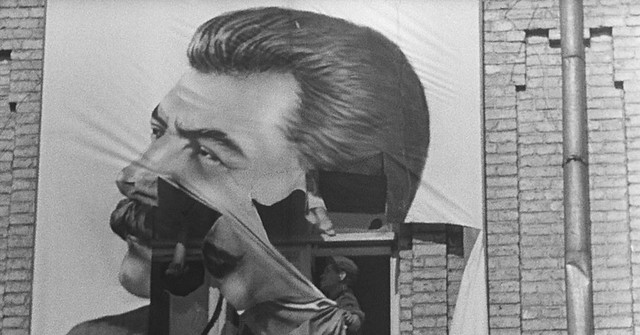
Babi Yar. Context - Sergei Loznitsa Babi Yar Babi Yar is a ravine near Kiev where execution of 33,771 Ukrainian Jews took place when the city fell to invading German troops in 1941. They were rounded up by German SS soldiers and the Ukrainian Police Force. In this all archival footage documentary, Ukrainian filmmaker, Sergei Loznitsa, approaches the subject in his typical, non-authorial way, without any narration and spares no one in the process. The holocaust memorial wasn't built until 2016. Now with the Russian invasion with Putin's shrewd campaign to 'denazifying Ukraine' and Svoboda - ultra-nationalist/neo-nazi element in Ukraine and also having a Jewish head of the state Zelenskyy emerging as the national hero during war time, Babi Yar. Context provides Ukraine's complex history and counters what is termed as chronocide, or erasing history, in our modern society full of misinformation and propaganda.
Feathers - Omar El Zohairy Feathers When her husband turns into a chicken during the magic trick at their son's birthday party, our unnamed female protagonist has to deal with 3 young children and crippling poverty and absurd amount of bureaucracy.
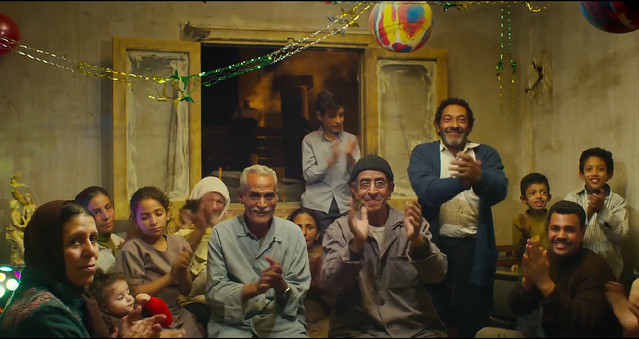
Feathers is an Kafka-esque absurdist social satire of the patriarchal, sexist Egyptian society. Director Omar El Zohairy, assistant director for fantastic 2016 film Last Day of the City, making his feature film debut, prefers tight, off-centered framing to accentuate the cramped interiors, physical dominance over the female heroine. Part surrealist comedy and part neo-realist drama, Feathers illustrates that there are very limited options for women living in a men's world.

A New Old Play - Qiu Jiongjiong A New Old Play Impeccably crafted, Chinese artist Qiu Jiongjiong's epic A New Old Play is seen through the eyes of Qiu Fu (Yi Shicheng), a gifted Chinese opera singer through the tumultuous modern history of China from 1920s to Mao's Cultural Revolution and beyond.
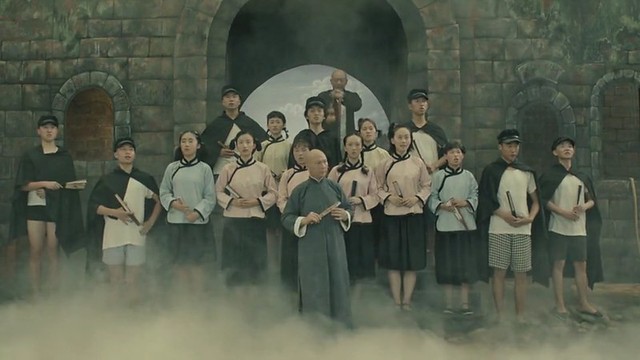
Qiu, with a white patch around his nose permanently because of wearing his clown makeup all his life, is summoned by two demons (Bullhead and Horsehead) to report to hell, because he is dead. We are then taken back to Qiu's early years as a street urchin being picked up by the Sichuan theater troupe headed by Chinese opera enthusiast and army commander Pocky. Spectacular handpainted sets and backdrops (production design done also by Qiu) and with simple but clever camera staging - slow dolly tracking and playing with deep focus, A New Old Play has in common with Roy Andersson's and Wes Anderson's cinema, if only aesthetically. Through its 3 hour runtime as these carefully orchestrated sets and movements settle you in to lived-in, comfortable feeling. And its Qiu's unbiased approach to Chinese history that gives melancholic resonance and wisdom being a witness to history on a personal level. Qiu hits home the idea of life being a stage, where we live and die on it

Reflection - Valentyn Vasyanovych Screen Shot 2021-09-13 at 10.36.22 AM If Valentyn Vasyanovych's previous filmAtlantis was dealing with fictional scenario of the future ecological devastation and human toll from the prolonged war, Reflection, using gray landscapes and claustrophobic interiors, delves into the psychological damage of on-going conflict and threat from the neighboring ominous superpower. Sly metaphors, like dead pigeon, makeshift pyre, ravenous stray dogs are all present. But as with Atlantis, there is a glimmer of hope in Reflection. This time, it's not the love between a man and a woman, but that of father and daughter. Known to use non-actors in his films, Vasyanovych uses his own daughter to play Polina. She in turn, gives a great performance in long takes, engaging in religious and spiritual discussion with Lutskyi who plays her father. Her innocence shines through in a dreadful industrial, monochrome winter Ukraine landscape. Daring in its cinematic language, and unflinching in its presentation of the present, the film makes you impossible to ignore the state of the on-going conflict in that part of the world.

Read my full review from Venice 2021: https://screenanarchy.com/2021/09/venice-2021-review-reflection-resonant-formalist-look-at-russo-ukrainian-war.html

Zero Fucks Given - Emmanuel Marre, Julie Lecoustre Zero Fucks Given Sharp observations on the service industry in the 21st century capitalism is at the center of Zero Fucks Given. Adèle Exarchopoulos is Cassandra, a flight attendant at a small European airline company, Wing. The film devotes most of its running time to the banal day to day life of young flight attendants who dream of one day working for Emirates Air, the creme de la creme of the industry and hard to get into. But Cassandra seems to have no directions or ambitions, other than going through, repeating her daily routines of work, dealing with constant micro-management, partying off-hours, being lazy by the pool side in sunny Lanzarote where the company hub is located and countless one night stands through online apps.

Things take a drastic turn when she is reprimanded for buying a distraught customer a wine out of compassion and sent home to Brussels. Staying with her younger sister and her sad widowed father, it is revealed she was running away from her mother's sudden death.

With verité style candid cinematography by Olivier Boonjing and Exarchopoulos's committed performance, Zero Fucks Given comments on hyper capitalist society where work and personal life exist like oil and vinegar, yet one dictates another whether we like it or not.

Thursday, July 18, 2019

Japan Cuts 2019 Preview

Blue Hour
blue_hour_02_1
Hakota Yuko's debut feature Blue Hour starts with a flashback of a little girl running carefree in the field in the early/late hours where you can't tell it's day or night- hence the title, Blue Hour. The little girl is Sunada. She is all grown up (Kaho of Our Little Sister) and just turned 30. She has a steady job as a CM director and married, so she should be content with her life. But her lifeless expression and awkwardness around people tell a different story. There is something missing in her life and her affair with one of her crew members doesn't seem to be filling that gap either.

In the spur of the moment, Sunada decides to take a trip to her rural home town in Ibaraki with her quirky best friend Kiyu (Shim Eun-kyung) to see her grandmother who is in an old folks facility. It's been forever since Sunada visited home. It is apparent that she is embarrassed about her dairy farmer parents' 'tacky' lives. It's the life Sunada grew up with but left behind for the city living long ago. But relentlessly cheerful Kiyu is having the best time with her parents and rural surroundings, often teasing her about her snobbish attitudes.

Director/writer Hakota's tale of a modern Japanese woman dealing with what the society expects of her vs her own happiness is beautifully and subtly drawn out. Kiyu tells Sunada that it's the 'tackiness' that makes her feel alive. Kaho and Shim has a great chemistry together. Like Bae Du-na in Kore-eda's Air Doll, using a Korean actress Shim in Blue Hour adds that extra other-worldliness to the character of Kiyu.

Kamagasaki Cauldron War
kamagasaki caldraun war
Largely using actual Kamagasaki residents as his cast, Sato Leon, a documentary filmmaker, creates a humorous, satirical look at an Osaka's less desirable neighborhood of the title. It concerns a stolen iron cooking pot/cauldron, which symbolizes family and community in times of famine and difficult times. But this particular pot, however, belongs to the local yakuza family with their insignia at the bottom. There is Nikichi, a no good bum who hangs around the local whore house. There is Tamao, a reluctant heir to the local yakuza and a rival of Nikichi in childhood. And there is Mei, a free spirited prostitute whom the two men still carry the flame.

Everyone is stealing kamas (cauldrons) in the neighborhood in the hopes of getting rewards and Nikichi becomes an accidental hero while stealing a giant ceremonial kama, to the local radical homeless activists opposing the redevelopment and eviction of undesirables in the area.

Shot in beautiful 16mm with lots energetic moving camera shots, the film has a look and feel of a 70s Japanese New Wave film. The Kamagasaki Cauldron War showcases a part of society that rarely gets depicted on screen.

Orphan’s Blues

31PFF01_1
We are introduced to Emma (Murakami Yukino) furiously scribbling notes on paper, then on her arms and legs in sweltering heat. She seems to have burn mark in her back from years ago. It is revealed that she owns a tiny roadside bookshop on the coast and she constantly forgets the customer's orders. So more scribbling down the name of the book...

Then Orphan's Blues, writer/director Kudo Riho's first feature, becomes a road movie. Emma, with her backpack and a letter that has her friend Yang's last known address, she starts out her journey to find her orphanage mate. On the road she runs into Van (Kamikawa Takuro), another friend from orphanage. He and his young girlfriend Yuri are on the run from some local gangsters. So he decides to tag along with Emma to help her find Yang. The address on the letter takes them to a roadside cafe owned by Luka (Kubose Tamaki), but no Yang. As they spend days together in Luka's tiny, electricity scarce house, the buried secrets and raw emotions come to the surface. With her memories quickly disintegrating, Emma becomes completely disoriented over time.

Orphan's Blues is an unexpectedly moving film about childhood traumas that have a lasting effects on a group of friends. Even though the film is narratively shaky, with natural camera work and young actors' committed, raw performances, Kudo shows great promises as a major voice in Japanese cinema.

Melancholic
Melancholic
Like many Japanese millennials, Kazuhiko (Minagawa Yoji) is floating through his post-college life- still living in his parents' house with no job prospects, even though he graduated from the prestigious Tokyo University. With lanky figure and crooked Jeffrey Dahmer glasses, he is the very definition of dweeb.

Kazuhiko runs into Yuki, a cute girl whom he went to High School with, at the local public bathhouse. And since the owner, Mr. Azuma, is hiring, Yuki suggests him to get a job there. It's a peaceful, easy job. And it also pleases his mild mannered parents that he is at least working, even though the job might be beneath him. But one night, Kazuhiko walks in on Azuma and a grunt co-worker killing and disposing a body in the bathhouse. He learns that they are indebted to Tanaka, a local yakuza and that he will need to be quiet about the body disposing business or else he will also get killed. So Kazuhiko becomes an accomplice, a cleaner after the deeds are done.

Even though director Tanaka Seiji borrows typical yakuza tropes, at heart, Melancholic is a laid back, quiet coming-of-age story that reflects Japan's economically depressed, directionless generation. The film sharply rejects the old, yet still finds comfort in the notion of 'family'. Its 'que sera sera', live-by-the-moment attitude is well suited for representing the 'melancholic' generation.

And Your Bird Can Sing
The Beatles song that film's title borrows from, is about people not really understanding who you are. It's an apt title for this poignant film about being young and living by the moment.

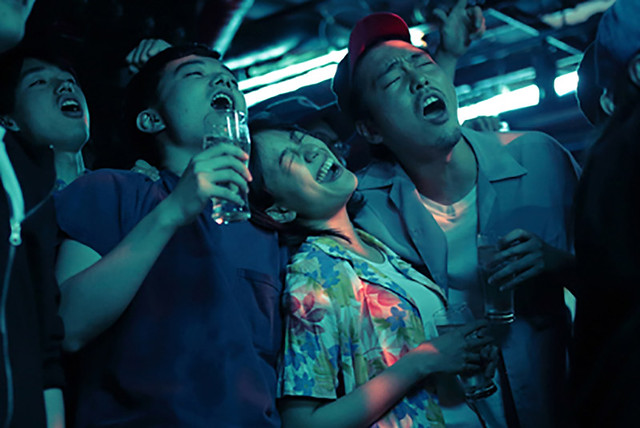
Emoto Tasuku is our nameless protagonist, sporadically narrating the film. He is a twenty something slacker working at a bookstore, part-time. He lives with an unemployed roommate Shizuo (Sometani Shota) whom he shares a one-room bunk bed apartment with. He hooks up with Sachiko (Isibashi Shizuka), a co-worker whose insistence in getting into his life he passively allows. The three of them spend their days out in bars, pool halls and clubs. The night is young for these young people.

Nothing fazes our protagonist. He insists and encourages Shizuo to take Sachiko out. He is indifferent about Sachiko's relationship with the boss at a bookstore. He just doesn't seem to care about anything. The good times won't last long, so why needlessly worry about the future?

And Your Bird Can Sing is much more interested in the embracing fleeting moments of youth than its character development. These three main characters don't have much of an arc nor have anything particularly interesting things to say. But director Miyake Sho captures the tone of this youthful melancholy right. It's that unspoken understanding that nothing is permanent that these characters are aware of and so do the audiences watching them. It's in his details - the fading bouquet of stolen flowers, the warm morning sun hitting Sachiko's pretty face and lovingly sketching out the lives of the film's secondary characters who seem to be contentedly living in their own bubble.

All three main actors Emoto, Sometani and Isibashi are outstanding for their roles in capturing the spirit of these young people. They could easily be seen as hedonistic, but their moments of sadness and silences tell a different story. The build up to the ending with the voice over that bookends the film seems a little tacked on but it worked for me.

The book the film is based on is Yasushi Sato's debut novel. The author killed himself in 1990. But many of his books have been adopted as of late including Sketches of Kaitan City, The Light Shines Only There. Even though the book came out in 1982, his wayward characters and sadness that hangs over like a cloud are still very much completely relatable in today's economically depressed nation.

Tuesday, April 7, 2015

KINO! 2015 Contemporary German Film Festival

KINO!, a celebration of contemporary German films, returns to New York for its 36th edition, setting up shop at Cinema Village in the West Village for the second year, April 9 - 16.

Selected from across the great expanse of different genres and from seasoned directors and newcomers alike, this year's edition features 10 features and 8 shorts, including new works from Christoph Hochäusler (The City Below, I am Guilty), Christian Zübert (Three Quarter Moon) and TV veteran Uwe Janson, as well as from rising stars Baran bo Odar (The Silence), Philippe Lienemann, Stephan Altricher and Neele Leana Vollmar (Vacation from Life).

In addition to the screenings, there will be panel discussions at Goethe Institut and Deutsches Haus for Beltracchi: The Art of Forgery and The Lies of the Victors with filmmakers attending.

KINO! 2015 runs April 9 - 16. Please visit Kino! 2015 website for more info and tickets.

Here are samples of five films I was able to catch:

The Lies of Victors
 photo 47e75f6a-42bb-4e81-ac3d-27363af69813_zpsydn81dls.jpg
Christoph Höchhausler's latest is a sleek, taut political thriller in the vein of All the President's Men and Z. Florian David Fitz (also representing Tour De Force in the series) plays a hotshot reporter named Fabian who had established himself with his Afgan war coverage for the fictional Berlin magazine Die Woche (The Week).

He is digging up some dirt about PTSD and toxic poisoning in vets returning from tours in Afghanistan. He is assigned a new perky intern Nadja (Lilith Stangenberg) to help him out by his editor-in-chief. Fabian who has always worked alone, resents her company at first and throws some unrelated story at her to investigate. It turns out that the story of a man who threw himself into a lion's cage has a connection with his PTSD story. But is he getting played by everyone? Is Nadja really who she says she is?

Without ever using car chases or gun fights, Höchhausler creates an engrossing thriller. Fabian doesn't really know that a powerful firm representing a big German chemical company which has ties with the politicians, is watching his every move and feeding false leads, every step of the way. And when Fabian realizes the fact, it's already too late.

With stylish back and forth dolly shots and 360 pans and a Howard Shore resembling, tense soundtrack (expertly arranged by Benedikt Scheifer), The Lies of the Victors is a sumptuous neo-noir experience.

Beltracchi: Art of Forgery
 photo ad26f2a0-045d-4c3d-ba54-8fbc58a70c7e_zpss09ify9f.jpg
This documentary tells an exciting story of master art forger, Wolfgang Beltracchi, who claims to have forged over 300 paintings by 20th century masters - Max Earnst, Heinrich Campendonk, Fernand Léger and others over 35 years. He's no mere copy artist. What's impressive about this long haired, affable aging hippie is his ability to convincingly forge 'new' paintings of those said artists' 'gap years' through meticulous research and craftsmanship thus tricking even the scholars and specialists of the art world.

Beltracchi and his accomplice/wife Helene, played the art market well, and made millions without getting caught until recently. Beltracchi not only illustrates the brilliant conman's career but also tells the sweetest love story ever told.

King's Surrender
 photo a4ae8dc7-c2be-404d-960a-805a38cab89a_zpsphuzxlze.jpg
A taut police thriller starring Ronald Zehrfeld (Barbara, Phoenix) and Misel Maticevic (In the Shadows). They play members of a tight knit special unit SWAT team. The country under austerity measures, things are tightening up even in the police headquarters. Some of the special unit resort to taking bribes.

After a bungled raid, team members are dropping like flies in what seems to be execution style revenge killings. Hot-headed Mendez (Maticevic) calls for blood while Kevin (Zehrfeld) digs deeper into corruption inside their unit and up the chain of command.

These testosterone filled, wayward cops involve themselves inadvertently in a conflict between local gangs and that proves to be a fatal mistake. With great cast, tense atmosphere and heart pounding suspense, King's Surrender is a gripping policier that rivals any Hollywood production.

Schmitke
 photo fa0a0393-cf5f-415a-8738-453a3be407d3_zpsdywocslm.jpg
Stephan Altricher directs a modern day retelling of Don Quixote in Schmitke. Schmitke (Peter Kurth) is a middle aged wind turbine engineer who dreams of being in the forest, away from his city life filled with jack hammers and traffic noises. Every morning he listens to the news of the discovery of a man who's been living in the forest alone. This so called Bear-Man is apparently refusing any help from authorities and only longs to go back to the forest. But being a prototypical German engineer who takes pride in his work and efficiency, Schmitke doesn't really buy into spiritual mumbo-jumbo that his daughter who just got back from India, talks about or the Bear Man.

He gets a chance to go into the mountains in the Czech Republic for maintenance work on a wind turbine, a model he practically designed, which stopped working. With his young, slacker assistant Tomas (Johann Jügens) in tow, he drives to the small mountain town.

Upon arriving, they notice an unending loud noise that sounds like a constipated dinosaur coming from the mountain. It turns out to be coming from the creaky wind turbine in question. But whatever he tries, the turbine is not responding. After getting icy receptions from the townsfolk and sleepless nights at the local inn, our engineer discovers that Tomas has disappeared. From a sexy local business woman Julie (Helena Dvorakova), Tomas was last seen talking about some mystical power of the forest and Bear Man. Schmitke's wild goose chase begins.

The yearning for nature and the process of giving into something bigger than yourself against reason takes a center stage in Schmitke. Kurth's plays the title character straight with his stone face and matter-of-factness which works well in this droll comedy. Shot beautifully by Cristian Pirjol in the Ore mountains of the Czech Republic, and with amazing sound design by Paul Wollstadt, Schmitke is a great surrealistic comedy.

Who Am I: No System is Safe
 photo 9bf0d468-c03b-419d-80b6-4ad08e2f18da_zpsp0xqlfdb.jpg
In the wake of North Korean hackers scandal, Baran bo Odar (The Silence) offers a fast paced, slick cybercrime thriller Who Am I: No System is Safe. It starts out with our unreliable narrator, Benjamin (Tom Schilling, looking like young Edward Norton) turning himself in to authorities, telling how it all started. Ben is a socially awkward, self-admitted misfit, who grew up in front of the computer. He is recruited by a group of fame seeking hackers and together they build CLAY (acronym for Clowns Laughing At You) with clown masks from his grandma's house.

They hack into various financial systems and pharmaceutical buildings, mostly for laughs. But more than anything, they want their cyber idol MRX's approval, whose driving mottos are 1. No system is safe, 2. Aim for the impossible, 3. Don't limit your fun to the virtual world.

They hack into German cybercrime unit to impress MRX but it turns out that MRX has other plans when it comes to eliminate the competition. Now the crew doesn't think the fame is worth risking their lives.

Co-scripted by his writing partner Jantje Friese, bo Odar creates a tension filled, cat-and-mouse thriller with lots of twists and turns. Elyas M'Barek (The Wave, City of Bones) plays charismatic Max, Hannah Herzsprung (4 Minutes, Beloved Sisters) plays Marie, the love interest and great Danish actress Trine Dyrholm (The Celebration, A Royal Affair) rounds up the top notch supporting cast as the seasoned Europol investigator. Who Am I is a superbly created entertainment. Hollywood should recognize bo Odar's talent sooner than later.

Tuesday, October 14, 2014

By Maguerite Duras at FSLC

Screen Shot 2017-06-16 at 6.58.49 AM With 4K digital restoration and re-release of Alain Resnais' 1959 classic, Hiroshima Mon Amour, Film Society of Lincoln Center announces a series devoted to the film works of a Nouveau Roman giant Marguerite Duras who provided the screenplay for the film. Duras, along with Alain Robbe-Grillet, was part of the Left Bank film movement and hugely influential for coming of  French New Wave.

Putting a big emphasis on mood and dialogue, Duras' elliptical stories have long been well regarded and respected by the film giants like Resnais and Godard. The film series presents 10 features and 3 shorts, 9 of which she directed - notables include, India Song, Le Camion, Natalie Granger, Madmoiselle (dir. Tony Richardson), Moderato Cantabile (dir. Peter Brook) and Every Man for Himself (dir. Jean-Luc Godard).

The series is a rare opportunity to catch some of these seldom available films anywhere on 35mm prints, written/directed by one of the most influential post-war French writers.

By Marguerite Duras
runs 10/15 - 22 at FSLC. Hiroshima Mon Amour will open at Film Forum and FSLC on Friday, October 17 in and Los Angeles at the Laemmle Royal Theatre following its sold out screening at the 2014 New York Film Festival. Long unavailable for exhibition in the US due to rights issues, it will be released nationally in a spectacular new 4K restoration.

The Film Society of Lincoln Center announced today By Marguerite Duras, October 15-22, a weeklong retrospective of the film work by the novelist, essayist, and playwright on the occasion of her centennial, and the re-release of Hiroshima Mon Amour at the Film Society on October 17. Duras directed 19 features and short films, many adapted from her own work, all exceedingly difficult to see in the U.S., until now. The lineup includes a selection of her formally daring films, movies adapted from her writing, short films, and more, all on 35mm.
Best known as a leading literary figure in postwar France with award-winning books, Duras's early novels were considered more conventional in form until Moderato Cantabile (1958), which was more experimental and placed the focus on what was not said. At 45, Duras penned the screenplay for Alain Resnais's Hiroshima Mon Amour (1959), whose nonlinear plot and elliptical editing would greatly impact the burgeoning French New Wave (a movement whose literary analogue, the Nouveau Roman, Duras was tangentially linked to). Its radical use of voiceover anticipated the disjunction of sound and image that would become her calling card.
By Marguerite Duras includes her solo directorial debut, Détruire dit-elle / Destroy, She Said adapted from her own play, and Les Enfants, winner of three prizes at the Berlin International Film Festival, which was Duras's final film as a director. Other highlights include Le Camion / The Truck, which was nominated for the Palme d'Or at Cannes; Moderato Cantabile, for which Jeanne Moreau won Best Actress at Cannes, and Jean-Luc Godard's Sauve qui peut (la vie) / Every Man for Himself, which he introduced as "my second first film," and is characteristically cerebral and peppered with literary allusions, including an unforgettable anti-cameo by Duras.
Special thanks to the Institut Francais for the loan of their prints, and the Cultural Services of the French Embassy for their support.

Films, Descriptions & Schedule
Agatha et les lectures illimitées
Marguerite Duras, France, 1981, 35mm, 85m
French with English subtitles

Hiroshima Mon Amour at the shore. A brother and sister (Yann Andréa and Bulle Ogier) meet at a seaside hotel to confront the nature of their relationship and try to achieve closure with the past. Their love for each other and its manifestations emerge in voiceover, with Duras herself articulating the sister's thoughts. Eschewing traditional approaches to storytelling, Duras keeps the siblings off-screen or obscured for much of the film and never allows them to share the frame. Her camera prowls the deserted hotel lobby and sometimes catches itself in the mirror, analogizing the film's reflective themes.
October 21, 8:30pm

Le Camion / The Truck
Marguerite Duras, France, 1977, 35mm, 80m
French with English subtitles

Initially conceived as the story of an older woman hitching a ride with a trucker, bemoaning the demise of the revolution and the impoverished state of society ("the world has gone to rack and ruin"), Le Camion ("The Truck") is the film that ensued when Duras couldn't find a suitable actress for the lead. Instead, she and Gérard Depardieu sit at a table and read from the script, discussing the film that might have been, with periodic cutaways to a truck driving along the highway at night. Celebrated by figures as disparate as Pauline Kael and John Waters, Le Camion was nominated for the Palme d'Or at Cannes and hailed by Jonathan Rosenbaum as "one of Marguerite Duras's most radically minimalist features . . . [also] one of her best, as well as one of her most accessible."
October 16, 8:30pm
October 22, 2:30pm


Détruire dit-elle / Destroy, She Said
Marguerite Duras, France, 1969, 35mm, 98m
French with English subtitles

Adapted from her own play, Duras's solo directorial debut concerns an isolated hotel surrounded by dense forest, with only four guests in evidence: a professor of "future history" and his young bride (Henri Garcin and Nicole Hiss), a troubled woman (Catherine Sellers) recovering from a miscarriage, and a German would-be writer (Michael Lonsdale) with designs on the professor's wife. Despite the roundelay of attraction, Smiles of a Summer Night this is not; its claustrophobia (the women fear the forest) and convergence of identities (Hiss and Sellers share one of the director's trademark mirror scenes) place it much closer to Persona. In Film as a Subversive Art, Amos Vogel praises its "highly stylized, non-logical dialogue [which] creates enigmatic fear."
October 15, 9:00pm

Les Enfants
Marguerite Duras, France, 1985, 35mm, 94m
French with English subtitles

Seven-year-old Ernesto (played by adult Axel Bogousslavsky) leaves school because he doesn't wish to learn, believing knowledge serves no purpose in a bankrupt world. His parents (Daniel Gélin and Tatiana Moukhine) try to make sense of their son's cynical and inscrutable convictions. Winner of three prizes at the Berlin International Film Festival, Duras's final film as director may have taken inspiration from her own unhappy years in a Saigon boarding school. Her penchant for uninhabited spaces is evident in her shots of the schoolyard--the empty playground pairs with Bogousslavsky's casting to make a comment on vanishing childhood and untimely disillusionment.
October 17, 4:30pm
October 22, 4:30pm


India Song
Marguerite Duras, France, 1975, 35mm, 120m
French with English subtitles

Duras's favorite collaborator Delphine Seyrig ("the greatest actress in France and possibly in the entire world") is hypnotic as Anne-Marie, the wife of a disgraced French diplomat (Michael Lonsdale), suffering from "leprosy of the soul" or what might be more chicly termed ennui. Through a mélange of off-screen gossip (again nearly all sound is nonsynchronous), we learn of Anne-Marie's scandalous conduct in 1930s India and her eventual fate, engendered by boredom, colonial guilt, and a string of meaningless affairs. Duras renders her study of mental torment in elaborate style (Dave Kehr calls her "the Busby Berkeley of structuralism"), and Bruno Nuytten's cinematography captures the glittering emptiness of life in a gilded cage--the feeling that privilege can be its own form of illness.
October 15, 6:30pm
October 17, 2:00pm


Mademoiselle
Tony Richardson, France/UK, 1966, 35mm, 103m
French, Italian, and Latin with English subtitles

Duras adapted Jean Genet's story of a repressed schoolteacher in rural France (an unflinching turn by Jeanne Moreau) who causes mayhem in her village and allows prejudiced locals to blame an Italian woodcutter (Ettore Manni), with horrific results. Director Tony Richardson renders a one-of-a-kind hybrid of arthouse drama and psychosexual thriller, which even its detractors found too audacious to ignore (Roger Ebert declared Moreau "flawless"). Fraught with Freudian symbols (snakes, felled pine trees) and a scathing vision of corrupt and unknowable humanity, Mademoiselle was nominated for the Palme d'Or and earned a BAFTA for Jocelyn Rickards' costumes.
October 16, 4:30pm
October 18, 9:15pm


Moderato Cantabile
Peter Brook, France/Italy, 1960, 35mm, 91m
French with English subtitles

"Moderate and songlike"--a musical tempo, but also an apt descriptor of this moody, deliberate drama co-scripted by Duras from her novel. Jeanne Moreau won Best Actress at Cannes for her haunting portrayal of a wife and mother whose husband is the chief employer of their steel town near Bordeaux. Her life consists of little more than shuttling their son to piano lessons, until one day, mid-sonata, she hears a scream. Before long she's conducting a murder investigation with one of her husband's workers (Jean-Paul Belmondo), unleashing her own morbid impulses and perhaps a private death wish. Theater giant Peter Brook's restrained direction casts rare moments of intensity in relief, and Armand Thirard's crisp cinematography conveys the desolation of life in a windswept town where "summer never comes."
October 16, 6:30pm
October 21, 5:00pm


Nathalie Granger
Marguerite Duras, France, 1972, 35mm, 83m
French with English subtitles

The woman's picture gets the Duras treatment in this spare account of two female cohabitants and their assorted vexations. One (Lucia Bosé) has a daughter in primary school (Valerie Mascolo in the title role) whose teacher reports violent outbursts despite her passive demeanor at home. The other (Jeanne Moreau) greets news of a killer on the loose with the same indifference she directs at burning trash. Gérard Depardieu shows up as a door-to-door salesman who may in fact be peddling himself. Customarily placid but for surprising dashes of absurdism ("There is no telephone here, madame," Moreau says into the receiver), Nathalie Granger is domestic melodrama as only Duras could pervert it.
October 15, 4:30pm
October 18, 7:00pm


Le Navire Night
Marguerite Duras, France, 1979, 35mm, 95m
French with English subtitles

Ever the iconoclast, Duras proffers two lovers who never meet face to face. Dominique Sanda plays a woman with tragic reasons for keeping her paramour (Mathieu Carrière) at a distance, confining their affair to phone calls initiated by her--a Durasian construct, language detached from images. The director invites us to share their frustrations by limiting our contact with the stars, sequestering them in dark rooms and cutting to empty streets as their words take on lives of their own. Featuring the voices of Duras and protégé Benoît Jacquot.
October 17, 7:00pm

Sauve qui peut (la vie) / Every Man for Himself
Jean-Luc Godard, France/Austria/West Germany/Switzerland, 1980, 35mm, 87m
French with English subtitles

Concluding a decade of experimentation, Godard returns to character-based storytelling with this portrait of restless, intertwining lives, survival in a capitalist state, and the myriad forms self-debasement can take. TV director Jacques Dutronc (playing a character named Paul Godard) has left his wife for a co-worker (Nathalie Baye), who--disenchanted with television and Paul--plans a move to the country. Meanwhile, a country girl (Isabelle Huppert) works nonchalantly as a prostitute in the city. Introduced by Godard as "my second first film," Sauve qui peut (la vie) is characteristically cerebral and peppered with literary allusions, including an unforgettable anti-cameo by Duras. "Breathtakingly beautiful and often very funny ... I trust it will outlive us all."--Vincent Canby, The New York Times
October 17, 9:15pm

Duras Shorts Program:
Cesarée
Marguerite Duras, France, 1978, 35mm, 11m
French with English subtitles

Duras's heartrending narration elegizes Queen Berenice, banished from Rome by Emperor Titus in the First Century. (In typical Duras fashion, the two are referred to only as "Elle" and "Lui.") Footage consists of discarded shots from Le Navire Night, with the Seine and Tuileries Gardens "playing" the title locale, the speculative site of Berenice's exile.
L'Homme atlantique
Marguerite Duras, France, 1981, 35mm, 42m
French with English subtitles

In this avant-garde short, Duras uses outtakes from Agatha et les lectures illimitées, removing Agatha and leaving only the voice and likeness of her brother (Yann Andréa). Duras scholar Leslie Hill contends that for the first time in her work, "the gap between image and sound is now aligned with the fissure of sexual difference itself."
Nuit noire, Calcutta
Marin Karmitz, France, 1964, 35mm, 24m
French with English subtitles

Duras scripted this sketch of Jean (Maurice Garrel), a writer struggling to complete a Calcutta-based novel while battling alcoholism and creative impotence. Most of the text is spoken off-screen, evoking dislocation that's echoed visually in the world beyond Jean's window--could the woman outside be the character he's unable to capture in words?
October 21, 7:00pm

Thursday, April 10, 2014

Preview: Art of the Real Tests Boundaries of Documentary Filmmaking

Film Society of Lincoln Center's inaugural film series Art of the Real - a showcase for nonfiction films that pushes the farthest boundaries of documentary filmmaking, is for me, one of the most exciting film series I have a privilege to be part of, even in New York standards.

It's only been the last couple of years that I've been writing about film seriously, realizing that film medium can go much further than just mere entertainment and that freeing from the dominant narrative structure can be exhilarating.

What started out as a simple question that if there was an adequate name to describe the current crop of shape-shifting postmodern cinema pulled me into the very depth of the cinematic rabbit hole, left me exhausted and confused and exhilarated at the same time. As I was reminded watching Film Socialisme (Godard), Sans Soleil (Marker), Fontainhas Trilogy (Costa), Koker Trilogy (Kiarostami), Tren de Sombras (Guerrin), Tabu (Gomes), A Man Vanishes (Imamura), and Two Years at Sea (Rivers) that I am just scratching the surface of this great artistic medium. At the same time, I feel glad and relieved that there are so much more to explore.

It was Lucien Castraing-Taylor and Verena Paravel's Leviathan screening at New York Film Festival in 2012 where everything clicked for me. Watching the film and noticing French filmmaker Philippe Grandrieux, whose visceral art films which happen to be some of my very favorite film watching experiences, in the audience. They turned out to be good friends. And the subsequent discussion I had with Castraing-Taylor and Paravel reaffirmed me that there could be much more to film as an art form than mere storytelling.

Curated by Denis Lim and Racheal Rakes, and presented in collaboration with the 2014 Whitney Biennial, along with the focus on the Sensory Ethnography Lab, I have no doubt Art of the Real's enthralling lineup would delight serious, adventurous film lovers senses and help expand their minds.

The series include last year's festival favorite Manakamana, works by renowned experimental filmmakers/documentarians - Thom Andersen, Harun Farocki, Robert Gardener, Alain Cavalier, Raymond Depardon, James Benning and more.

The series runs April 11 - 26. For tickets and more information, please visit Film Society of Lincoln Center website.

LUKAS THE STRANGE - John Torres
 photo 34d81fe8-72f3-44e1-95f1-97f1a957cb7a_zps1b8bf065.jpg
A girl narrator, friend of a 13-year old Filipino boy named Lukas, whispers to him softly and gives a loose, elliptical narrative to the all together dreamlike, strange film. The narrator tells him that it's the beginning of the film and he doesn't know it yet, but he will fall in love with an actress later in the film. One night, Lukas is told that his father is tikbalang (half-man, half-horse). In turn, his father abandons his family and disappears across the river. There is a film crew in town, casting roles and everyone in town is in a buzz. So goes Lukas the Strange - part documentary, part narrative, part free-association visual essay, part...

Lukas thinks he inherited some super powers and needs to test his abilities. He can run fast, he can jump high. He is bullet proof and has scars to prove it. Meanwhile, his father has settled in neighboring town. He earned a scar when he crossed the river but left his memories behind. The river has magical powers like that. There are videotapes that the narrator girl collected from the river. It contains grainly black and white footage of the actress the narrator talked about in the beginning. Lukas watches and falls in love (at least he tries to masturbate to it).

Shot on 35mm in full frame format, the rural Philippines in rainy season has never been more beautiful. The faces of none actors with out of synch sound (or just made up sound to push along the narrative) gives the film its light, playful tone. Perhaps the dreamest, strangest film about boy entering manhood. Folklore, improvisation, formal rigor...this is good stuff, very much akin to Weerasethakul films.


ACTRESS - Robert Greene
 photo aa3453ea-088d-4198-8338-da18d5704fac_zpsbaa30f69.jpg
Brandy Burre was an actress who was in The Wire. She gave up acting to have a family, moved to Beacon, NY with her partner, Tim. They have two young children. They own two restaurants/bars. But now in her late 30s, she realizes that being a housewife/mom of two kids is not what she wanted. She wants to get back to the business. Director Robert Greene chronicles trials and tribulations of an actress as she struggles with her life. Brandy's story is nothing really special. A lot of people go through the same family vs career crises. She has an affair, Tim moves out, she looks for a job, battling ageism and stage fright. It couldn't be any more special than a Lifetime channel movie. But that's just it. Because she is a real person, not an actress, it is quite compelling.

There is a scene where Burre putting away toys in the 'toy room', labeling them carefully with label maker. She says, "This is how I express my creativity." Then she says it again, as if reciting a line from a script. It's meta-ness aside, Actress, thanks to Burre's brevity to reveal her life in such a frank way and Greene's intimate approach, is quite mesmerizing experience. I had to imdb Burre and she has one more film under her name after Wire. Good to know that she is working. Hopefully she will retain her freedom by making a living as actress again.


TIME GOES BY LIKE A ROARING LION - Philipp Hartmann
 photo 9099ce83-ffc3-48b2-b833-b85aae813247_zps412dd276.jpg
An average German male who was born in the 70s, lives up to be 76 1/2 years. Philipp Hartmann started filming in 2010. He, then 38 1/4, was exactly at the half point of his life. Suffering from chronophobia - fear of passing of time, he made this movie, clocking at 76 minutes, one minute counting as one year of his life. At the half point of the movie, he hurriedly catches up to "now" in a very inventive fashion. This philosophical visual quandary isn't as dry as it sounds. It's warm, funny, and thought provoking.

The still photos of Hartmann's childhood in the beginning, all only half part exposed, are the compilation of the beginning of each film rolls, signifying the images just before his father captured that moment. He visits scientists at the site of atomic clock in Braunschweig. Apparently, because the earth is spinning slower at times, the clock needs to be adjusted a second every 18 months. The scientist futzes around with the switches and says, "Uh oh, I don't think it goes back..." Hartmann travels to the world's largest salt desert in Bolivia and contemplates the absence of time. He sets up situations with actors, narrating scenarios dealing with time. He asks one of his subjects/friends, who is a compulsive gambler about how he feels about ruining relations, his future. The friend replies that as the time passes faster, it hurts a little less. We watch Hartmann's shadow, sitting on a ski lift rolling over the green hills for the last 3-4 minutes of the movie. Contemplative and lyrical, Hartmann's inquiry is sincere and heartfelt rather than clever.


THE ANABASIS OF MAY AND FUSAKO SHIGENOBU, MASAO ADACHI AND 27 YEARS WITHOUT IMAGES - Eric Baudlaire
 photo eca48ec0-c3e0-40d1-ad1d-baa8702b6336_zps5fb5a2ca.jpg
Paris based visual artist Eric Baudlaire films modern day Lebanon in super 8 at the request of Masao Adachi, a former United Red Army (later Japanese Red Army) member and guerrilla filmmaker. The film juxtaposes the footage of Lebanon and Japan. It is narrated by Adachi and May Shigenobu, a daughter of JRA leader Fusako and a Palestinian guerrilla fighter. Both Adachi and May spent 27 years in hiding in Lebanon, then extradited to Japan in 2001. Their lives are filled with fascinating stories: Adachi, along with Koji Wakamatsu and Nagisa Oshima, plays a pivotal role in Japanese New Wave. But politically more extreme and hands on, Adachi chose a path that led him to devote in Palestine's cause for statehood, lived with guerrilla fighters in Lebanon refuge camps. May, who was born in Lebanon, never had a national or cultural identity until she was a teen, narrates her fascinating story in uninflected English. Their shared stories glide over the city and nature landscapes, film clips and news reels, accompanying the narrative. It's an interesting experiment: borrowing images, not to explicitly match them with someone's memories but to help us to imagine their experience. It's fascinating trip.

The series also plays The Makes, Baudlaire's adaptation of Michelangelo Antonioni's notes on unmade films and The Ugly One, a sort of a sequel to Anabasis.


A THOUSAND SUNS - Mati Diop
 photo 6e58f175-a260-4602-b8ab-a019d801b989_zps415e3a47.jpg
Mati Diop, the alluring actress in Clare Denis's 35 rhums directs A Thousand Suns, a dreamy documentary fantasy that encompasses Senegal's past, present and perhaps future simultaneously. Taking cues from her famous Senegalese director uncle (Djibril Diop Mambéty)'s seminal African avant-garde film Touki Bouki, she incorporates the real actor Magaye Liang of that film, now an old man, still living in Dakar, herding cattles, into a fiction and vice versa. New and old collide and co-exist, as Liang watches Touki Bouki on the screen in an outdoor screening projected digitally. He says proudly that the dashing young man on the screen is indeed him. The street kids laugh at him. In that seminal film, Mory (Magaye Liang) stays behind while her lover Anta (Mareme Niang) sails to France. It reflects what happened in real life some 40 years ago, sort of. Magaye tracks down Anta, now supposedly living in America. It turns out she lives in Alaska and works as a security guard on an oil rig or she tells him. The following snowy scene is jaw-droppingly sensual. The film is filled with colors, layers upon layers of hidden stories and rapturous images. I can't wait to see Diop's other work.

The series also plays Diop's Atlantiques which tells the story of a young boy’s tragic migratory voyage over the Moroccan border.


SWEETGRASS - no director credited *Part of Focus on The Sensory Ethnography Lab
 photo 3dc299cf-e237-42ca-bbb9-ae94a96f31b9_zps00a1b4fb.jpg
My full review here.


FOREIGN PARTS - Verena Paravel, JP Sniadecki *Part of Focus on The Sensory Ethnography Lab
 photo 097e0613-5a15-4f67-bcb7-c2977dd1a93d_zps2261e5f7.png
Shot in 2008-2009 in industrial neighborhood of Willets Point, Queens by Verena Paravel (Leviathan) and JP Sniadecki (People's Park) of the Havard's Sensory Ethnography Lab, Foreign Parts presents a rare glimpse into the lives of its inhabitants. Willets Point, in the shadows of 7 Train Line, Citi Field (Mets Baseball Stadium) and the constant planes flying overhead (La Guadia Airport only a stone's throw away) is where cars go die and being gutted and mutilated for their parts to various auto related shops. Without sewage system and sidewalks and most of work force being immigrant workers, you'd think you are in Mexico or some other less developed countries. Paravel and Sniadecki just follow them around as they go about their daily business. There is Joe Ardizzone, a white haired, vocal resident who's been fighting for the city's redevelopment plan, there is Julia, a sweet natured, tiny old lady, and there are Luis and Sara, a couple who live in an abandoned car. They all talk candidly about their lives. The combination of these people's lives and their otherworldly surroundings - mountains of auto parts, unpaved dirt roads, gigantic water puddles, roaming wild feral animals, sonic plane engine and car noise, make Foreign Parts a fascinating concoction.