Showing posts with label Film Forum. Show all posts

Tuesday, February 20, 2024

The Novelist's Films: The Cinema of Nuri Bilge Ceylan

Ceylan The latest film by Turkish film director, photographer, screenwriter, Nuri Bilge Ceylan, About Dry Grasses is three-plus hours of novelistic contemplation on human conditions in a stunning rural East Turkey backdrop.

Among the best Turkish New Wave directors, along with Reha Erdem (Times and Tides, My Only Sunshine) and Semih Kaplanoğlu (Honey, Commitment Hasan) Ceylan built a reputation as the world's most novelistic filmmaker, with deliberately slow pacing, long takes and themes steeped in vagaries of human existence, in often beautiful rural and urban settings in Anatolia and Istanbul. Indeed, experiencing each of his films is similar to reading a great thick book. And it's deeply satisfying, every time.

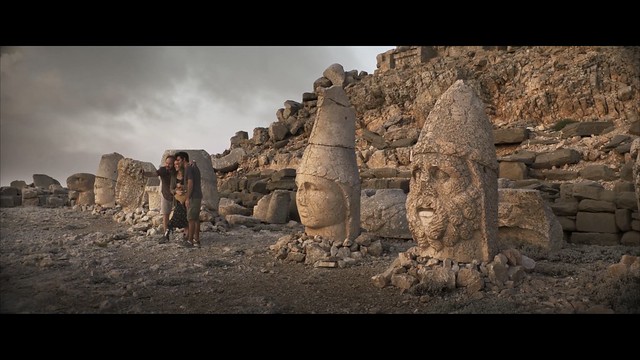
Ceylan studied engineering in school, then became a photographer: it is apparent that he has an eye for landscapes as you watch his films. Consider the snowy streets of Istanbul in Distant, ancient ruins on a hot summer day in Climates, the winding mountain roads from above at dusk in Once Upon a Time in Anatolia, the icicle covered resort in Winter Sleep, and snow-capped mountains in About Dry Grasses, just to name a few. And there is always a cinematic showstopper in every one of his films that makes your jaw drop.

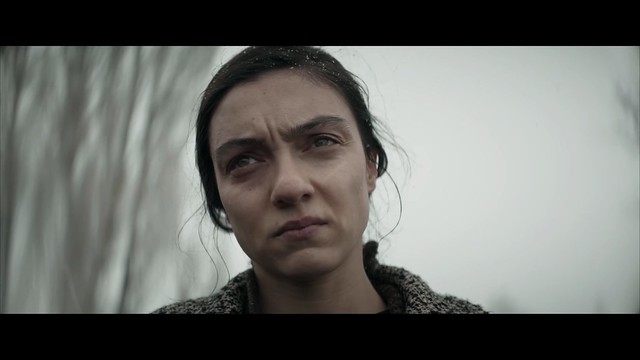
Yet, it's his juxtaposition of close-ups of the faces and their surroundings that gives meaning to his work. We humans exist among those spectacular places, with our jealousies, greed, lust, pride and other qualities intact.

With his wife Ebru Ceylan as a writing partner on most of his films, along with actor/physician Ercan Kesal (Three Monkeys, Once Upon a Time in Anatolia) and actor/teacher Akin Aksu (Wild Pear Tree, About Dry Grasses), he sketches out great, lived-in melodramas like no other.

Within the generous running time -- since Anatolia's comparitively modest 155 minutes, the runtime of Ceylan's films are more than three hours -- we get to know every main character in an intimate way with their faults and weaknesses, as well as their redeemable qualities. We get to live with them, like a main character in a great thick novel, at least a short while in darkened theaters. With Winter Sleep, the Palme d'Or winner 2013, adapting Anton Chekhov's play, The Wife, Ceylan explicitly let his audience know where his influences originate and where his interests lie thematically, while not sacrificing his cinematic playfulness.

About About Dry Grasses: Screen Shot 2024-01-23 at 3.29.12 PM Screen Shot 2024-01-23 at 3.29.52 PM Screen Shot 2024-01-23 at 3.34.36 PM Screen Shot 2024-01-22 at 4.19.55 PM Screen Shot 2024-01-22 at 4.26.07 PM Screen Shot 2024-01-22 at 4.54.37 PM Screen Shot 2024-01-22 at 2.01.27 PM About Dry Grasses deals with the usual Ceylan themes: how to live within your environment without making your surroundings a personal living hell.

Samet, our protagonist, skillfully played by Deniz Celiloglu, is a teacher in a small rural village, returning from the summer recess. He is counting the days until he is to reassigned and out of rural living, after the government's mandatory assignment period ends.

He is easily irritable and self-centered. Overall, he is not a likable character, like many other of Ceylan's male protagonists. All three principal characters -- Samet, Nuray (Merve Dizdar, Best Actress at Cannes 2023), Kenan (Musab Ekici), and Sevim (16-year-old Ece Bağcı) -- are exceptionally great.

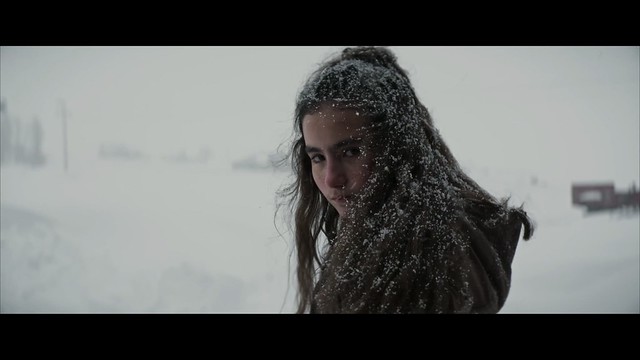
There are many great moments in the film but one showstopper comes in late in the third act of the film. After accusations of inappropriate behavior with the students quiet down, Samet's favorite student Sevim poses for him outside school in the snowy field, as he is an amateur photographer.

It's the closeup of Sevim's face, where Samet sees betrayal, lies and vengeance, while the audience sees innocence, beauty and indifference. While self-absorbed Samet might not realize, but we do, that it's our projection on others that makes our lives miserable.

Also, it is the first time in a long while Ceylan plays with the film medium. He used non-professional actors until the mid-2000s. He even starred along with his wife Ebru in Climates as a fictional couple in a tale of disintegration of a marriage shot on digital video.

If the run of Anatolia, Winter Sleep and The Wild Pear Tree gave the impression that the Turkish auteur is just making wordy filmed plays in a spectacular setting, About Dry Grasses will surprise you. There is a third-wall breaking scene in Grasses, where Samet and Nuray get intimate after being drunk.

The camera follows Samet to the bathroom, then out the door to a film set in a lot, revealing that the tiny apartment filled with trinkets of Nuray's life is indeed a film set, which takes you out completely from the film narrative. It gives you a sudden jolt that all the characters' lives, their thoughts and intimate details and blemishes that you invested in for the last two hours, are indeed a fiction. That now you can take a breather and reset.

With About Dry Grasses, we are witnessing a great, mature filmmaker paving his legacy as a novelistic filmmaker with a visual flair in the league of Tarkovsky and Bergman.

About Dry Grasses enjoys its U.S. premiere Friday, February 23, at Film Forum in New York City.

My review of Once Upon a Time in Anatolia (2012)

My review of Winter Sleep (2014)

My review of Wild Pear Tree (2018)

Wednesday, October 30, 2019

Modern Day Mythmaking Continues in Matthew Barney's Redoubt

Redoubt
Redoubt brings artist Matthew Barney back into a feature film world after River of Fundament (2014), that was 7-years-in-the-making, culminating in 6-hour filmic experimentation with elements of performance, sculpture and opera. Like his breakthrough The Cremaster Cycle (2002), it is usually the case that his film(s) are accumulation of gallery/museum installations and performances.

Redoubt, a relatively slight piece, clocking at 2 hours 14 minutes, is Barney’s newest project that he’s been working on for the last 3 years in the Sawtooth Mountains in Idaho, ending in Sculpture and engraving on copper plate exhibition at Yale University Art Gallery with the standalone film getting its 2-weeks theatrical release at Film Forum in New York.

As usual with his film work, Redoubt is told wordlessly, but rather through visual, sound and dance. It tells a very loose interpretation of Diana and Actaeon in Ovid’s Metamorphoses. Anette Wachter, a real life long-range sharp shooter champion, decked in camouflage suits and weapons, plays Diana, the Roman goddess of hunting and nature. Her two companions, played by Eleanor Bauer, who is also the film’s choreographer and Laura Stokes, are first seen sleeping and waking up in the hammock far up upon the trees. Their agility and movements are that of woodland creatures rather than humans. They are on the hunt for wolves in the snowy Idaho wilderness. Their path crosses with a land manager (played by white bearded Barney himself) who lives in a trailer with his wife (K. J. Holmes, also a dancer) in the wilderness.

Once the land manager spots Diana and her companions, he tracks their movements with engravings on copper plates which his wife carefully dip in electrified bath for corrosive effects- I do not remember the etching process that well since art classes in college, so I may not be explaining this well. Sorry.

Eleanor Bauer and Laura Stokes reenactment of the hunting ritual are often playful and beautiful, especially the killing and skinning of an animal, even though their acts are often overshadowed by their immense and powerful surroundings.

Barney’s fetishization of objects is prevalent here as well – the series of hunting rifles, bows and arrows and clothing, all designed for the film. So is his penchant for texture – engravings submerged and corroding in the bath of acid, the night vision camera’s image of Wachter dancing, strewn carcasses of an animal killed and pecked out by other animals surrounded by pinkish snow.

So, does Acteon gets his comeuppances for snooping around Diana? His copper plates get shot at, leaving unintended but highly desirable patterns, his trailer ransacked by a pack of wolves. But they are all pretty minor for Barney standards.

There are no bodily fluids flowing nor sexual provocation, nor elborate prosthetics, nor grand scale sculptural awe. Unlike painstaking, labor intensive production designs and mise-en-scenes of his previous projects, be it Cremaster or Drawing Restraint series, Redoubt relies heavily on its breathtaking snowy landscape of the Sawtooth Mountain Range. With aerial shots of frozen streams, woodland creatures and a little avalanche from the top of the mountains are all spectacular.

Barney goes for his nature shots to do the job for him rather than relying on his usually elaborate, labor intensive set ups. Still, Redoubt is undoubtedly a continuation of Barney’s unique modern day myth-making process. And its hypnotic images have to be experienced on the big screen.

Tuesday, August 8, 2017

Cog in the Machine

Machines (2016) - Jain
machines 3
Machines1
Machines
machines4
Machines2
In my humble opinion, digital filmmaking, with its extremely sharp image, isn't really suited for general narrative filmmaking. I do not need to see every pore on Charlize Theron or Scarlet Johansson's face. I do not need to see every piece of debris when an alien space craft explodes.

But the high resolution digital technology renders wonderfully in documentary filmmaking, capturing nitty-gritty details of everyday life that was not possible with shooting on a film stock. In comparison and in context, I can think of Forest of Bliss, a lyrical documentary depicting life and rituals in Benares, India, directed by much-revered documentarian Robert Gardner.

Even though I have a film background and am a big fan of anything shot on film (just the sight of 16mm shot, grainy images triggers Pavlov's effect on me), seeing that deteriorating film reel projected on screen -- scratched, high contrast, with no details in the shadows -- I can only speculate what Gardner, Malle, Van der Keuken and a lot of other great documentarians could've captured with light(er) weight, larger censor cameras that can shoot 6K to 8K images for hours on end without stopping.

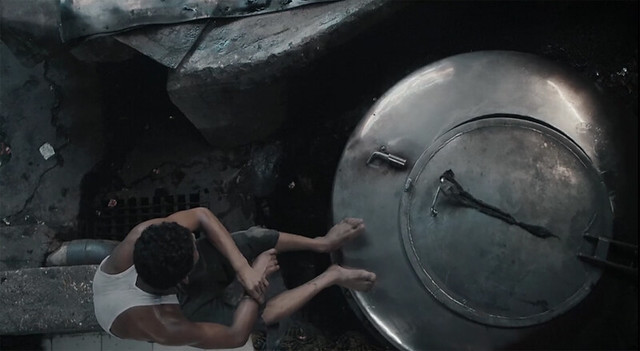
Machines, a film by Rahul Jain, answers that possibility. Shot entirely in and around a textile factory in the Guajarat region of India, the film doesn't only depict the everyday working conditions of the hundreds of manual laborers, but also captures it in a startlingly clear, beautiful imagery.

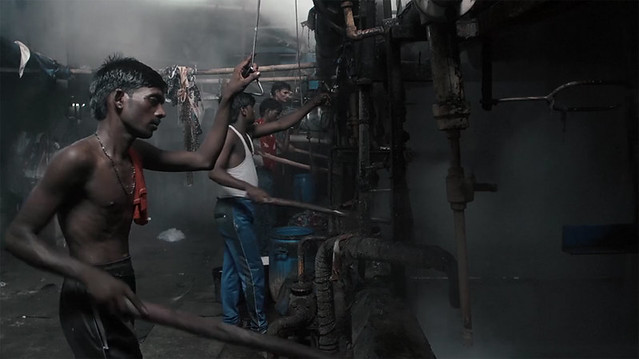
Using only medium to wide lenses, Jain invites us into the giant, labyrinthine factory where shirtless male workers go on about their work day. Even though the process is pretty heavily machinized on the floor, each step of the process needs human hands and eyes: moving the heavy loads of fabric, dragging paint drums from one place to another, the actual silk screening process, mixing paints, guarding fabrics through the machines, keeping the furnaces going, maintaining the axles of the machines. Their shifts in the factory require long, grueling, hard work.

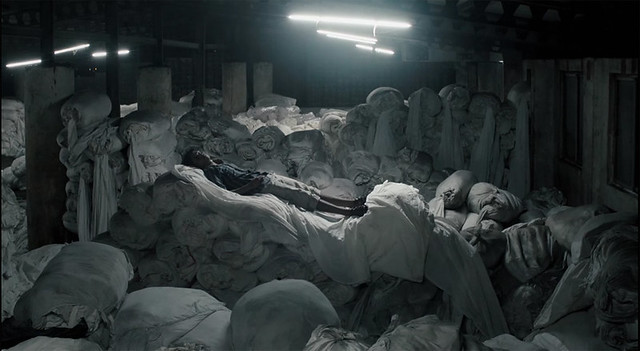
Perfectly framed, these static shots of the interiors of the greasy, grimy factory, lit only with cold, dim fluorescent lights, is strangely, hauntingly beautiful. Colors and texture -- steam, metal, glistening human skin, the brightness of the fabric they produce -- all contrast/accompany each other in mind-boggling detail on the screen.

Is Jain drawing a correlation between heavy machinery and human labor, as demonstrated in cinema history as early as Fritz Lang's Metropolis and Charles Chaplin's Modern Times? Machines and their beautiful imagery can be easily used for poverty porn, but Jain takes a different approach.

Without a swooping score to manipulate audience's emotions, he silently observes the workers and they in turn talk about their working conditions. The filmmaker rightfully excuses himself from being seen or heard, leaving his silent questions to be answered by workers in a breathtaking 360 degree shot just outside the factory, surrounded by workers.

They came to Guajarat because there is work. Their travel cost put them into debt. Their 12 hour shift pays 300 rupees (about 5 US dollars). They have a short break, then go back for another 12 hour shift. The only thing they can afford is chewing tobacco which will keep them awake.

They talk about the futility of organizing; who has time for union activities? In debt and exhaustion, they literally can't afford to go to a union meeting. It's a vicious cycle. Jain interviews the management also. A boss gives a speech that's right out of some early 20th century capitalist handbook: "If the workers get paid more than what they get now, they get lazy. They need to be hungry to be a good worker."

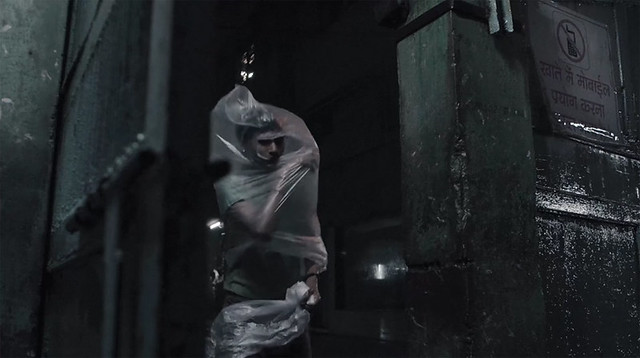
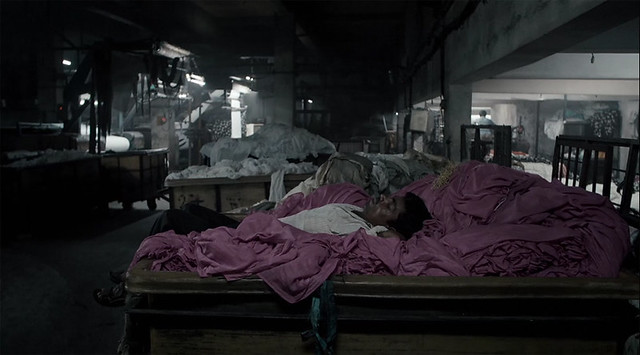
There is an imminent danger we feel when a child worker nods off while on the job, then there's a tranquility in the shots of workers taking a nap during their break wherever they can. It's all beautifully captured. Even their makeshift raincoats, a big plastic bag with the hole for their face under a torrential downpour, are beautiful.

Bosses vs workers is an age old subject. But Machines is a visually sumptuous observation piece that transcends being a mere social commentary.

Machines will have a one-week engagement, August 9 – 15, at Film Forum.

Tuesday, June 13, 2017

A subtle Revenge Thriller on the Shores of Lake Geneva

Moka (2016) - Mermoud
moka1
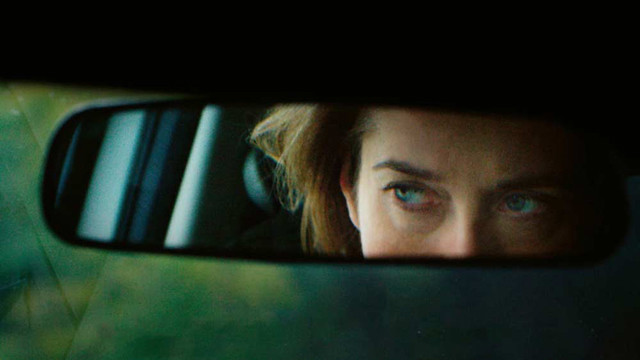
A new French/Swiss revenge thriller, Moka, directed by Frédéric Mermoud starts with a 5-minute breezy, silent sequence of Diane (Emmanuelle Devos) sneaking out of what seems to be a hospital/wellness sanitarium near Lake Geneva. It's dark and moody and sets the tone of this slow burn, Chabrol-esque revenge thriller.

It turns out, Diane is a grieving mother whose son was killed in a hit-and-run in Lausanne, the Swiss side of the lake. Through a hired investigator, Diane narrows down the facts that the driver and the passenger, a blonde woman and her male companion, were driving a coffee colored (hence the title) vintage Mercedes. She settles on a beautician named Marlene (Natalie Baye) and her younger, womanizing boyfriend Michel (David Clavel) with the matching car living on the French side of the lake, in Evian. Diane's obsession makes her plunge head first into the lives Marlene and her family.

Diane approaches Marlene unassumingly, guising herself as a writer in seeking seclusion by the lake side. Marlene takes her as a nosy writer-type in search of inspiration and keeps her barrage of personal inquiries at arm's length at first. But she finally lets her guard down at Diane’s genuine demeanor.

She also approaches Michel as potential customer as he tries to sell the car. Diane’s aggressiveness in her interests in the car turns on Michel in all the wrong ways. After chance meeting with a good looking young drug dealer on the ferry ride, she charms him to get a hold of a handgun. And the two get romantically involved.

Diane then befriends Marlene’s rebellious young daughter Elodie (Diane Rouxel) who might have been carrying on a sexual relationship with her stepfather.

Based on a book of the same name by best selling author Tatiana de Rosnay, and relocating its setting to Lake Geneva, Moka, like its neutral colored vehicle and with its picturesque and quiet Swiss setting, is all a very subtle affair. Somberly lensed by Irina Lubtchansky (who shot two recent Anaud Desplechin films- My Golden Days, Ismael's Ghosts) against stunning Lake Geneva backdrop, the film is a handsome, brooding noir.

It is a deftly directed, low-pitched noir that heavily relies on the charm of Devos. As always, she walks the fine line between confidence and vulnerability and makes Diane's unrelenting pursuit of revenge totally believable. With quiet determination and stubbornness in her eyes, she is one of the few actresses who can turn their dowdiness into sexy.

Baye, a veteran actress, gives a fine performance as an ordinary woman dealing with her career, motherhood and relationship. Her Marlene's guarded friendliness hides her dormant venom which we get to see in a glimpse of.

It's great to see two women in their mid-career finding juicy roles that show their subtle artistry. The film hints on the fraternity of womenhood by the end. Moka is a well acted, low-key but impactful revenge thriller for the fans of neo-noir.
Top 10 Favorite Films of 2015

Tuesday, June 6, 2017

Fuji-san Mon Amour

Ascent (2016) - Tan
Ascent1
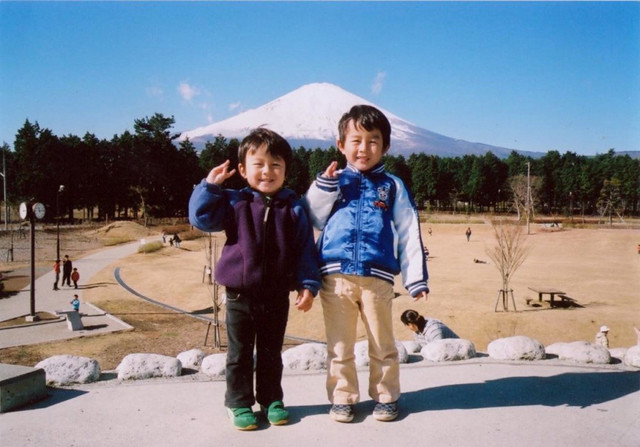
*Nope. That's not me and my brother.
Mount Fuji is perhaps the most photographed volcanic mountain in the world. Its iconic, perfectly shaped appearance (perfectly symmetrical 45 degree slopes on both side reaching to its slender necked caldera, often snow capped in winter) is instantly recognizable and fittingly figures into exquisitely coiffed Japanese culture landscape. You can see the prevalence of its presence in Japanese art- from Hokusai block prints, literature, manga to films. Visual artist Fiona Tan makes a poignant film completely comprised only of still pictures involving Mt. Fuji.

Ascent is a correspondence of two lovers in voice-overs. This fictional narrative starts with a woman (the director herself) informing us that she received a large package from her Japanese lover, Hiroshi, who has passed on. It's full of pictures of Mt. Fuji, both old and new, and she has a task of deciphering in what her dead lover was trying to convey in these pictures.

Hiroshi (Hasegawa Hiroki of Shin Godzilla and Why Don’t You Play in Hell? lends his voice here) narrates his part, as he climbs Mt. Fuji with hundreds other pilgrims (as many Japanese has been doing every season for centuries), relaying to her each step of the hike, accompanied by ordinary photos taken by hikers, often posing in front of the ever omnipresent mountain. With its elevation reaching 12,388 feet, even with hiking trails and rest stations, climbing Mt. Fuji is not an easy feat. He narrates a short poem:

Behold the sacred, magic mountain
The spiritual connection between heaven and earth
Symmetrical, solitary, snow-capped
And thus beyond reach of time

Through their narration, we find out the cultural and political significance of the mountain. As the Japanese folklore goes, Mt. Fuji is a home to Kono-Hana, the goddess of volcanoes. The presence of the mountain in popular culture was banned after the war, because westerners feared it would stir up the Japanese nationalism once again. Its perfect symmetry was broken when the volcano erupted in 1707, causing south slope of the mountain to collapse. But it's a reminder that Mt. Fuji is an active volcano. Tohoku earthquake in 2011 moved the Japanese main island of Honshu (where Tokyo and Mt. Fuji are situated) 2.4 meters eastward. Many seismologist predict the near future eruption is all but certain.

Tan explores several interesting ideas in Ascent. Using only still photographs in making the film, borrowing her dead lover's notion, she likens the photograph to ice, frozen in time, and film to fire, always moving and crackling. She co-relates grief and photographs as a means of stopping time. The active volcanic mountain, always present in Japanese psyche, is both permanent fixture and a symbol of impermanence and fragility of human life.

It's this duality that fascinates her. Mt. Fuji picture is often accompanied by cherry blossoms in the foreground. Kono-Hana is the goddess of both volcanoes and cherry blossoms. And the falling is the essence of flower. Hiroki demystifies the sacred mountain from beyond the grave that although it might look perfect from the distance, up-close, Mt. Fuji is nothing but shapeless volcanic rocks.

Contemplation of memories figure into Ascent greatly. And you can easily see the traces of Chris Marker and Alain Resnais in Tan's approach, both technically and thematically, considering both filmmakers had always grappled with the idea of memories and time- especially in La Jetée, Sans Soleil and Hiroshima Mon Amour. Ascent is a daring, visually arresting film that is also deeply poignant and beautiful.

ASCENT will have a one-week engagement, Wednesday, June 7 – 13, at Film Forum, NYC

*Film forum is showing the film with free admission, courtesy of support from the Ostrovsky Family Fund.

Wednesday, November 2, 2016

Boy in Red

Don't Call Me Son/Mãe Só Há Uma (2016) - Muylaert
 photo fd85d2db-5062-4de6-bf82-dc13c1751018_zpsjqoa9ndp.jpg
What's concerns more to a teenager -- a family or personal identity? Anna Muylaert (Second Mother)'s new Brazilian drama, Don't Call Me Son, examines this conundrum and finds a good balance in an astonishingly swift 82 minute film.

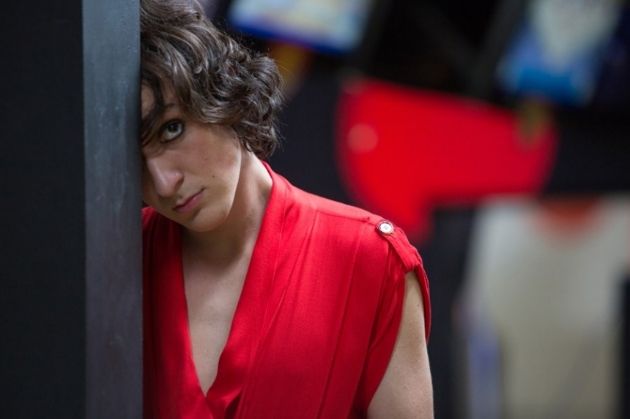
Pierre (Naomi Nero), an eyeliner wearing 17year-old High Schooler is first seen flirting and making out with both sexes in a night club. His trousers are on the floor, revealing he is wearing a g-string and garter belts. He paints his nails and plays guitar in a rock band. He tries on lipsticks and dresses secretly in his tiny room.

Pierre lives with his busy single mom, Aracy (Daniela Nefussi) and his younger sister, Jaqeline (Lais Dias). But one day, their normal lives get turned upside down when Aracy gets arrested for child abduction. It turns out Pierre was stolen from his crib 17 years ago and his biological parents were searching for him ever since. Through well-meaninged, but ineffectual social workers, his well-to-do real parents are anxious to reacquaint with him and make up for lost times. It turns out Pierre, now Felipe, has a brother Joca (Daniel Bothelho), a well-adjusted, normal kid who seems a little lonely.

At first, the interactions between the real parents, Gloria (again played by Nefussi) and hot-tempered Matheus (Matheus Nachtergaele) and Pierre/Felipe are polite and awkward. But after the teen moves in to their opulent house, they realize that their long lost son is not what they imagined him to be. Gloria's constant mommying and pampering and Matheus' frustrations with the effeminate nature of Pierre/Felipe soon boil over.

There is a hilarious scene at the mall concerning Pierre/Felipe trying out clothes while Gloria, Matheus and Joca look on. The parents pick out clothes for him to try on - polo shirts and slacks, the usual stuff teens would wear. He comes out of the dressing room in a black and white, skin-tight frilly dress. They think it's a joke or perhaps a rebellious teen angst statement-- haha funny, now change back to your polo shirt. But Pierre insists the dress is what he wants and they will buy it for him.

The film's original Portuguese title is Mãe Só Há Uma- There Is Only One Mother. But even though Daniela Nefussi plays both mothers, the film’s focus is exclusively on Pierre. Nero, with his good looks and natural performance, is magnetic as a teenager who is finding himself as an individual.

Don't Call Me Son doesn't dwell on nature vs nurture or rely on cheap sentimentality. The film doesn't even try to make any big statement on gender equality or social justice. It focuses on a young man who is very comfortable with his identity even though his life has become chaotic. But he's not a helpless victim who's unsure about his place in the world. And he also has a great, caring heart.

Beautifully acted and superbly written, Don't Call Me Son is a little gem of a film that needs to be seen widely.

Don't Call Me Son, has a two week exclusive engagement at Film Forum in NYC, starting 11/1.

Tuesday, October 14, 2014

By Maguerite Duras at FSLC

Screen Shot 2017-06-16 at 6.58.49 AM With 4K digital restoration and re-release of Alain Resnais' 1959 classic, Hiroshima Mon Amour, Film Society of Lincoln Center announces a series devoted to the film works of a Nouveau Roman giant Marguerite Duras who provided the screenplay for the film. Duras, along with Alain Robbe-Grillet, was part of the Left Bank film movement and hugely influential for coming of  French New Wave.

Putting a big emphasis on mood and dialogue, Duras' elliptical stories have long been well regarded and respected by the film giants like Resnais and Godard. The film series presents 10 features and 3 shorts, 9 of which she directed - notables include, India Song, Le Camion, Natalie Granger, Madmoiselle (dir. Tony Richardson), Moderato Cantabile (dir. Peter Brook) and Every Man for Himself (dir. Jean-Luc Godard).

The series is a rare opportunity to catch some of these seldom available films anywhere on 35mm prints, written/directed by one of the most influential post-war French writers.

By Marguerite Duras
runs 10/15 - 22 at FSLC. Hiroshima Mon Amour will open at Film Forum and FSLC on Friday, October 17 in and Los Angeles at the Laemmle Royal Theatre following its sold out screening at the 2014 New York Film Festival. Long unavailable for exhibition in the US due to rights issues, it will be released nationally in a spectacular new 4K restoration.

The Film Society of Lincoln Center announced today By Marguerite Duras, October 15-22, a weeklong retrospective of the film work by the novelist, essayist, and playwright on the occasion of her centennial, and the re-release of Hiroshima Mon Amour at the Film Society on October 17. Duras directed 19 features and short films, many adapted from her own work, all exceedingly difficult to see in the U.S., until now. The lineup includes a selection of her formally daring films, movies adapted from her writing, short films, and more, all on 35mm.
Best known as a leading literary figure in postwar France with award-winning books, Duras's early novels were considered more conventional in form until Moderato Cantabile (1958), which was more experimental and placed the focus on what was not said. At 45, Duras penned the screenplay for Alain Resnais's Hiroshima Mon Amour (1959), whose nonlinear plot and elliptical editing would greatly impact the burgeoning French New Wave (a movement whose literary analogue, the Nouveau Roman, Duras was tangentially linked to). Its radical use of voiceover anticipated the disjunction of sound and image that would become her calling card.
By Marguerite Duras includes her solo directorial debut, Détruire dit-elle / Destroy, She Said adapted from her own play, and Les Enfants, winner of three prizes at the Berlin International Film Festival, which was Duras's final film as a director. Other highlights include Le Camion / The Truck, which was nominated for the Palme d'Or at Cannes; Moderato Cantabile, for which Jeanne Moreau won Best Actress at Cannes, and Jean-Luc Godard's Sauve qui peut (la vie) / Every Man for Himself, which he introduced as "my second first film," and is characteristically cerebral and peppered with literary allusions, including an unforgettable anti-cameo by Duras.
Special thanks to the Institut Francais for the loan of their prints, and the Cultural Services of the French Embassy for their support.

Films, Descriptions & Schedule
Agatha et les lectures illimitées
Marguerite Duras, France, 1981, 35mm, 85m
French with English subtitles

Hiroshima Mon Amour at the shore. A brother and sister (Yann Andréa and Bulle Ogier) meet at a seaside hotel to confront the nature of their relationship and try to achieve closure with the past. Their love for each other and its manifestations emerge in voiceover, with Duras herself articulating the sister's thoughts. Eschewing traditional approaches to storytelling, Duras keeps the siblings off-screen or obscured for much of the film and never allows them to share the frame. Her camera prowls the deserted hotel lobby and sometimes catches itself in the mirror, analogizing the film's reflective themes.
October 21, 8:30pm

Le Camion / The Truck
Marguerite Duras, France, 1977, 35mm, 80m
French with English subtitles

Initially conceived as the story of an older woman hitching a ride with a trucker, bemoaning the demise of the revolution and the impoverished state of society ("the world has gone to rack and ruin"), Le Camion ("The Truck") is the film that ensued when Duras couldn't find a suitable actress for the lead. Instead, she and Gérard Depardieu sit at a table and read from the script, discussing the film that might have been, with periodic cutaways to a truck driving along the highway at night. Celebrated by figures as disparate as Pauline Kael and John Waters, Le Camion was nominated for the Palme d'Or at Cannes and hailed by Jonathan Rosenbaum as "one of Marguerite Duras's most radically minimalist features . . . [also] one of her best, as well as one of her most accessible."
October 16, 8:30pm
October 22, 2:30pm


Détruire dit-elle / Destroy, She Said
Marguerite Duras, France, 1969, 35mm, 98m
French with English subtitles

Adapted from her own play, Duras's solo directorial debut concerns an isolated hotel surrounded by dense forest, with only four guests in evidence: a professor of "future history" and his young bride (Henri Garcin and Nicole Hiss), a troubled woman (Catherine Sellers) recovering from a miscarriage, and a German would-be writer (Michael Lonsdale) with designs on the professor's wife. Despite the roundelay of attraction, Smiles of a Summer Night this is not; its claustrophobia (the women fear the forest) and convergence of identities (Hiss and Sellers share one of the director's trademark mirror scenes) place it much closer to Persona. In Film as a Subversive Art, Amos Vogel praises its "highly stylized, non-logical dialogue [which] creates enigmatic fear."
October 15, 9:00pm

Les Enfants
Marguerite Duras, France, 1985, 35mm, 94m
French with English subtitles

Seven-year-old Ernesto (played by adult Axel Bogousslavsky) leaves school because he doesn't wish to learn, believing knowledge serves no purpose in a bankrupt world. His parents (Daniel Gélin and Tatiana Moukhine) try to make sense of their son's cynical and inscrutable convictions. Winner of three prizes at the Berlin International Film Festival, Duras's final film as director may have taken inspiration from her own unhappy years in a Saigon boarding school. Her penchant for uninhabited spaces is evident in her shots of the schoolyard--the empty playground pairs with Bogousslavsky's casting to make a comment on vanishing childhood and untimely disillusionment.
October 17, 4:30pm
October 22, 4:30pm


India Song
Marguerite Duras, France, 1975, 35mm, 120m
French with English subtitles

Duras's favorite collaborator Delphine Seyrig ("the greatest actress in France and possibly in the entire world") is hypnotic as Anne-Marie, the wife of a disgraced French diplomat (Michael Lonsdale), suffering from "leprosy of the soul" or what might be more chicly termed ennui. Through a mélange of off-screen gossip (again nearly all sound is nonsynchronous), we learn of Anne-Marie's scandalous conduct in 1930s India and her eventual fate, engendered by boredom, colonial guilt, and a string of meaningless affairs. Duras renders her study of mental torment in elaborate style (Dave Kehr calls her "the Busby Berkeley of structuralism"), and Bruno Nuytten's cinematography captures the glittering emptiness of life in a gilded cage--the feeling that privilege can be its own form of illness.
October 15, 6:30pm
October 17, 2:00pm


Mademoiselle
Tony Richardson, France/UK, 1966, 35mm, 103m
French, Italian, and Latin with English subtitles

Duras adapted Jean Genet's story of a repressed schoolteacher in rural France (an unflinching turn by Jeanne Moreau) who causes mayhem in her village and allows prejudiced locals to blame an Italian woodcutter (Ettore Manni), with horrific results. Director Tony Richardson renders a one-of-a-kind hybrid of arthouse drama and psychosexual thriller, which even its detractors found too audacious to ignore (Roger Ebert declared Moreau "flawless"). Fraught with Freudian symbols (snakes, felled pine trees) and a scathing vision of corrupt and unknowable humanity, Mademoiselle was nominated for the Palme d'Or and earned a BAFTA for Jocelyn Rickards' costumes.
October 16, 4:30pm
October 18, 9:15pm


Moderato Cantabile
Peter Brook, France/Italy, 1960, 35mm, 91m
French with English subtitles

"Moderate and songlike"--a musical tempo, but also an apt descriptor of this moody, deliberate drama co-scripted by Duras from her novel. Jeanne Moreau won Best Actress at Cannes for her haunting portrayal of a wife and mother whose husband is the chief employer of their steel town near Bordeaux. Her life consists of little more than shuttling their son to piano lessons, until one day, mid-sonata, she hears a scream. Before long she's conducting a murder investigation with one of her husband's workers (Jean-Paul Belmondo), unleashing her own morbid impulses and perhaps a private death wish. Theater giant Peter Brook's restrained direction casts rare moments of intensity in relief, and Armand Thirard's crisp cinematography conveys the desolation of life in a windswept town where "summer never comes."
October 16, 6:30pm
October 21, 5:00pm


Nathalie Granger
Marguerite Duras, France, 1972, 35mm, 83m
French with English subtitles

The woman's picture gets the Duras treatment in this spare account of two female cohabitants and their assorted vexations. One (Lucia Bosé) has a daughter in primary school (Valerie Mascolo in the title role) whose teacher reports violent outbursts despite her passive demeanor at home. The other (Jeanne Moreau) greets news of a killer on the loose with the same indifference she directs at burning trash. Gérard Depardieu shows up as a door-to-door salesman who may in fact be peddling himself. Customarily placid but for surprising dashes of absurdism ("There is no telephone here, madame," Moreau says into the receiver), Nathalie Granger is domestic melodrama as only Duras could pervert it.
October 15, 4:30pm
October 18, 7:00pm


Le Navire Night
Marguerite Duras, France, 1979, 35mm, 95m
French with English subtitles

Ever the iconoclast, Duras proffers two lovers who never meet face to face. Dominique Sanda plays a woman with tragic reasons for keeping her paramour (Mathieu Carrière) at a distance, confining their affair to phone calls initiated by her--a Durasian construct, language detached from images. The director invites us to share their frustrations by limiting our contact with the stars, sequestering them in dark rooms and cutting to empty streets as their words take on lives of their own. Featuring the voices of Duras and protégé Benoît Jacquot.
October 17, 7:00pm

Sauve qui peut (la vie) / Every Man for Himself
Jean-Luc Godard, France/Austria/West Germany/Switzerland, 1980, 35mm, 87m
French with English subtitles

Concluding a decade of experimentation, Godard returns to character-based storytelling with this portrait of restless, intertwining lives, survival in a capitalist state, and the myriad forms self-debasement can take. TV director Jacques Dutronc (playing a character named Paul Godard) has left his wife for a co-worker (Nathalie Baye), who--disenchanted with television and Paul--plans a move to the country. Meanwhile, a country girl (Isabelle Huppert) works nonchalantly as a prostitute in the city. Introduced by Godard as "my second first film," Sauve qui peut (la vie) is characteristically cerebral and peppered with literary allusions, including an unforgettable anti-cameo by Duras. "Breathtakingly beautiful and often very funny ... I trust it will outlive us all."--Vincent Canby, The New York Times
October 17, 9:15pm

Duras Shorts Program:
Cesarée
Marguerite Duras, France, 1978, 35mm, 11m
French with English subtitles

Duras's heartrending narration elegizes Queen Berenice, banished from Rome by Emperor Titus in the First Century. (In typical Duras fashion, the two are referred to only as "Elle" and "Lui.") Footage consists of discarded shots from Le Navire Night, with the Seine and Tuileries Gardens "playing" the title locale, the speculative site of Berenice's exile.
L'Homme atlantique
Marguerite Duras, France, 1981, 35mm, 42m
French with English subtitles

In this avant-garde short, Duras uses outtakes from Agatha et les lectures illimitées, removing Agatha and leaving only the voice and likeness of her brother (Yann Andréa). Duras scholar Leslie Hill contends that for the first time in her work, "the gap between image and sound is now aligned with the fissure of sexual difference itself."
Nuit noire, Calcutta
Marin Karmitz, France, 1964, 35mm, 24m
French with English subtitles

Duras scripted this sketch of Jean (Maurice Garrel), a writer struggling to complete a Calcutta-based novel while battling alcoholism and creative impotence. Most of the text is spoken off-screen, evoking dislocation that's echoed visually in the world beyond Jean's window--could the woman outside be the character he's unable to capture in words?
October 21, 7:00pm