Showing posts with label Switzerland. Show all posts

Thursday, June 26, 2025

Trappings

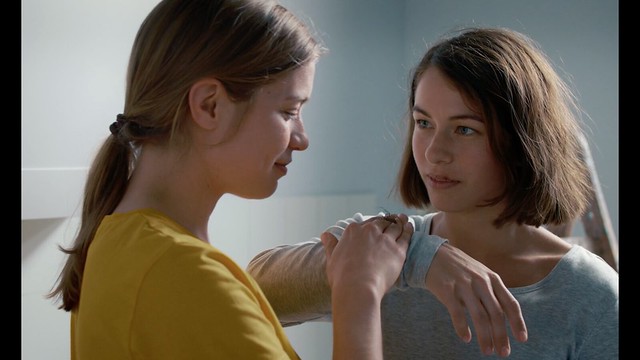
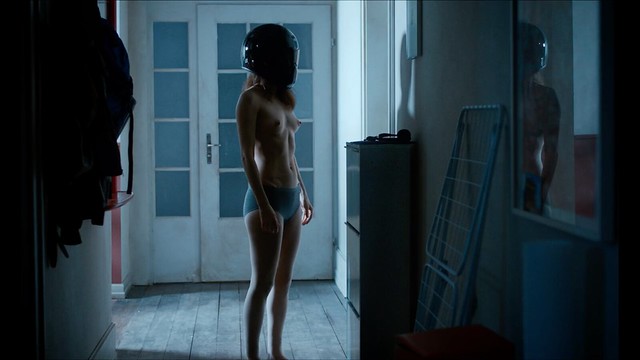
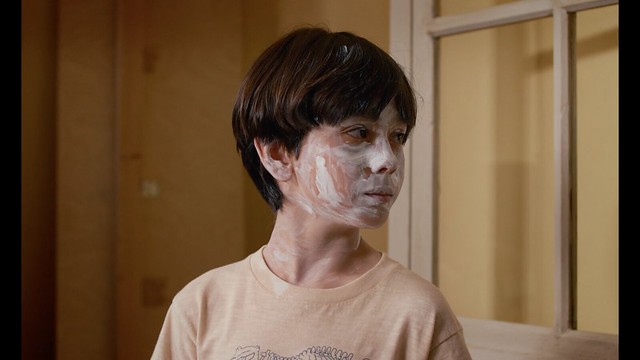
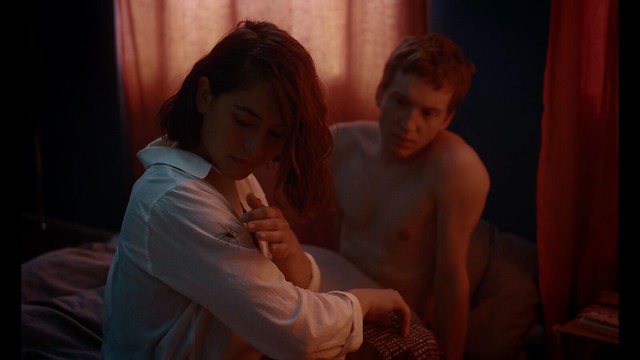
Der Spatz im Kamin/The Sparrow in the Chimney (2024) - Zürcher Screen Shot 2025-06-23 at 4.29.09 AM Screen Shot 2025-06-23 at 4.57.31 AM Screen Shot 2025-06-23 at 6.27.32 AM Screen Shot 2025-06-23 at 6.25.16 AM Screen Shot 2025-06-23 at 6.29.15 AM Screen Shot 2025-06-23 at 6.30.35 AM Screen Shot 2025-06-23 at 5.44.18 AM Screen Shot 2025-06-23 at 6.26.49 AM Screen Shot 2025-06-23 at 5.54.39 AM The Zürcher Brothers' 'animal trilogy' concludes with The Sparrow in the Chimney, another chamber piece that takes place in a summer Swiss lakeside house bathed in golden sunlight, where a simmering tension builds in a confined space as the family plans for a birthday celebration. Ramon, wearing director and writer's hat (and Silvan taking producer's role), concocts a wordy, ensemble piece around the always great Maren Eggert (a great German actress and the lead in many of Angela Schanellec’s films) as Karen, an unloved and unappreciated mother of three trying to plan a birthday party for her unfaithful husband, Markus.

The film starts with typical Zürcher fashion with static portraiture of two daughters: Johanna (Lea Zöe Voss) in her school, and Christina (Paula Schindler), the one who got away, on a plane coming home to attend her dad's birthday party. We see them behind the glass window from outside. This inside/outside theme is repeated throughout, with a sparrow flying out of the fireplace inside the house, leaving the trail of ash and leaving through the window early in the film, while the lake and its surroundings are taken over by the giant black commorants, ominously circling the sky- which beckon's the question: is outside any better?

Leon, the youngest of Karen's children, is seen prepping dinner for the whole extended family as they arrive, while Karen sleeps. Jule, Karen's sister and her husband and their baby daughter arrive. It is slowly revealed that the house Karen's family lives in belongs to Karen and Jule's deceased mother - the house the sisters grew up in, and the mother's shadow still looms large. It is also revealed that Karen's decision to move into the house after mother's death was not a favorable one for everyone else in the family.

Things are definitely not ok in Karen's household: the kids resent her. Leon is bullied in school and gets beat up a lot. Johanna, always an attention seeker, is testing her budding sexuality on any male figure around her. Christina has her reasons to be withdrawn. Markus is having an affair with Liv (Luise Heyer), a mentally unstable woman who took up residence in a cabin across from the house (used by the deceased mother and her lesbian lover) and has been watching over the family's dog.

The Sparrow in the Chimney is a densely scripted film where many things are said, yet nothing is said directly - the family dynamics here are not straightforward affairs and their feelings and thoughts are not communicated. Their cruelty to animals shows their frustrations with one another. We get the glimpse of their lives and past histories, but there's no big eureka moment until the end.

As with their last two films, Strange Little Cat and The Girl with the Spider, The Sparrow presents Zürcher's unique visual style - a blocking to create a claustrophobic atmosphere where everyone's cramped in the kitchen corridors, squeaking by each other and going in and out of static frames, and in and out of windows. The difference of The Sparrow here is that Zürcher's scope of visual filmmaking has grown and much more expansive. Karen's elaborate nightmare/hallucination sequence is something to watch, as it provides the inner workings of her fears, desires and secret wishes being manifested.

The Sparrow in the Chimney examines the familial trappings and yearning for freedom which might not be as ideal as it appears to be. Beautifully realized with sensuous visual details of inanimate objects to animals alike, the film cements the unique storytelling talents of the Zürchers.

Monday, September 30, 2024

Adieu Godard, Adieu Cinema

Scénarios + Exposé du Film annonce du film "Scénario" (2024) - Godard Scenarios-6-1600x900-c-default Jean Luc Godard's last, 17 minute film, Sénarios, which was completed just a day before his 2022 assisted suicide death, is paired with the 36 minute 'making of' documentary for this year's New York Film Festival. For the fans of the late master it is an emotional one. Because it's the last material to see and hear him on screen in his very last days. Originally planned as a feature, this long gestating project had been constantly worked on, even during Covid lockdown. With his failing health, Godard truncated the four part project into two chapters - DNA: Fundamental Elements and MRI: Odyssey. The message is also simplified and more direct. "The final warning," uttered on several occasions to whatever Godard saw as impending for us.

You can tell that the end was on his mind. Images of death, the violent ones at that are displayed - Pina (Anna Magnani)'s Death in Rosselini's Rome, Open City, car wreck that ends Contempt and the infamous car pile up in Week End (both from his own filmography). So are the images of war. Like the DNA itself- the base, the beginning element for all living creatures, Godard here equates the old film clips as what cinema is based upon. The distinctive sound MRI (Magnetic Resonance Imaging - a modern medical technology of scanning your body for grave illness) machine makes- the beeping, the loud thuds, are incorporated into the latter part of the film. Not new to the procedure at that point in life, Godard signals the end. Beginning and end, of life and cinema, at least his own, ending as well.

Sénarios exhibits primary colors boldly painted on stock papers over the images and words - the technique he used in his later periods with Image Book and the last year's posthumous release, Trailer of the Film That Will Never Exist: Phony Wars. The colors,shapes, texture painted over collages, Godard was in full late period Mattise mode. At the end, we are shown his exposed old man's hairy torso, as he puffs away his cigar with wild white hair, reading Sartre's aphorism "Using a horse to illustrate that a horse is not a horse is less efficient than using a non-horse to illustrate that a horse is not a horse." I keep wondering what he would make of the current state of the world - The war in Ukraine and Gaza, the rise of misinformation, the world in chaos.
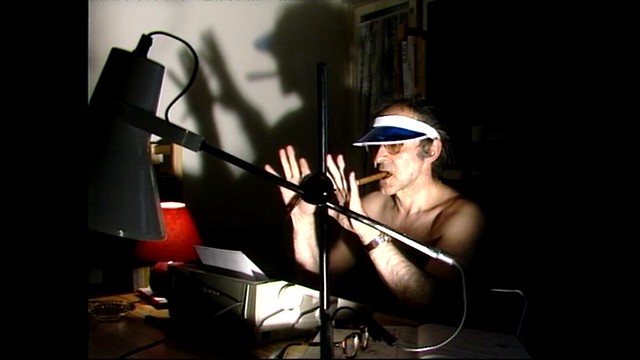
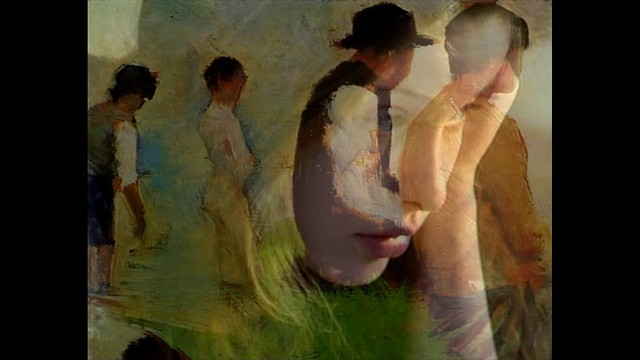
The making of documentary that follows Scénarios, confirms my assumption about the Mattise comparison. Mattise, wheelchair bound and with physical limitations in his final years, turned to a new type of medium, with the help of his assistants, he began creating paper cut collages (decoupage). Godard, filmed by his long time collaborator Fabrice Argano in 2021, gives detailed instructions on, then, a planned 4 part feature on stock paper cards, what to include, what to cut and what to modify in terms of images, music, colors and what sequences. With a lighter in his hand, we get the rare glimpse of his working method in his last years. It's an invaluable and emotional viewing for the fans of cinema at large.

Saturday, August 12, 2023

Perspectives

Les Trois Désastres (2013) - Godard Screen Shot 2023-08-11 at 11.57.05 AM Screen Shot 2023-08-11 at 11.59.29 AM Screen Shot 2023-08-11 at 11.55.04 AM Screen Shot 2023-08-11 at 12.07.06 PM Screen Shot 2023-08-11 at 12.05.57 PM Screen Shot 2023-08-11 at 12.04.56 PM Screen Shot 2023-08-11 at 12.04.35 PM Screen Shot 2023-08-11 at 12.01.49 PM Screen Shot 2023-08-11 at 11.58.34 AM Screen Shot 2023-08-11 at 11.58.40 AM Before Goodbye to Language (2014), where Godard embraced 3D as another art form, he participated in 3X3D, omnibus project commissioned by EU. I won’t even mention the other two shorts by other directors because they were terrible. But The Three Disasters, is a continuation of Godard’s contemplation on art and cinema. His wordplays are strong here: des =dice, astres=stars… as if predicting Hollywood’s short romance with the medium (again) as a gamble. “Writing was necessary. Printing was gratification. Digital will be dictatorship.” He drawls in his gravelly voice. He also observes the invention of perspectives in Western art ruined having any depth in content, correlating it to 2D and 3D in cinema. It’s Invigorating 20 minutes as any of his other films.

Thursday, March 30, 2023

Familial Boundaries

The Line (2022) - Meier the line The film starts with a tour de force slo-mo of household items thrown against the wall – the plates, bottles, records, vases, anything that is in the reaches of Margaret (Stéphanie Blanchoud) can hurl at her mom Christina (Valeria Bruni Tedeschi). It’s a total mayhem. The scene ends with Margaret striking Christina in the face and her head hitting the grand piano in the living room.

Next, we see is Margaret getting a restraining order. She can’t be within the hundred meters of the Christina’s house. With nowhere to go, Margaret, a singer, take temporary refuge in her former lover and bandmate, now a music producer Julien (Benjamin Biolay)’s apartment.

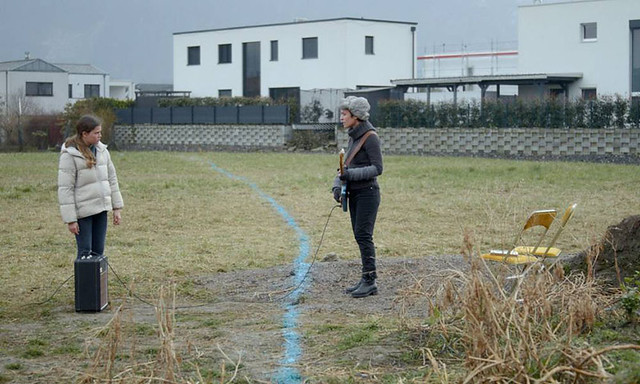
It’s up to Margaret’s young stepsister, Marion (Elli Spagnolo), a churchgoing devout middle schooler, whose communion’s coming up, to keep peace between her mom and her sister as they are both very volatile people. To prevent Marion from getting into more trouble with the law, Marion decides to paint the boundary around the house a hundred-meter distance fence made of light blue paint, this means the field, the road, the creek that goes through the small Swiss town they live in.

In the school, they already make fun of little Marion as a chubby little goodie two shoes. With the scandal Margaret caused is well known in the small town, the taunting is worse. But Marion doesn’t care. She loves them both equally: her imperfect mom, a former famous concert pianist, who doesn’t seem to find a true love and taking up one young boyfriend after another, and her emotionally unstable, violent sister Margaret. She prays day and night for reconciliation of the two.

Marion and Margaret meet at a field just outside the blue line overlooking the house to practice Margaret’s choir singing for her communion with an extended power cable for Margaret’s guitar amp. She incessantly asks for how mom’s been doing. Marion’s reluctant to tell her that her attack left mom half-deaf on her right ear and had to stop giving piano lessons.

Ursula Meier examined what constitutes home and family and its physical and metaphorical boundaries with her previous features – Home (2008), and Sister (2012). With The Line, she continues to illustrate the theme with literally drawing the line on the dirt. The line must be respected and cannot be crossed, not only because it’s against the law, but it is drawn by an innocent child. It would be a betrayal of her love and trust to break it.

Blanchoud, the wild-eyed actress and musician is perfect for volatile Margaret, whose hot temper drives people away from her. Bruni Tedeschi is also superb as a self-centered, nihilistic woman-child who had kids too young and too old.

As usual, Meier sketches out a dysfunctional family which is still a family, nonetheless. And she is wise enough not to question her characters motives or dig their backgrounds too deeply and let silence do the talking.

The Line opens on 3/31 at Metrograph, New York, as part of Permeable Boundaries: The Films of Ursula Meier and also Lensed by Agnès Godard. Meier and Godard will be at the Q&A post-screening on 3/31 and 4/2.

Thursday, November 3, 2022

Commodification of Time VS Collectivist Anarchism

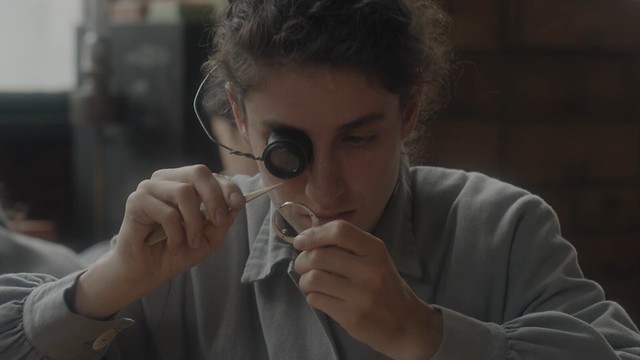
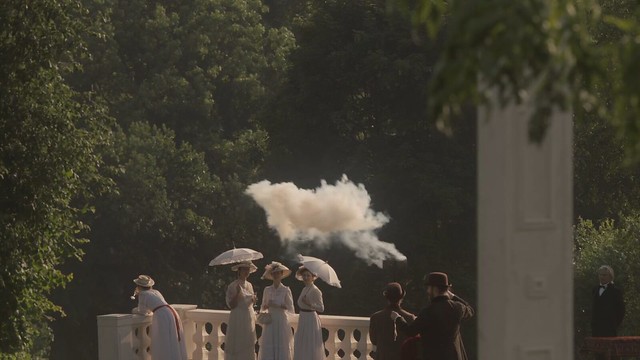
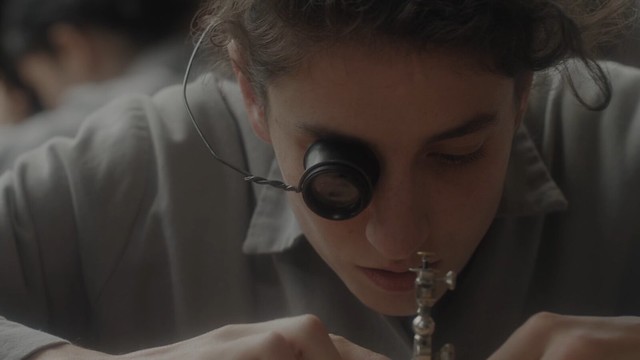
Unrueh (2022) - Schäublin Screen Shot 2022-10-30 at 8.38.10 AM Screen Shot 2022-10-30 at 8.03.28 AM Screen Shot 2022-10-30 at 7.27.10 AM Screen Shot 2022-10-30 at 7.51.56 AM Screen Shot 2022-10-30 at 8.52.36 AM Screen Shot 2022-10-30 at 8.52.13 AM Screen Shot 2022-10-30 at 8.51.17 AM Screen Shot 2022-10-30 at 8.45.26 AM Screen Shot 2022-10-30 at 7.35.49 AM Screen Shot 2022-10-30 at 8.56.54 AM When we think of Switzerland, few things come up to our minds- its long standing neutrality, direct participatory democracy, an army famous for its utility knives, punctuality and, watchmaking. Little did we know that up on the Jura mountains, near French-Swiss border, in the 1870s, were the hot spot for anarchism. Cyril Schäublin sets up the two contrasting forces - capitalism fueled by industrial revolution versus collectivist agitation in his beguiling film Unrest. It starts with a mild mannered, well-known Russian anarchist, Pyotr Kropotkin (Alexei Evstratov), rolling into a sleepy little town in the picturesque valley in the Jura Mountains, where its largest employer is a watchmaking factory. The large swats of its workers are comprised of women. The reason being, I am assuming, the nature of its delicate, detail oriented assembly work.

The traditional watchmaking process during this time, Schäublin demonstrates for us, is an extremely regimented, rigid, hands-on ritual that is half way between artisanal and Ford style assembly line, giving way to automation in the near future. The Factory owner and supervisors (all men) are all about productivity and time saving. With the local politicians' blessing, the town has four different time keeping - municipal, factory, local and church. If workers don't keep up with factory time, they are in jeopardy of losing their jobs. With the Jura Federation, the Bakuninist anti-state, anti-war anarchist group having a stronghold, workers and townsfolks, with the help of Kropotkin, engage in workplace agitation. They vote to form a union (despite efforts to thwart the voting from happening from the management), demand not to profit from selling their watches to military around the world.

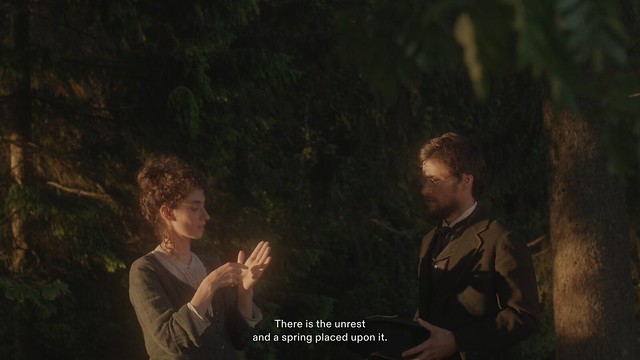
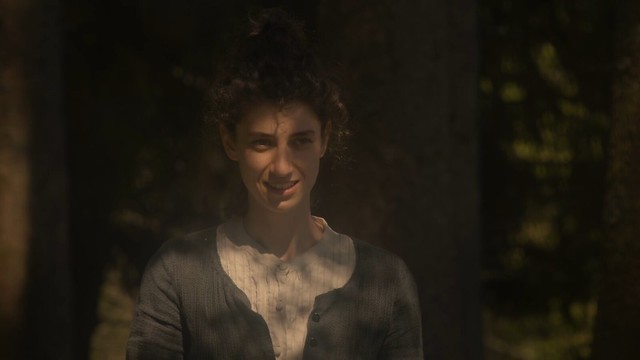
This all sounds exciting on paper. But Schäublin's approach is nothing but sensational. Shot with flair for artful composition, the sun drenched Switzerland backdrop is gorgeous to look at. And slightly suggested budding romance between Kropotkin and factory worker Josephine (Clara Gostynski) is beautifully photographed. Under the warm sunlight, with autumn leaves making patterns on her face, Josephine explains to Kropotkin, the axis of unrest, a tiny coil piece causing the swing in the center of the mechanical watch. Thus the title having its impact - under the surface of a well made, well run system such as an immaculate Swiss made watch, there is a part that controls the ticking mechanism that is highly unstable when unbalanced. Unrest is a beautiful allegory of the society we live in now where commodifying time - they just announced that daylight savings time is permanent, is completely normal and the news talk about people's productivity's down as if we exist only to be productive at work. Stunning in its unassuming beauty and timely message, Unrest is a true hidden gem of the year.

Wednesday, April 6, 2022

Chamber Piece with Thousands Stories

The Girl and the Spider (2021) - Zürcher Screen Shot 2022-04-02 at 10.00.52 AM Screen Shot 2022-04-02 at 10.05.43 AM Screen Shot 2022-04-03 at 12.37.41 PM Screen Shot 2022-04-03 at 12.42.15 PM Screen Shot 2022-04-03 at 12.33.45 PM Screen Shot 2022-04-03 at 12.23.05 PM Twin siblings Ramon and Silvan Zürcher's second film, after enigmatic The Strange Little Cat (2013), is yet another chamber piece as a microcosm of people's inner yearning and desire to connect in the modern society. And The Girl and Spider is just as ambiguous and non-conclusive as the former, if not more so.

The plot is pretty simple - one of the two roommates (who seem more than roommates), Lisa (Liliane Amuat), is moving out and getting her own flat. Mara (Henriette Confurius) with striking dark blue eyes, with herpes on her upper lip prominently displayed, is the one who is left behind. Like their debut feature, Zürchers concentrate on the indoor flat settings with a camera firmly fixed on the confines of the flats with several characters crammed in, squeezing by one another, making the places claustrophobic and devoid of any room for privacy. There's Lisa's mother, their friends, flirty neighbors, a handyman and his son, a cat, a dog, rowdy kids and of course, a hefty spider from the title who usually sits on the corner of the ceiling and makes unannounced appearances from time to time. Also like their previous film, The Girl is a very wordy film. Everyone has a story to tell, whether it falls on deaf ears is not as important. No communication is direct, no one would blurt out that they want to sleep with each other, or being extremely judgmental or cruel. Our society is too polite for that. It's in the slight touches on the shoulders and glances.

The human relationships are fickle; there are a lot of missed opportunities, one night stands, jealousy, yearning and desire that are not fulfilled - all these are happening around Mara, our static figure on the sidelines. She's not immune to be the object of desire, as she gets attention from both sexes. Is she taking a break from the sinewy human connections because of the STD? Or is she somewhat autistic the way talented people are (she sketches gorgeous portraits of people around her). She is also capable of cruelty. Does the spider which gets passed on from Mara to others and back, signify a disease or desire or both?

Only solvable mystery is the case of missing cat. It was the neighbor upstairs- a lonely old lady who took the cat in to her apartment. Does she need our scorn or empathy? Therefore, however complicated we see ourselves to be, do we need to be scorned for our jealousy, desire and cruelty or do we need empathy? Everyone, in Zürcher's films, imagined or otherwise, like the shop girl at the window, the chambermaid who left the piano in their apartment and went on to work at a cruise ship, even inanimate objects - plant, drawings, styroform cups, feathers, paint, have a story to tell and needs to be heard and deserve our empathy.

Stylistically original, but The Girl and the Spider reminds me of the ending of Kieslowski's Red by way of Schanelec in its enigmatic storytelling and it's wonderful. I can't wait for Zürcher's The Sparrow and the chimney as they conclude the trilogy.

Tuesday, February 2, 2021

Normalizing Hope

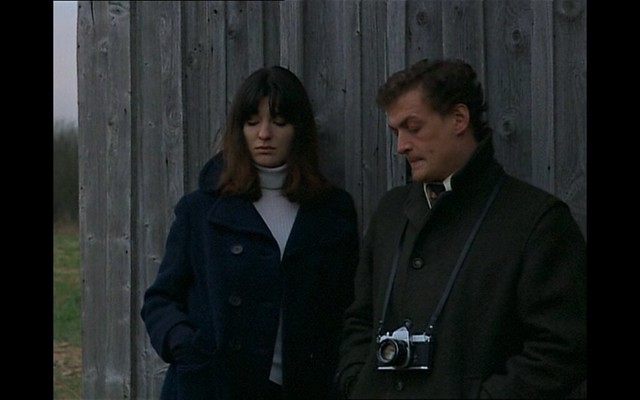
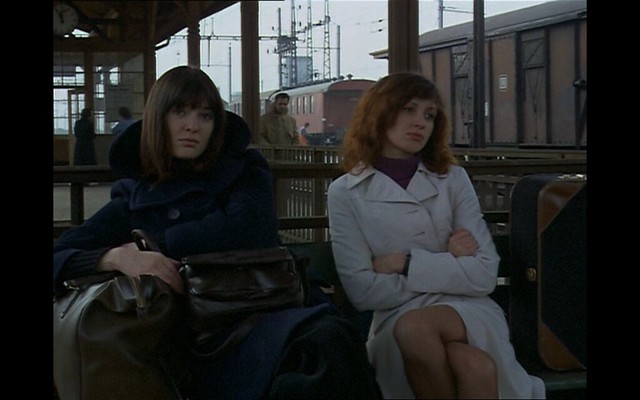
Le milieu du monde (1974) - Tanner Screen Shot 2021-02-01 at 1.58.31 PM Screen Shot 2021-02-01 at 5.44.16 PM Screen Shot 2021-02-01 at 2.33.07 PM Screen Shot 2021-02-01 at 5.34.07 PM Screen Shot 2021-02-01 at 6.08.24 PM Screen Shot 2021-02-01 at 6.25.51 PM
In the beginning, we are introduced to a winter landscape of rural Switzerland, cold and dreary and desolate. There is a film crew setting up a dolly tracking shot from a distance. A female voice preludes the theme of the film - how giving context to a film is important - the time, 1974, the place Switzerland, etc and the film's got to do with normalizing hope. What unfolds for the next hour and a half is a working class romance between an out of towner waitress and a local engineer turned politician. The center of the world is wherever you are - each of us as a center.

Adriana (Olimpia Carlisi) is a tall Italian from Venezia region arriving to a small rural town in Switzerland. She takes a job as a waitress at a local cafe where regulars hang out. Paul (Philippe Léotard), an engineer with a boxer's face, is being recruited and groomed by a local party officials to be a candidate for an upcoming elections for a seat in a local council or something. They are pushing him because he is young, married, a working class technician, someone who is obviously not a politician. Mrs. Schmidt, who owns the cafe, warns Adriana not to get into political conversations with the patrons. 'Business and politics don't mix'.

Adriana gets few sexist jokes and butt grabs from the locals at the cafe but she is a toughie and can handle them. She is an all around gal who's not born yesterday. She gets Paul's attention as he is in town for the election campaign and asks her out. It's a working class romance. But we know where it's going and it's not going to go well. People gossip and Paul's naive insistence that what's private affair is private while running for a political office is not going well. Adriana is just along for the ride. She keeps saying Paul doesn't really know her.

Alain Tanner's observation on a working class micro-affairs takes a cynical tone on Paul's false sense of hope - that he will leave his wife and move in with Adriana in to some fancy apartment. His hubris of showing off his 'Italian girlfriend' without thinking twice about what it means to his election, that it's all in context of the system- liberal democracy, class, sex in the 70s Switzerland. Election is just red herring because his loss is only mentioned in passing and everyone goes on the way it was before. It's no biggie: Politics is not a big deal either with the elites - they always can find another bloke or stay with the establishment, or working class - they can stop pretending to understand what those political slogans mean and go back to their lives. Adriana decides to leave town because she doesn't really know what she wants. It's her own volition. She will go and get a job at some factory. Everyone is in the middle of his/her world.

I understand what Tanner is trying to do in Le milieu du monde, but it's not all that successful. Carlisi and Léotard are affable enough. Juliette Berto shows up as a sexy peer waitress. But the matter-of-fact presentation and dreary winter setting are dry as hell. I'd try other Tanner's films some time soon.

Friday, April 10, 2020

History/Story of Cinema and Us

Histoire(s) du cinema (1988-98) - Godard
Screen Shot 2020-04-10 at 8.25.23 AM
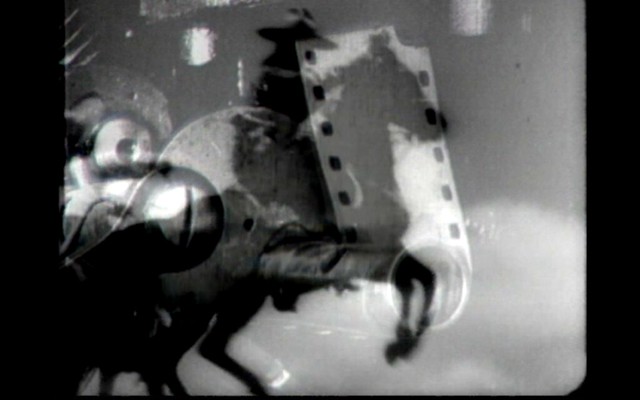
So one thing I am thankful for this time of worldwide pandemic, where we are witnessing our capitalist society slowly collapsing in real time, is it finally shoved me into watching the whole of Histoir(s)du cinema, Godard's monumental reflection on the 20th century and the role of cinema in it. It's been a long overdue, to say the least. Except for Numero Deux which Godard directed with Anne-Marie Miéville (1975), Histoire(s) is the precursor to all his later essayistic films. Clocking at 266 hours, although divided in 8 parts, it marks the longest among his films.
Screen Shot 2020-04-09 at 6.27.38 PM
With a cigar permanently fixed in the corner of his mouth, his electric typewriter always roaring its plastic screech in the background and forever blinking images testing us with our persistence of vision, Godard sets out to examine the 20th century riddled with war and destruction and cinema's place within it, or shall we say, our place in cinema. His repetitive themes throughout the whole series is that cinema is neither art nor technique but a mystery. He makes numerous comparison with art and cinema throughout. The difference between film theorist and their books, Godard has been a 'camera-pen' of the auteur theory in practice, churning out these visual essays for almost four decades now.
Screen Shot 2020-04-09 at 6.06.20 PM
Screen Shot 2020-04-09 at 6.08.14 PM
Godard makes the convincing case with him being a French New Wave filmmaker and how that puts him in unique position to assess cinema history: Belonging to the Post-War generation, seeing enough films through the cinema's evolution and progression. Born out of the idea of image projection by a feverish Napoleonic soldier in Russian prison, Histoire(s) is also the (hi)story of French cinema.
Screen Shot 2020-04-09 at 7.10.19 PM
Godard's wordplay never stops. Besides the word histoire in French having two meanings (history and story), he dissects words and constantly rearranges them also. This project being started during the peak of video technology, he points out the implications of its terms - Master/Slave when describing master tape/file and its copies - the term we still refer in film post-productions and information technology. His assertion of the power of image throughout his filmography also hasn't changed - it seems, in Godard's mind, sequential shots of dead bodies in the atrocities of war and pornography reveals the duplicitous nature of cinema.
Screen Shot 2020-04-09 at 7.45.16 PM
In Deleuze's Cinema I & II, the philosopher makes a distinction between Movement-Image period and Time-Image period before/After World War II: and how Movement-Image oriented thinking gave rise to nazism and propaganda and ended up in the gas chamber. Time-Image concerns aberration of image and sound. And that more or less starts with Italian Neorealism which precedes French New Wave. Partly because they didn't have any reference point with total destruction of their surroundings, they had to think seeing images differently with sound as an independent partner, not just dialogue track. Obviously well-read, Godard knows this, and praises the films of de Sica, Antonioni and Pasolini because Italian filmmakers, with its long illustrated history and language, didn't remain silent during the war years (1941-45) and right after. In Cinema II, Deleuze also makes a point of the power of false; falseness in image, just as impactful but also dangerous. Godard says cinema is not entertainment nor communication device but rather cosmetics, a small industry of lies.
Screen Shot 2020-04-10 at 10.48.04 AM
Balkan War in the 90s really affected Godard and its continuation and repetition of atrocities since the war affirmed his cynicism toward humanity greatly and it show in the later part of Histoire(s). He continues to revisit the notion of 'newness of history' and 'history of news'. In the time of fake news, how do we see through all these falseness and dig out the truth? Godard seems to admit that we live in a corrupt state, but like poetry and art, cinema can see us through. And I really hope this is the case.