Showing posts with label Retrospective. Show all posts

Thursday, April 30, 2026

If Trees Could Talk

Silent Friend (2025) - Enyedi Silent Friend After delving into the contemplation on nature with 'all animals are sentient creatures' message in her film, On Body and Soul in 2017, Hungarian filmmaker, Ildikó Enyedi, presents Silent Friend, a loosely connected three narratives dealing with our connection with trees across time, observed by 200 year old ancient ginkgo biloba tree.

Tony Leung (making his first European production appearance) plays Dr. Wong, a renowned Hong Kong neurologist, who gets marooned in a medieval looking university campus in Marburg, Germany, due to Covid outbreak. He was conducting an experiment on how the human brain functions differently in babies from that of adults. In a lecture with a bouncing light ball in darkened room, he gives an example with spotlight consciousness (adult brains- concentrate on one thing at a time), and lantern-light consciousness (babies- open to surroundings more and their concentration differs as their attention shifts more freely like a floating ball). Now due to Covid, all the students and faculty are cleared out. Wong's research is on hold. His perky German-Chinese assistant is only communicable through zoom sessions, and he is the only one left in the whole empty campus with a cranky German custodian who serves him daily meals while keeping distance in accordance with the pandemic restrictions.

The second story starts in black and white with Grete (Luna Wadler), a bright student attending the same Marburg University studying botany. It's the turn of the century and she experiences blatant sexism from a sea of male students and faculty. In a cringe-inducing selection process in front of the all old male committee, Grete is interrogated mercilessly through the texts of Carl Linnaeus, whose classification of plants based on their sexual organs which was groundbreaking at the time. The societal prejudices and sexual insinuation against young learned women bleed into her life, Grete loses her lodging and finds solace in an old photographer's studio as an assistant, where she explores her artistic freedom and sexuality.

The third narrative thread concerns introverted Hannes (Enzo Brumm), who has a love/hate relationship with nature, due to his rural upbringing, falling for fellow university student Gundula (Marlene Burow) who has a lab experiment set up in her dorm room. The setting is in the 1970s - counterculture, drug use and free love. Gundula tries to record her geranium's reaction to humans, because she believes our silent friends- plants, trees, fungi, etc, want to communicate with us as much as we do with them.

While being stuck in isolation, Dr. Wong contacts a fellow scientist Alice Sauvage (Léa Seydoux) who specializes in communicating with plants, and decides to conduct an experiment on the ancient ginko tree right in front of his temporary residence at the university. But he has to deal with the German Gatekeeper, who is suspicious of his activities and is actively trying to sabotage his experiments.

With all these intersecting stories and through breathtakingly beautiful images (by Gergely Pálos, About Endlessness, Pigeon Sat on a Branch Reflecting on Existence, shooting in digital for 2020 section, 16mm film for 1970 and 35mm film for 1908), Enyedi tells our relationship with nature and by extension, among ourselves. Dr. Sauvage tells Dr. Wong via zoom that she sees lonely souls when she enters a garden. Male ginko trees separated from their female counterparts for landscaping reasons.

Tony Leung is aging like a fine wine. He carries the film with hefty philosophical implications with ease and elegance. His soulful, searching eyes and his wrinkles add to the wisdom and intelligence of his character, draping over simmering underlying sexual tensions in the film. He also does a tai-chi session in the garden completely naked.

Throughout these interconnecting stories, Enyedi makes us contemplate the fact that while a ginkgo tree can live up to a thousand years, observing us silently, as generations of us live and die in its time.

Silent Friend can be seen as narratively unsatisfying, by not tying up its threads neatly enough. But it reminds us that fleeting human existence and brief, yet meaningful connections that are what matters, in the eons of time.

Silent Friend opens on May 8, in conjunction with the Tony Leung retrospective at Lincoln Center - The Grandmaster: Tony Leung.

Saturday, February 8, 2020

A Yellow Jacket is Just a Yellow Jacket, Nothing More: Angela Schanelec Interview

Schanelec
One of the leading figures of the Berlin School, Angela Schenelec has been quietly garnering reputation and fan base as one of the most important contemporary German directors, for her complex, enigmatic work since the early 90s with such films as Marseille and Orly. With her new film, I Was at Home, But…, she won a Silver Bear (Best Director prize) at Berlinale, 2019. The film is getting a theatrical run in New York on 2/14 and Film at Lincoln Center is presenting the complete retrospective titled Dreamed Paths: The Films of Angela Schanelec (2/7-2/13) As a big fan of Schanelec’s mysterious and thought-provoking films, I was ecstatic to find out that she would be in town for the last year’s New York Film Festival. I sought out to get a chance to talk to her during the festival and was richly rewarded with an one-on-one interview at posh yet empty Library Bar, situated in Hudson Hotel Midtown, last October afternoon.

I watched your latest film I Was at Home, But… and there’s a lot to take in. It starts with a pastoral scene with barnyard animals - a donkey in particular. I know you are a fan of Robert Bresson. Was Au hasard Bathazar something you were thinking about When you were making the film?

I mean, Au hazard Balthazar is one of the most beautiful films ever made. The first film I saw from Bresson was L’Argent. It impressed me very deeply. Many many questions arose in me after seeing that film, not only about filmmaking but about life. Then I saw other films by him. The last scene where the donkey is going to die in Au Hasard Balthazar…. I mean, there is nothing more to say. But I saw the film long ago…. At the same time, a donkey is a donkey, you know? Nothing more. Maybe I wanted to free myself (from Bresson) by showing it. The original idea was not Balthazar. Nevertheless, this Bressonian donkey has been in my mind for a long time. But there is a German fairytale: These barnyard animals live together in the house. There is a donkey and a dog and so on.

You mean the Bremen Town Musicians?

Yes. This was the idea for me. Humans don’t want them anymore because they are old. So they find each other and they live together in a house. So there are different influences for that scene.

It was interesting to me. I interpret it in respect to Balthazar that the donkey is protecting the dog whose nature is taking small animals apart. That he is there to forgive everything.

Yeah.

That he is a protector. That’s how I felt when I saw that scene. And it was very beautiful.

It seems that grief and death are hanging over the whole film. Was that your starting point for this film when you were first writing?

The starting point was the image of the boy who comes back and he is 13 or so. I saw him all dirty at a street crossing which is now in the film. And then…so what does that mean? And yes I have a son but he never disappeared. Maybe the image came about from the relief that he never disappeared or fear that he could have disappeared. And then I wrote scene by scene and that’s how the film came about. It was never my intention to write about grief.

It wasn’t?

No it wasn’t. It came up during writing. So he comes home and who else is there- there’s a mother and a little sister. Who else? No one. A dog but not a father.

The color choices on the film are also very striking to me. The boy’s jacket is yellow and the girl’s is bright red. All the images you present in all your films really fascinate me. Since your films are not strongly narrative oriented and in fragments, I always wanted to know for a long time what your writing process is like. How do you approach your subject? As you say, you build it up from a particular image in your mind?

Yes. In the beginning there is an image, then that image creates the next image. But I would say these images aren’t all that important. The emphasis on these images are not the approach I take. A yellow jacket is just a yellow jacket. There is nothing behind, I want to say. You understand what I mean? The yellow is felt because it’s just yellow. It doesn’t have to…

It doesn’t have to symbolize something…

Yes! I think that is very important to realize.

This so called the Berlin School where they group you with a bunch of other German filmmakers, the way I see it, the way I always thought of the Berlin School is that of transient life, the loss of identity or looking for identity. In your films I see that theme a lot as well. Do you have affinity to the School? Or is it just critics and scholars grouping you guys together.

In the beginning when the label first came up it was only Christian (Petzold), Thomas (Arslan) and me and we know each other because we started around the same time. Christian and I were never that close but Thomas and I are friends still. But we don’t talk much about our work. I mean, when we started together we talked about films and shared similar interests in films. More Thomas and me. We didn’t really involve ourselves in each other’s films - I am talking about writing scripts together or anything like that. We saw each other’s films when they were done. But later on, anything made in Germany that is not comedy is considered the Berlin School films (laughs), and they found some funny moments of my films too, so… (laughs) See, it became so general that it (the label) lost all meaning.

If it’s not a grouping of themes, I feel it’s a generational thing - you guys grew up and went through the Berlin wall coming down in 89 and there is this divide… Watching yours or Arslan’s or Petzold’s I always felt that it played a big role. But in I Was at Home, But… I didn’t feel that. I can say that there was a historical context regarding the divide in your last film Dreamed Path. I don’t see that much of a historical context in the new film. Is this a fair assessment?

I think it is true. I mean you are right that with Christian and Thomas, I am in the same generation, the generation who started to make films in the 90s. It’s different with Christoph Hochhäusler, Ulrich Köhler, because they are next generation of filmmakers. We are only ten or fifteen years apart but that plays a big role. You are right about the fact that we started in the 90s when Germany is saturated with comedies, so that plays a role. But time has passed since then. So there is no connection between Thomas and me and Christian’s films anymore. And that’s why.

Maren Eggert, the actress who has been in many of your early films, plays the main character, Astrid. I am curious about your working process with her. Does she know what you are trying to do with each of your films in advance? (she shakes her head) No?

But she can’t, because I don’t.

It’s not written in the script as...?

No the script is written exactly, the dialog’s written exactly what you see. Nothing is improvised. The long scene with the daughter and her, for example, I mean she learned it, she learned the text but she can’t know because I don’t know.

Interesting.

And the difference with her compared to other actors is that she gives me the feeling that she trusts me. She doesn’t ask questions. She takes the scene that is given and she lets herself go with it. She is not afraid, probably because we’ve known each other for so long. She knows that with me she doesn’t have to prove anything. It’s always the case that if you work with an actor that you haven’t worked with before, he wants to prove it to you. It really doesn’t make sense. It’s about situations and it’s about sentences and it’s about practical things that have to happen in front of the camera. It’s never about interpretation, it’s never about meaning, it’s never about where we are going. Maren doesn’t ask these because films are not about where we are going. (laughs) It’s about a scene. Then another scene.

Is it the same for you when you are directing children?

Yes. With I Was at Home, but also Dreamed Path I employed child actors. For Maren I give her the script since I know her and we have a mutual trust. But I don’t give other actors the whole script. Because it won’t make sense. It doesn’t have anything. On the contrary, if they saw the script, there will be more conflicting questions that will not be productive for the project. Sure for children I didn’t have the script. They didn’t need it.

It is fascinating to hear this since watching your films I had all these ideas about how you approach your films. This is very helpful.

There are many visual images that strike me in this film. There is a recurring image of the crown. I don’t want to ask what it means but how does it connect with the film?

The crown…

I was also thinking about Balthazar again, about the flower wreath the girl puts on the donkey.

Presenting the crown to someone is a very beautiful act. Then you make him very independent and strong in a way. Because the king doesn’t need to be told what he has to do or anything. I mean you can read it like that but you know it’s more complex. The crown means, “I exist and I don’t need you to…”

“Validate me?”

Yes. So then, giving the crown to children, it’s even more beautiful. But you can’t do it like that in real life. Shakespeare gave me a chance to do it. And to go one step further, there was a boy in the supermarket and I did it without Shakspeare since there was a crown already in the film.

I thought it was beautiful. It’s a striking image. The crown in the mud and the custodian picks it up. I loved that scene.

I loved the scene in the parking lot with the teachers who, I guess one professing his love to the fellow teacher and it broke my heart. How did you come up with the scene and how does that tie with the rest of the film?

The question of motherhood is the one that ties in. It was presented in the film very soon. I mean… it is always more complex than that. When mother doesn’t want to have a child, it stops right there and then. Every man, every boy has a mother. It has so many aspects. The fact that our society today we stopped accepting what nature makes possible. This notion of “I have the right to have a child” and “if the nature doesn’t give it to me, for whatever physicla circumstances, then modern medicine will give it to me”. This idea is very strange to me. That we don’t accept anymore what is given to us. And on the other hand, in the scene, she is the other way around. Physically she can get pregnant and can give birth but she doesn’t want children. So that’s how it came up. I was interested in a woman who says “no”. And it is impossible for the man to understand but it does not make him stop loving her.

No, this is true. That’s why the scene is beautiful and heart breaking because he asks, “so you love me and I understand that you don’t want to have a child but then what else is out there after we are gone?” It really struck me.

Yes. But there is nothing more to say than that in that scene. The young woman who decides not to have children, opposite mirror Astrid.

Another scene that I really loved was that Astrid was in the Kitchen and the kids were making mess and she just loses it. And the children try to console her and she just pushes them away. That’s tough for children.

That’s something I feel very strong about: children don’t judge. They are not able because they need the mother. At some point in their lives they start to judge but I think it’s a very existential point when that happens but in this film they don’t. It’s also important that there are two. They have each other. And that makes them stronger but also generous.

Also important for me that that kitchen scene is not some turning point. We see her the next morning that she is the same. That that scene is not some kind of clutch, as if that will solve things going forward. No, nothing can be solved. And life continues. In film dramaturgy, this would be the plot point. No it’s not. It’s not essential to be a plot point. It’s a scene of humans. Maybe they later will have some epiphany but they can not know at that point. I also don’t know.

Interesting point.

There has been 6 years gap between Orly and Dreamed Path. And three years gap between Dreamed Path and I Was at Home. Why is that? And what is your next project?

Yes I am working on a new script. But the long period between Orly and Dreamed Path was very painful. It’s a long story. The money wasn’t there and I had three producers. I had written I Was at Home already before I shot Dreamed Path. Also when I shot the Dreamed Path we had this summer scene in the beginning and at the end. But most of the scenes were shot in October and November and we had to wait 6 months to shoot the summer scene in Croatia and another part of Germany for the end of the film. There were also free phases that I was able to think about a new film. It’s based on the Oedipus myth. We now associate Oedipus with Freud, but my story is not that. The first part of the story is this child who was lost and grows up not knowing his real parents and accidentally murdering his real father and then also not knowing his mother and accidentally meeting her and falling in love with her. So that’s the first half of the film. Then they have a child and then they understand who they are.

I am interested.

We are trying to find the money for it and if everything goes well, I’d like to start shooting next September. I am really worried about how it’s gonna go with the financing because it will be more expensive than I Was at Home, but… because we want to shoot in Greece.

Got you. You shot in Greece before no?

Yes. Dreamed Path was also shot in Greece. It was also at higher cost. So this film, I Was at Home but was much lower cost and I produced it myself.

Is it always difficult to finance your film?

Yes. 

It’s a pity. Hopefully you won't have problems for the new one so we will be able to see it soon.

Monday, July 22, 2019

An Ode to Kiarostami: Abbas Kiarostami Retrospective at IFC 7/26 - 8/15

In celebration of Abbas Kiarostami Retro at IFC Center starting this weekend, I present you something I wrote about the master a while ago. Please visit IFC website for schedule

28353id_014.tiff
   
   
        Abbas Kiarostami, an Iranian master filmmaker, painter, photographer, and poet, passed away from gastrointestinal cancer in Paris in 2016. As an avid fan of his humanistic, genre transcending films, I can say with a certain conviction that we've lost one of the greatest artists in the world of cinema.

        My introduction to Iranian cinema came when a good friend of mine introduced me to Mohsen Makhmalbaf's films (on bootlegged VHS). Soon I was enamored by anything Iranian. It was a spur of the moment decision that led me to check out The Wind Will Carry Us in theaters in 2000, not knowing anything about the film other than it being from Iran. And what an experience it was! Its elegant simplicity and great eye for landscapes impressed me greatly. Seeing Wind Will Carry Us (1990) was also a watershed moment in my cinematic education. I’ve never seen such a truthful observation of human life before and it made me a life long devotee of his work. What's most striking about Kiarostami’s artistry is his effortless, seamless quest for truthful representation of human conditions on film. Whether they are shot on 35mm or with a consumer grade handy-cam, the inquisitive interactions of non-actors with their natural dialogue often imply that there is no real distinction between cinema and reality.

The-Wind-Will-Carry-Us-gallery_01b
   
        It was Kiarostami’s Taste of Cherry, winning the Palme d'Or at Cannes Film Festival in 1997 that introduced his poetic, meta-fictional cinema to the world and put many of his contemporaries on the world cinema map. And yet, when the director first burst onto the world cinema stage, critics didn't know what to make of his films: Roger Ebert gave Taste Of Cherry one star, calling it “excruciatingly boring” (Ebert, Taste of Cherry Review, RogerEbert.com,1998), while Jonathan Rosenbaum desperately tried to find some sort of reference in Western cinema tradition in his films by comparing Godard’s early work to Kiarostami’s in terms of reflecting society in certain periods or suggesting the similarities between Close-Up and John Guare’s play Six Degrees of Separation which later was adapted into a film. (Rosenbaum, 2001, 2) But as Kiarostami himself says in 10 on Ten (2004), a documentary on his reflection on the techniques he used on his 2001 film, Ten, he believes that simply showing austere reality with an open ending can entice audiences to reflect on their own lives. I can't think of a higher compliment to the audience than what Kiarostami bestows upon us with his films.

        Kiarostami’s main themes throughout his filmography are Children facing and overcoming harsh reality, Time Passing/Fleeting Nature of Human Existence, and the Perceived Notion of Truth and Reality. His observations of children, for example, date back to 1970s when he helped establish the filmmaking department at the Institute for Intellectual Development of Children and Young Adults (Kanun) in Tehran. There he made a series of documentaries and shorts concerning school children. Kiarostami's depiction of children, from his Kanun days (The Bread And The Alley, Break time, The Traveler) to later films (The Koker Trilogy, ABC Africa, Ten) is that of a nondisciplinarian in that he simply observes children being children. Often, these films are about children facing harsh reality (Soltani, The Child Heroes of Abbas Kiarostami’s Films, Movie Mezzanine, 2016). In his feature documentary, Homework (1989), for example, it is obvious that the educational system in Iran is too strict and puts a lot of pressure on children, both in school and at home. It's revealing that all the children interviewed for the film know what “punishment” means but don't know the meaning of the word “praise.” Parents, as well, say that the system is too harsh on the children; that it kills their creativity and ends up producing a generation of mindless drones. The director seems to be agreeing with this sentiment: “I tried to look at the world from a child’s point of view” (Jones, Children of the Revolution, Guardian, 2000).

006839a1

        Children facing harsh reality is the theme of his films, later known as the Koker Trilogy. Kiarostami made three films set in Koker village in Gilan Province, an area of Northern Iran lying along the Caspian Sea. Where is Friend’s Home? (1987) was the first of the three, and is about a boy trying to deliver a notebook that belongs to a friend who lives in the next village. The second one, Life and Nothing More… (1992), was made after the devastating earthquake in 1990. A middle aged man and his young son are on the road to Koker, a northern rural village leveled by the devastating earthquake. They spend most of the film's running time in their car. It is only revealed later on that the man is a film director (a Kiarostami stand-in) who is looking for a child actor who starred in his previous film, Where Is Your Friend's Home? Through The Olive Tree (1994), completes the trilogy. A fictional 'making-of' Life And Nothing More, the film is a beautiful film that shows resilience of children after a life altering disaster.

        From the bustling bottleneck traffic of Tehran in The Report (1977) to Ten (2002), Kiarostami’s films remind us that life with its ebbs and flows is never stopping and always changing. This is never as apparent than in his masterpiece, Taste of Cherry. Inquisitive dialog scenes, just like intimate questionnaires in documentaries, are staged usually in moving cars (and after Taste of Cherry, interior driving scenes became synonymous with Kiarostami’s films). The beauty of Taste of Cherry lies in its simplicity: a man drives around looking for someone to assist him in his suicide. They don't have to do the deed; he will take sleeping pills and lie down in an already dug up grave. In the morning, they can put some earth on him if he's dead and they will be rewarded handsomely for doing so. First, a young soldier runs away after finding out what the man is up to. Second, a seminary student from Afghanistan objects because of his religious beliefs and tries to dissuade him. And finally, an old taxidermist agrees to it, because he has a sick child. He tells the suicidal man that he too, contemplated committing suicide. Adding that he abandoned the idea after tasting cherries.
  
        Kiarostami reminds us that we are watching a film throughout Taste of Cherry; for example, he inserts the footage of himself shooting the film into the narrative. The nameless protagonist does not exist in real life, that his moral quandary is an invitation for us to mull over. It’s Kiarostami himself who is asking us these questions directly. What makes him contemplate such thoughts? What would you do if you were asked to help him kill himself? With Louis Armstrong's St. James’s Infirmary Blues, a song usually associated with funerals, playing at the end over the image, he tells us that death is inevitable for all of us, and it makes us contemplate our own mortality. If the great Russian filmmaker Andrei Tarkovsky tried to make us feel the 'passage of time' with his virtuosic creeping camera dolly movements, framing and lighting, Kiarostami succeeds in astounding simplicity, in one hour and forty minutes- Life is a moving car. Done. The impact is still immense. It all fits nicely with his theme of life, death, blurring boundaries of cinema and reality.

        Kiarostami draws from many aesthetic sources. His admiration for Japanese culture, for example, can be seen in his haiku style poems and in Like Someone in Love (2014), which was set in Japan with Japanese cast. In an interview he said:
I am certain that my fascination with Japan has been with me forever, even before I got to go to Japan. Even my very first attempt at any kind of artistic expression, which were poems that I wrote when I was 20 years old, resemble haiku. I had no idea at the time, but I wrote poems that are very like haikus. And in my photography work, there are some kind of common forms found in traditional Japanese paintings. There is some sort of resonance in my practice and Japanese art. So there has always been real interests before my first visit there which was confirmed whenever I went back thereafter. I've been visiting Japan periodically over 20 years now. (Chang, We Are All the Same: Abbas Kiarostami Interview,Screen Anarchy 2013)
The influence of Japanese cinema is evident in Five (2003), in which Kiarostami pays homage to Yasujiro Ozu. The film consists of five segments set in a coastal area in Iran without any characters or dialogue. With zen-like simplicity, we are presented with five static shots of various lengths. The camera remains static, but birds, dogs and people are heard and seen, in and out of the frame. With each long take we observe nature and human existence for what they are. In the final part of Five, Kiarostami traces the reflection of the moon on the surface of a pond. We don’t really understand what we are watching for a while. It’s dark, and the black and white image is grainy. We then realize that it’s the reflection of the moon on water as it ripples from time to time. We watch it with the chorus of insects in its nighttime surroundings to the breaking of dawn. This entrancing, collective cinematic experience –of us the audiences staring at the screen silently for 7 minutes, to witness the every day miracle of sun coming up, realizing the smallness of human existence has been one of the most thrilling experience in the cinema of all time for me.

        It's only been the last couple of years that I've been writing about films seriously, realizing that film medium can go much further than just mere entertainment and that freedom from the dominant narrative structure can be exhilarating. Attending Art of the Real series showcasing non-narrative films at Film at Lincoln Center was an eyeopener for me because it exposed me to a current crop of shape-shifting postmodern cinema, which subverts the medium’s traditional narrative structure and characterization and tests the audience’s suspension of disbelief (the works of Apichatpong Weerasethakul, Miguel Gomes, José Luis-Guerrin, Lisandro Alonso and others), enticed me and pulled me into the very depth of the cinematic rabbit hole, and left me exhausted and confused and exhilarated at the same time. And this is where Kiarostami’s Close-Up (1990) serves as a precursor for these more contemporary filmmakers. In Close-Up, he returns to the idea of an imposter of a film director: a man swindles an upper middle class family by pretending he is a famous Iranian film director, Moshen Makhmalbaf. It’s a story of a movie fanatic who admired Makhmalbaf so much he wanted to be him, but without malicious intent. The film is based on a true court case, and everyone participating in the film are real life characters reenacting their ‘roles’ in Kiarostami’s film under his direction, including the imposter, who is questioned off frame in the courtroom scenes. The result is a touching, moving examination on 'life imitating art imitating life', rather than sensationalistic satire about fame and deception.

        There is no doubt Kiarostami’s success in the West has brought a spotlight to the Iranian cinema on the international stage and drawn attention to a second generation of Iranian New Wave with directors, such as Jafar Panahi, Majid Majidi, and Asghar Farhadi. Kiarostami’s influences are quite palpable in younger generation of Iranian directors. Panahi started out as his assistant director, and many of his films take place in a moving car. Majid Majidi’s films usually deal with children’s flight and they owe a lot to Kiarostami’s Kanun films, Where’s Friend’s Home and Life and Nothing More…. and Asghar Fahadi’s elusive narratives and unreliable heroes in About Elly and A Separation owe a lot to Kiarostami’s convention subverting cinema.

        Unlike many other Iranian filmmakers who actively make political statements with their work (his former assistant Jafar Panahi being the most vocal one), many of Kiarostami's films can be seen as Iranian sociopolitical fables rather than overt political statements. But the given complexity of his work, the Iranian government has banned the exhibition of his films, fearing that there might be hidden subliminal messages. And unlike many Iranian New Wave filmmakers of his generation who fled the country after the 1979 revolution, Kiarostami stayed and kept making films exclusively in Iran. He accepted that restrictions and censorship were a part of life in a rigid theocratic society, but always had found ways to express himself in changing environs both before and after the revolution. The prime example of this would be The Report (1977). Firouzkoui (Kurosh Afsharpanah), the tax investigator, is perhaps the least likable character in all of Kiarostami's protagonists- he cheats, lies and abuses his position as a government official. After being accused of corruption and short on rent money, he resorts to beating his wife and neglecting his baby daughter. Kiarostami observes all this from a distance. Considering The Report was made before the Iranian Revolution in which the Shah wasoverthrown and The Islamic Republic established, the film is a snapshot of the state of Tehran of that era —women wearing revealing Western clothes, men drinking and gambling, gridlocks in the city streets, etc. The film is a report on petite bourgeoisie, steeped in selfishness and materialism.

07ed74a7da95a507d67e8379a95f9a76        
Kiarostami made films exclusively in Iran until 2011. I reckon it was exactly that transcending subtle artistry that fooled the censorship for a long time. But during the conservative president Mahmoud Ahmadinejad’s tenure, he found practicing his craft in Iran increasingly difficult. Thankfully for us, it directly resulted in two international productions, Certified Copy (2011), set in Italy, and Like Someone in Love (2013), set in Japan. Even though the film’s settings are different and have international movie stars, his artistry hasn’t changed. His cinematic playfulness and his usual theme of perceived notion of truth and reality are there, even deepened and more sublime than before.

    
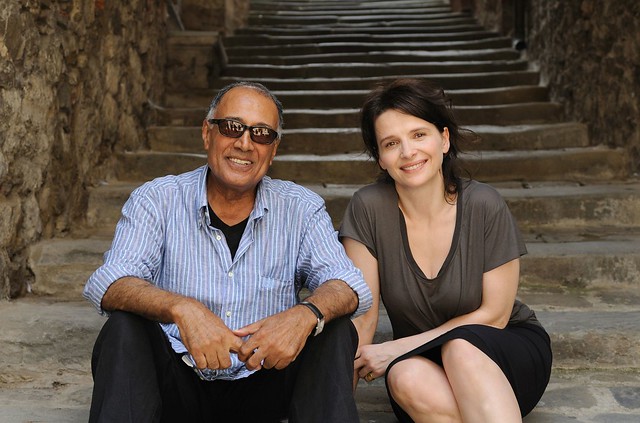
        Juliette Binoche, an internationally renowned French actress, stars in Certified Copy. It starts out with an Englishman James (William Shimel) giving a talk on his new book about the legitimacy of copies compared originals in art in picturesque Florence. As infatuated antique dealer (Binoche) picks James up and drives him around town as a guide, the film becomes something else: deconstruction of a relationship. Even though it's the first film set outside Iran, there are Kiarostami touches everywhere- long driving shots, actors talking while looking at you straight in the eyes, blurring the lines of what's real and what's not. As the couple discuss the legitimacy of a copy of a master painting, mirroring their relationship, as we witness the copy of the real married couple breaking apart. Is it any less humanistic because we are watching a film with big movie stars? Do our emotions feel false when we watch Binoche’s character suffering? Deceptively simple, yet as much complex as Close-Up and Taste of Cherry, Certified Copy doesn’t disappoint.
        
Like his other films about acting and being and perceived notion of truth and reality plays heavily on Like Someone in Love. The premise of the film is pretty simple: Akiko (Rin Takanashi), a pretty young Japanese college student doubling as a call girl meets an elderly professor Takashi (Tadashi Okuno) who takes a protective role in her life. But like Kiarostami’s other films, it ends in quite a different place than where it starts. Many scenes in the film are seen through the windows and the dialog spoken off frame or on the phone. Just like the technology being a hindrance to human connections in Wind Will Carry Us, the abundance of cell phones here sets people apart. The film’s three protagonists – Akiko, Takashi and Akiko’s overjealous boyfriend Noriaki (Ryo Kase) act and behave like they don’t know how to behave in each other’s company. Yet they are more frank about their secrets with total strangers than with their own families. And there are many clues that suggest the cyclical nature of love that we can chew over for a long time. It’s a harder puzzle than usual in Kiarostami’s oeuvre and more complex. Although the film is less optimistic than his previous films, one can tell that the master filmmaker is adventurously expanding uncharted territories both physically and culturally.
     
        Kiarostami's passing in 2016 was very unexpected. Among all the cultural luminaries who passed on recently, his death really saddened me in a very personal way. When I heard the news of 24 Frames, the film he's been working for three years and unfinished at the time of his death, was going to be released with the help of his son Ahmad, I was more than eager to see the late master's final work. The film is, in large part, a collaboration of Kiarostami and visual effects artist Ali Kamali. Based on Kiarostami's photographs and videos, Kamali was responsible for digitally creating multilayered images that (provide description here). Kiarostami's idea for 24 Frames is simple—try to bridge the gap between painting, photograph and moving pictures. That instant is frozen in time forever, but what about just before and after that moment? They are usually easily discarded from and forgotten in our memories. Cinema as we know it, can prolong that moment for a little longer, to help us in imagining the narrative, in contextualizing the content within the frame a little more. Comprised of 24 4-1/2 minute static shots, the film most resembles Five, where he held his camera to five static scenes in various length. And it's the same minimalistic approach without human presence(except for two scenes) he applies here.

P_Bruegel_Hunters
    
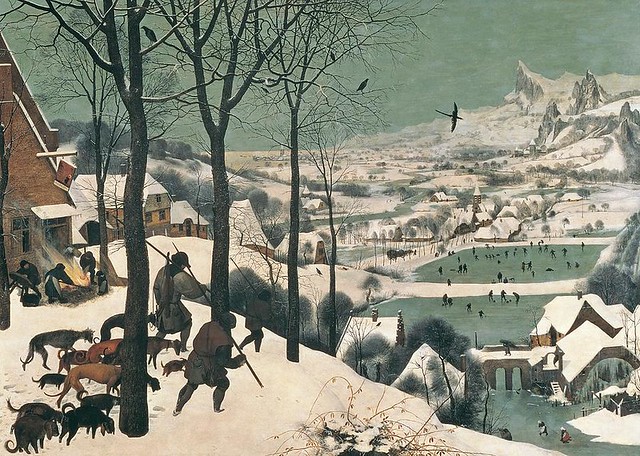
         In order to demonstrate the landscape frozen in time, 24 Frames’s opening frame is the famous winter landscape painting, The Hunters in the Snow, by Pieter Brueghel. Accompanied by the sound of hounds, wind, footsteps, and people playing on the frozen lake below, we see subtle animated movements - smoke billowing out of chimneys from down below, birds flying across the frame, one of the hounds coming alive and trots and pees on the tree, while certain elements stay frozen, like the hunters themselves and the pheasant flying across the sky. In this moment, Kiarostami offers us the chance to contemplate on various things—the power of our imagination, fleeting nature of time, immortality of art—.all in one frame. Kiarostami's love of nature and landscapes comes to the fore - deer, cows, various birds, dogs, horses, cats, snow, rain, wind, ocean, forests, and mountains.
        
        Windows figure heavily in the film as well, constantly framing the frame. If it's not windows, it is fences or columns. He wrote in 2009 about his photography:
I've often noticed that we are not able to look at what we have in front of us unless it's inside a frame. (Kiarostami, Interview with Abbas Kiarostami, Guardian, 2009)

As he championed shooting from the moving car throughout his films, he uses car windows to frame images. One scene, for example, is dedicated to the snowy landscape outside the car window—a couple of horses run parallel to the moving car, we lose the sight of the horse as it lags behind. The car stops, the automatic window rolls down, the horses reappear. Now we are presented with two horses playing around in the blizzard through the car window. After a while, the car moves on. Humans are not in the frame most of the time. Kiarostami doesn’t necessarily makes a nuisance out of humans nor does he present them as a threat to nature. He seems to say that this is the life as is, with us in it. But as always the case with Kiarostami's films, 24 Frames is only deceptively simple.
        
        One moment in the film exemplifies this complexity. It consists of a group of Iranian family looking at the Eiffel Tower from a distance, with their backs toward the audience. At first we don't know if this frame is a photograph or not. The voices from the crowd, then people working by in the foreground follow. It's another intoxicating concoction by the master: mixing the idea of 'the window to Paris' and current climate of immigration in the first world since it's hard to determine where this scene takes place.

46317387022_5a24563d13_o

Accompanied by Andrew Lloyd Weber's "Love Never Dies," the last 'frame' is strikingly beautiful. We are presented with a frame within a frame – of a window. A girl, back to us had fallen asleep with her headphones at her desk in her room. Her laptop is playing some unidentifiable Hollywood movie where a couple slowly kisses. We see tall trees blowing in the wind through the window. With Weber’s lyrics tell ‘love conquers all, even death”, it’s a fitting send off to the culmination of Kiarostami’s artistry. It's even more sublime than the last scene of his film Taste of Cherry that ends with Louis Armstrong's "St. James Infirmary blues". His son Ahmad did an admirable job choosing these 24 out of 30 'frames' or so Kiarostami considered using in the film.

    Nothing is comparable to his artistry. As Asghar Fahadi told me last year about his death:
This was the bitterest occurrence that happened in the cinema past year, because he was one and only. There is no one like him. Many people tried to be like him or copy him but because their personalities are different from his, their films didn’t come out the way his films did. (Chang, Interview: Asghar Fahadi on His New Film Salesman, Screen Anarchy, 2017)
        Kiarostami was a true polymath. For those who are familiar with his artistry - his haiku inspired poetry, his minimalist landscape photography as well as his enigmatic films, 24 Frames represents the culmination of all his artistic practices. What make it so sad to me at least, is that there is no finality to the film. It's as if it can go on forever, completely consistent with what he had been doing all his artistic life. 24 Frames is a great testament to his being as an artist and as a person.
      
        I had an honor and pleasure to interview Abbas Kiarostami in 2013 when his film Like Someone in Love played at the New York Film Festival. As expected, he was the warmest, wisest, humblest, most thoughtful artist I've ever encountered in my short career as a film critic. This was his answer when asked about the universality of his films:
I think it's a lifetime practice, or habit or way of seeing things. I remember for a long time as a young man I wouldn't take what I see on TV for granted. I would never accept generalizing 'that's how Americans are,' or 'that's how Japanese are.' I was always much more interested in individuals rather than a culture or a country in general sense. This collective judgment or agreement on certain culture has always annoyed me. I deeply believe, excluding ideological positions, that we are the same. In details we can have our differences but in the main aspects of our lives -- our sufferings, joy and pain -- no matter if we are Japanese, American or Iranian, we are the same human beings. So if you have this as the principle of life and relationship, then it shows in your work.
        When I think about Kiarostami’s films, it’s not his style that strikes me the most. I think of his search for genuine human connections within the film medium, both among his characters and us the audiences and him the filmmaker. I think of his effortlessness in doing so. I think of his generosity and warmth when I got to meet him. As one critic said, postmodern need not mean post-human (Ebri, Post Modern Need Not Mean Post-Human: Abbas Kiarostami and the Paradox of Cinema, Village Voice, 2016). Everything he pursued in his paintings, poems, photographs, films, he found common ground in us as humans. Instead of spoon-feeding us in a didactic manner, the open-endedness of his work made us contemplate on our childhood, fleeting human life and the nature of reality. It’s that participatory aspect of his work I respond to the most and appreciate. He was really one of a kind. And I will miss him greatly.

….
Works Cited
Kiarostami, Abbas. Beard, Michael. (Translator)“Walking with the Wind” Harvard
University press, February 28, 2002
Chang, Dustin. “We Are All The Same: Abbas Kiarostami Interview.”
Screenanarchy.com, 14 Feb. 2013, https://screenanarchy.com/2013/02/abbaskiarostami-
interview.html
Chang, Dustin. “Interview: Asghar Farhadi on His New Film, THE SALESMAN.”
Screenanarchy.com, 25, Jan.2017,
Rosenbaum, Jonathan. “ABBAS KIAROSTAMI: A Dialogue Between the Authors
(Mehrnaz Saeed-Vafa & Jonathan Rosenbaum).” Jonathan Rosenbaum.net, 7
Nov. 2001, https://www.jonathanrosenbaum.net/2001/11/40847/
Kiarostami, Abbas. “Interview Abbas Kiarostami’s best shot.” Theguardian.net, 29 Jul.
2009, https://www.theguardian.com/artanddesign/2009/jul/29/photography-abbaskiarostami-
best-shot
Ebert, Roger. “Taste of Cherry.” 27, Feb.1998,
https://www.rogerebert.com/reviews/taste-of-cherry-1998
Chang 15
Bilge Ebri, Post Modern Need Not Mean Post-Human: Abbas Kiarostami and the
Paradox of Cinema, Village Voice, 2016
Jones, Jonathan. Children of the Revolution, Guardian, 2000
Soltani, Amir. The Child Heroes of Abbas Kiarostami’s Films, Movie Mezzanine, 2016
References
Wikipedia contributors. “Mohammad Reza Pahlavi.” Wikipedia, The Free Encyclopedia.
Wikipedia, The Free Encyclopedia, 15 Jan. 2019

Tuesday, April 10, 2018

Lucrecia Martel Retrospective at FSLC 4/10 - 4/15

In conjunction with the theatrical release of Martel's new film Zama, Film Society of Lincoln Center is hosting the retrospective of one of the most important, daring filmmaker working today. My first encounter was with her much celebrated third feature, Headless Woman/La mujer sin cabeza. It didn't make much impact on me then. I thought the satire on upperclass Argentinian society was, if not cinematically daring, maybe too little on-the-nose. I had no point of reference since I've never seen her previous two films.

It was a German director, Christoph Höchhausler (I am Guilty, The City Below, considered as one of the key members of what critics termed as the Berlin School), who told me that Martel is the filmmaker he admires most when I interviewed him while he was in town three years ago. He pointed at the poster of La ciénaga on the wall of Silversalt PR office in midtown Manhattan, when asked what his favorite film was. Indeed, watching La ciénaga changed everything. Its visual/aural examination of dark and complex underbelly of Argentine bourgeoisie was an eye opener. As an adventurous cinema lover, La ciénaga offered everything I was looking for in cinema. Then Holy Girl, holy moly! I can stress enough the greatness of Martel who is quite possibly the greatest living filmmaker of our time.

I can't find what I wrote about Headless Woman, but here are the my reviews of her other three films for your reading pleasure. Watch Zama on the big screen if you can. It will change what you think of cinema once and for all.

La ciénaga (2001) - Martel
tumblr_obo160iKlZ1r6kxjco4_1280
Compared to bombastic, unsubtle satires and social commentaries that we are used to, Lucrecia Martel puts some perspectives on how they should be done, masterfully in La Ciénaga (The Swamp). Taking place in the decaying manor in the jungle in one unbearably hot and sticky Summer in Argentina, the film illustrates the murky underbelly of bourgeoisie without delving into surrealism or making caricatures out of characters. Mecha (Graciela Borges) is seen sunbathing while drunk along with the rest of the inebriated grownups of the house by the pool side. After demanding ice cubes for her wine, she slowly rises in her stupor, tries to collect filthy wine glasses, drops them, falls on top of the shards. The rest of the family are not much better. The emasculated, husband keeps dying his hair and staining the sheets, the 15 year old Momi (Sofia Bertoloto) is obsessed with the pretty native housemaid Isabel (Andrea Lopez), the older daughter Vero (Leonora Balcarce) flirts with her ne're-do-well grown up brother José, who's living with a much older family friend, Mercedes in Buenos Aires, visiting after Mecha's fall and doesn't seem to have problem jumping in mother's bed for a cuddle. Young Joaquin lost one of his eyes while horsing around in the jungle with other boys.

Tali (Mecedes Moran), concerned cousin of Mecha shows up with her family (a grumbling husband, 3 girls and one boy who figure largely into the story later on), not only to check on her cousin but also use the pool for kids who are bored out of their minds. The said pool, neglected and not cleaned for years, is filthy, murky grey disease breeding ground. Isabel warns Momi not to go in there- she might catch something terrible. The contempt for native population is totally out in the open from Mecha down to Joaquin, casually calling them savages and accuse Isabel of constantly stealing towels. With TV always in the background, everyone, across the social strata, is drawn in by the news of appearance of Virgin Mary on top of a cement tower.

With amazing array of characters and richly contrasting social stratification not only in a familial but geographical and cultural, La Ciénaga is a complex examination of a society still steeped in colonial legacy and religion.

La niña santa/The Holy Girl (2004) - Martel
71a923c2-9137-4081-a85e-4618f5859055_zpsgwq9padw
f6d54976-796a-4f21-9eec-e9b3789860fa_zpsr4hjtubx
5411cf9a-a200-48d4-8798-d9a3d523e75e_zpsr9fxlewt
e1efc07f-f5b0-4f8a-b447-651c72c46d39_zps4lxtigpu
16eeacdf-9acf-44da-83c4-b13f7c8031f9_zps8hmg0qui
Amalia (María Alche), a sullen teen girl, lives with her divorced mom Helena (Mercedes Morán) in an old hotel with a thermal pool where mom works as a representative. She attends bible study group with her catholic school girl friends and recite prayers under her breath obsessively. Lately, she is obsessed with 'vocation'. A ear-nose-throat doctors convention is taking place in the hotel. Amalia finds herself being an interest of Dr. Jano (Carlos Belloso), a married man with kids, when he rubs against her bottom in the crowd gathered for a theremin player just outside the hotel. On the verge of sexual awakening with the help of a promiscuous, gossipy best friend Jose(fina), the experience leaves her not repulsed but curious.

She soon becomes obsessed with Jano, sneaking into his shared room, smelling his shaving cream, following him and spying on him at the poolside. Whatever this man means to her, her obsession becomes her 'vocation'. Jano's guilty conscience is not helping Amalia's cause. To make matters worse, Helena finds him attractive as well.

Martel proves to be the master of close-ups and shallow focuses. The details of the senses and small moments she captures on screen - touch, smell, whispers make up the film's superbly orchestrated, organic feel. All the connective tissues of the film are all spread out- the fact doctors are ear-nose-throat specialists - whispers and misheard information, smell, singing, but her approach is so subtle and fluid, you can't help but admire her skills. The Holy Girl is about Amalia as much as it isn't. The film's sordid details of the lives of middle class bourgeoisie can be seen as Almodovar-esque melodrama. But as in all Martel's films there is always a it's-barely-there-but-there satire. I can't really think of any director working today who works on Martel's level. The Holy Girl is a true cinematic feat!

Zama (2017) - Martel
zama
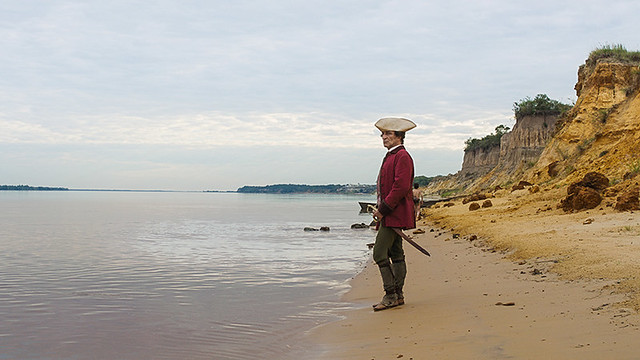
Lucrecia Martel suggested in her introduction to her sold-out screening of the much anticipated follow-up to Headless Woman that we audience might want to take in Zama like a whiskey. Indeed, it's a heady, at times bitter, at times sweet hallucinatory trip to the heart of darkness, showing the white man's identity crisis and misguided manifest destiny in the colonial era Latin America.

The film is a historical period piece, based on the much praised Latin American classic literature by Antonio di Benedeto. It's a hugely ambitious undertaking for Martel with just 3 films under her belt. But if anything, Zama confirms Martel one of the greatest directors of our time. Her mastery over the medium both in complex narrative storytelling and technical ingenuity has grown to exceptional height with Zama.

Don Diego de Zama (Mexican actor Daniel Giménez Cacho with an impressive Romanesque nose), a magistrate stuck in some unnamed South American colonial town deep inland in the 18th century, is anxiously awaiting to hear from the Crown (of Spain), his new assignment to the city. Even though he is a man of certain position and been stationed there for a while, he can't ever seem to get ahead or get what he wants - the letter of transfer never materializes, his rival Ventura (Juan Minujín) is much better at kissing asses and the local society lady de Luenga (Lola Dueñas) flirts with him but wouldn't give in.

Zama doesn't fair well with the natives either- seen in the beginning peeping at nude women taking mud bath and getting caught. He also has a nagging native woman he had an invalid child with. And the thought of the existence of this child weighs in his conscience like a brick. His misplaced valor to protect three virginal sisters is always overshadowed by the overhanging threat of a mythical bandit named Vicuña Porto who is notorious for raping and pillaging.

After physically threatening Ventura over de Luenga, Zama is demoted and moved out of his semi-opulent living quarters to a squalor with rotting walls, just outskirts of a city. At the governor's insistence and a promise of recommendation letter to the Crown, he delivers a scathing review of a book written by a well-meaning, trusting young civil servant (the governor can't stand the thought of the young man wrote the book while on the job). But no matter how many favors, how many people he fucks over, Zama realizes that he won't be leaving the backwater town any time soon.

Fallen out of favor and aging, Zama reinvents himself as a guide to the band of soldiers in the late stages of colonization. As they advance inland, they are terrorized by the red body paint natives who populate the land. Fighting with the elements and among themselves (one of the soldiers claims to be the elusive Vicuña- is he really? Does it even matter?), Zama and the men get completely lost in the strange land.

There have been countless other films about the white men's delusion of grandeur- Aguirre, Wrath of God and Apocalypse Now! easily come to mind. With Zama, along with lyrical Jauja few years back, directed by fellow Argentine Lisandro Alonso, Martel captures the existentialist angst in the age of colonialism/ad infinitum in Latin America with astonishing efficiency and grace. Shooting digital for the first time, Martel and her Portuguese DP Rui Poças (Tabu, The Ornithologist, To Die Like a Man), create lush, bright palates that are intoxicating and hallucinatory.

Martel's mastery of the cinema medium as sensory medium first and foremost is nothing short of brilliant. She subjects us to painterly framing and exceptional sound design in every scene. Those of you who followed her trajectory closely through La Cienaga, Holy Girl and Headless Woman and have been admiring her artistry will be richly rewarded here - a carefully measured framing where people's faces are just off the frame, shallow depth of field, soft focus, the full use of background/foreground and the use of dialog fading in and out with internal monologue thrown in, just to name a few.

She also uses the Shepard Tone whenever there is a dramatic moment for Zama. The tone is an illusory aural phenomenon that creates continuously swelling sound which builds tension and suspense. All these are very simple methods and not radical experiments at all, but it's Martel's simple approach that makes everything so fresh and radical. As you watch Zama, you can't help but feeling that you are watching a true cinematic masterpiece.

Finding the Latin American identity, as European settlers and their offspring, has been the continuous source for great literature over 300 years. Throw in the idea of class, masculinity, racism, sense of belonging, you get a very complex picture of what makes up the theme of Zama.

As usual, in Martel's hands, what seems to be an extremely messy affair at first, the sense of cohesiveness emerges from the chaos, then the sense of warm comfort wraps around the whole experience. Even though Zama is a lost character who goes through traumatic experiences, there is sense of catharsis that is reached in the last moments of the film. That he finally found home, that he reached his el dorado, imagined or otherwise. Zama is a utterly brilliant film. See it on the big screen if you can.

Thursday, July 6, 2017

Mondo Bava: A Near Complete Retro of Italian Horror Maestro Mario Bava and Kill, Baby...Kill! in 2K! at Quad

killbabykill
killbabykill1
killbabykill2
To celebrate the 50th anniversary of Mario Bava's horror classic Kill, Baby...Kill! New York's newly renovated Quad Cinema has organized a near-complete retrospective of the highly influential Italian horror maestro's filmography.

But the main draw here is the world premiere and full theatrical run of the 2K restored (courtesy of Kino Lorber) Kill, Baby...Kill!, a gothic masterwork that influenced Fellini, Lynch, Argento, del Toro, J-horror and countless others.

A young woman in a medieval-looking Transylvanian village runs up to the ruins in fear. She, as if in a trance, throws herself onto the iron fence and impales herself to death. So begins this hallucinatory ghost story.

Eswai (Giacomo Rossi Stewart), a young, impossibly coiffed doctor is called in to perform the autopsy with the help of a fetching blonde, Monica (Erika Blanc). He discovers a coin shoved in the victim's heart. The superstitious townsfolk, it turns out, in order to ease the evil spirit, placed the coins themselves in all the dead who met their untimely demise.

killbabykill1.jpgEswai soon finds that most of the townspeople are not only unwilling to cooperate, but afraid of a spirit of a dead child named Melissa, who was accidentally trampled to death by a horse carriage.

Preceded by an iconic red ball bouncing down the stairs and rolling down the corridors, Melissa, the blonde child ghost, marks you for death. Then you are gripped by an uncontrollable urge to kill yourself, usually with sharp, piercing objects.

As the dead bodies pile up, in order to fight the supernatural, Eswai, the man of science, must resort to the help of a beautiful sorceress named Ruth (Fabienne Dali).

Spiral staircases, cobwebs, a labyrinthine, Escherian mansion, and outdoor swing POV shots all mix in with a hint of Bava's psychosexual thrillers to come. Kill, Baby...Kill! is a true masterpiece from the father of both gialli and slasher films.

More than anything, the film is first and foremost an audacious technical marvel. Bava's ingenious, agressive camera work is fully on display, as well as his amazing mise-en-scene, both interior and exterior. His background as a special effects technician and cinematographer serves him well here with deep focus, crazy zoom-in crane shots and claustrophobic sets.

I remember seeing the film in a murky VHS version. The restored version is just beautiful to look at: colors pop, film grains are visible in the shadows and blemishes on the negatives are all but cleaned up. The restoration makes the film truly the most gorgeous and elegant among all of Bava's films.

Mondo Bava, Mario Bava's retrospective at Quad Cinema, will showcase 21 of his films, including Black Sunday, Bay of Blood, Lisa and the Devil, Planet of Vampires, Danger: Diabolik, Blood and Black Lace, along with his foray into Westerns, sword and sandal epics and sex comedies, many of them on 35mm prints imported from Italy for the occasion.

The 2K restored version of Kill, Baby...Kill has a world premiere on Friday, July 7 at Quad Cinema and Mondo Bava, a near complete retrospective, continues through July 23.

Thursday, May 12, 2016

Interview: Terence Davies on poetry, art, actresses and more

Terence Davies, regarded as one of the greatest living British directors, doesn't make films too often. So when he does, it's a monumental event every time. With his long delayed passion project Sunset Song finally coming out in theaters this weekend and A Quiet Passion, his new film about American poet Emily Dickinson already in the can, the 70 year-old British director suddenly finds himself more prolific than ever (he's done only 9 features in 4 decades of filmmaking).

He is in town for his complete retrospective at Museum of Moving Image, 5/7 - 5/22, and I got a chance to sit down with him for an interview.

It was quite intimidating meeting the master filmmaker in person, but his unguarded, warm disposition put me at ease. It wasn't long before Davies, in his Liverpudlian accent, enthusiastically, breathlessly, explained his craft to me. It was a truly spellbinding experience.

*Fair bit of warning here: this interview contains loads of spoilers for Sunset Song.

You have Sunset Song and A Quiet Passion coming out back to back! To whom do we owe thanks?

Yes, not by design but a sheer accident. (laughs) It comes down to money as it always does. We didn’t have enough money to shoot Sunset Song. It was a very difficult shoot because of not having enough money and the post production dragged on for a long time, again because of the money. In the mean time I’d already written the Emily Dickson Film, A Quiet Passion. And we ended up having shot that. And by the time we were finishing shooting, that, by sheer accident, happened. It never happened like that to me before.

It’s great. We didn’t have to wait 8 years for another Terence Davies film to come out! Haven’t seen Quiet Passion yet but am very excited.

I just love Emily Dickenson’s poetry. I think she is the greatest 19th century American poet. Although the very first thing I’ve ever read, I was 9 or 10, was The Song of Hiawatha, It has a great stretches in that octosyllabic rhyme. You can’t ever forget it. But thank god now who reads The Courtship of Miles Standish anymore? I’ve never responded Longfellow’s poetry but I think Dickinson was a true genius and was well before her time. And the great poems are truly, truly great. It’s so succinct, i mean it’s distilled down to the bare essence. That’s why it’s so powerful.

The dying needs but little, dear-
A glass of water’s all,
A flower’s unobtrusive face
To punctuate the wall,
A fan perhaps, a friend’s regret,
No color in the rainbow
Perceive when you are gone.


(grabs his chest) Just heartbreaking.

Bravo! I really wish I have a better ear for language. Sunset Song takes place in Scotland and the film’s based on a revered Scottish novel by Lewis Grassic Gibbon. Did you have to do a lot of preparation to get the language right? How was the adaptation process?

Not so much…whenever you do an adaptation of a novel or a play, you try to get an essence of it. While remain true to the source, something has to change. There are things you can do in a film that you can’t do in a novel and vice versa. but if you listen to the material, the content dictates form, never the other way around. I mean, it will tell you. The worst thing is when you get back into the editing room and there are two particular scenes you love and and they got to go. That’s really heart breaking, but the material’s telling you that it’s too much and you have to listen to that.

And sometimes you get the essence of what something is without literally doing what was in the book. I mean at the end of Sunset Song, the whole of Kinraddie come to these standing stones and the preacher preaches about forgiveness. The wind was so strong, the standing stones we had were going like this (swaying his hands). It was awful.

So what is it in the ending that is about forgiveness? Well, let’s make it domestic. We’ve already seen Kinraddie people: there was a thrashing dinner and there was her wedding, we didn’t see them any other time. so let’s make it domestic. And there it’s a poetic license: when the sun comes up, it comes up at the same time, it doesn’t come up separately. And to do that we make up something strange - light enters the room and it’s strange and that’s when we hear him come back. He says, I’ve come home and that captures the essence.

And she goes up to the stones and the sky and the piper and her voice over and that’s how it ends in the book. But it’s the getting there by a different route and you are restricted by what you shot. It looked awful. It was just grey and flat. So you have to something. What does the subtextual meaning of those closing pages? And you think, well I think this will do it. Just as you putting things that are not there - like the scene where she holds his clothes. that’s not in the book.

That was a beautiful scene.

The whole Kinraddie going to church. That's also not in the book. It just says the town goes to church and you hear the sermon which is awful - it's about two and a half pages long and its full of xenophobia and hatred. What would be wonderful I thought, was the whole of Kinraddie arrive, in this gorgeous light. Someone said, well they would not walk through the crops and I said I don’t care. They are going to walk through the crops. So they arrive in this golden light of god. And then, after that, going to the church wanting the grace of god, and the preacher tells to go and kill one another.

Right.


That’s what’s horrific. And I’ve known about that song, All in the April Evening, since I was about 17. That’s when I started to listen to classical music. There was a thing on the radio called your hundred best tunes, the best known classical music, you know, Peer Gynt and Lachmann and all that. And then I heard this and that was an amateur choir from Glasgow, which was founded by a Glasgow Region Undertaker and the singing was just amazing. I’ve never forgot it and when I started the adaptation, I was going to put it somewhere. Because it was really important for me.

Shooting outdoors and a lot of farm animals. Was it hard for you?

It was very very difficult. It comes back to us not having enough money. We all took the risk. There were times when I said, “Can we afford this" and and the answer was "No we can’t, we have to cut it from the script”. I’ve never done that in 14 years and I’d never ever want to do it again. Because it can really seriously damage the film- you are cutting things that perhaps are needed but once in the cutting room, you can’t go back to New Zealand for it. No, we can’t even go back to Scotland to redo things. So that was the great strain.

You went to New Zealand to shoot it?

Yes, for the summer sequences. Because you can’t rely on Scotland’s weather. It rains all the time so we had to go to New Zealand to shoot that. The seasons are characters and if it’s just too grey and flat, there is nothing interesting about that.

But it was a very hard shoot. But everyone pulled together. I couldn’t have done it without not just the crew and not just the actors but financiers and the bond company- they were so supportive, I can’t tell you. It was quite wonderful. But it did take a lot out of me. I thought, "I am not gonna work like this ever again!"

All the exterior scenes are shot on film but all the interiors are shot on digital. Do you have any opinions on all these changing technology and how you make and see the film?

There used to be film then. Film still had an edge. It’s one of the things you have to take care of- you choose the right stock and you do the test and you say yes, it should look like that. But all the interiors are inspired by a Danish painter called Hammershøi who was active in the late 19 and early 20th century. His paintings were like Vermeer but with a smudged northern lights. They are of empty rooms with the doors open and if there was as subject in them, they were usually women back to the view and are exquisite. Obviously not the same class as Vermeer, my favorite painter but they have that Vermeerlike quality - the stillness, the ghosts of those people who used to be in those rooms. Exterior was just the way it was. Sometimes we got lucky and got that gloaming light. But it was pure luck.

But when we came to do Emily Dickinson, the digital replaced the film. It’s just as good. In fact, it’s getting better.

So you are fine with that.

It’s just good. And what they can do now is breathtaking. It’s just marvelous. I think it’s as important as coming of sound really. On a practical level, when you mark the dissolve on a film, it will take you most of the day. It takes two days for it to come back from the laboratories and with this (digital), you can do it in an instant.

Right.


The drawback of that is it can rob you of thinking time. And you got to say no, I want to think about this for two days. You got to wait.

Right right.


Just like anything in your films, the casting is always Impeccable. You’ve worked with some great actresses in the past, Gina Rowlands, Gillian Anderson and Rachel Weisz. Agyness Deyn did an amazing job as Chris Guthrie, the protagonist of the film, but she is kind of unknown, isn’t she? Do you have a preference in with whom you want to work with? How did you get to cast her?

No. I always cast people who I think are right for the part. I don’t care if they are big names or not. I’m not interested in that. And I don’t know anything about popular culture or anything about models. It was our casting agents who found her and she was the first person (at the audition) Monday morning. And she gave the most wonderful audition and I said to my producer that we found her.

You can tell, I get the feeling that she is right for the part. It’s got to be felt. I always know. It’s like when you are shooting and you feel that you gonna get (what you want) this time. The thing is I don’t want them to act. If it doesn’t work, we can try it again, because it’s digital and it’s cheap. But really it’s usually first couple of takes that’s what ends up on the screen. In A Quiet Passion, most of them I got in less than 4 takes. For the rape scene and marriage scene (in Sunset Song) we did it once. I didn’t even plan on doing another take. I told her I can’t possibly put you through that again.

Other times, like the execution scene, these are all young lads from Luxembourg, because all the interiors and war scenes are shot in there. Someone said, “They can’t act.” and I said, “Look, just put them in costumes, frame it and we’ll just watch them.” and of course people don’t stand still. They shift the gun around. That’s what you do when you don’t do anything but stand still. And that’s what makes the scene. In fact we shot that scene in 48 frames per second. It’s slightly slower and what you get is like a ballet performance. It has to be - both balletic and horrible.

The tension and sadness in that scene is unbelievable but I didn’t even notice that it was slowed down.

The train goes by in the background somewhat slowly.

Oh yeah!

You’ve done series of films that feature tragic female protagonists. Has it been a conscious decision on your part?

No, I’m just attracted to the story. But you mustn’t forget that when I was growing up in the 50s the big commercial hits were all about women. Love is a Many Splendored Thing, Magnificent Obsession, All That Heaven Allows, they were all huge successes. So I grew up with the idea of women being the main protagonists. Then a TV came along and that’s where I relearned all Joan Crowford films for instance. And The Letter from Unknown Woman, The Heirless, those are huge riches when they were finally shown on television. And they were all about women. By sheer accident!

It was funny that I found a youtube clip of you introducing 2001: Space Odyssey in some TV program, explaining things very technically.

(Davies laughs)

Because however visually accomplished your films are, I don’t ever think of you as a technical director.

It’s because I work with people who are artists on their own right, they can help me the correct lenses in front of the camera. Because I can ever remember what I’m looking at when I look down on the lens. I write as I see it. And for pure practical reasons, because we haven’t got much money, you can say, this and this days we’ll be tracking, on this day we’ll need a crane and that day we will need 25 extras. Because you’ve got to husband your resources. Since we don’t have vast resources, so you’ve got to know what you are doing technically.

I guess A Quiet Passion is your second American film, set in Massachussettes.

We shot very little in America. Because of the lack of money, we shot most of it in Belgium. (laughs) And a lot of Belgian actors do very good american accent it turns out. So they rebuilt the exact replica of the Dickinson house with two separate floors. It's quite extraordinary. But we shot in America for 3 days or something. We just couldn’t afford it. The whole production was just pure joy. There wasn’t a single problem from beginning to end. Absolutely wonderful. Especially after sunset song which was a murder. Everything went right for A Quiet Passion. It was an absolute bliss. I should never complain again. (laughs)

I am very much looking forward to it. I hope it comes out soon.

Oh me too.

How was Cinthia Nixon as Emily Dickinson?

she was extraordinary. It is the most extraordinary performance. She is Emily Dickinson! She really is! There is this one shot where she turns around and it’s emily Dickinson. And Jennifer Earle, who plays her sister who is just radiant. When they have a rouse, you gotta watch out. They are family and they support each other to the hilt but when they fall out, they really fall out. And they really go for each other. They were quite wonderful. But that performance is the most extraordinary I’ve ever seen.

We did a lot of guide tracks of her reciting poems. After movie was shot and we were in the editing room, she asked me if she needs to recite the poems again. I said that’s not necessary. The way she reads them… The first time I discovered Emily Dickinson was Claire Bloom reading Because I could not stop for death. She read it with this air of amusement, as if this was happening to someone else. It was devastating. It was just…WHAT MADE YOU THINK OF DOING IT LIKE THAT?

So what’s next for you since you became so prolific all of sudden?

Well one is already written. It’s called Mother of Sorrows. It’s based on an American novel by Richard McCann. That’s probably gonna happen next year. And at the moment I am writing a film about Siegfried Sassoon. I was asked to do it.

You have a lot on your plate. And hopefully money will come along?

Now, I’m all for that!

Thursday, April 14, 2016

Ebbs and Flows: Gabriel Mascaro Interview

Gabriel_Mascaro
I had a chance to get a phone interview with Mascaro to discuss his first retrospective anywhere and his new film, Neon Bull.

Brazilian visual artist and filmmaker Gabriel Mascaro’s new narrative feature, Neon Bull, is garnering much critical acclaim. On the occasion of the theatrical release of the film in New York, Film Society of Lincoln Center revisits the works of one of international cinema’s most exciting new auteurs in Gabriel Mascaro: Ebbs and Flows, a five-film retrospective, starting 4/15.

Living and working in Recifé, the cultural capital of Pernambuco, a once neglected northeast region of Brazil, Mascaro established himself as an artist delving into photography, installations, documentaries and digital animation, commenting on ever so changing political, cultural, geographic landscapes. His astute observation on the lives of margins of society using non-actors in their working environs bore layered, fascinating, impossible to categorize films.

Neon Bull is the culmination of all of Mascaro’s preoccupations and his practices as an artist. It stars hunky Brazilian TV star Juliano Cazarré as a Vaqueiro (cowboy) who dreams of being a fashion designer. Gorgeously lensed by Diego Garcia (Cemetery of Splendour) and naturally acted by non professional and professional actors alike, the film observes human body at its most natural state – at work place and subverts it in the social, cultural, political context. It’s a multi-layered, sensual, deeply complex film.

Q: Congratulations on your retrospective, Gabriel Mascaro: Ebbs and Flows at the Film Society at the Lincoln Center here in New York.

A: Thank you very much. It’s the first time that my work has been shown all together. It’s a very interesting moment for me to see them all in one setting like that. I like the title Ebbs and Flows. For me it was a short (A Onda Trás o Vento Leva) that didn’t really work. It’s a happy choice of a title because I can reflect on my own work.

Q: Your discipline as a visual artist is not limited to a feature filmmaking. You’ve done shorts, documentaries, computer animation and installation work. Now you’ve done two feature length films back to back, what is it about a feature length narrative that are different than your other work? What is it that you are exploring in a narrative feature?

A: It’s a difficult question. I don’t really know exactly. But for me it’s a natural evolution. I came to make narrative features after getting into discussions about negotiating images in making documentaries. For me, documentaries are like auto-fictions…I don’t know how to translate this, but it’s the real people telling fictional stories about themselves, like a self-made fiction. In a way I wanted to deepen that experience.

Working with experienced actors in Neon Bull was a very different experience. It was a challenge because I’ve never really worked with experienced actors before. There was a change in my approach. But interestingly, one of my favorite moments was when Cacá (Aline Santana, an 8-year old who’s never acted before) became quiet in the film. The silent moments were the time when she was actually discovering herself and building her character. It was a magical moment in directing because she’s not an experienced actress. I told Aline to only speak when it’s necessary and assured her that there is no hurry, that filming can wait. That she should speak only if she believed in what she was saying, that she should take a deep breath and speak when only necessary. So it’s a film where characters only speak when they want to, when they have a desire to speak.

Q: On that note, I was wondering about your writing process. Did you have a tightly written script for both August Winds and Neon Bull? Or is your filmmaking more of an organic process where improvisation is necessary?

A: It’s an interesting question. I do work with a structured screenplay- the traditional one with dialog. But what’s different is the process of preparation with the actors.

In case of Neon Bull, the actors all read the script and they spent two months of preparation where they didn’t use the script anymore. They were working more on the dynamic of interactions. They did exercises with the dialog from the script but they weren’t rehearsing the dialog.

Before shooting the scenes in Neon Bull, I’d read out loud the dialog to the actors. And they would try to recover the structure of the script but they would still use the dynamic that they had developed during those two month of preparation. It brought them to a special place because these mixture of two approaches.

Q: That’s very interesting. How did Juliano Cazarré (who plays the main character, Iremar) take the script when he first read it?

I think Juliano was very intrigued and happy because the script gave him the opportunity to change the image that people have of him and the role they usually associate with him - strong, tough, macho type. And with this character, he shows his sweet and sensitive side.

He was worried about the sex scene, because he realized that it was a very strong scene. But he was very nervous and insecure about doing it. It was a challenge. But they figured it out.

The process for preparing the roles was that of a…gradual deduction: shedding the typical element of their supposed characters. They were entering it and giving themselves slowly to the process.

Q: There are a lot of interesting contradictions in Neon Bull. Iremar is a big handsome cowboy but he wants to be a fashion designer and two girls - Galega and Geise are a tough truck driver and an armed security guard. Was this sexual politics something you were interested in exploring?

I think the film is about the process of transformation, transforming bodies. Economically the transformation is very accelerated in Brazil. To project these bodies to the landscape without the typical gender roles and to contextualize them in the cowboy universe was something I was interested in.

It’s not just about inverting gender roles, its about bodies that are working in different scale - the opposites of pleasure and violence, sensibility and anger, it’s all about all these things together. It’s not about masculine woman and feminine man but we are talking about more abstract categories.

Q: What’s also interesting is that Housemaids, August Winds and Neon Bull all feature working people doing manual labor. Can you elaborate on that aspect of your films?

A: It’s a great question. No one asked me that before. I do research on bodies that are contextualized in the world of work. So in some ways, my work is a gesture in trying to explore the common subject. I guess the larger meaning in my work is to try to find extraordinary experiences in ordinary work.

Their occupation, their work that I show in these films often shows impersonalized faces and movements in repetition. So these films are subversion of the work itself. For example in August Winds, they have sex in the coconut cart during their break where they work and in Neon Bull, he makes fashion out of fallen tails of the bulls. So in a way it’s imagining the work in a more personal way. I am trying to elaborate the intervals of this kind of work with an eruption of the body in a more abstract sense as well- a warm and affectionate form of a body in impersonal places.

Q: Can you tell me about Pernambuco, the northeast region of Brazil in context to your films?

A: The region is often associated with poverty and hunger and people wanting to escape. I spent my whole life there and never left nor I wanted to. So I tried to build my work there. With the characters in my films, I try to discuss how to redefine this place. They are there in the northeast and they don’t want to leave.

The way these characters are written, they are not the ones you feel sorry for. They might have simple lives but they are strong people and they are not naive. Though in some ways, Neon Bull deals with the economic transformation that is happening in the region and it shows a lot of challenges that people are facing there, but I think a lot of it is universal - like gentrification, industrialization, large scale construction everywhere.

Q: What is your assessment of the recent surge in Brazilian cinema? I’ve seen some really interesting films produced in recent years. Adirley Queirós’ White Out, Black In and Kleber Mendonça Filho’s Neighboring Sounds, just give you couple of examples…

A: We are speaking of very special moment in Brazilian cinema. Many filmmakers who are working are more interested in developing a new language of film. They don’t have the pressure of the market so much. They are modest budget films but they all have one thing in common - they are all supported by the government funds. So they are able to elaborate their language of film without making any concessions.

The filmmakers you mentioned, Adirley Queirós and Kleber Mendonça Filho are doing very interesting films. Filho also has a new film out called Aquarius, and it will be a special and important film for Brazilian filmmaking.


**Special thanks to Austin Kennedy at FSLC for arranging the interview and Micheal Gibbons for translation

Thursday, April 7, 2016

I am an Animal and That's OK.

Neon Bull (2015) - Mascaro
 photo f0f72c4a-c036-4c2f-82dc-22da69b89daf_zpss206jcrd.jpg
It wouldn’t be too much of a stretch to say that now, the pulse of the contemporary cinema could be found in Latin America. With relative political and economic stability (I use the term loosely here) after the economic crisis in the early 2000s, Argentina, Chile, Uruguay and Brazil have been producing some of the most exciting new talents in recent years.

In the case of Brazilian cinema, after the initial success of the favela movies in the international market- such as Central Station, City of God and Elite Squad which still owed themselves heavily to the tradition of Cinema Novo, a new generation of filmmakers emerged, severing the ties with the past and cultivating a different kind of art house cinema with the support of government’s cultural agencies. If this morning’s news of inclusion of Kleber Mendonça Filho’s new film Aquarius in competition at Cannes Film Festival this year, I’d say the future of Brazilian cinema is only getting brighter.

Brazilian filmmaker/visual artist Gabriel Mascaro is one of the happy recipients of such support from a pro-culture government. Mascaro’s hometown, Recifé, in the northeastern region of Pernambuco became a hub for burgeoning independent filmmakers as a result of government allotting money, finally, not only to the more developed, and commerce oriented southern region – Rio de Janeiro and Sao Paolo but also elsewhere in the country.

Mascaro, with his documentary background, demonstrates his anthropologist tendencies and lends sharp insights into often invisible cultural, societal, sexual boundaries of rapidly changing Brazilian society.

His latest, Neon Bull, is his second narrative feature after critically acclaimed narrative debut, August Winds. The film defies easy categorization as with the former. Exquisitely lensed by Diego Garcia (Cemetery of Splendor), Neon Bull transports us to yet another marginal segment in Brazilian society in Panambuco, northeast region of Brazil. The title comes from Brazilian rodeo (vaquejada)- it involves two cowboys on their horses sandwiching the bull from both sides and taking it down by yanking their tails. Sometimes the show goes on at night and they put iridescent paint over the bulls, hence Boi Neon (Neon Bull). The film follows one such traveling vaquejada trope.

The narrative pull is a little more consistent here than in August Winds. But as in his other films, the director's interest is elsewhere. While keeping a distance, the director zeroes in on a specific societal spectrum, stripping it down to a base level.

The slight, episodic narrative tells a story of Iremar (Juliano Cazarré), a hunky vaqueiro (cowboy) and his immediate surroundings. Iremar works for a vaquejada, which makes him to lead a nomadic existence- sleeping in a hammock and making use of outdoor showers and outhouses. His makeshift family consists of a young cattle truck driver Galega (Maeve Jinkings) and her preteen daughter Cacá (Alyne Santana) and with two other ranch hands.

Getting bulls ready for the rodeo is a filthy job and vaqueiros are constantly covered in dust and cow dungs. But unlike his looming physique and the rough sport he deals with day in and day out. He has different aspirations: he wants to be a fashion designer.

When he is not dusting bull's tails or shoveling cow shit, he is hunched over his tiny sewing table, working away the nights or drawing designs over naked bodies in fellow cowhand's porn magazines. Using Galega as his model (she works as an exotic dancer in his outfit with a horse mask over her head), Iremar horns his skills and dreams of getting a professional sewing machine.

Neon Bull is a culmination of all of Mascaro’s preoccupations and cinematic skills. It might be a deceptively simple film about a marginalized society at first glance, but the film's much more complex in both theme and form. Not only he plays with the notion of machismo in cowboy and Brazilian culture in general, he also applies same matter-of-fact life observations in nature documentary to his human characters. Animal and human sexuality and bodily needs are depicted with no frills (Cazarré's sculpted body is often shown full-frontal). The film features some of the most sensual, uninterrupted long sex scenes (involving a very pregnant woman, no less) depicted in recent film history.

Mascaro is fascinated with a human body and it’s often idealized and naked (both in August Winds and Neon Bull). He throws it into rapidly changing surroundings – culturally, politically and geographically, to contrast and conform and subvert what’s seen in the frame.

He thrives in authenticity that he cultivated in his documentary days and makes full use of it in this 'ordinary people with their small dreams' narrative. He gets spectacularly naturalistic performances out from his cast - most of his actors are non-actors playing characters pretty close to themselves. Cazarré, a big TV soap star, under Masaro’s direction, disappears into the role of lowly cowboy.

Neon Bull is heady, sensual, political, layered trip to the heart of Brazil done masterfully and one can only hope that the director continues on his experiment with the narrative form of filmmaking.


After appearing at ND/NF, Neon Bull gets a theatrical run on 4/8 at FSLC. Mascaro's retrospective Gabriel Mascaro: Ebbs and Flows runs 4/15-4/21 as well. Please visit FSLC website.