Showing posts with label Iran. Show all posts

Monday, September 29, 2025

Revenge and Morality

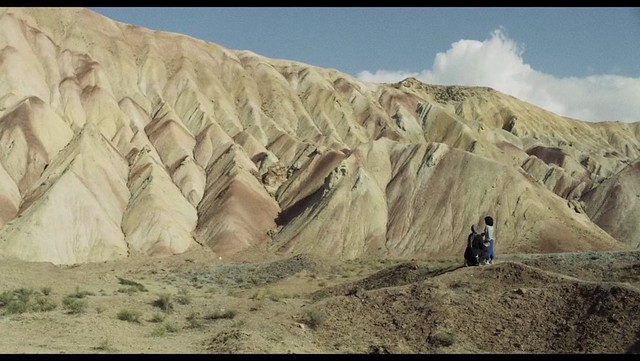
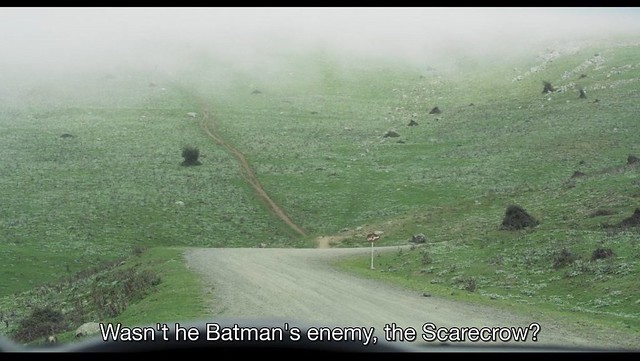
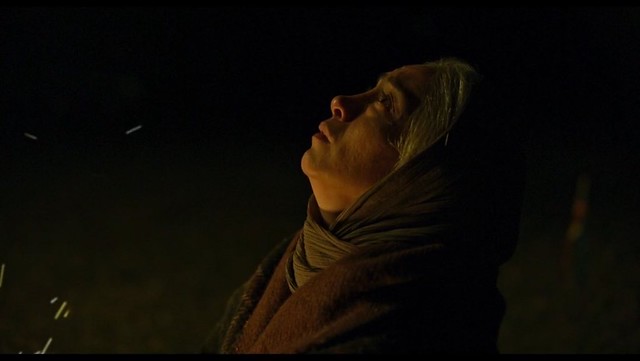
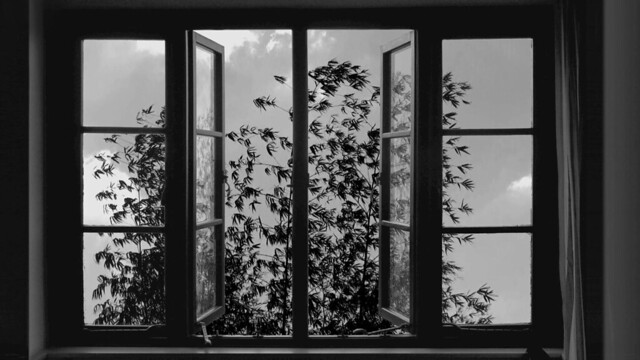
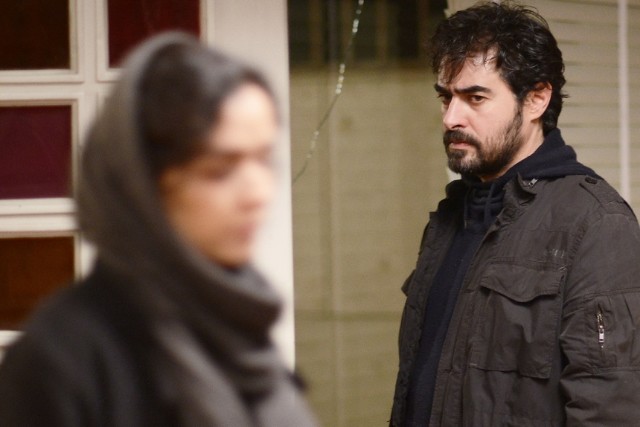
It Was Just an Accident (2025) - Panahi It was Just an Accident Jafar Panahi's new film, It was Just an Accident, starts with a roadside accident at night: a family on a trip back home, runs over a dog with their car. The father stops, gets out of the car, and determines the dog is dead. It was an accident. But his young daughter keeps egging on, "you killed him," even with the father protesting that the road was underlit and her very pregnant mother saying that these things happen all the time in life. With the sustained damage from the accident, soon the car breaks down. The father will need to take it to the garage. So begins the ominous foretelling of the simple, yet rivetting and deeply humanistic morality tale.

The garage owner Vahid is spooked when the father shows up to his garage to get his car fixed. Vahid is gripped in complete fear. He doesn't want to show his face or have his voice heard to this customer. Next thing Vahid does is pretty shocking: he stalks the man - follows him home, and when he gets a chance, knocks the man unconscious and kidnaps him and puts him in his van. It turns out that Vahid thinks the driver of the car is an intelligence officer, Eghbal, who tortured him in prison. It was the dragging sound of his peg leg, as he approached the garage, a giveaway. In a fit of rage, Vahid digs a hole in the desert, in an intention of burying his former torturer alive. Eghbal, tied, blindfolded and covered in dirt in the ground, vehemently pleads that Vahid is soley mistaken, that he is not the man Vahid says he is. Blind folded while being tortured in prison, Vahid now is unsure if he got the right man, and wants to confirm if this man is the right 'Peg Leg' maybe by asking fellow former political prisoners. Via a bookseller friend, Vahid seeks out a wedding photographer Shiva and her subjects - the soon-to-be-married couple, and later, Hamid, a hot headed blue-color worker who was also in prison, who says he can positively identify their Peg-Leg the torturer.

With all of them in the van, as it often does in Panahi films, It Was Just an Accident becomes a road movie of sorts. They discuss the morality of killing a man while their torturer is inside the box they are sitting on, gagged and tied, in the van. What makes them any different from the torturer who threatened and abused them, if they do the same? If they kill him, are they any better than Eghbal?

To make matters more complicated, Eghbal's daughter calls his phone, to inform that her mother fainted while pregnant. Now the crew has to take Eghbal's wife and daughter to the hospital and have the baby delivered safely.

Panahi, in this slow-burn thriller, brings up the concept of morality and justice in Iran. And he reveals how the totalitarian regime inflicted upon political dissenters from all social strata, an unspeakable collective trauma - constant threat of death with a noose around their necks for hours while standing on the platform, imminent sexual violence against young women and physical torture that crippled them. After being released from his jail sentence and years of house arrest in 2023, the prolific Iranian filmmaker doesn't shy away from being bluntly critical about the totalitarian regime of his country, while showing ordinary people's humanity not being lost. It Was Just an Accident is a riveting and beautiful film.

Saturday, April 26, 2025

My Winnipeg

Universal Language (2024) - Rankin Screen Shot 2025-04-25 at 1.06.20 PM Screen Shot 2025-04-25 at 12.24.40 PM Screen Shot 2025-04-25 at 12.07.53 PM Screen Shot 2025-04-25 at 12.04.31 PM Screen Shot 2025-04-25 at 11.53.05 AM Screen Shot 2025-04-26 at 7.56.32 AM Screen Shot 2025-04-26 at 8.00.51 AM Screen Shot 2025-04-26 at 8.01.30 AM Screen Shot 2025-04-26 at 8.09.22 AM Screen Shot 2025-04-26 at 8.14.58 AM Screen Shot 2025-04-26 at 8.24.35 AM Screen Shot 2025-04-26 at 8.29.08 AM A missing case of the prize-winning turkey, a mistaken identity and money frozen in ice consist of Matthew Rankin's droll and absurd comedy, Universal Language. The surburbs of snowy, drab Winnipeg as its backdrop, Rankin pays tribute to the world of Abbas Kiarostami, from school kids and their quests to provide for their friend's missing pair of glasses, to the static, wide landscape shots. But unlike Kiarostami's Iranian countryside, we are presented with mundane brutalist architecture of none-discript, baige and grey brick and mortar buildings and highway over-passes of Winnipeg.

Rankin's visual comedy resembles that of Jacques Tati and Roy Andersson. The main characters, played by Rankin (Matthew) and co-writer Pirouz Nemati (Massoud), expressionlessly go about their very specific businesses - one reluctantly returning home by abandoning his city life and government job in Montreal, to see his mother, and the other, acting as a tour guide of made-up mundane history of Winnipeg - "This is a bench and a brief case left by someone who might have been waiting for bus in 1989," "this is Tim Hortons," "this dried up water fountain in an abandoned mall might one day shoot up gaysers once more, one would hope," etc, etc.

The nearsighted boy will get his glasses back, the beauty pageant turkey will be found, the frozen money in ice will be thawed, then put back into the ice in the ground again, the mistaken identity will turn out to be not mistaken at all. Rankin and co, create a deadpan comedy that is not only an ode to Iranian cinema, but a unique cross-cultural netherworld that feels consciously dour and less hipsterly yet familiar. Universal Language is a truly unique comedy that will put a smile on your face.

Wednesday, June 5, 2024

Ministry of Fear

No Bears (2022) - Panahi Screen Shot 2024-06-05 at 8.44.22 AM Screen Shot 2024-06-05 at 11.09.49 AM Screen Shot 2024-06-05 at 9.11.24 AM Screen Shot 2024-06-05 at 11.08.59 AM Screen Shot 2024-06-05 at 10.29.34 AM Screen Shot 2024-06-05 at 10.35.40 AM Jafar Panahi has been steadily making films in Iran despite threats of imprisonment and bans from making films and traveling outside Iran by the government. All things considered, his films made within the parameters of draconian restrictions he faced, were subversive, comical and even life affirming. No Bears is perhaps the most damning film about the oppressive Iranian regime and perhaps the saddest Panahi film I've seen. As usual, Panahi puts himself in the middle of his creation - film director in self-imposed exile in a small border town near Turkey, directing a film about an Iranian couple waiting for their passports by human traffickers so they can escape to Europe. Things are tough because he is directing it remotely and the internet connection is bad. He also has to deal with the locals who are uneasy about a famous film director staying in their midst with a fancy SUV and cameras. He gets embroiled in controversy when he takes some pictures of the locals and being accused of recording an illicit love affair that doesn't jive with the local tradition. The locals talk and it's a matter of time that police and the Revolutionary Guards showing up at the door of his rented room.

There's a poignant and telling scene where Panahi's assistant leads him to the dirt road to the border crossing, used by smugglers at night and urges him to escape. After they reached the hill, overlooking the lights of a Turkish border town in the distance. After receiving the signal, they can cross to Turkey. It's that easy. Panahi asks where the border is. His assistant tells him that he is standing on it. The camera tilts down to his feet and Panahi retracts like a turtle, down the hill to the direction where they just came from without saying a word.

No Bears confronts the perils of documenting the truth in an oppressive society. Beyond the theme of rural traditions vs. modern life, Panahi's film illustrates the underlying fear that is dividing people and making them hostile to each other. It also shows the limits of cinema as a truth telling medium, that things still go on after the camera stops rolling/recording. The film reminded me of the news of his fellow Iranian filmmaker, Mohammad Rasoulof's daring escape from the country to show his new film at this year's Cannes film festival, as he was sentenced to 8 years in prison and flogging by the Iranian government. No Bears’ two tragedies that Panahi witnesses in the film- the death of two people, even though they are fictionalized, they take on the new meaning, considering what the revered filmmaker is facing every day in the country that he still refuses to abandon.

Saturday, July 30, 2022

Family Road Trip

Hit the Road (2021) - Panahi Hit the Road Hit the Road Hit the Road Hit the Road Hit the Road Hit the Road Hit the Road Hit the Road Hit the Road Hit the Road A family, mom (Pantea Panahiha), dad (Hasan Majuni), older son (Amin Simia), younger son (Rayan Sarlak) and sick dog are on the road in a borrowed SUV, in a picturesque Iranian countryside. Yet this is not a joyous family vacation. Something is up. Mom is overly paranoid thinking that they are being followed. Dad with one leg in a cast changes the phone's SIM card every so often. They do so while dealing with their hyperactive 8 year-old son who is just a bundle of energy and joy. The older son, whose been driving, rarely says a word. He is moody as he chastizes his doddering mom that he is not a child anymore.

It turns out that they are going to the border to see the older son off, as he is entangled in something the Iranian State deemed as unlawful. And the parents have been telling the younger son that his brother is going abroad to get married - a not-so-convincing lie that might be adding to his hyperactive state. On their journey, they meet people, talk to each other and share some magical moments together.

Panah Panahi, the son a famed Iranian filmmaker and democracy activist, Jafar Panahi, who was just sentensed 6 years in jail for criticizing the theocratic Iranian regime, makes a beautiful film here in the tradition of 'moving pictures', that usually take place in a car, of Kiarostami (Taste of Cherry, The Wind Will Carry Us) and his dad (This is Not a Film, Taxi) that emphasizes time passing and fleeting human life on earth. Hit the Road boasts perhaps the most memorable child acting in recent memory- by Sarlak as an adorable rascal. His joyful presence peaks out over the overall somber tone of the film that hangs like low lying clouds. His joy is infectious. It also features gorgeous rural Iranian vistas, humor, magical realism (relating to 2001: Space Odyssey) and poetry. It's a short, life affirming film that lingers long after watching.

Monday, July 22, 2019

An Ode to Kiarostami: Abbas Kiarostami Retrospective at IFC 7/26 - 8/15

In celebration of Abbas Kiarostami Retro at IFC Center starting this weekend, I present you something I wrote about the master a while ago. Please visit IFC website for schedule

28353id_014.tiff
   
   
        Abbas Kiarostami, an Iranian master filmmaker, painter, photographer, and poet, passed away from gastrointestinal cancer in Paris in 2016. As an avid fan of his humanistic, genre transcending films, I can say with a certain conviction that we've lost one of the greatest artists in the world of cinema.

        My introduction to Iranian cinema came when a good friend of mine introduced me to Mohsen Makhmalbaf's films (on bootlegged VHS). Soon I was enamored by anything Iranian. It was a spur of the moment decision that led me to check out The Wind Will Carry Us in theaters in 2000, not knowing anything about the film other than it being from Iran. And what an experience it was! Its elegant simplicity and great eye for landscapes impressed me greatly. Seeing Wind Will Carry Us (1990) was also a watershed moment in my cinematic education. I’ve never seen such a truthful observation of human life before and it made me a life long devotee of his work. What's most striking about Kiarostami’s artistry is his effortless, seamless quest for truthful representation of human conditions on film. Whether they are shot on 35mm or with a consumer grade handy-cam, the inquisitive interactions of non-actors with their natural dialogue often imply that there is no real distinction between cinema and reality.

The-Wind-Will-Carry-Us-gallery_01b
   
        It was Kiarostami’s Taste of Cherry, winning the Palme d'Or at Cannes Film Festival in 1997 that introduced his poetic, meta-fictional cinema to the world and put many of his contemporaries on the world cinema map. And yet, when the director first burst onto the world cinema stage, critics didn't know what to make of his films: Roger Ebert gave Taste Of Cherry one star, calling it “excruciatingly boring” (Ebert, Taste of Cherry Review, RogerEbert.com,1998), while Jonathan Rosenbaum desperately tried to find some sort of reference in Western cinema tradition in his films by comparing Godard’s early work to Kiarostami’s in terms of reflecting society in certain periods or suggesting the similarities between Close-Up and John Guare’s play Six Degrees of Separation which later was adapted into a film. (Rosenbaum, 2001, 2) But as Kiarostami himself says in 10 on Ten (2004), a documentary on his reflection on the techniques he used on his 2001 film, Ten, he believes that simply showing austere reality with an open ending can entice audiences to reflect on their own lives. I can't think of a higher compliment to the audience than what Kiarostami bestows upon us with his films.

        Kiarostami’s main themes throughout his filmography are Children facing and overcoming harsh reality, Time Passing/Fleeting Nature of Human Existence, and the Perceived Notion of Truth and Reality. His observations of children, for example, date back to 1970s when he helped establish the filmmaking department at the Institute for Intellectual Development of Children and Young Adults (Kanun) in Tehran. There he made a series of documentaries and shorts concerning school children. Kiarostami's depiction of children, from his Kanun days (The Bread And The Alley, Break time, The Traveler) to later films (The Koker Trilogy, ABC Africa, Ten) is that of a nondisciplinarian in that he simply observes children being children. Often, these films are about children facing harsh reality (Soltani, The Child Heroes of Abbas Kiarostami’s Films, Movie Mezzanine, 2016). In his feature documentary, Homework (1989), for example, it is obvious that the educational system in Iran is too strict and puts a lot of pressure on children, both in school and at home. It's revealing that all the children interviewed for the film know what “punishment” means but don't know the meaning of the word “praise.” Parents, as well, say that the system is too harsh on the children; that it kills their creativity and ends up producing a generation of mindless drones. The director seems to be agreeing with this sentiment: “I tried to look at the world from a child’s point of view” (Jones, Children of the Revolution, Guardian, 2000).

006839a1

        Children facing harsh reality is the theme of his films, later known as the Koker Trilogy. Kiarostami made three films set in Koker village in Gilan Province, an area of Northern Iran lying along the Caspian Sea. Where is Friend’s Home? (1987) was the first of the three, and is about a boy trying to deliver a notebook that belongs to a friend who lives in the next village. The second one, Life and Nothing More… (1992), was made after the devastating earthquake in 1990. A middle aged man and his young son are on the road to Koker, a northern rural village leveled by the devastating earthquake. They spend most of the film's running time in their car. It is only revealed later on that the man is a film director (a Kiarostami stand-in) who is looking for a child actor who starred in his previous film, Where Is Your Friend's Home? Through The Olive Tree (1994), completes the trilogy. A fictional 'making-of' Life And Nothing More, the film is a beautiful film that shows resilience of children after a life altering disaster.

        From the bustling bottleneck traffic of Tehran in The Report (1977) to Ten (2002), Kiarostami’s films remind us that life with its ebbs and flows is never stopping and always changing. This is never as apparent than in his masterpiece, Taste of Cherry. Inquisitive dialog scenes, just like intimate questionnaires in documentaries, are staged usually in moving cars (and after Taste of Cherry, interior driving scenes became synonymous with Kiarostami’s films). The beauty of Taste of Cherry lies in its simplicity: a man drives around looking for someone to assist him in his suicide. They don't have to do the deed; he will take sleeping pills and lie down in an already dug up grave. In the morning, they can put some earth on him if he's dead and they will be rewarded handsomely for doing so. First, a young soldier runs away after finding out what the man is up to. Second, a seminary student from Afghanistan objects because of his religious beliefs and tries to dissuade him. And finally, an old taxidermist agrees to it, because he has a sick child. He tells the suicidal man that he too, contemplated committing suicide. Adding that he abandoned the idea after tasting cherries.
  
        Kiarostami reminds us that we are watching a film throughout Taste of Cherry; for example, he inserts the footage of himself shooting the film into the narrative. The nameless protagonist does not exist in real life, that his moral quandary is an invitation for us to mull over. It’s Kiarostami himself who is asking us these questions directly. What makes him contemplate such thoughts? What would you do if you were asked to help him kill himself? With Louis Armstrong's St. James’s Infirmary Blues, a song usually associated with funerals, playing at the end over the image, he tells us that death is inevitable for all of us, and it makes us contemplate our own mortality. If the great Russian filmmaker Andrei Tarkovsky tried to make us feel the 'passage of time' with his virtuosic creeping camera dolly movements, framing and lighting, Kiarostami succeeds in astounding simplicity, in one hour and forty minutes- Life is a moving car. Done. The impact is still immense. It all fits nicely with his theme of life, death, blurring boundaries of cinema and reality.

        Kiarostami draws from many aesthetic sources. His admiration for Japanese culture, for example, can be seen in his haiku style poems and in Like Someone in Love (2014), which was set in Japan with Japanese cast. In an interview he said:
I am certain that my fascination with Japan has been with me forever, even before I got to go to Japan. Even my very first attempt at any kind of artistic expression, which were poems that I wrote when I was 20 years old, resemble haiku. I had no idea at the time, but I wrote poems that are very like haikus. And in my photography work, there are some kind of common forms found in traditional Japanese paintings. There is some sort of resonance in my practice and Japanese art. So there has always been real interests before my first visit there which was confirmed whenever I went back thereafter. I've been visiting Japan periodically over 20 years now. (Chang, We Are All the Same: Abbas Kiarostami Interview,Screen Anarchy 2013)
The influence of Japanese cinema is evident in Five (2003), in which Kiarostami pays homage to Yasujiro Ozu. The film consists of five segments set in a coastal area in Iran without any characters or dialogue. With zen-like simplicity, we are presented with five static shots of various lengths. The camera remains static, but birds, dogs and people are heard and seen, in and out of the frame. With each long take we observe nature and human existence for what they are. In the final part of Five, Kiarostami traces the reflection of the moon on the surface of a pond. We don’t really understand what we are watching for a while. It’s dark, and the black and white image is grainy. We then realize that it’s the reflection of the moon on water as it ripples from time to time. We watch it with the chorus of insects in its nighttime surroundings to the breaking of dawn. This entrancing, collective cinematic experience –of us the audiences staring at the screen silently for 7 minutes, to witness the every day miracle of sun coming up, realizing the smallness of human existence has been one of the most thrilling experience in the cinema of all time for me.

        It's only been the last couple of years that I've been writing about films seriously, realizing that film medium can go much further than just mere entertainment and that freedom from the dominant narrative structure can be exhilarating. Attending Art of the Real series showcasing non-narrative films at Film at Lincoln Center was an eyeopener for me because it exposed me to a current crop of shape-shifting postmodern cinema, which subverts the medium’s traditional narrative structure and characterization and tests the audience’s suspension of disbelief (the works of Apichatpong Weerasethakul, Miguel Gomes, José Luis-Guerrin, Lisandro Alonso and others), enticed me and pulled me into the very depth of the cinematic rabbit hole, and left me exhausted and confused and exhilarated at the same time. And this is where Kiarostami’s Close-Up (1990) serves as a precursor for these more contemporary filmmakers. In Close-Up, he returns to the idea of an imposter of a film director: a man swindles an upper middle class family by pretending he is a famous Iranian film director, Moshen Makhmalbaf. It’s a story of a movie fanatic who admired Makhmalbaf so much he wanted to be him, but without malicious intent. The film is based on a true court case, and everyone participating in the film are real life characters reenacting their ‘roles’ in Kiarostami’s film under his direction, including the imposter, who is questioned off frame in the courtroom scenes. The result is a touching, moving examination on 'life imitating art imitating life', rather than sensationalistic satire about fame and deception.

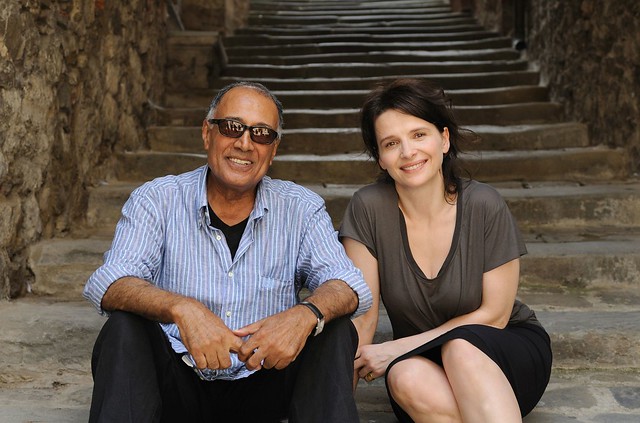
        There is no doubt Kiarostami’s success in the West has brought a spotlight to the Iranian cinema on the international stage and drawn attention to a second generation of Iranian New Wave with directors, such as Jafar Panahi, Majid Majidi, and Asghar Farhadi. Kiarostami’s influences are quite palpable in younger generation of Iranian directors. Panahi started out as his assistant director, and many of his films take place in a moving car. Majid Majidi’s films usually deal with children’s flight and they owe a lot to Kiarostami’s Kanun films, Where’s Friend’s Home and Life and Nothing More…. and Asghar Fahadi’s elusive narratives and unreliable heroes in About Elly and A Separation owe a lot to Kiarostami’s convention subverting cinema.

        Unlike many other Iranian filmmakers who actively make political statements with their work (his former assistant Jafar Panahi being the most vocal one), many of Kiarostami's films can be seen as Iranian sociopolitical fables rather than overt political statements. But the given complexity of his work, the Iranian government has banned the exhibition of his films, fearing that there might be hidden subliminal messages. And unlike many Iranian New Wave filmmakers of his generation who fled the country after the 1979 revolution, Kiarostami stayed and kept making films exclusively in Iran. He accepted that restrictions and censorship were a part of life in a rigid theocratic society, but always had found ways to express himself in changing environs both before and after the revolution. The prime example of this would be The Report (1977). Firouzkoui (Kurosh Afsharpanah), the tax investigator, is perhaps the least likable character in all of Kiarostami's protagonists- he cheats, lies and abuses his position as a government official. After being accused of corruption and short on rent money, he resorts to beating his wife and neglecting his baby daughter. Kiarostami observes all this from a distance. Considering The Report was made before the Iranian Revolution in which the Shah wasoverthrown and The Islamic Republic established, the film is a snapshot of the state of Tehran of that era —women wearing revealing Western clothes, men drinking and gambling, gridlocks in the city streets, etc. The film is a report on petite bourgeoisie, steeped in selfishness and materialism.
07ed74a7da95a507d67e8379a95f9a76        
Kiarostami made films exclusively in Iran until 2011. I reckon it was exactly that transcending subtle artistry that fooled the censorship for a long time. But during the conservative president Mahmoud Ahmadinejad’s tenure, he found practicing his craft in Iran increasingly difficult. Thankfully for us, it directly resulted in two international productions, Certified Copy (2011), set in Italy, and Like Someone in Love (2013), set in Japan. Even though the film’s settings are different and have international movie stars, his artistry hasn’t changed. His cinematic playfulness and his usual theme of perceived notion of truth and reality are there, even deepened and more sublime than before.

    
        Juliette Binoche, an internationally renowned French actress, stars in Certified Copy. It starts out with an Englishman James (William Shimel) giving a talk on his new book about the legitimacy of copies compared originals in art in picturesque Florence. As infatuated antique dealer (Binoche) picks James up and drives him around town as a guide, the film becomes something else: deconstruction of a relationship. Even though it's the first film set outside Iran, there are Kiarostami touches everywhere- long driving shots, actors talking while looking at you straight in the eyes, blurring the lines of what's real and what's not. As the couple discuss the legitimacy of a copy of a master painting, mirroring their relationship, as we witness the copy of the real married couple breaking apart. Is it any less humanistic because we are watching a film with big movie stars? Do our emotions feel false when we watch Binoche’s character suffering? Deceptively simple, yet as much complex as Close-Up and Taste of Cherry, Certified Copy doesn’t disappoint.
        
Like his other films about acting and being and perceived notion of truth and reality plays heavily on Like Someone in Love. The premise of the film is pretty simple: Akiko (Rin Takanashi), a pretty young Japanese college student doubling as a call girl meets an elderly professor Takashi (Tadashi Okuno) who takes a protective role in her life. But like Kiarostami’s other films, it ends in quite a different place than where it starts. Many scenes in the film are seen through the windows and the dialog spoken off frame or on the phone. Just like the technology being a hindrance to human connections in Wind Will Carry Us, the abundance of cell phones here sets people apart. The film’s three protagonists – Akiko, Takashi and Akiko’s overjealous boyfriend Noriaki (Ryo Kase) act and behave like they don’t know how to behave in each other’s company. Yet they are more frank about their secrets with total strangers than with their own families. And there are many clues that suggest the cyclical nature of love that we can chew over for a long time. It’s a harder puzzle than usual in Kiarostami’s oeuvre and more complex. Although the film is less optimistic than his previous films, one can tell that the master filmmaker is adventurously expanding uncharted territories both physically and culturally.
     
        Kiarostami's passing in 2016 was very unexpected. Among all the cultural luminaries who passed on recently, his death really saddened me in a very personal way. When I heard the news of 24 Frames, the film he's been working for three years and unfinished at the time of his death, was going to be released with the help of his son Ahmad, I was more than eager to see the late master's final work. The film is, in large part, a collaboration of Kiarostami and visual effects artist Ali Kamali. Based on Kiarostami's photographs and videos, Kamali was responsible for digitally creating multilayered images that (provide description here). Kiarostami's idea for 24 Frames is simple—try to bridge the gap between painting, photograph and moving pictures. That instant is frozen in time forever, but what about just before and after that moment? They are usually easily discarded from and forgotten in our memories. Cinema as we know it, can prolong that moment for a little longer, to help us in imagining the narrative, in contextualizing the content within the frame a little more. Comprised of 24 4-1/2 minute static shots, the film most resembles Five, where he held his camera to five static scenes in various length. And it's the same minimalistic approach without human presence(except for two scenes) he applies here.
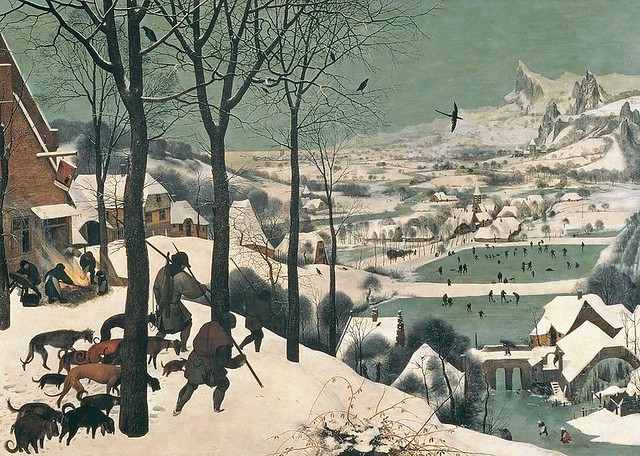
P_Bruegel_Hunters
    
         In order to demonstrate the landscape frozen in time, 24 Frames’s opening frame is the famous winter landscape painting, The Hunters in the Snow, by Pieter Brueghel. Accompanied by the sound of hounds, wind, footsteps, and people playing on the frozen lake below, we see subtle animated movements - smoke billowing out of chimneys from down below, birds flying across the frame, one of the hounds coming alive and trots and pees on the tree, while certain elements stay frozen, like the hunters themselves and the pheasant flying across the sky. In this moment, Kiarostami offers us the chance to contemplate on various things—the power of our imagination, fleeting nature of time, immortality of art—.all in one frame. Kiarostami's love of nature and landscapes comes to the fore - deer, cows, various birds, dogs, horses, cats, snow, rain, wind, ocean, forests, and mountains.
        
        Windows figure heavily in the film as well, constantly framing the frame. If it's not windows, it is fences or columns. He wrote in 2009 about his photography:
I've often noticed that we are not able to look at what we have in front of us unless it's inside a frame. (Kiarostami, Interview with Abbas Kiarostami, Guardian, 2009)

As he championed shooting from the moving car throughout his films, he uses car windows to frame images. One scene, for example, is dedicated to the snowy landscape outside the car window—a couple of horses run parallel to the moving car, we lose the sight of the horse as it lags behind. The car stops, the automatic window rolls down, the horses reappear. Now we are presented with two horses playing around in the blizzard through the car window. After a while, the car moves on. Humans are not in the frame most of the time. Kiarostami doesn’t necessarily makes a nuisance out of humans nor does he present them as a threat to nature. He seems to say that this is the life as is, with us in it. But as always the case with Kiarostami's films, 24 Frames is only deceptively simple.
        
        One moment in the film exemplifies this complexity. It consists of a group of Iranian family looking at the Eiffel Tower from a distance, with their backs toward the audience. At first we don't know if this frame is a photograph or not. The voices from the crowd, then people working by in the foreground follow. It's another intoxicating concoction by the master: mixing the idea of 'the window to Paris' and current climate of immigration in the first world since it's hard to determine where this scene takes place.

46317387022_5a24563d13_o

Accompanied by Andrew Lloyd Weber's "Love Never Dies," the last 'frame' is strikingly beautiful. We are presented with a frame within a frame – of a window. A girl, back to us had fallen asleep with her headphones at her desk in her room. Her laptop is playing some unidentifiable Hollywood movie where a couple slowly kisses. We see tall trees blowing in the wind through the window. With Weber’s lyrics tell ‘love conquers all, even death”, it’s a fitting send off to the culmination of Kiarostami’s artistry. It's even more sublime than the last scene of his film Taste of Cherry that ends with Louis Armstrong's "St. James Infirmary blues". His son Ahmad did an admirable job choosing these 24 out of 30 'frames' or so Kiarostami considered using in the film.

    Nothing is comparable to his artistry. As Asghar Fahadi told me last year about his death:
This was the bitterest occurrence that happened in the cinema past year, because he was one and only. There is no one like him. Many people tried to be like him or copy him but because their personalities are different from his, their films didn’t come out the way his films did. (Chang, Interview: Asghar Fahadi on His New Film Salesman, Screen Anarchy, 2017)
        Kiarostami was a true polymath. For those who are familiar with his artistry - his haiku inspired poetry, his minimalist landscape photography as well as his enigmatic films, 24 Frames represents the culmination of all his artistic practices. What make it so sad to me at least, is that there is no finality to the film. It's as if it can go on forever, completely consistent with what he had been doing all his artistic life. 24 Frames is a great testament to his being as an artist and as a person.
      
        I had an honor and pleasure to interview Abbas Kiarostami in 2013 when his film Like Someone in Love played at the New York Film Festival. As expected, he was the warmest, wisest, humblest, most thoughtful artist I've ever encountered in my short career as a film critic. This was his answer when asked about the universality of his films:
I think it's a lifetime practice, or habit or way of seeing things. I remember for a long time as a young man I wouldn't take what I see on TV for granted. I would never accept generalizing 'that's how Americans are,' or 'that's how Japanese are.' I was always much more interested in individuals rather than a culture or a country in general sense. This collective judgment or agreement on certain culture has always annoyed me. I deeply believe, excluding ideological positions, that we are the same. In details we can have our differences but in the main aspects of our lives -- our sufferings, joy and pain -- no matter if we are Japanese, American or Iranian, we are the same human beings. So if you have this as the principle of life and relationship, then it shows in your work.
        When I think about Kiarostami’s films, it’s not his style that strikes me the most. I think of his search for genuine human connections within the film medium, both among his characters and us the audiences and him the filmmaker. I think of his effortlessness in doing so. I think of his generosity and warmth when I got to meet him. As one critic said, postmodern need not mean post-human (Ebri, Post Modern Need Not Mean Post-Human: Abbas Kiarostami and the Paradox of Cinema, Village Voice, 2016). Everything he pursued in his paintings, poems, photographs, films, he found common ground in us as humans. Instead of spoon-feeding us in a didactic manner, the open-endedness of his work made us contemplate on our childhood, fleeting human life and the nature of reality. It’s that participatory aspect of his work I respond to the most and appreciate. He was really one of a kind. And I will miss him greatly.

….
Works Cited
Kiarostami, Abbas. Beard, Michael. (Translator)“Walking with the Wind” Harvard
University press, February 28, 2002
Chang, Dustin. “We Are All The Same: Abbas Kiarostami Interview.”
Screenanarchy.com, 14 Feb. 2013, https://screenanarchy.com/2013/02/abbaskiarostami-
interview.html
Chang, Dustin. “Interview: Asghar Farhadi on His New Film, THE SALESMAN.”
Screenanarchy.com, 25, Jan.2017,
Rosenbaum, Jonathan. “ABBAS KIAROSTAMI: A Dialogue Between the Authors
(Mehrnaz Saeed-Vafa & Jonathan Rosenbaum).” Jonathan Rosenbaum.net, 7
Nov. 2001, https://www.jonathanrosenbaum.net/2001/11/40847/
Kiarostami, Abbas. “Interview Abbas Kiarostami’s best shot.” Theguardian.net, 29 Jul.
2009, https://www.theguardian.com/artanddesign/2009/jul/29/photography-abbaskiarostami-
best-shot
Ebert, Roger. “Taste of Cherry.” 27, Feb.1998,
https://www.rogerebert.com/reviews/taste-of-cherry-1998
Chang 15
Bilge Ebri, Post Modern Need Not Mean Post-Human: Abbas Kiarostami and the
Paradox of Cinema, Village Voice, 2016
Jones, Jonathan. Children of the Revolution, Guardian, 2000
Soltani, Amir. The Child Heroes of Abbas Kiarostami’s Films, Movie Mezzanine, 2016
References
Wikipedia contributors. “Mohammad Reza Pahlavi.” Wikipedia, The Free Encyclopedia.
Wikipedia, The Free Encyclopedia, 15 Jan. 2019

Thursday, February 1, 2018

Life in 24 Frames

24 Frames (2017) - Kiarostami
Screen Shot 2018-01-31 at 10.13.24 PM
Iranian master Abbas Kiarostami's passing in 2016 was very unexpected. Among all the cultural luminaries who passed on recently, personally Kiarostami's death really saddened me the most. His deeply humanistic, genre and form transcending cinema has been truly unique and inspirational to my cinematic education, so his death was a devastating blow. So when I heard the news of 24 Frames, the film he's been working for 3 years, unfinished at the time of his death, is going to be released with the help of his son Ahmad, I was more than eager to see the late master's final work. And it's as usual, infinitely wise and achingly beautiful unlike anything.

Kiarostami's idea for 24 Frames is simple - try to bridge the gap between painting, photograph and moving pictures: we go great length to capture one still moment. That instant is frozen in time forever. But what about before and after that moment? They are usually easily discarded from and forgotten in our memories. Cinema as we know it, can prolong that moment for a little longer, to help us in imagining the narrative, in contextualizing the content within the frame a little more. Comprised of 24 4 1/2 minute static shots, the film most resembles his 2001 film, Five, where he held his camera to 5 static scenes in various length. And it's the same minimalistic approach without human presence (except for two scenes) he applies here.

24 Frames is, in large part, a collaboration of Kiarostami and visual effects artist Ali Kamali. Based on Kiarostami's photographs and videos, Kamali was responsible for digitally creating the multilayered images. Frame 1 is the famous winter landscape painting: The Hunters in the Snow by Pieter Bruegel. Accompanied by the sound of hounds, wind, footsteps, and people playing on the frozen lake below, we see subtle animated movements - smoke billowing out of chimneys from down below, birds flying across the frame, one of the hounds coming alive and trots and pees on the tree, etc. while certain elements stay frozen, like the hunters themselves and the pheasant flying across the sky. Once again, Kiarostami offers us the chance to contemplate on various things - the power of our imagination, fleeting nature of time, immortality of art...all in one single frame.

Kiarostami's love of nature and landscapes comes to the fore - deer, cows, various birds, dogs, horses, cats, snow, rain, wind, ocean, forest, mountains. Each scene is quiet and static, just held long enough to have something happening within the frame. Windows figure heavily into the film as well- constantly framing the frame. If it's not windows, it is fences or columns. He wrote in 2009 about his photography:

I've often noticed that we are not able to look at what we have in front of us unless it's inside a frame.


As he championed shooting from the moving car throughout his films, one scene is dedicated to the snowy landscape outside the car window: a couple of horses run parallel to the moving car, we lose the sight of the horse as it lags behind. The car stops, the automatic window rolls down, the horses reappear. Now we are presented with two horses playing around in the blizzard through the car window. After a while, the car moves on.

Humans are not in the frame most of the times but with the sound of gun fire of hunters in many of these scenes, you can feel their presence. I don't think Kiarostami necessarily makes a nuisance out of humans or a threat to nature, he seems to say that this is the life as is, with us in it. But as always the case with Kiarostami's films, 24 Frames is only deceptively simple- there are a lot more layers than what meets the eye. These animals' behaviors, whether playing, fighting, cheating, waiting or moaning, resemble our behaviors closely. And they provide a lot of humor because of that.

There is a funny frame of a group of Iranian family looking at the Eiffel Tower from a distance, with their backs toward us. At first we don't know if this frame is a photograph or not. The voices from the crowd, then people working by in the foreground follows. It's another intoxicating concoction by the master: mixing the idea of 'the window to Paris' and current climate of immigration in the first world since it's hard to determine where this scene takes place.

The whole film closes with the powerful and one of the most striking images in cinema. Image can't move people is a lie. Accompanied by Andrew Lloyd Weber's "Love Never Dies", the last 'frame' will go down in cinema history as perhaps one of the most iconic and most beautiful imagery in history. It's even more sublime than the last scene of his film Taste of Cherry which ends with Louis Armstrong's "St. James Infirmary". His son Ahmad did an admirable job choosing these 24 out of 30 'frames' or so Kiarostami considered using in the film.

Kiarostami was a true polymath. For those who are familiar with his artistry - his haiku inspired poetry, his minimalist landscape photography as well as his enigmatic films, 24 Frames represents the culmination of all his artistic practices. What make it so sad to me at least, is that there is no finality to the film. It's as if it can go on forever, completely consistent with what he had been doing all his artistic life. Nothing is comparable to his artistry. As Asghar Fahadi told me last year about his death:

This was the bitterest occurrence that happened in the cinema past year, because he was one and only. There was no one like him. There is no one like him. Many people tried to be like him or copy him but because their personalities are different from his, their films didn’t come out the way his films did.


The film is a great testament to his being as an artist and as a person. It's easily the best film I've seen this year so far.

Thursday, January 26, 2017

Revenge and Shame

The Salesman (2016) - Fahardi
Salesman
It's an earthquake: The building shakes, plaster tiles fall from the bedroom ceiling. You look out the cracking window to see what's going on. Then you realize that it's a track hoe digging for a foundation next door that caused your rude awakening. This is how Asghar Farhadi's The Salesman sets up the things to come, rather ominously, from the get-go for a young middle-class, childless couple living in bustling Tehran.

Emad (Shahab Hosseini) and Rana (Taraneh Alidoosti) are theater actors who are preparing for their roles in a stage production of Arthur Miller's Death of a Salesman. Their lives are rudely interrupted when their building gets condemned because of that construction snafu. Luckily, one of the cast members has a newly vacated property and suggests that they consider moving in. It's a spacious top-floor apartment but still strewn with other people's belongings. The man says the previous tenant will pick her stuff up soon. Gracious for the offer and desperate to find something fast, Emad accepts the colleague's suggestion despite Rana's misgivings about many personal items still left by the previous tenant.

Not long after they move in, Rana is assaulted by an unseen attacker while taking a shower and gets knocked unconscious while Emad is out. She buzzed the assailant in because she thought it was her husband. Physically and emotionally traumatized, Rana is having a hard time coping and has tearful breakdowns while performing in the play.

Emad, not trusting the authorities' ability to execute swift justice, starts investigating the matter himself. He is furious to find out that the previous tenant is a prostitute and the Rana's attacker might have been one of her regular johns. He is soon consumed by the thought of revenge as he gets closer to finding out who the attacker was.

Just like his award winning neo-realist drama, A Separation, Farhadi is superb at creating tension in The Salesman that plays out like a thriller in its first half. But that part is not the true selling point of the film. The film doesn't end with Emad finding the assailant. The meaty part of the movie only begins after. So this is by no means a spoiler: paralleling the story of Willy and Linda Loman in Death of the Salesman is not Emad and Rana, it turns out, but the attacker, an old man who delivers bread around the neighborhood who had a relationship with the former tenant, and his family who doesn't know his secret. This is where things get interesting.

Farhadi's mastery is in his densely layered script. Not only in the way he structures the story within a story with Miller's play, there is also another dimension involving audiences. It seems that public humiliation and making sinners to confront their loved one with the truth is the worst thing that can happen to a person in a socially conservative society.

Emad, whose passive, timid personality gradually changes after the home invasion, lets his anger cloud his good judgment. This parallels yet another story, Ingmar Bergman's Shame. The movie's poster for the Bergman's film is visible throughout the film in their abandoned apartment. In it, there is a childless couple. A war changes ineffectual and apolitical husband, played by Max Von Sydow, into a coward and ultimately a murderer.

As Emad's zealous pursuit of a punishment for the old man becomes more strained and agonizing to watch, Farhadi is, in effect, putting us the audience in Emad's shoes. Are we really prepared to live with the guilt and shame of the knowledge that we ruined someone else's life, even if the person did us wrong?

Both Shahab Hosseini and Taraneh Alidoosti do fantastic jobs as an ordinary couple struggling with the aftermath of a home invasion. The Salesman shows a man's failure to put himself in other people's shoes. Irony is not lost on him being an actor.

Farhadi has a real knack for portraying the guilt of ordinary people. The degree of guilt he is showing might be a little too dramatic to pass as a real life. But that degree is small enough to make us uncomfortable. Deeply philosophical with human entanglements, culture, tradition, class and morality, The Salesman is a complex drama with a great narrative pull that is a richly rewarding experience.

Wednesday, January 25, 2017

Interview: Asghar Farhadi on His New Film, The Salesman

686592.189
With his latest film, The Salesman, Asghar Farhadi once again proves his mastery in presenting complexities of human relationships within the confounds of his native country Iran. But he also demonstrates that even when there are political and cultural differences among us, deep down, certain things in life are constant and universal. I was eager to talk to Farhadi about his richly layered human drama when he was in town before the theatrical release of the film on Friday, January 27.

* Many thanks to our translator Sheida Dayani of Harvard University. 

The structure of this film is very interesting. Loved how you set it up in the beginning with the broken window and cracked walls, as we learn that the foundation of the couple’s relationship is shaking with what happens in the middle of the film. Earthquakes aside, does this kind of construction mishap happen a lot in real life in Tehran?

Tehran is a very large city. Everyday, they are dismantling old buildings and building new ones, almost like New York in the 50s and 60s. Everything changes very fast. And all these destructions put harms on older buildings and make them collapse. This is not something that happens everyday but it happens sometimes.

But the structure of the film itself, there are two parts into it: One part is theater and one part is real life. This was the first time I was experiencing something like this. And I wanted these two parts to go parallel, reach for and connect with each other at some point. And i wanted it to be the case that by the time we get to the end of the film, the boundaries between these to merge and then turn into one.

People usually think that the couple in the film -- Emad and Rana -- is the same couple in Death of the Salesman, Willy and his wife Linda. But there is something else that I’d like you to know. The older man who comes into the film later, and his wife are the ones representing Linda and Willy for me.

Right. I get that.

Doing this was a very new experience.

DEATH OF A SALESMAN. Why that particular play?

When I wrote the treatment of the story, I thought about many plays. Then I got to Death of the Salesman which I was familiar with in my student years, it excited me in many aspects. The theme of the play and the theme of my script were very similar -- they had both stressed on the theme of humiliation but also contempt.
They were very close thematically but it was interesting for me that I had a character in my story that is very close to Willy in that play. In (Arthur) Miller’s play, there is a touch, there is a color or residue of sexual theme, especially when he goes into a hotel in Boston and he sees the woman and his son Biff comes in and catches him.

Right.

In my story, there is also a sexual theme. And there are also these subtle things and colors, minute connections that I later on developed but this theme really convinced me that the play was the best one that I can play with.

In some of your films, characters take the laws into their own hands, trying to do the right thing. Is it because the system too untrustworthy or because vagaries of human life need to be solved with a more nuanced approach? Can you elaborate on that a bit?

It could be all the things that you listed. But the most important thing is that applies globally is that people usually like to implement laws themselves. When a person is furious and angry, they don’t feel at ease with themselves until they take revenge. When you leave justice in the hands of law it takes a very long time and that doesn’t satisfy people.

Maybe you don’t trust law, maybe you don’t want this private issue to be revealed publicly. The thing that many people enjoy is when they do justice themselves and when they could stand up for their own rights. And this is when the retaliation and revenge begins. Revenge in a sense that you both judge and execute your own orders.

The scene that struck me the most was when Emad stops eating the food bought by the money that was left in the house and returning the money to the old man at the end. That would never happen in America. Is he just very traditional and old fashioned or is it his character that Rana later finds as faults in his character, and that’s why they are not going to be together?

The character has this impression of himself, the notion that he has of himself, the notion that other people have of him gradually changes throughout the film. When he is put in one specific situation, another side of him comes out. Even he is surprised of this change.

At that table when he doesn’t want to eat the food, he is not a religious character. But he comes to a point that personally, that food to him is polluted. And he feels that the shadow of that old man or that person whom he assumed as guilty is everywhere. Permeating everything he sees. And this is what leads him to revenge. He doesn’t decide to revenge but more like he is gradually thrown into it. You can’t say that’s a fault of his.

No.

This is the characteristic of his personality. I believe he is oscillating between his modern and traditional behavior. And he himself doesn’t know about it.

I noticed Ingmar Bergman’s SHAME poster in their old apartment.

Ah! [Laughs.]

With them not having children and them joking about it made me realize that there is some kind of connection there, albeit very subtly. Am I right about that assessment?

In Bergman’s Shame, there is also a couple that doesn’t have a child. And because of war, the character of man [played by Max Von Sydow] changes like we wouldn’t believe. The woman doesn’t change but it’s the man who changes. And we see the side of character of that man we didn’t expect.

True.

The same thing happens here except that instead of war, it is their surroundings, the environment that causes him to change.

With its title being SHAME, I was wondering if there is a connection between being an artist and apolitical in Bergman’s film and the characters in THE SALESMAN where both of them are artists and living a semi-comfortable life that there is a class distinction between them and the old couple.

In Bergman’s film, those characters are very sensitive people- they are close to nature and very vulnerable. Their relationship is very subtle and they always communicate their feelings with each other. The woman [played by Liv Ullman] plants flowers and has a very sensitive personality. And the man is very dependent on his wife and he always talks to her and reveals his feelings. Bergman does this because he wants us to feel the change in people who are sensitive and subtle to people who are aggressive.

In my film I turned this into people who are dealing with culture and they are theater actors. Being an actor means being someone who can put himself in other people’s shoes. We are surprised in this film because Emad is supposed to know how to put himself in other people’s shoes and play the roles but he fails to do that when he fails to put himself in the shoes of his wife- that he failed to see through her eyes.

Being an actor, yes I would say he is a cultural elite.

There is also life as a stage thing that I’ve been thinking about ever since I saw the film. As it ends with two of them getting their makeup on for the stage, the film takes on yet another, metaphysical layer to it. Much has happened and I don’t see Emad and Rana staying together. But ‘Life is a stage and it goes on’ no matter what happens?

One of the things you can sense is that life still goes on for everyone. But these people are not the same people that you know before it happened. In the last scene you see them going through their make up, they look older and tired.

True.

Every night they have to go on stage and play the role of a family that they have cause into destruction and death. And this seems to be an endless torture for them. When I look at the last scene, I think about how they are going to perform the play after what happened. They have a sense of shame about themselves.

We lost of a lot of great artists throughout 2016. The most devastating for me was the passing of Abbas Kiarostami, one of the greatest filmmakers of our time. Can you say a few words about what he meant for you as an artist?

This was the bitterest occurrence that happened in the cinema past year, because he was one and only. There was no one like him. There is no one like him. Many people tried to be like him or copy him but because their personalities are different from his, their films didn’t come out the way his films did.

I met him a few weeks before his death the last time. He was lying in bed in his house when I went to visit him with a woman who was a friend of his. When we entered his room the first thing he said to the woman was, “the flowers on your scarf are very beautiful.” I spent an hour with that lady on the way there and I hadn’t noticed that. He had always seen the world from a different angle. He had learned to see the beauty in the world. He respected life very much. He appreciated life but the life didn’t appreciated him unfortunately.

That’s for sure.

Friday, January 6, 2017

Iranian Neo-Realism at its Best

A Separation (2011) - Farhadi
9separation
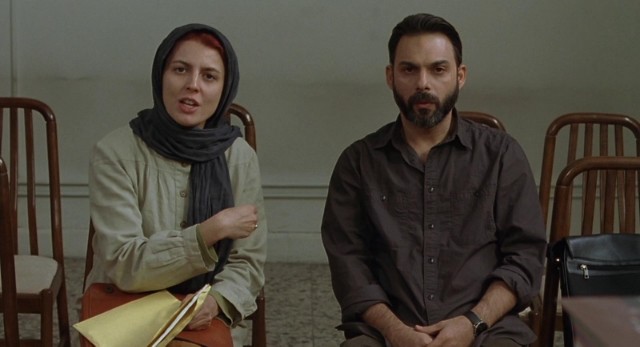
Riveting morality tale from Asghar Farhadi. Nader (Peyman Moaadi) and Simin (Layla Hatami) want a divorce after 14 years of marriage. Nader has an old father who has an alzheimer so he won't leave the country with his wife and 11 year old daughter. Simin's mind was set on immigration, for the future of their child. They go to a judge but he won't grant the divorce since Nader is not a bad man. Things begin to unravel when Nader takes up a caretaker to take care of his dad while he is working. Razieh (Sareh Bayat) with his young button nosed daugther in tow, starts working for Nader but taking care of the old man who doesn't know where he is most of the time and can't clean himself is just too much for her with hot tempered, unemployed husband at home. She is also pregnant.

Things get out of hand when Razieh leave the old man tied to the bed and go to the doctors appointment - Nader comes home with his daughter, finds his dad fallen off bed unconscious, goes mad, throws Razieh out when she comes back. In the scuffle that ensues, Razieh has a miscarriage. The intense court drama (in the office of a judge) begins.

Farhadi's moral dilemmas where no one is really at fault but everyone finds himself in bad circumstances in a deeply religious society is extremely well-balanced and beautifully drawn out. He is especially good at observing all these rigmaroles from children's perspective. Outstanding performances by all involved. A great example of neo-realist Iranian cinema.

Monday, July 4, 2016

Master Filmmaker Abbas Kiarostami, 1940 - 2016

 photo 592c0441-aee9-4207-a893-c43edfe29c49_zpsf545555b.jpg
Abbas Kiarostami, an Iranian master filmmaker, passed away from gastrointestinal cancer in Paris today. As an avid fan of his humanistic, genre transcending films, I can say with a certain conviction that we've lost one of the greatest artists in the world of cinema.

It was his film, Taste of Cherry, winning the Palme d'Or at Cannes Film Fest in 1997 that introduced poetic, meta-fiction laiden Iraninan cinema to the world and put many Kiarostami contemporaries (Jafar Panahi, Asghar Farhadi, Moshen makhmalbaf) on the world cinema map.

But it was seeing one of his Koker trilogy, Wind Will Carry Us, that was a watershed moment for me in my cinematic education. I've never seen such a humanistic and poetic cinema before and the film made me scramble for anything Iranian afterwards.

Over the years, even though his films were never overtly political (although they could easily be seen as Iranian sociopolitical fable), he found filmmaking increasingly difficult within Iran under the government censorship. I reckon it was exactly that transcending subtle artistry that fooled the censorship for a long time. Thankfully for us, it resulted in two international productions - Italy set Certified Copy in 2011 and Japan set Like Someone in Love in 2013.

I had an honor and pleasure to interview Abbas Kiarostami in 2013 when his film Like Someone in Love played at NYFF. As expected, he was the warmest, wisest, humbliest, most thoughtful artist I've ever encountered in my short career as a film critic.

Kiarostami was not only a film director, but a renowned poet as well. Succinct and deceptively simple, his poetry was very much akin to his cinema or vice versa. Ill leave you with one of his short poems from his book of poetry walking with the Wind, published in 2002:
 photo 1753180c-9d4c-468e-b8b3-e179a4cf2e59_zpsqwohlhmw.png

My interview with Kiarostami

Rest in Peace, master.

Monday, September 28, 2015

Ubering with Jafar Panahi

Taxi (2015) - Panahi
 photo 05ccdf17-c9b8-41fc-ade9-43e0d7117850_zpskhrbqpef.jpg
Jafar Panahi was jailed, then put on house arrest and banned from filmmaking for 20 years by the Iranian government in 2010 when it deemed the award winning filmmaker an anti-government propagandist. This didn't stop the filmmaker from making films though.

At first, Panahi was creatively bending the absurd rules that were put on him by making unscripted films in his house with with a small video cameras and smart phones. His frustration and ingenuity were in full display in This is Not a Film and Closed Curtain. With Taxi, his latest, the Golden Bear winner at this year's Berlinale, Panahi raises his middle finger again. The film is yet another self-reflexive, droll, poignant whatsit and defies the powers that be.

In Taxi, very much in the tradition of the fellow Iranian great Abbas Kiarostami, Panahi uses the confines of a moving car to unfold the snapshot of Tehran and its inhabitants in real time. Things are little more sophisticated this time around. There are multiple angle shots, edits and the line between fiction and reality are blurrier than the previous two films.

Panahi himself sets out as a taxicab driver, picking up passengers and their interactions are all captured by small dashboard cameras. The passengers are as diverse as they get. Some get into a heated political discussion - the harshness of the Sharia Law. Ironically the one who advocates the capital punishment turns out to be a criminal.

A motorcycle accident on the street brings in a couple, an wounded man and his hysterical wife. On the way to a hospital, the bloody man orders Panahi to record his last will with his cell phone. He wants to leave all his assets to his wife. Panahi knows that his injuries are minor and will be OK. But after he drops the couple off at the hospital, he promises the wailing wife that he will make sure that she will get the footage.

Then there is an illegal DVD seller who recognizes the famed director. He is the reason how Panahi got to watch films like Once Upon a Time in Anatolia and Midnight in Paris in Iran where most of foreign movies are banned.

There are deeply superstitious old ladies who wants to go to Ali Spring to release a couple of goldfishes. They think their lives depend on the fishes being free. The hilarity ensues after the ladies break the fishbowl in the cab, due to Panahi's bad driving.

But it's Panahi's own niece Hana (Hana Saeidi), a precocious, button nosed young schoolgirl who steals the show. Armed with her tiny digital camera, she wants to make a 'distributable' film. The guideline to make a distributable film that her film teacher told her reveals a lot about the country still steeped in religious fundamentalism - respect the Islamic headscarf, no touching between opposite sex, no political discussion, voluntary self censorship ("deep down, you know what's best"), no sordid realism. After giving Panahi's human rights lawyer friend a ride to the jail where she is trying to visit a woman who is on hunger strike after getting arrested for attending a volleyball game (along with other women), bright eyed Hana asks her uncle what sordid realism means: "We are all real. And that means what we see is all truth." To this, Panahi replies, "There are some truth they don't want you to see."


I used to think that Panahi's more politically active approach in filmmaking is less elegant in portraying human conditions. With Taxi, it's either me warming up to his filmmaking or he is getting better and wiser as a filmmaker, even with much less resources and more restrictions.

The film shows regular Iranian's resilience. Many recognizes his dashboard cam and understands that Panahi is making yet another film. No one in the film hides his/her face or runs away screaming. Whatever the conditions your government put you under, the life still goes on. And the filmmaker has enough of a common sense not to put up the credits at the end of the film.

The film ends with a plain clothes government officials trying to steal the memory card from his dashboard camera while Panahi is out to deliver a purse that was left in the cab by one of the old ladies.

Deeply poignant in its simplicity and undeniably human, Taxi is one of the best non-political, political films I've ever seen.

Taxi will have its New York Premiere at BAM Cinematek on 9/29 and opens nationwide Oct. 2nd.

Tuesday, May 19, 2015

Minimalist Vampire Flick

A Girl Walks Home Alone at Night (2014) - Amirpour
 photo 05b0e0b9-c467-46b1-be1b-3db11a654671_zps4rugjmby.png
 photo 575c4013-7aa4-4561-82af-a3b9ef9b48ab_zps67vt9kta.png
 photo 339f28b7-3e3c-485e-adb8-083516ab39c5_zps900bwu3v.png
 photo ad8b2a11-8357-4929-9b99-5a3b741e4649_zpsbqyqlzz5.png
Vampire genre has been explored and elaborated in a lot of different ways in literature and film. What else is left there in it to explore? Ana Lily Amirpour's minimalist vampire flick in farsi has a couple of things going for it. One is moody, beautiful night time b & w cinematography. The second is Sheila Vand who plays a mysterious young woman. She listens to 80s pop songs in her dark basement apartment, skates in the empty streets at night and happens to be a vampire.

There is Arashi (Arashi Marandi) and his junkie father and Atti (Mozan Marnò) the prostitute storylines that intertwine with the girl's, but who really cares? She listens to Lionel Richie and she ends up with a big fluffy cat that belonged to her victim! The film is a sly take on Iranian society, being a lonely, young, moody person. There is nothing much going on and substance is lacking, but I can't help being pulled in by the film's seductiveness.

Thursday, February 14, 2013

Abbas Kiarostami Interview

 photo 592c0441-aee9-4207-a893-c43edfe29c49_zpsf545555b.jpg
In my short career as a film journalist/blogger, I have been lucky enough to interview some of my idols over the years -- Claire Denis, Apichatpong Weerasethakul, Michael Haneke and John Sayles among them. But no one (not even Haneke!) made me as nervous as I was when I sat down for a round table interview with the master Iranian filmmaker Abbas Kiarostami at last year's New York Film Festival. What could you possibly ask an artist who is infinitely wiser than you (not that others aren't), whose films leave you with awe and admiration, who seems to have figured out what life is about?

Having spent all day answering questions, Kiarostami looked tired behind those dark glasses (he has light sensitivity issues). And, unfortunately, our group occupied the last slot of the press day, so the interview felt very short and unsatisfying. I didn't get to ask any of the questions about restrictions and censorship put on his filmmaking. Looking back, without any nervousness I felt that day, listening to his calm voice again as I write this, I am now able to appreciate his warmth and generosity and his sense of humor a lot more than the first time.


I ask you this because you directed FIVE: DEDICATED TO OZU and seem to have great admiration for Japanese culture. What kind of conversation did you have within yourself before making LIKE SOMEONE IN LOVE?

I am certain that my fascination with Japan has been with me forever, even before I got to go to Japan. Even my very first attempt at any kind of artistic expression, which were poems that I wrote when I was 20 years old, resemble haiku. I had no idea at the time, but I wrote poems that are very like haikus. And in my photography work, there are some kind of common forms found in traditional Japanese paintings. There is some sort of resonance in my practice and Japanese art. So there has always been real interests before my first visit there which was confirmed whenever I went back thereafter. I've been visiting Japan periodically over 20 years now.

Filmmaking for me is quite contradictory. It happened to all my films: whenever I feel attracted to a project there is this necessary heaviness -- the pre-production period is always longer than it should be. So I get bored and restless until things get ready. Deep down, I always wish something would happen to cancel it all. The more I am excited about a project, [the more] I want it be stopped by some kind of unforeseen event. The only exception was the production of Close-Up. Because it was the only film that didn't take long to prepare it. I came up with the idea the day before I started to shoot it, so I didn't have time to get bored. This double state of mind also happened in this Japanese project. I was very much looking forward to it except that I found its pre-production idling as it's always been as with others.

Did the tsunami affect the production of the film at all?

That tsunami was the exact unforeseen event I was telling you about! It was a sign for me because I couldn't find actors, even though the pre-production had started. I thought the project was not meant to be and I thought I would give it up.

This old close friend of mine, a Japanese woman who has been an assistant to a director for a long time (Nogami Teruyo, a long time assistant to Kurosawa Akira). She's always asked me why, what was it that I love so much about Japan and the Japanese people. She told me that just after the tsunami, she was a part of these people in Shibuya sitting on the floor and just seeing what was going on without any reaction or fear or despair. "I wish you would've been with us to see how Japanese people react to a catastrophe,"  she said. And love and admiration she had for her co-citizens, she was seeing them through my eyes.

There is a certain universality in your films that anyone can relate to whether they take place in Tehran, Tokyo or Florence. How did you cultivate that universality?

I think it's a lifetime practice, or habit or way of seeing things. I remember for a long time as a young man I wouldn't take what I see on TV for granted. I would never accept generalizing 'that's how Americans are,' or 'that's how Japanese are.' I was always much more interested in individuals rather than a culture or a country in general sense. This collective judgment or agreement on certain culture has always annoyed me. I deeply believe, excluding ideological positions, that we are the same. In details we can have our differences but in the main aspects of our lives -- our sufferings, joy and pain -- no matter if we are Japanese, American or Iranian, we are the same human beings. So if you have this as the principle of life and relationship, then it shows in your work.

The title of this film LIKE SOMEONE IN LOVE, sung by Ella Fitzgerald, is an American jazz standard. Considering the poetic nature of many of your films' titles -- TASTE OF CHERRY, WIND WILL CARRY US -- why did you choose this particular one? And are you a fan of jazz music?

I would say it's more of a generational thing. Jazz was a worldwide phenomenon when I was growing up. It would play on the radio and the LP came along and jazz came with it. So when it came to music for the film, I asked Mr. Okuno (Okuno Tadash, who plays professor in the film), what his character would listen to; even though he is ten years older than me, he said jazz because that's what he grew up listening to.

I think in Iran, the era of modernity was accompanied by this music. So the music came and the lyrics were translated and there are many singers who'd imitate jazz music. So I think of jazz as not the music that was born somewhere between America and Africa but as something that is shared universally in a certain generation. So for me the title is not a cultural reference, but came from a nostalgia for a certain era.

I was struck by the presence of many cell phones/telephones in LIKE SOMEONE IN LOVE. We are living in a society where we depend on those almost exclusively as a means of communication. How do you feel about that?

There is not much I can do. Things come into our lives and become part of our everyday living. People's lives in my stories also rely on those devices and there is no escaping it.

I never had a mobile phone myself and never imagined having one until the day I was given one. That day I had left home and in the middle of the traffic, I realized that I forgot the mobile phone at home, so I had to drive back to get it. Then suddenly I realized that it's less helpful and more of a constraint, a restriction. Now it's part of everyone's lives: they visit me and they leave their phones at my house and there is a knock on the door....(everyone laughs)

The professor even says in the film that he doesn't have a mobile phone. He only has his telephone with an answering machine and complains that he has to check stupid messages other people leave for him. That's my sentiment too.

There is obviously a progression in your filmmaking over the years. So what's different now than when you first started making films?

Well, if there were any changes in my method, it should be reflected in my films. I think best way anyone put it comes from my friend Nogami Teruyo who told me a story. She hesitantly told me the reaction of Kurosawa when he saw my first (feature) film, The Traveler. She said, "I don't know if I should tell you this because I don't know if you will take it as a compliment or an insult." I said, " No, tell me. Tell me." It happened that he (Kurosawa) had seen my other films but it was much later that he saw The Traveler. And apparently he said, "Oh that Kiarostami fellow, he hasn't progressed a bit!" (everyone laughs)

I don't think my concept has changed since the beginning. All I know is that I don't rely on my previous efforts. Every film I do, I start it from scratch. If there is a change or progression, it's there on the screen. I can't tell you much more than that.


His new film Like Someone in Love opens on February 15 in New York and Los Angeles with a national roll out to follow.

Thursday, February 7, 2013

Moving Picture: Close-Up of Abbas Kiarostami at FSLC

 photo kiarostami-1_zpsffc208cc.jpg
Coinciding with the North American release of his new film, LIKE SOMEONE IN LOVE, Film Society of Lincoln Center presents Close-Up of Abbas Kiarostami: a 9 day retrospective featuring the Iranian master filmmaker's documentaries, shorts and selective narratives. This retro is a rare opportunity to witness the evolution of one of the most prominent filmmakers working today.

Kiarostami's TASTE OF CHERRY winning Palme d'Or at Cannes in 1997 put Iranian cinema and Iranian New Wave on the map, shedding a light on many other deserving Persian filmmakers (Mohsen Makhmalbaf, Jafar Panahi, Amir Naderi among others) . Disarmingly simple yet highly sophisticated, blurring the line between documentary and fiction and defying easy categorization, AK's films are regarded as the prime examples of post-modern cinema. But the fact is, AK has been making films since the 70s: he helped establishing the filmmaking department at Institute for Intellectual Development of Children and Young Adults (Kanun) in Tehran and made series of documentaries and shorts concerning school children. All of his Kanun films will be shown at the retro.

My first AK experience was WIND WILL CARRY US. Its simplicity and humanism with great eye for landscapes impressed me greatly and made me a devotee ever since. What's most striking about his artistry is his effortless, seamless quest for truthful representation of life on film. Whether they are shot on 35mm or with a consumer grade handi-cam, the inquisitive interactions of non-actors with their natural dialogue often imply that there is no real distinction between cinema and reality.

 photo c6ce27b7-1cdc-482d-99f2-363d56933c9d_zps6d64a654.jpg
AK's depiction of children, from his Kanun days (THE BREAD AND THE ALLEY, BREAKTIME, HOMEWORK) to later films (KOKER TRILOGY, ABC AFRICA, TEN) is that of non-disciplinarian. In his feature documentary, HOMEWORK, it is obvious that the educational system in Iran is too strict and puts a lot of pressure on children, both in school and at home with a lot of homework. It's revealing that they all know what punishment means but don't know the meaning of the word praise. Then there are parents who say the system is too harsh on the children, that it kills their creativity and would end up producing a generation of mindless drones. Kiarostami seems to be agreeing with this sentiment.

Unlike many of other Iranian filmmakers who actively make political statements with their work (his former assistant Jafar Panahi being the most vocal one), AK's films aren't overtly political. But the given complexity of his films, Iranian government bans any exhibition of AK films in Iran, fearing that there might be hidden subliminal messages. But unlike the Iranian New Wave filmmakers of his generation who fled the country after the 1979 revolution, AK stayed and kept making films exclusively in Iran until CERTIFIED COPY in 2010. He accepts that restrictions and censorship are a part of life in a rigid society but always finds ways to express himself in changing environs.

 photo d37d49f3-344d-48d1-827b-280ca3c7962e_zps4db9107c.jpg
Cold and bitter, THE REPORT is nothing like his later films that are optimistic and life affirming. Firouzkoui is perhaps the least likable character in all of AK's protagonists- he cheats, lies and abuses his position as a tax investigator. After being accused of corruption and short on rent money, he resorts to beating his wife and neglecting his young daughter. Considering THE REPORT was made before the Iranian Revolution in which Shah was overthrown and The Islamic Republic established, the film is perhaps a snapshot of the state of things in the era, a report on petite-bourgeoisie, steeped in selfishness and materialism. It's also interesting to see the secular Tehran- women wearing revealing western clothes, men drinking and gambling, gridlocks in the city streets, etc. AK observes all this from a distance. THE REPORT is a hard film to like but I can see its merits.

 photo a146e0f0-f528-47f6-9417-0c040545e335_zps4635c03a.jpg
Any scenes with interior of moving cars became synonymous with an AK film. From bustling bottleneck traffic of Tehran in THE REPORT to TASTE OF CHERRY, WIND WILL CARRY US and TEN, the master reminds us that life with its ebbs and flows, is never stopping/always changing. If Tarkovsky tried to make us feel the 'passage of time' with his creeping tracking shots, Kiarostami achieves this in astounding simplicity- life is a moving car.

A middle aged man and his young son are on the road to Koker, a northern rural village leveled by the devastating earthquake in 1990. They spend most of the film's running time in their car. This is the premise of LIFE AND NOTHING MORE... It is only revealed later on that the man is a film director (a Kiarostami stand-in) who is looking for a child actor who starred in his previous film, WHERE IS YOUR FRIEND'S HOME? (AK's 1987 film also taking place in that region). As they encounter monstrous traffic jam and many victims of 'the god's will', the line between reality and fiction evaporates. Shot shortly after the real earthquake that took the lives of 50,000, and based on his own experience driving around (with his own son), LIFE AND NOTHING MORE... shows resilience of the people amid a horrible disaster. As they make ends meet, digging out their household items from debris, they still look forward to a better future. They fidget a TV antenna to watch a World Cup match in ruins. THROUGH THE OLIVE TREE (a fictional 'making-of' LIFE AND NOTHING MORE...), completes the trilogy that takes place in Koker. Elegantly simple and captivating throughout with an open ending, LIFE AND NOTHING MORE... is a beautiful film.

 photo 1fbd8306-1e17-47b6-9d4e-7fb699ac9248_zps8086d796.jpg
In CLOSE-UP, AK retraces an imposter case starring real life participants. The result is a moving examination on 'life imitating art imitating life', rather than sensationalistic satire about fame and deception.

AK pays homage to Ozu Yasujiro in FIVE. The film consists of 5 static long takes of a coastal area in Iran without any characters or dialogue. The commonality of their films lies in humanism and respect for their audience rather than the camera placement. The final part where he traces the reflection of the moon on the surface of a pond with the chorus of its nighttime surroundings to the breaking dawn is a thrilling cinematic magic.

When AK first busted out onto the world cinema stage, critics didn't know what to make of his films: Roger Ebert gave TASTE OF CHERRY one star, calling it 'excruciatingly boring', while Jonathan Rosenbaum desperately tried to find some sort of reference in Western cinema tradition in his films. But as he says in 10 ON TEN that in simply showing austere reality with an open ending, AK believes, can entice audience to reflect on their own lives. I can't think of a higher compliment to the audience than what AK bestows upon us with his films.

The retro includes much praised TASTE OF CHERRY, WIND WILL CARRY US, CERTIFIED COPY along with the theatrical release of LIKE SOMEONE IN LOVE.

For tickets and complete listings please visit FSLC website.