Showing posts with label Sundance 2022. Show all posts

Tuesday, August 30, 2022

American Family Portrait, Textured

The Cathedral (2021) - D'Ambrose The Cathedral Ricky D'Ambrose, a micro-budget indie filmmaker whose initial series of shorts gained acclaim on the international festival circuit -- including Berlinale and New Directors/New Films -- made his feature-length film debut with Notes on an Appearance in 2017.

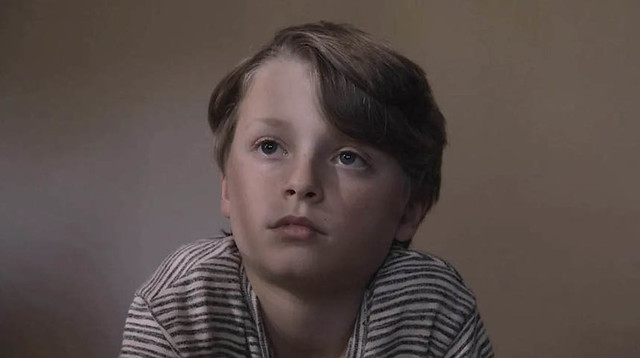
The Cathedral, his astute, semi-autobiographical follow up, premiered at Venice last year, then screened at Sundance earlier this year. The film paints a picture of an American family and its two decades of slow dissolution, with the culturally and politically volatile climate of the 80s and 90s in the U.S. as a backdrop, observed through the eyes of young Jesse Damrosch. It showcases the same minimalistic approach to filmmaking that D'Ambrose embraced while making shorts over the years: static shots, slow zoom-ins, and fragmented images, consisting of stills, old TV commercials, and archival news footage, with "narration" provided by voice-overs and diegetic sound.

Jesse Damrosch recounts how his parents, Richard (Brian d'Arcy James) and Lydia (Monica Barbaro), met, and then dramatizes how their uneasy union unraveled over time, partly due to Richard's volatile relationship with Lydia's family, the Orkin's. Their story is just like many other middle-class, suburban American families: money problems, death in the family, resentment and gossip, the divorce of one's parents and growing apart. We see birthday celebrations, the communion, funerals, family dynamics -- stepparents and extended families bickering over taking care of aging parents, and so forth -- all dryly narrated by an anonymous female voice.

The film also comments on changing times. Richard inherits a printing business from his dad, then struggling with the emergence of digital technology.

Time swiftly passes, jumping from the Reagan through the Clinton and Bush eras, covering the AIDS crisis, scandals, natural and man-made disasters, wars, and terrorism, all witnessed and heard by Jesse, a clear-eyed chap who's often seen staring yonder in various ages. D'Ambrose omits most of his own personal experiences. So there are no scenes of teenage rebellion, no mention of any friends, no love interests, no time of joy or disappointments.

In a way, the film is both autobiographical and not at the same time. It's like he is at the center of it all but also the fly on the wall. It acknowledges the political and cultural climate D'Ambrose (and by proxy, Jesse) and his generation are subjected to, without any prejudice or judgment.

What we are left with, are lingering small details, like the patterns on old furniture upholstery or how the light hit on the parts of his father's apartment or the metal ticking sound of an old radiator.

D'Ambrose's economical aesthetics and sensibilities have a lot in common with contemporary indie filmmakers across the globe. I see resemblance in the works of Dan Sallitt, Matìas Piñeiros, Bas Devos, and Ramon and Silvan Zürcher. His use of interior spaces in his chamber pieces is very much reminiscent of Chantal Akerman's.

Yet, with his even-keeled observations and dense layering of world events mixing with his own childhood memories, The Cathedral feels very much universal and personal at the same time, as it plays out like an emotionally unencumbered version of Richard Linklater's Boyhood, akin to Terence Davies' work.

The Cathedral establishes D'Ambrose as one of the major American voices in indie cinema, in tune with other contemporary filmmakers in the global indie scene embracing minimalist aesthetics with a keen observational eye on the world we live in. I welcome it.

The films opens on September 2, 2022 for one week engagement at Film at Lincoln Center in New York, then begins streaming exclusively via Mubi.

Tuesday, July 5, 2022

Same Passion

Fire of Love (2022) - Dosa Fire of Love Facing volcanos and their sudden eruptions can cause anyone into a deep existential crisis – is anything in life ever stable? What is human existence compared to the awesome power and magnitude of these cataclysimic natural events?

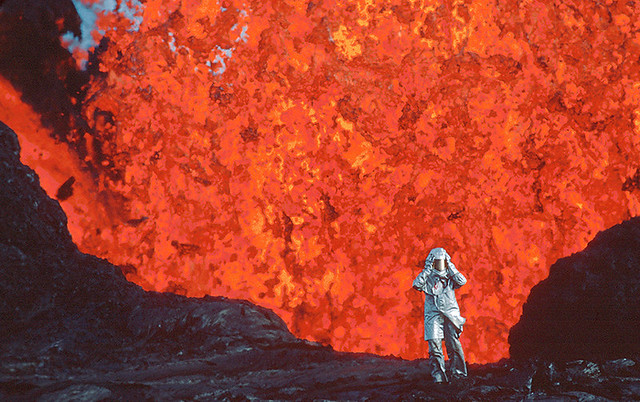
The first time I’ve seen the footage of mesmeric volcanic eruptions with unnaturally glowing bright red lava, captured by The Kraffts, Katia and Maurice, the famed volcanologist couple, was in Werner Herzog’s Fireball. Using long lenses with a 16mm camera, the Kraffts captured some of the most awe-inspiring, iconic volcanic eruptions ever recorded on film. Through that Herzog’s film, I learned that they lost their lives in 1991 when they were on the path of a deadly pyroclastic flow after the eruption of Mt. Unzen near Nagasaki, Japan.

Filmmaker Sara Dosa (The Seer and the Unseen), sifting through tons of film and TV footage, photos and books the volcanologist couple left behind, crafts a poignant narrative about two people who lived and died together doing what they loved. Fire of Love starts with the last known footage of Katia and Maurice together, at the foot of Mt. Unzen, the day before their death. Then it retraces back to how they met in Alsace region in Strasbourg, France.

Growing up in post-WWII with all the aftermath of destruction, both Katia and Maurice leaned toward nature early on, visiting volcanos of Italy –the Mts. Etna and Stromboli respectively. Both were drawn to volcanos and its awesome power. After their first meeting in 1966 and attending anti-Vietnam War demonstrations of 1968, they decided to dedicate their lives to studying volcanos, “because we were disappointed with humanity. And since a volcano is greater than man, we felt this is what we need. Something beyond human understanding.” Maurice was the wanderer with his film camera, trying to capture everything and Katia, sharing the same passion, trying not to lose sight of him. Not that they had a deathwish, both preferred intense and short life rather than long and monotonous one.

So, they married in 1970 and the Geologist/Geochemist volcanologist couple was formed. They traveled everywhere volcanic eruptions were about to happen through the network of fellow scientists and ran straight to the calderas to study and archive, with Maurice’s trusty Arri SR 16mm camera and Katia’s still cameras. For them, studying volcanos is the science of observation. The closer you get, the more you see. And the images they captured were out of this world. And we see plenty of jaw-dropping images in Fire of Love, all culled from the Krafft archive- hundreds of film rolls. Their ‘freelance’ profession took them to Italy, Congo, Iceland, Indonesia, Washington State, Colombia, Japan… to all continents except Antarctica.

Since most of the footage was shot on film without accompanying sound recorder, Dosa and her team do a fantastic job in sound design – explosions, bubbling lava, lava flows, rocks falling, gaseous rolling clouds. And lyrical stop-motion animation illustrates the couple’s early encounters as well as many cataclysmic eruptions throughout human history.

The film is narrated by filmmaker/artist Miranda July, who came onboard after seeing Dosa’s first cut and deeply moved by what she saw: their passion, curiosity, and sense of awe toward nature- all things she as an artist could relate to. Her voice quivers at times as she is choked with emotions. July’s vulnerable delivery adds greatly to the love story narrative.

Volcanic eruptions were everything for them: as Katia describes as ‘feeling of being nothing’ in front of them. To keep chasing volcanos to the far sides of the world, they had to keep making appearances on TV, write books and give interviews and lectures. They definitely took advantage of being the only volcanologist couple in the world in their matching Jacques Cousteau-style red beanies.

The relatively safe ‘red’ volcanos that gave them otherworldly images of lava spewing and flowing gave way to studying more dangerous and unpredictable ‘grey’ volcanos in their later years, which ultimately killed them.

They knew the danger of these unpredictable, deadly eruptions. It was Nevado del Ruiz eruptions in Colombia in 1985 that killed estimated 25,000 that the Kraffts questioned their purpose in life. And they worked hard to create a warning system for evacuations which they are in place across the world now.

It is hard to find someone to spend our lives with, let alone to find one who shares the same passion. Armed with explosive materials accompanied by lyrical collages, Dosa accentuates the story of two lovers who shared the same passion and lived and died together. Fire of Love is an ultimate love story for the ages, presented in a spectacular manner. See it on big screen. Fire of Love is distributed by NatGeo, opens in theaters in NY and LA and national rollout to follow.