Showing posts with label Venice Film Festival 2021. Show all posts

Tuesday, August 30, 2022

American Family Portrait, Textured

The Cathedral (2021) - D'Ambrose The Cathedral Ricky D'Ambrose, a micro-budget indie filmmaker whose initial series of shorts gained acclaim on the international festival circuit -- including Berlinale and New Directors/New Films -- made his feature-length film debut with Notes on an Appearance in 2017.

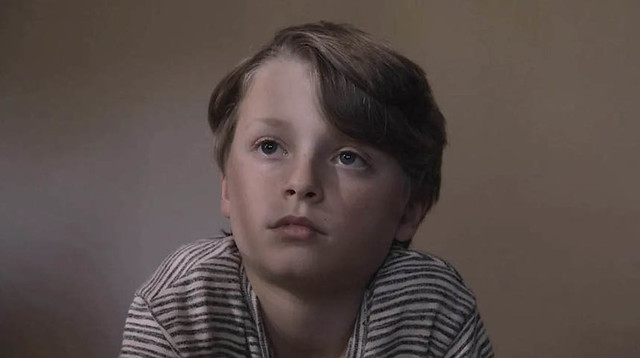
The Cathedral, his astute, semi-autobiographical follow up, premiered at Venice last year, then screened at Sundance earlier this year. The film paints a picture of an American family and its two decades of slow dissolution, with the culturally and politically volatile climate of the 80s and 90s in the U.S. as a backdrop, observed through the eyes of young Jesse Damrosch. It showcases the same minimalistic approach to filmmaking that D'Ambrose embraced while making shorts over the years: static shots, slow zoom-ins, and fragmented images, consisting of stills, old TV commercials, and archival news footage, with "narration" provided by voice-overs and diegetic sound.

Jesse Damrosch recounts how his parents, Richard (Brian d'Arcy James) and Lydia (Monica Barbaro), met, and then dramatizes how their uneasy union unraveled over time, partly due to Richard's volatile relationship with Lydia's family, the Orkin's. Their story is just like many other middle-class, suburban American families: money problems, death in the family, resentment and gossip, the divorce of one's parents and growing apart. We see birthday celebrations, the communion, funerals, family dynamics -- stepparents and extended families bickering over taking care of aging parents, and so forth -- all dryly narrated by an anonymous female voice.

The film also comments on changing times. Richard inherits a printing business from his dad, then struggling with the emergence of digital technology.

Time swiftly passes, jumping from the Reagan through the Clinton and Bush eras, covering the AIDS crisis, scandals, natural and man-made disasters, wars, and terrorism, all witnessed and heard by Jesse, a clear-eyed chap who's often seen staring yonder in various ages. D'Ambrose omits most of his own personal experiences. So there are no scenes of teenage rebellion, no mention of any friends, no love interests, no time of joy or disappointments.

In a way, the film is both autobiographical and not at the same time. It's like he is at the center of it all but also the fly on the wall. It acknowledges the political and cultural climate D'Ambrose (and by proxy, Jesse) and his generation are subjected to, without any prejudice or judgment.

What we are left with, are lingering small details, like the patterns on old furniture upholstery or how the light hit on the parts of his father's apartment or the metal ticking sound of an old radiator.

D'Ambrose's economical aesthetics and sensibilities have a lot in common with contemporary indie filmmakers across the globe. I see resemblance in the works of Dan Sallitt, Matìas Piñeiros, Bas Devos, and Ramon and Silvan Zürcher. His use of interior spaces in his chamber pieces is very much reminiscent of Chantal Akerman's.

Yet, with his even-keeled observations and dense layering of world events mixing with his own childhood memories, The Cathedral feels very much universal and personal at the same time, as it plays out like an emotionally unencumbered version of Richard Linklater's Boyhood, akin to Terence Davies' work.

The Cathedral establishes D'Ambrose as one of the major American voices in indie cinema, in tune with other contemporary filmmakers in the global indie scene embracing minimalist aesthetics with a keen observational eye on the world we live in. I welcome it.

The films opens on September 2, 2022 for one week engagement at Film at Lincoln Center in New York, then begins streaming exclusively via Mubi.

Saturday, September 11, 2021

War Trauma in a Box

Reflection (2021) - Vasyanovych Screen Shot 2021-09-13 at 10.36.22 AM Call it a silver lining in the midst of unrelenting global pandemic, that we are blessed with not one but two Valentyn Vasyanovych's films this year. Atlantis, after winning Orizzonti (Best Film) at Berlinale 2019 and being included in the late edition of New Directors/New Films in 2020, the film saw a brief streaming release through New York's Metrograph early this year. With his new film Reflection, having a world Premiere at Venice just now, we get to witness the major new voice in the world cinema emerging. Mark my word: Vasyanovych is a real deal. He will be regarded as a new master with the release of his each new film in the future. His almost surrealist formalist approach to filmmaking is akin to the works of Swedish master Roy Andersson sans humor combined with the gravitas and emotional punch of Andrey Zvyagintsev. Reflection, a sort of companion piece to Atlantis, is a truly impactful and impressive filmmaking.

Just like Atlantis, Reflection is only composed of wide, static long takes - the camera only moves when necessary with no cutaways or coverage. There are about 27 shots all together in its two-hour running time. We do not see close ups of actors faces, unless they come closer to the camera. The depth and isolation of its characters, without many words uttered, are all told visually.

The film starts with an absurd scene: Serhiy (Roman Lutskyi), a surgeon, is meeting up with his ex-wife Olha (Nadiya Levchenko) and their teenage daughter Polina (Nika Myslytska) and Olha's new beau, Andriy (Andriy Rymaruk of Atlantis), a soldier, in what seems to be a large industrial indoor playpen. But Polina is suiting up in white HAZMAT suit before disappearing behind the giant glass window. It turns out that playpen is a large indoor paintball court. The teenagers in groups are shooting paintballs at each other while parents outside watch them while talking about the war in Donbas, the south-eastern Ukraine, as the glass window is slowly but surely adorned with bubblegum colored paintball shots. The year is 2014, at the start of the Russo-Ukrainian War.

The next scene is Serhiy in the hospital operating table tending to the badly wounded soldier coming from the front line. But it is too late. He bled out.

The film is divided in two: the war and its aftermath. Serhiy voluntarily joins the war effort, then being captured and tortured by Russian troops. Since he is a surgeon, deemed by Russians to be useful, he is spared and given an assisting role in checking and determining if the tortured Ukraine captives are dying or not. There he encounters Andriy, who is almost dead after a power drill torture session.

The power lies in its long takes and imposing compositions. Vasyanovych possesses an impressive eye for architecture and symmetry, In Atlantis, it was industrial wasteland and outdoor scenes that were the main draw. In Reflection, its oppressive, bunker like industrial indoor spaces the director/cinematographer utilizes for creating dread - whether it's the hospital operating table, torture chamber, portable furnace Russians use to cremate their victims and a pigeon crashing into a high-rise apartment window.

The first half, showing horror of war is relentlessly bleak and dark. The second half concerns Serhiy, thoroughly traumatized by the war experience, trying to get a grip on life where everything is pretty normal. Andriy is regarded as missing in action where no one can find his body; guilt stricken Serhiy has to deal with Olha and Polina. Polina, being a teenager and affected by Andriy's absence, become distant and withdrawn while Serhiy tries to overcompensate it with gifts and horseback riding lessons.

If Atlantis was dealing with fictional scenario of the future ecological devastation and human toll from the prolonged war, Reflection using gray landscapes and claustrophobic interiors, delves into the psychological damage of on-going conflict and threat from the neighboring ominous superpower. Sly metaphors, like dead pigeon, makeshift pyre, ravenous stray dogs are all present. But as with Atlantis, there is a glimmer of hope in Reflection. This time, it's not the love between a man and a woman, but that of father and daughter. Known to use non-actors in his films, Vasyanovych uses his own daughter to play Polina. She in turn, gives a great performance in long takes, engaging in religious and spiritual discussion with Lutskyi who plays her father. Her innocence shines through in a dreadful industrial, monochrome winter Ukraine landscape. Daring in its cinematic language, and unflinching in its presentation of the present, Reflection makes you impossible to ignore the state of the on-going conflict in that part of the world.