Sunday, January 3, 2016

Night Hunting

Hunter (2015) - Barley
 photo 87a3c9ea-5300-48f8-8aee-7b47a3c0afde_zpsnh8mwqye.png
 photo 92fa8640-5f98-4d40-9b74-5c7a21892912_zps0ub0ozuw.png
 photo 3200254a-3a7b-4526-a62a-92dfbed96449_zpsr6wtr3b4.png
 photo 4c12798a-e8fb-407e-9440-9791b3a6e9a2_zpswapdvjbp.png
It's inspirational. A short film shot entirely on iphone by artist Scott Barley. The pitch dark night time photography barely sketches out the outlines of the scapes and objects. Barley's on par with Grandrieux to chart the unknown visual sensory territory here. Sound is just as immersive - the constant running of mountain stream. Barley then blends his images with computer generated aurora to top it off at the end. marvelous stuff.

Saturday, January 2, 2016

Uncomfortably Intimate, Bafflingly Beautiful

Field Niggas (2015) - Allah
 photo 73a42e1c-0456-4b1d-8208-6c75f2312f28_zpses4tek01.png
 photo 58b47754-e644-4643-9248-56972532beb8_zpszzfclixo.png
 photo 9430b6f1-b046-4a4e-b17d-5543adcd7dc8_zpszhqefsdo.png
 photo dbe2f1e2-ac73-4f12-b545-2c9e313c4184_zps6mnnrjv8.png
 photo 25516a4b-9cc6-49fc-a8ff-07eebc437384_zpsesv3gbtn.png
 photo 2a360c90-1a8f-4978-b8b0-21a27c4f6013_zps9n1o6hdi.png
 photo 5b555469-1ce3-4098-97de-5dbdfde92495_zps1hjwueo4.png
 photo 26ad3a0c-3ae8-49ed-82b9-85b6ddd6abd3_zpscllkgyag.png
 photo 2ce713bb-665c-463a-a3a4-46e6941ab1a1_zps6kzy7e80.png
 photo 6d49f8e4-e48f-4ce0-a476-e3f6d5a19f82_zps6266bh2o.png
 photo 43fd997f-5b16-448d-b06a-89019b069daf_zpsgi1mmsif.png
 photo 5f6b0aa6-c97d-43be-a83f-6513362174a9_zps3mwjldf2.png
 photo 8906a125-461c-40a1-80a0-649b8d88b5f0_zpsuicmtwpm.png
Kalik Allah has been photographing people in East Harlem (Lex & 125st) for years with his analog 35mm camera. Field Niggas is an extension of his practice with a small DSLR (shot in half the normal speed). The power of his arresting images is in his subject looking back at you straight in the eye. The experience of their lingering glance is bafflingly beautiful and uncomfortably intimate. I haven't felt like that probably since Robert Bergman photo exhibit in 2009. Accompanying wild tracks of its many subjects conversing with Allah give necessary context to the images presented. Obviously, Allah being a brother from the neighborhood gives him advantage to take these intimate photos at night in East Harlem. And the young photographer is not shy about his involvement in the process. He is seen and heard throughout the film.

Shot in the shadow of Robert Gardener incident during the Summer of 2014, the tension on the streets is reflected in the film as well. Police presence is everywhere and Allah includes them in his universe too. These young officers might be voiceless and distant in the film, but that doesn't stop Allah from getting in their faces and share his photo albums with them.

With the evocative title and constant presence of old chain gang songs, Allah draws parallels to the present inner-city life - poverty, drugs (it seems the drug of the choice at the moment is K2, the synthetic cannabis) & single motherhood. Field Niggas is a great snapshot of the nitty gritty present of the street people. But Allah seems incapable of staying away from beauty- time and time again he revisits pretty faces lit only by the dim street lights.

Please visit Khalik's Tumblr

Thursday, December 24, 2015

Same Suffering

Pursuit of Death/Jjacko (1980) - Im
Screen Shot 2021-08-08 at 11.49.37 AM Screen Shot 2021-08-08 at 11.43.54 AM Screen Shot 2021-08-08 at 11.44.22 AM  photo 75fd07dc-940f-46ef-9f86-d4aff55db07b_zpsdm2nfhxi.png
 photo a181dec7-19b4-45c0-acaf-3ddd899adcb7_zpshws94gte.png
 photo 36c5bd0c-ca4e-485e-bf7b-a08deed35698_zpsyu37mlyv.png
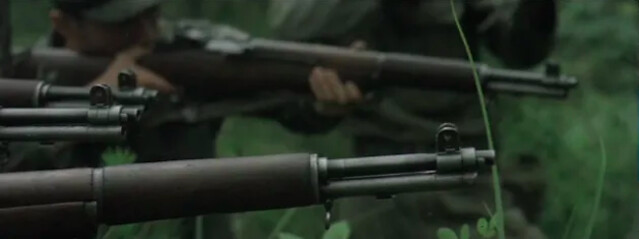
Song Gi-yeol (Kim Hi-Ra), an aging vagrant dying of stomach cancer gets picked up while sleeping in the streets and sent to a 'rehabilitation center': a place where old and invalid homeless people go to live and work (gardening and such) according to a strict schedule and eventually expire. It's a last stop for these unfortunates. There he finds Jjacko/Bak Gong-san (Kim Sang-Soo), his nemesis and obsession over the last 30 years. In the 50s, Song was a cop pursuing Jjacko, the notorious commie guerrila fighter, who's responsible for killing hundreds of civilians. Song's relentless pursuit of the commie took a toll on his life: lost everything that he holds dear and became a limping beggar. But no one at the rehab believes his tall tales and regards him as a mental case. Yet he is determined to bring Jjacko to justice and clear his name once and for all.

There are a lot of technical and plot issues with the version of the film I saw - there are scenes cutting out, has a terrible audio in some parts. Some seemingly important elements and motives are planted but never play out. And this being made while Korea was still in military dictatorship, there are no real political nuances to speak of: it's given that the reds are dirty, evil civilian killers and nothing more. Different ideologies that divided the country never factor in.

Jjacko is a slang for people with asymmetrical nose. It's also interesting to note that the bad commie is an ugly man with a huge mole over his nose and the cop always wears dark shades very much similar to ones Park Jung Hee (a military dictator who was assassinated in 1979)'s trademark look. I wonder if that was intentional or not.

But the film's all about how both sides suffered non-discriminately and that no one really cares now. Through overly melodramatic flashbacks, we see how both Song and Jjacko are alike in suffering- Jjacko as a fugitive and Song as an obssessive pursuer. These are also very macho characters who never regrets anything. Remorse doesn't figure in their thoughts. And women are just there to be sacrificed and remembered. Im is a competent director who always provides with some stunning compositions and energetic camera movements. He also weaves in two men's flashbacks as how their lives are connected in dramatic and bizarre ways. Jjacko is not a great film but an interesting one nonetheless.

Wednesday, December 23, 2015

Don't Cry, So Why Don't We Sing?

Good Men, Good Women (1995) - Hou
 photo 292ad633-a2d1-47c4-baf3-abac0b593c49_zpsixgenv4i.png
 photo 3dc6908f-b160-4d10-9e3c-3c2fbe9ad058_zpsjvr1f4xl.png
Compared with Hou's another Taiwanese historical epic City of Sadness which is told as a straight forward family saga, Good Men, Good Women is a much more complex film, both structurally and thematically. So it makes a much more challenging viewing experience. It starts out with a young actress Liang Ching (Annie Shizuoka Inoh) with a troubled past as she prepares the role of Chiang Bi-yu, a real life character in a film version of Good Men, Good Women, about a group of young Taiwanese idealists going over to the mainland China to join the resistance against Japanese in WWII. The monochrome version of the film within the film is scattered through out, giving the island nation's tumultuous history through these well intentioned characters who fell victims to political circumstances. It also loosely connects with the life of Liang in the present time who has been leading rather a trashy, decadent life.

Someone is stalking Liang with late night phone calls and faxing her the snippets of her own diary which was stolen. The diary reflects on her seedy past to herself as a bar hostess and a drug addict. She is also haunted by the memories of her lover, Ah Wei, a low level gangster who was murdered some years ago. We spend most of the running time with Liang in her present life and in flashbacks with Ah Wei, shot and framed beautifully in typical Hou mastery. The seemingly unconnected story resonates in the film's end as the same wide shot of people crossing the field of Chinese countryside, singing (one in monochrome and one color) reminding the prologue: "When yesterday's sadness is about to die/When tomorrow's good cheer is marching towards us/Then people say, don't cry. So why don't we sing." Liang's life can be construed as the director's comments on decadent present Taiwanese society. But Liang is a deeply unhappy character who can't escape the shadow of her past. We can't help but sympathize with her. There is obviously a larger context in play here - the nation's shameful past needs to be recognized in order to go forward.

Complex, asymmetrical and enigmatic, yet richly rewarding, Good Men, Good Women is the Hou film I was craving for. But now I have to watch Puppetmaster to finish the Hou's Taiwanese History Trilogy.

Tuesday, December 22, 2015

Blood Soaked Feministing

Tag (2015) - Sono
 photo 8350a5aa-7c74-4ead-8634-d1c3a01a04e7_zpslfeoblo4.jpg
Most of its 1 hour 25 minute running time, our titular heroine(s), Mitsuko/Keiko/Izumi are engaging in cardio vascular activity. Tag is Mulholland Dr. meets Ken Russell over the topness for the video game crowd. Sono even takes jabs at the largest movie watching demographic (his included) teen male, and teaches them a thing or two about respecting women while still engaging in upskirt photography (not as predominant as his other films though). Can he take the cake and eat it too? Is this even allowed?

Sono's strength has always been his manic energy and with all the drone shots and running, Tag is an unstoppable ball of energy with plenty of violence and gore. The cartoonish violence against these girls are not overtly sexual and interestingly, Sono keeps sex and violence separate until the last minute. There is obviously an agenda here that all of the characters are female until Mitsuko enters the 'male world' that Sono's commenting on male oriented society where 'girls' are treated as objects. But is he really serious about desensitization of these boys through games and pornography or half-heartedly commenting while actively engaging in desensitization himself? Is suicide the only option for girls everywhere? Unlike the promo trailer for the film where bikini girls get their heads blown off, Tag is much less scintillating in its presentation. He made a conscious choice not to push farther and mire him in contradictions. Like Sono's dark satire breakthrough Suicide Club, Tag leaves you in a somber, rather sad mood. In many ways, Tag is a better Sono film that actually has a direction and is a more concise and less exhausting experience than his grander scale, sprawling, unruly films. Sono exemplifies, along with Paul Verhoeven, that one can make a biting satire while awash with the very trope he's satirizing.

Monday, December 21, 2015

Top 10 Discoveries of the Year

The films below are the ones I discovered for the first time this year. Actually, I've seen Godard's Eloge de l'amour in theaters and I remember hating it. I wasn't really a Godardhead back then. Innocent times. But the rest of the films are the first time viewing.

My search for the works of particular artist continued and I landed on the works of Lisandro Alonso, who is by far, one of the most interesting filmmakers working out there. Then there is of course, Pedro Costa and Godard. My film viewing dwindled because of a job change in the middle of the year and not as robust as last few years. But still got to discover quite a few gems, the the ones below:

O Sangue - Costa
 photo d3733167-1a88-46ae-a60f-f5bee869f04b_zpskgxstg4t.png
Los Muertos - Alonso
 photo 61033b81-91a4-4c1b-ba7f-90825314b3b8_zps2n7woqba.png
Il Futuro - Scherson
 photo 8b53a354-4605-4ecd-b78e-b311dbb30005_zpsurybhhyt.jpg
Liverpool - Alonso
 photo b452ed8e-9619-4c48-abac-d21a7c553965_zpscykyvhup.jpg
Eloge de l'amour/Forever Mozart/Passion - Godard
 photo 9eea4be3-8894-43ba-b5ee-dc4a48c4d0ab_zpsvkgkgd74.png
 photo 8a1f9bfe-0f48-440a-ad75-8862c5652876_zpsh4ugzgr9.png
 photo f93d2f95-b32d-479f-a616-0ed6866243cd_zps7ab18eb9.png
Mildred Pierce *mini series - Haynes
 photo 79ec81c4-4428-48cc-90d3-dbefb3718c7f_zpstunksmtt.jpg
La belle personne - Honoré
 photo ffa44972-544c-464d-a876-684704f95dff_zps4es77nr9.png
Yearning - Naruse
 photo 2194cd01-4ed9-453f-a878-6ec32ecbb93f_zpsfqf7ih7j.png

Sunday, December 20, 2015

Beautiful Melancholia

Dust in the Wind (1987) - Hou
 photo b7898d79-c7f4-43e5-a887-6e40bcd354a4_zpsnkbrzxik.png
Wan (Wang Chien-wen) and Huey (Hsin Shu-fen) are teenage lovers in a small mining town. After graduating middle school, they decide to go to bustling Taipei to earn money for their families. Wan takes a job at printing factory then later as a motorcycle delivery man while going to night school. Huey works as a seamstress. They befriend with billboard painter and his gang at a movie theater, hang out and drink sometimes. But life is tough and as you know, things never go the way you wanted.

Hou's elegy to his adolescent times is full of stunningly beautiful moments - a train ride home in the beginning, normally shy Huey taking off her shirt in a spur of the moment, grandpa's firecrackers, suspicious, shipwrecked Chinese family in the army barracks, watching people fighting fire from across the street, drunken dad trying to lift a stone, etc. It feels almost indecent to share these memories of Wan and Huey as intimately and vividly as I watch Dust in the Wind. But like past memories, Hou's treatment of these moments are so fleeting and democratic, it just quietly floats by without much time for reflection (which comes later). And before you know it, the film ends and leaves you with beautiful melancholia. Another bittersweet masterpiece by Hou.

Friday, December 18, 2015

My Top 10 Favorite Films of 2015

Due to job changes in the middle of the year, my film viewing has been less than robust in 2015. There were films I very much wanted to see but missed the opportunity, namely: Carol, Cemetery of Splendour, Right Now, Wrong Then and Our Little Sister. But there is always next year, right?

On the same coin, the list I got going here is a little different than two other web publications I contributed my list to - CriticWire and ICS (International Cinephiles Society) which restricts to the films theatrically released in that particular year. Since this is my personal site, I list them as I see fit here without any restrictions put on myself. So don't be surprised if you don't see such great films as Clouds of Sils Maria, The Look of Silence, Jauja, Timbuktu and Eden on here- They all ended up in my last year's list. So without further a do:

1. Arabian Nights
 photo c9f50290-19b8-49b8-8c78-b4d5a097e746_zpsxyabkbtr.jpg
Sprawling, uninhibited, playful, languid, beautiful, funny... Miguel Gomes's cinematic reflection on Portugal in Crisis didn't have a real match to be my favorite film of the year. This 6 hour movie in 3 volumes might be giving the film distributors gigantic headache, but it's better to see them back to back and enjoy its fabulous labyrinthine storytelling, melding reality and fantasy, narrative and documentary and everything else. So good.

* My interview with Miguel Gomes

2. Court
 photo 7f82bd88-acca-4fb5-80fa-ecacd8a3558e_zpsdc0az9ek.jpg
A big surprise of the year. On the surface, Court is a biting social commentary but the film is much deeper and more humanistic than that. Chaitanya Tamhane takes a daring formalist approach in painting India's very complex class system without losing the sight of humanity.

3. The Assassin
 photo 701ba8b9-a2f1-44ae-bb37-12d832b3131e_zpsvxmnfvrv.jpg
In my review, I compared watching The Assassin to watching the flow of a river under the sunset. It's a rapturous experience.

4. Phoenix
 photo 3ecef6f5-98dd-47a2-b81f-5928074e54e3_zpsczbtm45z.jpg
Finely tuned inverted Vertigo from one of the most gifted storytellers of our time. Nina Hoss gives the performance of the year. Now streaming on Netflix.

5. Louder than Bombs
 photo 9498f605-f304-42bc-a269-70538b222325_zpsjpfmlq2c.jpg
Nuanced, rich, beautifully written story of grief and family ties. Best American film not written by Americans. Joachim Trier and his writing partner Eskil Vogt really nail it here.

6. Son of Saul
 photo eb25a6cd-8bd7-4740-a7ed-c1b586dc380f_zps4maofobz.jpg
Not only a technical marvel but it also punches you in the gut. Bravura filmmaking at its best.

7. Li Wen at East Lake
 photo 98dc3735-2126-4559-aa83-b2f5569a7abd_zpsvwkuqj6j.jpg
A droll examination of China's changing society with much playfulness and humor by Li Luo, which shows you that China's underground indie filmmaking is alive and well.

8. Girlhood
 photo aeda6ae5-837a-4214-a584-b74f5b25c198_zps6562fa60.jpg
Karidja Touré gives a great performance in this beautifully written, beautifully acted coming of age film by the great Celine Sciamma.

* My Interview with Celine Sciamma

9. Mad Max: Fury Road
 photo a45f7ead-2e06-4196-8870-2e1a443a6731_zpsn4hnd0mi.jpg
I had so much fun at the movies thanks to George Miller. But I think it will take at least 2-3 George Millers to save that sacred experience. But I'll take what I can get for now.

10. Taxi
 photo 05ccdf17-c9b8-41fc-ade9-43e0d7117850_zpskhrbqpef.jpg
No restrictions or bans from powers that be can prevent from Jafar Panahi from making films. He makes giving middle finger to authority so much fun!

The rest:

11. Lost River - Gosling

12. Le Dos Rouge/Portrait of the Artist - Barraud

13. 100 Yen Love - Take

14. A Pigeon Sat on a Branch Reflecting Existence - Andersson

* My Interview with Roy Andersson

15. Voice of Water - Yamamoto

16. La Sapienza - Green

17. The Duke of Burgundy - Strickland

18. Metamorphoses - Honoré

19. Parabellum - Rinner

20. Violet - Devos

Monday, December 14, 2015

Present Reimagined

Dreams Rewired (2015) - Luksch, Reinhart, Tode
 photo 10ec939f-d5dd-49af-b865-cc0a005dd2a6_zpsjv9zgv2a.jpg
Directed by Manu Luksch, Martin Reinhart and Thomas Tode, Dreams Rewired is a fascinating historical reflection of our obsession with connectivity. Appropriating old world technology to draw the parallels to our own, the post-NSA era society where files can be stored in the ether and anyone can have access from anywhere, any time.

The film digs deeper into history of mass media- early films, phonograph, radio and early television- culling from more than 200 archival silent movie clips and retro style animation, the Austrian experimental filmmakers examine not only development of technology but also human desire to connect with one another and to relentlessly innovate. The film also puts a mirror on 21st century society as it asks serious questions about our blind dependency on technology.

Narrated, ever so appropriately, by our resident alien queen from the future, Tilda Swinton, in her crisp, otherworldly voice, Rewired is a dense, playful, philosophical and poetic look not only at how the old, both real and imagined, technology (roughly from 1880s to 1930s) matches up to 21st century world that we are taking for granted - from radio transmitter on a garter belt, mobile device the size of shoe box, notions of virtual reality and world in harmony and understanding. Swinton playfully plays along, often having conversations all by herself in clips with two characters.

Beautifully structured, It sets up with the clips from infant stages of film technology - films by Edison, Feuillade, to early greats like Griffith, Vertov, Eisenstein, to early avant-garde silents where they imagined technology fueled Utopia.

The film takes a darker turn as it talks about invasion of privacy ('I can see everything through the wall!') and 'human zoo' with the exotic world archival footage that is today's equivalent of the third world poverty porn. It cleverly makes a transition from early Soviet propaganda films (including Battleship Potemkin) to aerial view of bombed out Europe after WWI, to the first international TV broadcast of the Olympics game being Nazi Germany in 1936. That 'the world within arm's length also means within striking distance.' Then it hints at the rise of fascism and totalitarianism and surveillance.

Dreams Rewired is not only an entertaining visual feast for the eyes, but also a kin, thoughtful, cautious observation on how these 'imagined' world where total connection might have meant a 'transparent future' unlike our uncertain world where we store and share information in ether and deal with whistle blower scandals in the deepest reaches of the governments every other year.

Dreams Rewired has world theatrical premiere, Wednesday, Dec. 16 at Film Forum.

Monday, December 7, 2015

Christmas Spirit

Krampus (2015) - Dougherty
 photo 92b7bf92-f8ee-41a1-ab47-537b22bb74c4_zps3vfrsyck.jpg
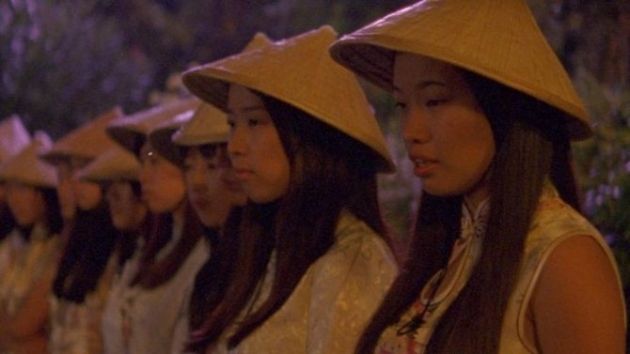
'Tis the season folks. The slo-mo scene of stampede and mayhem at the mall that opens Michael Dougherty's Krampus is one reason enough to give this rather old-fashioned horror movie the thumbs up. Krampus, a goat hooved, horned creature with a long red tongue who punishes naughty children who forgets Christmas spirit of giving and sharing in German folklore is the counterpart to fat jolly St. Nicolas who climbs down the chimney and leaves you present under the Christmas tree. Krampus is a silly fun film that pokes fun at rampant materialism and Coke bottle Santa worshiping and uses puppetry, and animatronics rather than CGed monsters for scare. Dougherty does a real good job with the actual Krampus design too. Incidentally, it was Krampusnacht on Dec.6

Thursday, December 3, 2015

Arabian Nights, Portuguese Style

*originally published 10/2/2015 at NYFF
Arabian Nights: Volume 1, 2 & 3 (2015) - Gomes
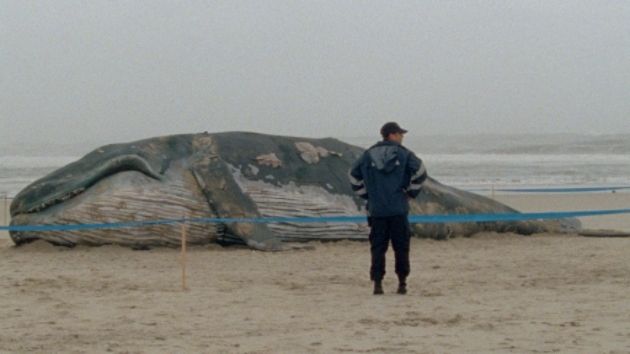
 photo 53bc85db-d420-400b-b021-57d14f9333ce_zps3wo4iobv.jpg
 photo ab746edb-e5f1-4740-b1d0-86d13367d262_zpsphxaordw.jpg
 photo ae8efea9-d42b-41de-b04a-b7dbdea8e4cc_zpsbedkdwhm.jpg
The last time I talked with Miguel Gomes, the subject of our conversation was not about his latest film, Tabu, but almost exclusively about the impact of the devastating austerity measure by the Portuguese government on the Portuguese film community and its general population in this global recession era. It is no surprise then, that the Portuguese director's next project concerns just that. He makes it clear in the preface of each volumes of Arabian Nights:
This film is not an adaptation of the book ARABIAN NIGHTS despite drawing on its structure

The stories, characters and places that Scheherazade will tell us about acquired a fictional form from facts that occurred in Portugal between August 2013 and July 2014. During this period the country was held hostage to a program of economic austerity executed by a government apparently devoid of social justice. As a result, almost all Portuguese became more impoverished.

As soon as I'd heard of its release at this year's Cannes, it became my most anticipated movie of the year. And it definitely doesn't disappoint. What's surprising is that the result is a sprawling, ambitious 6+ hour film divided in to 3 volumes, shot on anamorphic widescreen format.

Political films are often boring. Well intentioned films are even more boring. But since it's Miguel Gomes, the director of such genre defining, inventive, playful films as Our Beloved Month of August and Tabu, Arabian Nights is nothing but. Even with limited resources, the film is full of wonder in the best sense of the word. Gomes's aim is to tell as many real stories of people of Portugal under economic siege, which explains the 6 hour running time. But he does so so effortlessly with his fluid, unhurried filmmaking.

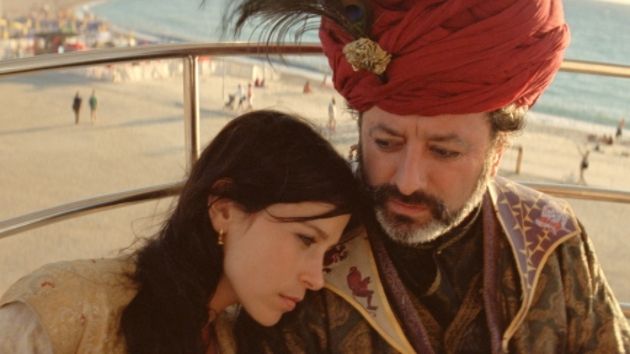
The film starts with two differing occurrences in a declining port town: there are massive lay offs in the shipyard and an sprawling invasion of Asian wasps in vineyards and homes. Unable to make the coherent story out of these two seemingly unconnected happenings, a haggard, lost film director (Gomes) is seen cowardly running away from his film. He is not seen again until the Volume three as he makes a brief appearance as one of the Arabian slaves of the queen Scheherazade. Then we are told about Scheherazade's fate - The Ruthless and murderous King weds beautiful virgins and kill them off one by one if they can't provide nightly storytelling. Beautiful Scheherazade has to keep telling myriad stories to keep alive, hence, begins the labyrinthine tales within tales of Gomes's own version of Arabian Nights in three volumes- Volume One: The Restless One, Volume Two: The Desolate One and Volume Three: The Enchanted One.

The episodic storytelling ranges from a full on satire - as in 'The Men with Hard-ons' about camel riding politicians and bankers (so-called Troika- IMF, European Central Bank and European Commission) whose wishes come true by an African genie they encounter on a dirt road. Their wishes- a round-the-clock hard-on. Pleased with themselves, they decide to throw out the harsh austerity measure but only to find out that eternal hard-ons are not only unpleasant and hurtful but also major inconvenience, they put the austerity measure back on, to a weighed symbolism - the explosion of a beached dead whale on a New Year's Day in 'Bath of the Magnificents', to a tragicomedy - in a lovely chapter called, 'The Owners of Dixie', going into the history of suburban housing projects and its low-income occupants, to an observational documentary in 'The Inebriated Chorus of Chaffinches' about brusque urban bird-trappers and the finch singing contest.

But above description doesn't do justice to the immense beauty and lyricism of Arabian Nights. Even its political subtext is always there, Gomes doesn't abandon the human element and showing resilience of ordinary people in dire circumstances neither does he neglect playing with conventions of cinema as a narrative medium.

Fittingly, he uses both professional actors and non-professionals in different roles in three volumes throughout, building the sense of intimacy of each 'person' and lived-in atmosphere.

Gomes's cinematic playfulness is evident in every aspect - sometimes Scheherazade's narration and texts on screen are literal translation of what's unfolding before us, sometimes not. Sometimes he leaves the story to unfold itself without interruption. Simple edit tricks like a long cross-fades and some costumes and papier mâché are the extent of the special effects he incorporates. Thai cinematographer Sayombhu Mukdeeprom, a long time Apichatpong Weerasethakul's collaborator lends his magic here with his languid visual poetry.

Since I saw the three volumes in succession, I can't really say if each volume works as a standalone film. It would be a hard sell for distributors to release it as a 381 minute film though (Kino Lorber is distributing in stateside). The thing is Gomes's storytelling (via Scheherazade) could go on forever, in order to stay alive (haha). But I can't say enough about what a wondrous, one of a kind cinematic storytelling Arabian Nights is. It is definitely this year's cinematic highlight for me.