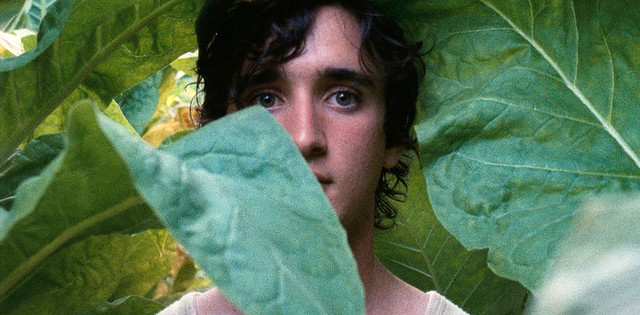
I've come to love folksy, good hearted nature of Alice Rohrwacher's delicate, charming films about rural Italian villages and their eclectic inhabitants peppered with her brand of unsentimental magic realism. Happy as Lazzaro, her latest offering is an allegorical tale that goes wonderfully unexpected ways.
Inviolata is an isolated mountain village that seems like it is stuck in the middle ages. The farmers are seen tending livestock, harvesting tobacco plants and living in squalid conditions. Electricity seems to be scarce as they complain when the only light bulb in the common area of the house goes out. Everyone in the village, young and old, is working from morning to dusk non-stop. A wide eyed, good natured boy, Lazzaro (Adriano Tardiolo), seems to be in everyone's demand. Whatever the task, he is there to do it without questioning.
Nicola, in a funny suit and tie who seem to be in charge of the whole production comes in to collect the villager's tobacco harvest, does the calculation and tells them that they are in the red again after all the expenses that he brings in - light bulbs, supplies and what not. The villagers complain but quiet down soon enough. It seems their arrangement has been like this way for a long time. Nicola's wife, marquise de Luna (Nicoletta Braschi of Life is Beautiful and Johnny Stecchino) and their spoiled children Tancredi and Maria are in town, staying in their opulent mansion. Tancredi, a blonde boy who is clueless about the villager's living conditions, strolls around in his fancy clothes and his walkman, bored out of his skull. But he takes a liking to Lazzaro who obliges to his every whim.
After Lazzaro showed Tancredi his secret hangout up on the dusty hill, the rich boy comes up with an idea of kidnapping himself and sending a ransom letter to his parents. Days go by. Nicola suspiciously refuses to call police and marquise refuses to pay the ransom. Lazzaro, busy working, but also worried about his new friend up on the hill all by himself, worries himself sick and falls ill. Maria secretly calls the police and all hell breaks loose.
See, the first half of Happy as Lazzaro plays out like a gritty yet affable tale of small folks up in the mountains. Everything is very authentic and natural, showing their way of life- Young people fall in love and want to leave the village. They have to protect livestock from marauding wolves, tobacco plants need to be harvested and smoked and dried. It plays out something like humorous version of Ermano Olmi's realist film, except some strange inconsistencies like the presence of Tancredi's walkman and flip phones (Rohrwacher deliberately makes the time period obscure). You think it's a throw back of old, folksy yarn so far, then the film turns into something different altogether.
After the arrival of police, it is revealed that the town of Inviolata has been taken advantage of by the marquise and Nicola: after the historic flooding long ago, the town was cut off from the outside world and unbeknownst them, the marquise family continued to exploit them for their labor in their little modern feudal system. By the time our Lazzaro, who had fallen ill and in his delirium, fell from the cliff looking for Tancredi, regain his consciousness, many years had gone by and Inviolata had been emptied out.
Lazzaro meets two thieves, Ultimo (great Sergi Lopez) and Pippo, at now abandoned villa of the marquise and hitch a ride with them to their house, an old tanker beside the railroad tracks. There Lazzaro reunites with Antonia (Alba Rohrwacher, sister of director Alice), who was a little girl back in Inviolata and now is a grown up. In fact, most of the villagers who live in the same place, are all old now. They are scraping by, by way of stealing and scavenging. They regard Lazzaro, who hadn't aged a bit, with great deal of skepticism at first, calling him a ghost. But recognizes his innocence and good heartedness. Lazzaro, who had sworn his friendship with Tancredi, would never stop looking for him.
One can regard Lazzaro as Chance character in Being There. Almost saint like, Lazzaro is a metaphysical being that is too good to be true. In fact, all the villagers are. What's done is done. They don't hold the grudge against the marquise and her family. They are even willing to give them expensive pastries.
Rohrbacher makes a point about the current immigration situations that it's just as exploitative as the middle ages. As Lazzaro and Antonia watches, there is a scene involving a sort of reversed slavery auction: The recruiter shouts that a job pays four euros and 50 cents. Migrant workers grumble that the wage is too low. But instead of asking for higher wages, they compete for lowering their wage demands just to get a job.
Child actors are great, so is always excellent Alba Rohrbacher. And Hélène Louvart lensed 16mm cinematography is gorgeous. But the real star is Tardiolo. There is sense of decency in that babyface and wide fawny eyes. Lazzaro is someone who is desperately needed in this cynical, cruel world. Alice Rohrbacher's writing shines in bringing out humor and humanity in an whimsical yet pointy allegory full of wonders.

