Showing posts with label Black Comedy. Show all posts

Wednesday, April 2, 2025

Marriage Counselor

Psycho Therapy: The Shallow Tale of a Writer Who Decided to Write about a Serial Killer (2024) - Karaçelik Psycho Therapy Keane (John Magaro, First Cow) is a struggling writer who has been toiling on a book about a love story set in prehistoric time, for the last 4 years. His somewhat successful previous book was about Mongolians, which he had no knowledge about, just like the Cro-Magnons and Neandertals. His publisher is not crazy about the concept. It's not sexy enough - Keane should write about what he knows, he suggests. It is pretty obvious that his interior designer wife Suzie (Britt Lower, Severance) is not happy with having been a sole bread-winner of the house, and can't stand listening to his idiotic idea for the book that he will never finish, at dinner parties with friends. Her glacial expression and silence speaks volumes. She wants a divorce.

Everything changes when Keane is approached by Kollmick (Steve Buscemi), who says he's a fan and seems to know a lot about the author, at a bar. Kollmick has a proposition - 'write about a serial killer and I will tell you everything I know about serial killers.' Because he himself is a retired serial killer. He will show Keane the ropes. But after getting caught by Suzie, sneaking into the house in the middle of the night with Kollmick, Keane tells Suzie that Kollmick is a marriage counselor. So starts an unusual, funny dark comedy with the incredibly long title: Psycho Therapy: The Shallow Tale of a Writer Who Decided to Write about a Serial Killer.

Suzie is not convinced that Kollmick is what he says he is. His method- bringing his stuffed dead cat with a doll's arm and telling the couple to talk to each other while looking only at the cat, doesn't really help to quell Suzie's suspicions. Also, she is suspecting that Keane is trying to kill her, based on all the books he's been reading - about serial killers and poisoning, which were given to him by Kollmick. But strangely, the counselling sessions, however unorthodox they seem, are proving to be helpful in their marriage.

Kollmick's idea- kidnapping Keane's publisher to get first-hand experience of the serial killer's process, doesn't sit well with Keane even with Kollmick's assurance- "He will understand, if it's for a sexy bestseller." But the plan, involving an Albanian gun dealer and a bottle of chloroform, doesn't go the way they expected, of course. To make matters worse, Suzie is on their trail, watching all the absurd situations that Keane and Kollmick find themselves in.

Psycho Therapy plays out like a dark indie noir comedy from the 90s, which we don't see often nowadays. Tolga Karaçelik's writing is brimming with absurdist humor and keeping unnecessary expositions to a minimum. With his-high pitched cracking voice, John Magaro is perfect for a bumbling poseur writer. Britt Lower's glacial Suzie with killer instincts had me cackling. Buscemi, who executive produced the film, chews up the scenes with that disdainful stare he is known for. The film ends abruptly, but rightfully after the night of kidnapping(s) gone wrong, where true natures of the couple are revealed. Psycho Therapy is a wildly entertaining black comedy with a pitch perfect cast.

Psycho Therapy: The Shallow Tale of a Writer Who Decided to Write about a Serial Killer will be in New York Theaters on April 4th with a Theatrical Expansion and On Demand April 11.

Friday, June 5, 2015

Interview: Roy Andersson on Being Human

6
Roy Andersson, arguably one of the most singular voices in cinema and widely regarded as one who godfarthered that droll, deadpan 'Scandinavian Humor', has a new film out in 8 years and it's titled, A Pigeon Sat on A Branch Reflecting on Existence. If you are an Andersson fan like me, who's been waiting for 15 years for the conclusion of his 'Human Trilogy', you won't be disappointed. For the film's two week engagement at Film Forum and Lincoln Plaza Cinema here in New York City, the legendary Swedish director is in town and I was lucky to snag an interview.

In person, Andersson is nothing like the sad sack characters in his films. He is warm, extremely friendly and full of laughs. I really treasure those twenty minutes being with him.

*Andersson will be on hand for Q & A sessions for selected shows. Please check Film Forum website.

It took you 15 years to do 3 films. Why is it taking so long for you to make a film?

If it's any consolation, you can expect my new movie in 3 years.

Really?

Maybe 3 and a half.  This time I don't need a pause. Between those, I needed to pause. Obviously I don't need 7 years for production, but 3 and a half seems doable. Between those I do other things.  So the new one will be coming out in 2018. I hope, anyway.

Would it be something quite different than the three films we've seen?

Of course, the audience wants a surprise. But it is hard. It's taken a long time to cultivate that style so it's hard for me to find something better. I won't change it until I am sure that I can do something that is actually better. Maybe it will be wilder. More... whump, whump (pumps his fist in the air), surprising. (laughs)

The title of your new film: A PIGEON SAT ON A BRANCH REFLECTING ON EXISTENCE.  How did you come up with that?

It was actually very simple. I was looking at some Flemish paintings of the 17th century.

Bruegel?

Yeah. He always depicted daily lives of regular people in the village you know. It's always in every one of his paintings depicting outdoor scenes, that there is a bird sitting in a tree, looking down, observing whatever people are doing, perhaps wondering about their lives. Bruegel painted crows. I just changed it to pigeon. (laughs)

You've influenced a generation of filmmakers with your distinctive style and deadpan humor. Recently I had a chance to ask Ruben Östlund (Force Majeure) who takes a lot of element from your style, about your influence. He said that his generation grew up with watching your commercials and that you are more influential to a lot of people than Ingmar Bergman ever was. What do you think of these imitators?

It's OK to copy me. I've known people imitating my style, especially in commercials. Many people still come up to me and say, "I saw your new commercial." And it turns out that it is not by me. (laughs)

It's just not good enough in my eyes. They might have copied it very well, but its quality is not the same.

Obviously you have a very distinctive style. The look of your films remind me of great many painters from Bruegel, Goya to Ed Hopper. Are paintings where you draw your inspirations from?

From daily life, first and foremost, of course. I do get it from paintings, photographs and even films. But painting I should say is number one source. I wanted to be a painter when I was young. Well, I wanted to be many things- a musician, author and painter. It's good with film making because it combines all those elements and I'm happy to have found that as my profession.

What's fascinating about painting is that you can spend hours looking at them. But there are so few movie frames which have that quality.

Who are some of the painters that you like and draw inspirations from?

The last time I felt a kinship with the paintings was when I was looking at Otto Dix's painting. He works are very very special to me. Also George Grosz- same period as Dix, in Weimar era Germany. These guys were in WW1. They saw many terrible things in that war and it influenced their grotesque style. It's called Neue Sachlichkeit, the New Objectivity. What comes out of that is not only satire but the use of deep focus. I really hate to lose deep focus in my films. I want to have deep focus as far as I can get.

But now, today, the young generation of filmmakers, they seem to avoid using deep focus. They diffuse the background use shallow focus. It depends on not having enough money or not being patient enough. But I guess it cost a lot of money to afford what I do.

From WORLD OF GLORY to PIGEON's segment on 'The Weeping Machine'- heinous musical instrument, you are very critical of people's apathy and conformity. Do you still think people are capable of those things?

That scene is from real history. It was not a machine but a Roman emperor in 300 A.D. who constructed something called the Brazen Bull. It was a torture and executing device made out of bronze in the shape of a bull. You put the people there and set fire under it. Their cries would transform into music.

The scene is a metaphor for how people have been cruel to each other throughout history. It's also about exploitation. Nowadays you don't put fire under people but you exploit them brutally to death in economical means.

Your films are full of pale, ugly people. But you always portray young people as full of hope ever since your first film, SWEDISH LOVE STORY. Are you an optimistic person?


I hope I am optimistic. (laughs) I want to be optimistic. But I can't accept where the world is heading. I can't accept this brutal attitude toward other people, toward poor people, exploiting nature, exploiting other human beings. It's impossible to run the world like that and expect the future to be bright. All these problems we see now are the direct result of the shortsightedness. They plan for immediate profit and the results are unhappiness for both exploiters and exploited.

The saddest sight I can think of is a ninety- year old billionaire. Now, that's sad. (laughs)

Just like in Pigeon. The old man holding a gun in his grand office alone, telling he's OK on the phone.

Good that you noticed a gun. (laughs)

One scene that was really funny was 'Limping Lotta of Göthenberg'. What's the origin of that story?

It's based on a true story and it's also little bit of a myth. There were signs that she literally existed and ran a restaurant during war time. It was long before my time though. The song they sing has been popular for a long time. I remember as a child singing that song.  It goes, "ten cents for a shot and if you have no money you can pay with a kiss." I found the story very beautiful. It was during WW2 and soldiers didn't have money. I find Lotta very generous.  (laughs) That's why I included that scene.

The world you create in your films is so specific. It feels like it's suspended in time. Where is that coming from?

After I left realism, I was happy to find what I call abstracted, purified and condensed style. I regard myself as a universalist. I wanted to create universality, the timelessness in my films. So the challenge was how to show the timelessness?

For me it was growing up in the fifties in Sweden, when we created a, so-called Welfare Society. They built all these buildings for people with special colors in a special architecture. And that's my timelessness, roughly. I don't like people saying, "Oh, that's Sweden in the 50s." I want to say it's timeless. It's the same way that cartoons can be timeless and universal.

Do your films get better receptions from older audiences or younger ones?

It's strange. But younger people responds more to my films than older ones. It seems every time I come out with a new movie, I gain new set of young audiences.

Thursday, June 4, 2015

Bird's Eye View

A Pigeon Sat on a Branch Reflecting Existence (2014) - Roy Andersson
 photo apigeonsat_zpsbmjer02l.jpg
The final installment of Roy Andersson's 'being human' trilogy (15 years in the making!) doesn't quite conjure up the awe factor of his previous two films. But it's more or less the same - the ugly pale Swedes doing mundane things, masterful formalist approach, the driest black humor, acerbic wit, occasional beauty and contemplation. Again, we are introduced to tableaux of sad, tired looking people of the north in their habitats. Drab colors and absurd humor remain. The main characters in this is a couple of traveling salesmen in 'entertainment' business, trying to sell lame party gadgets- extra long fake vampire teeth, laugh bag and hideous 'uncle one-tooth' masks. They have a love/hate relationship - one's mean and the other a crybaby. People don't need to wear that Brugel-like masks because without masks, they are just as hideous.

There are a couple of disturbing sequences later on as the films repetitiveness get quite sleepy- involving a lab monkey and a giant musical instrument which Andersson reminding us that we are all capable of thinking up heinous things.

It starts with variations of mundane death. In death, we are all equal. But we are all equally miserable in Roy Andersson's films. I still loved it.

Thursday, October 23, 2014

Men versus The Avalanche: Ruben Östlund on Force Majeure

 photo 1ff8bba8-f19d-4e82-abf4-0a7dcf84df8e_zpsc1bc5bf2.jpg
Swedish filmmaker Ruben Östlund's new film Force Majeure, a wickedly funny jab at modern masculinity, garnered a lot of buzz as it made the rounds on festival circuit. It has earned its fair share of love from the Twitch community as well (read Ryland Aldrich's review from Fantastic Fest here).

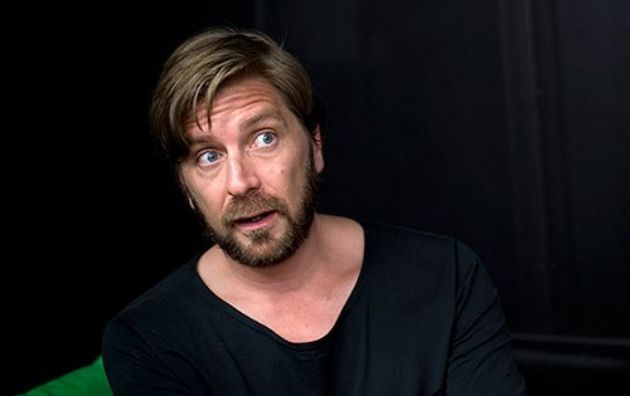
I had a chance to sit down with the director the day of the New York premiere of the film at the Film Society of Lincoln Center. Östlund, in person, was very friendly, easy going and eager to talk about anything from the role of modern men in society, Swedish humor, his influences to Seinfeld.

Your take on Swedish society really fascinates me. Your previous film, PLAY, was such an impactful, divisive film. How did FORCE MAJEURE originate?

Well, Play was very well regarded by critics in Sweden and pretty much all over where it was released. About Force Majeure, I have to go back 20 years. I used to make ski films, so I spent a lot of time in ski resorts. When I was accepted into film school, I left the ski world and went into the cinema industry. So I have been looking for a way to get back into that environment and use my knowledge about it. It's been hard, I mean, Play is raising questions that are existential and it's about human behavior in a wider perspective. To find a topic that takes place in a ski environment is quite hard to make existentially interesting.

But the idea of the avalanche came up in my mind: Tomas running away from his family in survival mode and coming back and facing his crushed self-image. It asks questions about a man's role in the family, expectations on gender roles in society from a behavioral perspective. So at that moment, I felt I could be able to do a feature that takes place in a ski resort, even though the idea of a film taking place in a ski resort is so kitschy- neon colors, people that are in control of their lives, have a lot of money and wear matching underwear and reflective shades and so on. So it all came with the idea of an avalanche.

Is it a normal destination for a Swedish family going on a ski trip in the Alps?

Yeah. A modern ski resort was created in the 50s in the Swiss Alps. They had an economical plan: over 30 year period, they set up 300,000 hotel beds in the mountain regions of Savoy. That changed the lifestyle of the whole of Europe, I would say. There was a growing middle class that had money to go on ski trips. It's quite common to go to the Alps.

Having seen your other films, I am wondering if Swedish society is a constant inspiration for your comedies.

Yeah I guess so. I think it comes across like that because I'm a Swede and the context and situations are reflected in Swedish culture. But in this film, I think that you can use the situation in almost every culture and you will have similar results. I think the expectations of a male is quite similar. I think it would be even stronger in North America because the context of a nuclear family is more pronounced. If you look at cinema history, it's all heroic men. It is so prevalent in Hollywood.

Sure, Bruce Willis, Liam Neeson, it's still very much 'father knows best'.

So it would be even more interesting to see it in an American context.

Yeah I can totally see the Hollywood remake of FORCE MAJEURE at some point.

The statistics of survival rates of major disasters that came with the press notes for this film were very interesting. I was quite surprised that the male survival rate is a lot higher than that of females, and of children. Is it safe to say that we as men, deep down inside, are all cowards? Is that what you are trying to say with this film, Ruben?

I think we all have ability in acting egoistic when it comes to crisis situation. And what happens with women, maybe they...it's hard to say it's biological or cultural, but men are more likely to abandon their kids. [laughs]

But what I really like about this is, if you look at the culture that we live in, we are brought up to think that we should stand up for our family if there was an outside threat. But when it comes to survival instinct, the culture is put away. Even though men have been conditioned to be loyal to their country, to their family, or to their football team or whatever, when it comes to survival instinct, all those things are put to the side. But the idea of men being loyal to something bigger, like a country, of course, we have to raise our young men to go to war and such. We are not looking at the film industry as an ideologue, but it's pretty obvious that it's producing a certain ideology about family, about the kind of politics that are used to make young men to be in the military.

What should we all have learned from the avalanche?

Well, I hope, everyone who saw the film would have a easier time confessing something they did that they are ashamed of. I know it's very very hard to confess because I think one of the things we humans are most scared of is to lose face. For example, if you look at the captain of Costa Concordia [shipwrecked on the coast of Italy in 2012], now dubbed as 'Cpt. Coward', famously said that he 'fell into the lifeboat'. He was trying so hard not to lose face, you know. I think it's very human behavior.

Because outside perspective we have on ourselves, I think that's something that sticks out in humans when compared to other animals. And that outside perspective also makes us very good in cooperating and it makes us very efficient. This is why we are such a successful species. But this fear of losing face is sometimes bigger than survival instinct. I think it's very interesting. You remember the principal who was on the South Korean ferry who abandoned his students in the fit of survival instinct. But then he killed himself to avoid losing face. And I think that's extraordinarily interesting that you decide to kill yourself when your instincts want you to survive.

FORCE MAJEURE is shot quite differently than your previous films. It's less formally vigorous than your other works; there are close ups and camera movements. I wonder how that came about?

Well I think there's a lot of drama that takes place inside the character this time. So I needed to step closer and focus on what's happening on the faces. That was also important when I was choosing the actors, because they had to be able to express what's going on inside on their faces. This is one of the reasons. Both Lisa Loven Kongsli [the wife, Ebba] and Johannes Bah Kuhnke [the husband, Tomas] have very expressive faces. But also, when I made Play, it was very hard to create dynamic scenes when I was editing it. The film consists of 42 static, wide shots, so we cut it after we premiered in Cannes.

Wow, I didn't know about that.

Because we didn't manage to do it in the best sense. This time I wanted to have more opportunity to be more dynamic and able to change the rhythm of the film- going fast to going very slow and deep whenever needed to.

Were you influenced by Roy Andersson? Because I can totally see his influence in your films.

Yeah sure, I mean, if you were brought up in the 70s in Sweden, you have his commercial films in your blood. So I guess he was much more influential to me than Ingmar Bergman was. We have been working with the same producer also [Philippe Bober, whose credit includes Songs from the Second Floor, and Ulrich Seidl's films]. Andersson is an extraordinary filmmaker. He is unique in perspective from all the directors in the world. I really love his kind of humor- his way of taking very trivial situations and treating them as deadly serious, I think it's beautiful.

There was another recent American film that dealt the same theme of male emasculation in the face of disasters called THE LONELIEST PLANET by Julia Loktev. Have you seen it?

No. But when we were preparing this film, people were telling me about that moment from the film, when he was trying to hide behind his girlfriend when threatened by a gunman but I've heard so many funny examples about the same kind of stories when I was talking about the avalanche situation.

A friend of mine told me about his friend who was supposed to have a bachelor party. They were doing a fake kidnapping on him. So, a bunch of them in ski masks and guns knocked on his door and when he opened the door, he was so scared he hid behind his fiancée. And they were supposed to get married like in 2 weeks. And they had a really hard time getting over that. And there is this episode of Seinfeld- when George Costanza is at a children's birthday party and the fire alarm goes off and he pushes away all the children and runs for the exit. [laughs] So there are some moments that remind us of the same kind of conflict and expectations of men.

I know that the avalanche seen from the terrace was shot on green screen. I read somewhere that you used CG in your other films. But I couldn't really place where.

For example when the kid was doing push ups... in Play, how do you say it?

Yeah, push ups.

He does like ten and stays still but in the film he does like 89 push ups or something. That was CG'd.

That's cheating.

[laughs] Oh and the beginning of Play, that surveillance shot with the camera panning? That's also one static shot that we manipulated.

My time is up. But thank you very much and have fun at the NY premiere tonight and LA Tomorrow.

Thank you.


Force Majeure opens Friday, October 24 in NY and LA. The film is Sweden's official Oscar entry this year.

Film Society of Lincoln Center just announced IN CASE OF NO EMERGENCY: THE FILMS OF RUBEN ÖSTLUND, January 14-22, 2015. Östlund will be in attendance to present the series.

Act of Cowardice

Force Majeure (2014) - Östlund
 photo f2746b63-1667-4260-84e9-4c443de1edfe_zps33273a3a.jpg
Formally less vigorous, Force Majeure is a departure for Östlund. Gone are the static long takes and distant wideshots, ala Roy Andersson style, it only focuses on one family and their immediate contacts in a luxurious ski resort up in the Alps. A well to do Swedish family, headed by handsome, Clark Kent jawed dad Tomas (Johannes Bah Kuhnke), mommy Ebba (Lisa Loven Kongsli) and two young blonde kids, is a picture perfect white family straight out of a Banana Republic catalog. The massive resort and ski area is well kept to a tee by daily ground maintenance and subject to 'controlled avalanches' (I'm guessing, to make snow fresh for skiers). On day two of their ski trip, a controlled avalanche comes down to where Thomas and his perfect family are having breakfast on the balcony. In blinding panic, Tomas flees the scene, leaving horrified family behind. But it turns out that the avalanche didn't reach where they were, just blowing some snow over them. It was no big deal. Tomas comes back, as if nothing has happened. But for his family, their inner peace is shattered, forever.

Östlund takes a crack at that concept of impenetrable masculinity. Tomas wouldn't admit the fact that he ran away- it's too unmanly to man up and admit his mistakes, and Ebba can't let go the fact that he is a sort of person who'd leave his family behind in time of disasters. If Julia Loktev's The Loneliest Planet examines the male's cowardliness on an individual scale, Force Majeure gives it a societal/familial context. The incident and subsequent talk gives Tomas's divorced friend (Kristofer Hivju) who is on the trip with a 20 year old girlfriend, a pause. Up in the mountains, the only choice to vent, for these scrubby and bearded manly men, is to scream from the top of the mountain (and risk another avalanche) or do a stag night with bunch of shirtless meatheads: drink, vomit while yelling at each other/at anything and repeat.

The question is, how does Tomas reclaim and show his family that assurance? Do we keep going with 'Daddy Knows Best' tradition, or go with 'Daddy Doesn't Always Know'? Do we admit that we are all scared shitless child inside, despite our manly exterior? Östlund seems ambivalent about the answer. Not that his other films are laugh out loud comedies, but I found Force Majeure more disturbing than funny.

Wednesday, June 29, 2011

I Hate Musicals

Sell Out! (2008) - Yeo
The Filmbegins with sultry Rafflesia (Jessica Lai) interviewing a Malaysian film auteur for her low end TV talk show called "For Art's Sake". The auteur is Yeo Joon Han (the director making a cameo) who just won the prestigious Young Overseas Chinese Women New Directors Honorary Mention Award at the Krychindangzhongbushaus Village Far Eastern Film Festival. When asked about why his almost silent indie art film "Love is Love and Nothing Else", is so slow and boring, Yeo, who appears in the nude for the interview (and seems very comfortable), vehemently defends the authenticity of his film by citing that in real life, nothing really happens, that no one actually breaks out into a song in the middle of it. He goes on even further, stating that people who make musicals should be chopped into 18 pieces!

This prologue shows director Yeo's mischievous intentions. Sell Out! is an all-out, over-the-top satirical musical romantic comedy where many things happen and people break out into songs, many times over. And it's uproariously funny.

After capturing her lovelorn boyfriend's death on camera where he recites his poem before he dies, Rafflesia comes up with a concept for the ever-popular reality TV - a televised death. This will surely show her pretty half-English rival who the boss is. The only problem is, she has to wait by the deathbeds until her sadsack subjects croak. A potential megahit in her hand but under the tight deadline, she has to find a more reliable subject very soon. What kind of deaths are predictable? Suicides.

Enter Eric (Peter Davis), an honest engineer who works for the same greedy conglomerate that Rafflesia works for, named, ahem, Fony Corporation. He is in a pickle because the clownish corporate bigwigs can't believe their ears when they hear his 8-in-1 soy bean machine is built so well, it won't break right after its warranty runs out. How can you make money out of the product that won't break down? This is followed by musical number, "Money". They end up exorcising Eric's creative 'dreamer' side out of him, But the exorcism goes wrong, resulting in two Erics - the dreamer and the practical. Deeply depressed by all this, the practical Eric comes up with a plan involving lovely but heartless Rafflesia.

Director Yeo jabs at many things with his ironic sense of humor - snobby art film scene, money hungry corporate culture, absurd reality TV shows and even Malay English (Manglish). The film's filled with horrible, insensitive jokes and people but in Yeo's hand, they never feel malicious.

Sell Out! caught me by surprise, since I didn't know what to expect watching my first Malaysian movie. It's a light romantic comedy version of Network set in bustling modern day Kuala Lumpur with its own karaoke singalong time built in for the audience. I haven't had this rib roaring good time watching a film in a long while.

Sell Out! will be screening as part of the 10th annual New York Asian Film Festival on Friday, July 1st and Monday, July 4th. You can find out more information at the NYAFF website.

Monday, November 22, 2010

Tony Chestnut (see the movie to get the joke!)

Mumsy, Nanny, Sonny and Girly (1970) - Francis
PhotobucketPhotobucket
Photobucket
Photobucket
The children, Sonny and Girly dressed in English school uniforms find homeless people in the park and bring them home, to Mumsy and Nanny, to make them family playmates. When their playmates break the rules, they send them to the angels. This nursery rhyme filled, giggly family slowly disintegrates when they bring home a new feisty friend.

Part Teorema and part Wicker Man, Mumsy and Co, features some of the most delicious dialog and bewitching Vanessa Howard as Girly who can sing Siamese National Anthem. Another great Brit class satire borne out of the clash of the traditional family values of the war generation and 60s free love/anti anything generation. Great fun.