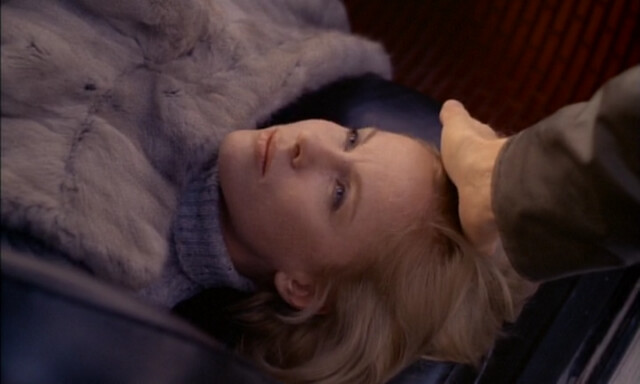
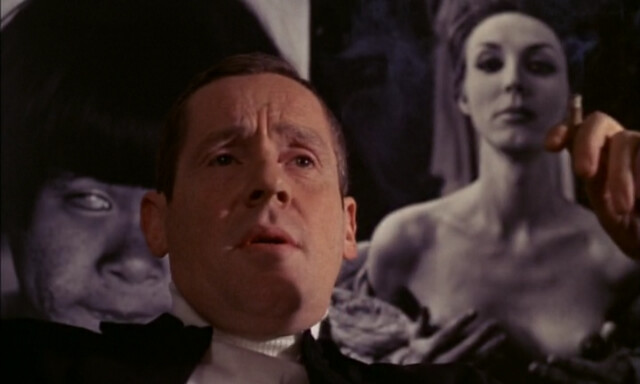
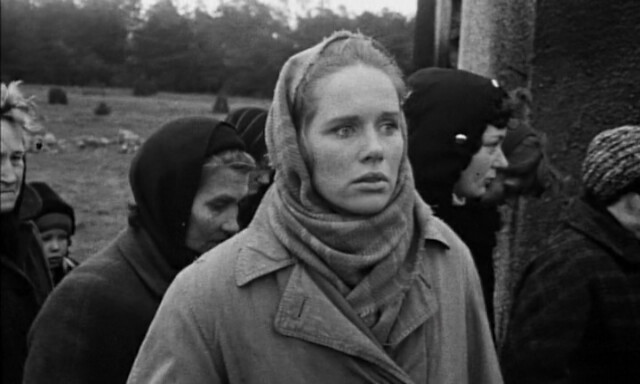
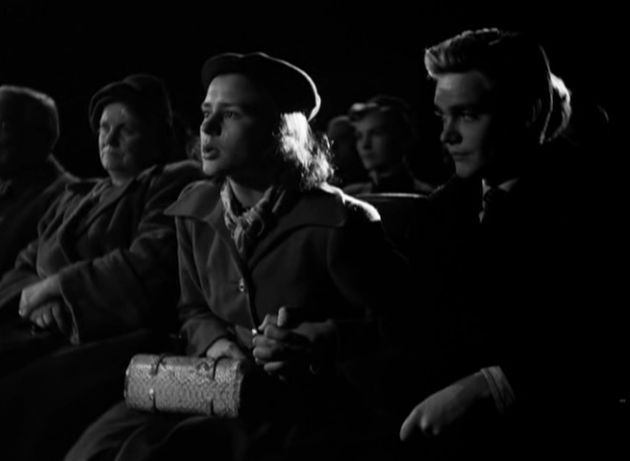
Showing posts with label Sweden. Show all posts

Wednesday, July 3, 2024

Strays

Paradiset brinner/Paradise is Burning (2023) - Gustafson Screen Shot 2024-07-03 at 10.51.56 AM Screen Shot 2024-07-03 at 9.14.25 AM Screen Shot 2024-07-03 at 9.20.19 AM Screen Shot 2024-07-03 at 9.21.06 AM Screen Shot 2024-07-03 at 9.29.14 AM Screen Shot 2024-07-03 at 9.55.16 AM Screen Shot 2024-07-03 at 9.57.07 AM Screen Shot 2024-07-03 at 10.06.20 AM Screen Shot 2024-07-03 at 10.19.02 AM Screen Shot 2024-07-03 at 10.30.22 AM Screen Shot 2024-07-03 at 10.36.59 AM In the tradition of kitchen sink realism of Andrea Arnold and Lynne Ramsay, Mika Gustafson's feature debut Paradise is Burning paints young sisters trying to survive in a Swedish working-class neighborhood. There's a teenager Laura (Bianca Delbravo), the oldest of the sisters and the head of the family and two preteens Mira (Dilvin Asaad) and Steffi (Safira Mossberg), running wild in a household without any parental supervision. Mom's gone since Christmas and dad was never in the picture. Steffi still wets the bed. She is teething and has a bad tendency to bring stray dogs (and sometimes street kids her age) home - there's a theme of strays throughout the film, Mira is having her first menstruation and getting an attention from a local drunk at the pub. To have the house in order, Laura is skipping school to take care of her younger sisters.

Things are tight, so Laura resorts, with the help of her sisters, to stealing clothes and food from their neighbor’s backyard cloth lines, laundromats, supermarkets and corner stores. She and her marauding strays/friends constantly break into rich people's houses to party and swim in their pools.

Laura befriends a bored housewife, Hanna (Ida Engvoll), when she escapes the police at one of such pool parties and ends up in Hanna’s house. Hanna finds Laura's lawless behavior fascinating. The young girl’s feral, seemingly free existence stir something inside her. Hanna suggests that she wants to tag along when Laura breaks into other people's houses. For Laura, Hanna is an obvious mother figure, constantly seeking her company. Their bond deepens. But it’s a lopsided affair. Obviously, Laura has a lot more at stake.

There’s a heartbreaking scene that shows Laura, however tough and carefree she presents herself, is still a child needing attention from an adult, as she waits Hanna’s phone call and how extremely delighted she gets when she receives them. It’s not a healthy relationship by any social, moral standards.

Laura hides the fact that social services are on their case from her younger siblings. She knows that like other neighborhood friends she knows, the social services will try to separate them and put them in different foster care facilities. She cannot let that happen. As the appointment for a visit from the social services approaches, Laura slowly breaches the subject to Hanna, of pretending to be their mom.

Gustafson gets phenomenal performances out of young actresses. Delbravo's Laura, a girl who's been put in a position to grow up fast is great, as is Asaad and Mossberg who play Mira and Steffi. They are utterly believable at playing close sisters who put enormous amounts of trust in one another. Paradise is Burning brims with vitality and emotional honesty seldom seen in teen/preteen films beautifully captured by Gustafson. A real stunner.

Things are tight, so Laura resorts, with the help of her sisters, to stealing clothes and food from their neighbor’s backyard cloth lines, laundromats, supermarkets and corner stores. She and her marauding strays/friends constantly break into rich people's houses to party and swim in their pools.

Laura befriends a bored housewife, Hanna (Ida Engvoll), when she escapes the police at one of such pool parties and ends up in Hanna’s house. Hanna finds Laura's lawless behavior fascinating. The young girl’s feral, seemingly free existence stir something inside her. Hanna suggests that she wants to tag along when Laura breaks into other people's houses. For Laura, Hanna is an obvious mother figure, constantly seeking her company. Their bond deepens. But it’s a lopsided affair. Obviously, Laura has a lot more at stake.

There’s a heartbreaking scene that shows Laura, however tough and carefree she presents herself, is still a child needing attention from an adult, as she waits Hanna’s phone call and how extremely delighted she gets when she receives them. It’s not a healthy relationship by any social, moral standards.

Laura hides the fact that social services are on their case from her younger siblings. She knows that like other neighborhood friends she knows, the social services will try to separate them and put them in different foster care facilities. She cannot let that happen. As the appointment for a visit from the social services approaches, Laura slowly breaches the subject to Hanna, of pretending to be their mom.

Gustafson gets phenomenal performances out of young actresses. Delbravo's Laura, a girl who's been put in a position to grow up fast is great, as is Asaad and Mossberg who play Mira and Steffi. They are utterly believable at playing close sisters who put enormous amounts of trust in one another. Paradise is Burning brims with vitality and emotional honesty seldom seen in teen/preteen films beautifully captured by Gustafson. A real stunner.

Wednesday, April 19, 2023

A Temple

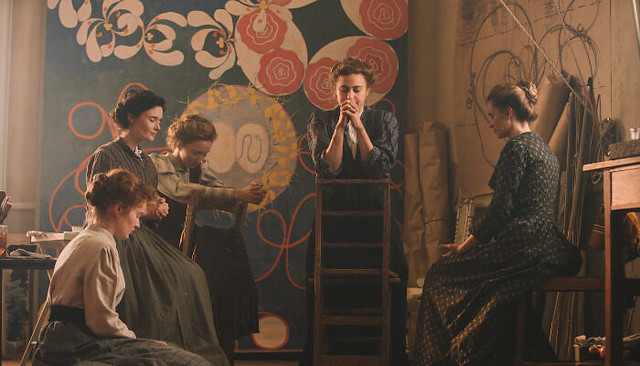
Hilma (2022) - Hallström Hilma 1 Hilma af Klint, a pioneering Swedish abstract painter whose work predates Kandinsky and Mondrian but forgotten in history until recently, gets a biopic from a fellow Swede, Lasse Hallström with his wife (Lena Olin) and daughter (Tora), playing the titular heroine young and old. And the seasoned director zeros in on the injustices she had to face because of her sex in a male dominent, still very patriarchal society in late 19th century. It starts with the death of her younger sister, which haunts her for the rest of her life as she becomes involved in spritiualism and the life-long friendship with 4 other women (known as 'the Five'). Hallström rightly suggests the painter's lesbian tendencies as she was never married and had close correspondences with Anna (Catherine Chalk).

Hilma soon finds the writings of a popular new age German philosopher of the time, Rudolph Steiner (Tom Wlaschiha), and meeting with him and getting his validation of her work becomes her life-long obsession. In telling her story, Hallström makes Hilma a proto-feminist, trailblazing artist, but at the same time, a victim of patriarchal society. She was an artist who wanted to find a meaning of life through art. But with her stunning work, she didn't need a validation from any men.

I personally got to experience af Klint's work at Guggenheim, aptly titled Paintings for the Future in 2019. Seeing her largely abstract work, in person, was an overwhelming experience: their enormity, geometric shapes and colors make long lasting impression. Her work- I could describe them as somewhere between colorful scientific charts and abstract celestial maps. Hallström connects the dots with af Klint's spiritual journey through her background - a curious, rebelious young woman who was interested in math and science, moving into painting in the hopes of communicating with the spirits and mapping out the universe to make sense of the world. Looking at her gigantic painting in one place, you really get the feeling that you are in a temple of some sort. And this is the fact that the film drives in with older Hilma (played wonderfully by Olin) trying to get a funding for a temple that she herself designed (which happens to be the spiral shape, like Guggenheim!) to exhibit her work in her later life.

Tora Hallström gives a great performance as a strong willed, spiritual woman who thought her abstract art was the result of the spirits working through her. Chalk's also great as Anna, who becomes a benefector/lover who finds Hilma's belief and spirit irresistable. Hilma the film is not revolutionary or anything. With its typical linear plot and timeline, it is rather an old fashioned, standard biopic. It does have some visual flaires with flashbacks and underwater scenes. But the most intriguing part of the film is definitely af Klint herself.
Monday, December 12, 2022

Oh Captain My Captain

Triangle of Sadness (2022) - Östlund Triangle of Sadness Good comedies are hard to come by these days. Ruben Östlund, riding the success of absurd satires like Force Majure and the Square, comes back with another over the top-class satire, with international cast, in Triangle of Sadness. He starts out with modeling tryouts with hunky Harris Dickenson (Beach Rats). At one point, a casting director tells him, “Why don't you lose that triangle of sadness between your eyebrows?" Yes, male modeling is easy to make fun of, as well demonstrated in Ben Stiller's Zoolander. But what's easier? Social influencers. They live off their good looks. They make the age-old meet and greet of asking 'what do you do for living?' completely obsolete. So, what would be the ultimate setting for a class satire? On a luxury cruise ship, of course.
So, a model Carl (Dickenson) and his influencer girlfriend Yaya (Charlbi Dean) gets invited to a luxury cruise filled with uber rich crowd. It's an old money and new money alike: a Russian fertilizer tycoon, an English arms dealer couple, a lonely internet security expert and Carl (Dickinson) and Yaya. There's a team of dedicated crew who waits on the customers hand and foot, to attend their every absurd demand - like stop everything they are doing and jump on the water slide on the side of the boat, to celebrate their class consciousness(?). There's a recluse, alcoholic, Marxist captain (Woody Harrelson) who finally emerges from his deck only to go mano a mano with the Russian on which is better- Capitalism or Communism, while looking up and exchanging memorable quotes from google. After a big storm with everybody's projectile vomiting and shitting subsides, the ship is hijacked by pirates and the ship sinks.

Only a few survivors wash up ashore in what seems like a remote island. The water and food supply are limited. Paula (Vicky Berlin) the yacht steward, tries to keep everything and everybody in order, but soon realizes that there is no hierarchy anymore. Abigail (Dolly De Leon), a Filipino crew member who oversaw cleaning the toilet, emerges to be the leader because she is the only one who knows how to start the fire, how to fish and she gets to decide who eats and doesn't. She soon chooses Carl to be her sexual pet.

The reversal of roles is cathartic and delicious, but short lived. Östlund let you not forget that we live in an overly developed world that capitalism took over every corner of the world that it can't be defeated that easily. The world of pretend, married to our phone and constant flux of information that we rely our identity on, will not let you go. With all that cringey funny business he is so good at, at heart, Östlund is true Haneke pupil. But whereas Haneke has courage to cut the cord/throat/head off, two-time Palm d'Or winning director doesn't, as the murky ending suggests. And just like the people onboard of the yacht, when the movie is over, we laugh and pat ourselves on the back because the ordeal's over and exit to the elevator.

Thursday, July 22, 2021

First Look 2020/21 at MoMI

After taking a Covid hiatus last year, MoMI (Museum of Moving Image)'s annual new film showcase First Look is back! Celebrating tenth year, First Look takes a peak at innovative new international cinema.

Opening Night is the NY premiere of Claire Simon’s The Grocer’s Son, the Mayor, the Village, and the World… and Closing Night is the NY premiere of Dash Shaw’s Cryptozoo.

First Look 20/21 presents 22 features and more than two dozen mid-length and short works from around the world, plus its signature “Working on It” sessions, which focus on the creative process. The festival runs from July 22nd through August 1st.

A special kick-off event for First Look 20/21 takes place at Green-Wood Cemetery in Brooklyn on July 19, with a screening of October Country featuring the world premiere of a live score by Michael Palmieri and Donal Mosher, co-presented with Rooftop Films.

The program comprises both documentary and narrative works, and live performances, with work hailing from countries including Belgium, Canada, Colombia, France, Georgia, Germany, India, Israel, Iran, Italy, Madagascar, Niger, Poland, Slovenia, South Africa, Sweden, Turkey, United Kingdom and the United States. More than half of the films are directed by women.

Please click on MoMI website for tickets and more info.

Below are what I was able to sample:

The Grocer's Son, the Mayor, the Village and the World... - Claire Simon *Opening Night Film grocers-son Filmmaker Jean-Marie Barbe has a vision for his hometown, Lussas, a rural farming community in Ardeché region of southern France. He wants to build a publicly funded independent film complex and a website dedicated exclusively to documentary filmmaking. It will be called Documentary Village of Lussas. It will be the source of attraction for jobs for the younger generation and local economy. Claire Simon of a direct cinema tradition, documents the trials and tribulations of people in Lussas - including Barbe, his team, the mayor, and local farmers taking a huge leap of faith.

Simon draws the parallels between farming - as a local farmer describes it as a huge gamble every year, where everything has to go right, that those produces people take for granted are nothing but a miracle, and Barbe's endeavor which might or might not bear any fruit. That everyone passionate in what they are doing is looking at things for the long term - for future generations. The Grocer's Son, the Mayor, the Village and the World... is an intimate and absorbing documentary with a lot of heart.


Ridge - John Skoog Ridge Taking place in Swedish farmland, Ridge examines loneliness and isolation of some immigrant farmhands and rural youth, not through dialog but controlled, wide screen visuals. The story goes that a couple of strayed cows became wild after spending some time in the ridge before they were found and brought back. The film's formalist approach - camera always slowly tracking and dollying in, gives you the ominous feeling that every move is watched, either from above or eye level and its subjects looking back suggests mutual consent.

Mingling our unprecedented technology era where everyone is isolated in his own sphere of smartphones, Ridge seems to suggest to take a trip to ever shrinking nature and enjoy the wilderness while we can.


Transnistra - Anna Eborn Transnistra Between Moldova and Ukraine, a long strip along the Dniester river, sits unrecognized breakaway state of Transnistria, where people seem to be carrying on the Soviet tradition and lifestyle. Anna Eborn, a Swedish born filmmaker follows a group of 16 year olds, consists of 5 horny boys and one girl, Tanya, from the hot days of summer to blistering winter in the rural setting as they swim in the lake, hang out in brick and mortar abandoned army barracks and tend to farm animals.

The 16mm shot documentary is intimate portrayal of friendship and love among the restless youth. Their fits of jealousy, envy, hate, euphoria as well as their hopes and dreams are all captured in sun-kissed imagery. It's a small pond story that is completely relatable and universal. Their fugu state of teen years where nothing is stable reflecting its status of their country is an apt one.


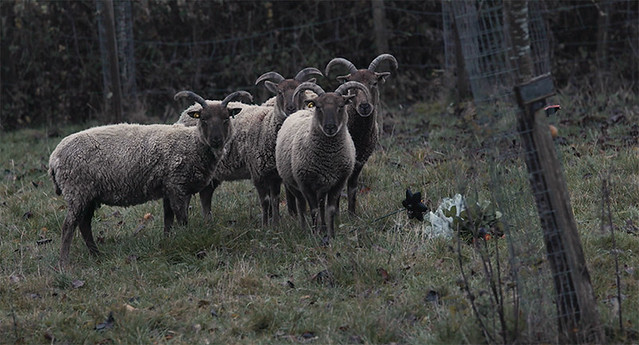
Some Kind of Intimacy - Toby Bull Intimacy As we grow older, it is inevitable to experience the death of our loved ones more and more. There might be differences in how we grieve, but the pain, and the heartache remain the same. And it is sometimes difficult to talk about how you feel. Toby Bull achieves some kind of intimacy or the fraternity of orphanhood in less than 6 minutes with his wonderful short film Some Kind of Intimacy. Through a simple phone conversation, while observing a flock of sheep trampling his parents grave in the rain, we get to contemplate our fleeting existence within the context of nature. Humor helps to dull the pain, so does shared collective melancholy.


Il mio corpo - Michele Pannetta Il Mio Corpo Sun drenched Sicily is both home for Oscar and Stanley - Oscar and his brother Roberto collects scrap metals on the side of the road under the watchful eye of their sometimes abusive father. Stanley, an African refugee, after getting a 2-year visa, stayed in Sicily and trying to eke out a living doing menial work for a local priest while helping his fellow refugee friend get his visa.

We see their daily routine simultaneously, slowly revealing what their lives are like. Il mio corpo is not unlike Gianfranco Rossi's Fire at Sea, another documentary that deals with the state of refugee crisis in the southern European country close to the African continent. But the film is much more subtle and poetic. We feel for these youngsters as they struggle in their own way, licking the bottom of the barrel in the late stages of global capitalism. Their brief, wordless encounters at the end gives hope that there's unspoken fraternity and cooperation in humanity in an ugly world.


Zinder - Aicha Macky Zinder Zinder is a city in Niger. It's known for violent youth gangs and delinquents. Director Aicha Macky is from there. And she gets an unprecedented access to the inhabitants of Kara Kara, the city's most dangerous slum. She interviews former members of palais, the youth gangs, and examine how poverty and unemployment perpetuate the unending macho culture. It starts with a jarring swastika adorned flag with 'Hitler' written on it: it's the flag of the bodybuilder's club calling themselves Hitler. They think Hitler is the name of an invincible warrior in America. Siniya Boy, the leader of the club, a former palais, is trying to build a security firm filled with fellow former gang members and friends who are currently in jail. Second chance in Kara Kara is hard to come by and the people of the slum are trying to help each other.

There is Bawo, a former gang member who is a pedicab driver. He confesses he had done some very bad things when he was young. NGO changed his outlook on things and now he is trying to help people in the city's red light district. Then there is Ramesses, a gas smuggler who overcame the stigma of being a hermaphrodite, trying to survive in Kara Kara just like everyone else.

Macky captures all these incredible stories in a seldom seen part of the world. It shows the survival and resilience of the human spirit. One of the most eye opening documentary I've seen in a while.

Saturday, July 4, 2020

Macho Dance

And Then We Danced (2019) - Akin
And then we danced
Tradition and love collide in a superb new film, And Then We Danced. Merab (Levan Gelbakhiani) is a dedicated dancer in National Georgian Ensemble, a prestigious and traditional Georgian dance academy under Aleko, a stern disciplinarian. Merab's estranged father was also a dancer who didn't see the future in the traditional dancing and now a mechanic. His delinquent brother David is also in the academy, but his foot is always half-way out the door. A new dancer Irakli (Bachi Valishvili), catches Merab's attention - his skills and masculinity, are well suited for rigidity of Georgian traditional dance, which Merab lacks (according to Aleko). Along with Merab's long time dance partner and childhood friend Mary (Ana Javakishvili), friendships blossom among them.

There is going to be an audition for a male dancer spot in the national dance team, vacated by a dancer who is accused of homosexuality and committed to a clinic. Naturally, Merab and Irakli are strong contenders for this audition. They practice hard while juggling jobs and family life. But their attractions to each other is growing. At the Mary's birthday party, Merab and Irakli make out. The forbidden affair takes hold of Merab, as it's his first love. Irakli disappears and David gets kicked out of the group. In despair, Merab injures his ankle during a practice run. At David's shotgun wedding, Irakli reappears, citing his absence to attending his dying father back home and a girlfriend he will probably need to marry for his father's wishes. And he will probably not come back to the academy. Now Merab is determined to express himself at the audition.

Anchored by Gelakhiani's stellar performance, And Then We Danced is a life affirming coming-of-age film and also a resistance film in the face of rigid and traditional society. Akin's portrayal of young loves and self-expressions are captured with pulse pounding energy and grace.

Friday, January 13, 2017

Vacillation

The Passion of Anna (1969) - Bergman
Screen Shot 2017-01-13 at 7.11.08 AM
Screen Shot 2017-01-13 at 7.12.27 AM
Screen Shot 2017-01-13 at 7.13.18 AM
Screen Shot 2017-01-13 at 7.14.03 AM
Screen Shot 2017-01-13 at 7.15.28 AM
The Passion of Anna is a difficult work. Bergman had always tussled with the bleak view on humanity, commented on how vile human relationships can be- that people go on living together for the sake of living together. But at the end, we all die alone. With his regular actors who were still contractually obligated to work with him after Shame and the set from it still left over, Bergman made this small but more abstract film that is supposed to be a sequel/companion piece. But where Shame shows how war degrades humanity, The Passion looks more inward to reach the same conclusion and the result is just as devastating. His disgust with humanity is loud and clear, no doubt brought on by the raging Vietnam War.

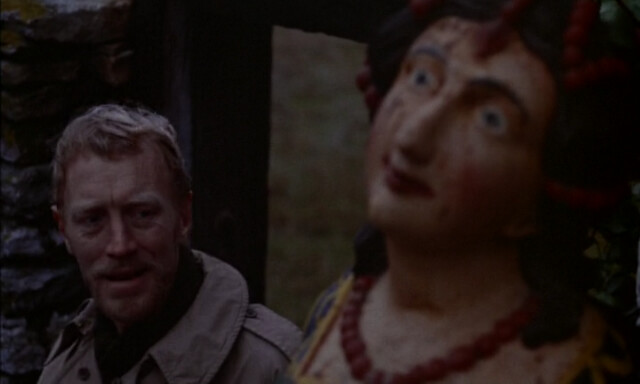
Andreas (Max Von Sydow) leads a solitary life in a rural island. He spends his time fixing his house and doing daily chores. His wife has left him long ago. Occasionally he screams to the cold Swedish air out of loneliness, but he seems to be content most of the time. One day, he lets in Anna (Liv Ullman), a friend of the neighbor couple Eva and Elis (Bibi Andersson and Erland Josephson) to make urgent phone call. He eavesdrops the conversation and looks through her bag and reads the letter from Anna's dead husband. Unlike her professing her love for her dead husband to anyone who listens, that her marriage was 'perfection', the letter tells the very opposite, her husband telling her that if they go on living together, it will end in psychological and physical violence.

Andreas hooks up with Eva, who in turn spills out her innermost thoughts- she has no thoughts of her own, no ambition and always following the lead of her intellectually superior, successful architect husband who seems to be away on business trips often. Elis's sarcasm and contempt for the world don't sit well with the other three. Being an amateur photographer, he laments on not being able to capture the human soul with his photos. But his clinical observation on humanity and how he sees it is obvious.

The passion is like Bergman's hit medley. His usual themes are all there, portrayed by four archetypes: Andreas - a vacillating coward caught between humanly desire and disgust, Anna - a guilt stricken, self-deceiving woman capable of intolerable cruelty, Eva - a naive, empty vessel trotting through doomed life and Elis - an arrogant, distant, soulless observer of humanity. The actors candidly talk about their characters in length on camera within the movie, as if in DVD extras.

Andreas then shacks up with Anna- the monotonous narrator tells us that they are living together without any passion. And we see them eating and talking like a normal couple. The union of necessities I suppose, to keep a warm body next to you. To have someone to talk to to alieviate loneliness.

Bergman, who found his home in remote Faro Island living in relative isolation and solitude while the raging war on the other side of the world is blaring on TV reminded him of the ugly humanity, reflects his sentiments in The Passion. The title is misleading since because Anna's passion of her past relationship is a bold faced lie. It questions if it will ever help Andreas, Anna and Eva go on their almost unbearable existence if they had it in the first place. The Passion ends with horrendous fistfight between Andreas and Anna, as predicted by the letter in the beginning, and Andreas literally walking back and forth, vacillating and collapsing under the weight of his own guilt and shame and desire both to be alone and be with someone.

Emotionally bare and structurally, technically jarring, The Passion of Anna is a deeply pessimistic, open wound of a film. Unlike his other depressing films I've seen, I failed to see the beauty in it.

Friday, June 5, 2015

Interview: Roy Andersson on Being Human

6
Roy Andersson, arguably one of the most singular voices in cinema and widely regarded as one who godfarthered that droll, deadpan 'Scandinavian Humor', has a new film out in 8 years and it's titled, A Pigeon Sat on A Branch Reflecting on Existence. If you are an Andersson fan like me, who's been waiting for 15 years for the conclusion of his 'Human Trilogy', you won't be disappointed. For the film's two week engagement at Film Forum and Lincoln Plaza Cinema here in New York City, the legendary Swedish director is in town and I was lucky to snag an interview.

In person, Andersson is nothing like the sad sack characters in his films. He is warm, extremely friendly and full of laughs. I really treasure those twenty minutes being with him.

*Andersson will be on hand for Q & A sessions for selected shows. Please check Film Forum website.

It took you 15 years to do 3 films. Why is it taking so long for you to make a film?

If it's any consolation, you can expect my new movie in 3 years.

Really?

Maybe 3 and a half.  This time I don't need a pause. Between those, I needed to pause. Obviously I don't need 7 years for production, but 3 and a half seems doable. Between those I do other things.  So the new one will be coming out in 2018. I hope, anyway.

Would it be something quite different than the three films we've seen?

Of course, the audience wants a surprise. But it is hard. It's taken a long time to cultivate that style so it's hard for me to find something better. I won't change it until I am sure that I can do something that is actually better. Maybe it will be wilder. More... whump, whump (pumps his fist in the air), surprising. (laughs)

The title of your new film: A PIGEON SAT ON A BRANCH REFLECTING ON EXISTENCE.  How did you come up with that?

It was actually very simple. I was looking at some Flemish paintings of the 17th century.

Bruegel?

Yeah. He always depicted daily lives of regular people in the village you know. It's always in every one of his paintings depicting outdoor scenes, that there is a bird sitting in a tree, looking down, observing whatever people are doing, perhaps wondering about their lives. Bruegel painted crows. I just changed it to pigeon. (laughs)

You've influenced a generation of filmmakers with your distinctive style and deadpan humor. Recently I had a chance to ask Ruben Östlund (Force Majeure) who takes a lot of element from your style, about your influence. He said that his generation grew up with watching your commercials and that you are more influential to a lot of people than Ingmar Bergman ever was. What do you think of these imitators?

It's OK to copy me. I've known people imitating my style, especially in commercials. Many people still come up to me and say, "I saw your new commercial." And it turns out that it is not by me. (laughs)

It's just not good enough in my eyes. They might have copied it very well, but its quality is not the same.

Obviously you have a very distinctive style. The look of your films remind me of great many painters from Bruegel, Goya to Ed Hopper. Are paintings where you draw your inspirations from?

From daily life, first and foremost, of course. I do get it from paintings, photographs and even films. But painting I should say is number one source. I wanted to be a painter when I was young. Well, I wanted to be many things- a musician, author and painter. It's good with film making because it combines all those elements and I'm happy to have found that as my profession.

What's fascinating about painting is that you can spend hours looking at them. But there are so few movie frames which have that quality.

Who are some of the painters that you like and draw inspirations from?

The last time I felt a kinship with the paintings was when I was looking at Otto Dix's painting. He works are very very special to me. Also George Grosz- same period as Dix, in Weimar era Germany. These guys were in WW1. They saw many terrible things in that war and it influenced their grotesque style. It's called Neue Sachlichkeit, the New Objectivity. What comes out of that is not only satire but the use of deep focus. I really hate to lose deep focus in my films. I want to have deep focus as far as I can get.

But now, today, the young generation of filmmakers, they seem to avoid using deep focus. They diffuse the background use shallow focus. It depends on not having enough money or not being patient enough. But I guess it cost a lot of money to afford what I do.

From WORLD OF GLORY to PIGEON's segment on 'The Weeping Machine'- heinous musical instrument, you are very critical of people's apathy and conformity. Do you still think people are capable of those things?

That scene is from real history. It was not a machine but a Roman emperor in 300 A.D. who constructed something called the Brazen Bull. It was a torture and executing device made out of bronze in the shape of a bull. You put the people there and set fire under it. Their cries would transform into music.

The scene is a metaphor for how people have been cruel to each other throughout history. It's also about exploitation. Nowadays you don't put fire under people but you exploit them brutally to death in economical means.

Your films are full of pale, ugly people. But you always portray young people as full of hope ever since your first film, SWEDISH LOVE STORY. Are you an optimistic person?


I hope I am optimistic. (laughs) I want to be optimistic. But I can't accept where the world is heading. I can't accept this brutal attitude toward other people, toward poor people, exploiting nature, exploiting other human beings. It's impossible to run the world like that and expect the future to be bright. All these problems we see now are the direct result of the shortsightedness. They plan for immediate profit and the results are unhappiness for both exploiters and exploited.

The saddest sight I can think of is a ninety- year old billionaire. Now, that's sad. (laughs)

Just like in Pigeon. The old man holding a gun in his grand office alone, telling he's OK on the phone.

Good that you noticed a gun. (laughs)

One scene that was really funny was 'Limping Lotta of Göthenberg'. What's the origin of that story?

It's based on a true story and it's also little bit of a myth. There were signs that she literally existed and ran a restaurant during war time. It was long before my time though. The song they sing has been popular for a long time. I remember as a child singing that song.  It goes, "ten cents for a shot and if you have no money you can pay with a kiss." I found the story very beautiful. It was during WW2 and soldiers didn't have money. I find Lotta very generous.  (laughs) That's why I included that scene.

The world you create in your films is so specific. It feels like it's suspended in time. Where is that coming from?

After I left realism, I was happy to find what I call abstracted, purified and condensed style. I regard myself as a universalist. I wanted to create universality, the timelessness in my films. So the challenge was how to show the timelessness?

For me it was growing up in the fifties in Sweden, when we created a, so-called Welfare Society. They built all these buildings for people with special colors in a special architecture. And that's my timelessness, roughly. I don't like people saying, "Oh, that's Sweden in the 50s." I want to say it's timeless. It's the same way that cartoons can be timeless and universal.

Do your films get better receptions from older audiences or younger ones?

It's strange. But younger people responds more to my films than older ones. It seems every time I come out with a new movie, I gain new set of young audiences.

Thursday, June 4, 2015

Bird's Eye View

A Pigeon Sat on a Branch Reflecting Existence (2014) - Roy Andersson
 photo apigeonsat_zpsbmjer02l.jpg
The final installment of Roy Andersson's 'being human' trilogy (15 years in the making!) doesn't quite conjure up the awe factor of his previous two films. But it's more or less the same - the ugly pale Swedes doing mundane things, masterful formalist approach, the driest black humor, acerbic wit, occasional beauty and contemplation. Again, we are introduced to tableaux of sad, tired looking people of the north in their habitats. Drab colors and absurd humor remain. The main characters in this is a couple of traveling salesmen in 'entertainment' business, trying to sell lame party gadgets- extra long fake vampire teeth, laugh bag and hideous 'uncle one-tooth' masks. They have a love/hate relationship - one's mean and the other a crybaby. People don't need to wear that Brugel-like masks because without masks, they are just as hideous.

There are a couple of disturbing sequences later on as the films repetitiveness get quite sleepy- involving a lab monkey and a giant musical instrument which Andersson reminding us that we are all capable of thinking up heinous things.

It starts with variations of mundane death. In death, we are all equal. But we are all equally miserable in Roy Andersson's films. I still loved it.

Thursday, December 4, 2014

Potent Indictment of Colonization of Africa and Its Aftermath

Concerning Violence (2014) - Olsson  photo 4b83902c-18de-4bf9-a778-55b728690872_zps6886afef.jpg
Whew, where do I begin....

Concerning Violence, a new stock footage documentary from Goran Hugo Olsson (Black Power Mixtape) is an extremely sharp indictment on the colonization and its aftermath of the African continent. The matter of fact headiness of Olsson's style may turn off some viewers in its college thesis paper dryness, but one can not deny its power of arresting images and portent words.

Borrowing the text of Frantz Fanon, a Martinique born controversial Afro-French thinker and revolutionary, from his book The Wretched of Earth and powerfully narrated by musician Lauryn Hill as the large white texts appear on screen, the film explains how Europe's five hundred years of exploitation and violent oppression led dehumanization of the whole continent.

Gayatri Chakravorty Spivak, a Columbia professor, opens the film in its preface, noting that Fanon's dissertation and books were rejected and criticized by the likes of Sartre as inciting violence against the colonizing oppressors. She urges us to read between the lines and acknowledge that under murderous colonizing power, the poor and the oppressed were forced to resort to violence in order for change to occur.

A long time admirer of Fanon, Hill came on board to narrate the film for Olsson after he sent her the texts and his idea for the documentary. Here she gives a strong, commanding oration to Fanon's fiery words.

Most of the of footage in the film comes from the Swedish TV archive from the 60s and 70s -- as was the case with Black Power Mixtape, Swedish TV seems to possess great wealth of black experience on film all over the world during that time -- and covers pretty much the whole continent, from Angola to Zimbabwe. The images are upsetting, unforgettable and revelatory. 

The film starts with an aerial view of the green field below and the African soldiers senselessly mowing down peacefully grazing cows, Apocalypse Now! style. Then close up of cow as it gets shot to death. The image is shocking and extremely upsetting. This is the legacy of Europe's ruthless colonialism over the continent. And one of the more unsettling images of the film is 'black venus' as Spivak calls it in the preface (she even criticizes the film of its inclusion): a young mother and her suckling baby. She is missing an arm (like Venus de Milo) and the baby is missing a leg, they are both victims of a bomb dropped by government forces. In my opinion, Olsson's fearless approach (and not shying away even from the criticism) is completely appropriate and commendable.

As most African countries gained their independence around the 60s and 70s, the film is a good time capsule; there are a lot of footage of white settlers being interviewed and expressing their views in changing political climates in their large homes with black servants and workers. There are also embedded war journalists filming the carnage of guerrilla wars on both sides. Even though The Wretched of the Earth was published (and subsequently banned) in 1961, Fanon's words are just as relevant today as it was then. In the film's hopeful conclusion, because Europeans, and in turn, Europe aping capitalist Americans, were so successful at dehumanizing the world, Fanon through the hopeful voice of Ms. Hill, calls all African comrades to find the new way to be 'whole human' and completely abandon European approach to build the new post-colonial world.

But Concerning Violence is most impactful when one reflects on the current state of Africa -- kidnappings by Boko Haram and the siege of Timbuktu, and realizes that the death grip of colonialism on the continent is still very hard to pull away from. Along with Joshua Oppenheimer's The Look of Silence, Concerning Violence is one of the best and most potent documentaries I've seen this year.

Concerning Violence is a Kino Lober release. It opens 12/5 at IFC Center, New York

Thursday, October 23, 2014

Men versus The Avalanche: Ruben Östlund on Force Majeure

 photo 1ff8bba8-f19d-4e82-abf4-0a7dcf84df8e_zpsc1bc5bf2.jpg
Swedish filmmaker Ruben Östlund's new film Force Majeure, a wickedly funny jab at modern masculinity, garnered a lot of buzz as it made the rounds on festival circuit. It has earned its fair share of love from the Twitch community as well (read Ryland Aldrich's review from Fantastic Fest here).

I had a chance to sit down with the director the day of the New York premiere of the film at the Film Society of Lincoln Center. Östlund, in person, was very friendly, easy going and eager to talk about anything from the role of modern men in society, Swedish humor, his influences to Seinfeld.

Your take on Swedish society really fascinates me. Your previous film, PLAY, was such an impactful, divisive film. How did FORCE MAJEURE originate?

Well, Play was very well regarded by critics in Sweden and pretty much all over where it was released. About Force Majeure, I have to go back 20 years. I used to make ski films, so I spent a lot of time in ski resorts. When I was accepted into film school, I left the ski world and went into the cinema industry. So I have been looking for a way to get back into that environment and use my knowledge about it. It's been hard, I mean, Play is raising questions that are existential and it's about human behavior in a wider perspective. To find a topic that takes place in a ski environment is quite hard to make existentially interesting.

But the idea of the avalanche came up in my mind: Tomas running away from his family in survival mode and coming back and facing his crushed self-image. It asks questions about a man's role in the family, expectations on gender roles in society from a behavioral perspective. So at that moment, I felt I could be able to do a feature that takes place in a ski resort, even though the idea of a film taking place in a ski resort is so kitschy- neon colors, people that are in control of their lives, have a lot of money and wear matching underwear and reflective shades and so on. So it all came with the idea of an avalanche.

Is it a normal destination for a Swedish family going on a ski trip in the Alps?

Yeah. A modern ski resort was created in the 50s in the Swiss Alps. They had an economical plan: over 30 year period, they set up 300,000 hotel beds in the mountain regions of Savoy. That changed the lifestyle of the whole of Europe, I would say. There was a growing middle class that had money to go on ski trips. It's quite common to go to the Alps.

Having seen your other films, I am wondering if Swedish society is a constant inspiration for your comedies.

Yeah I guess so. I think it comes across like that because I'm a Swede and the context and situations are reflected in Swedish culture. But in this film, I think that you can use the situation in almost every culture and you will have similar results. I think the expectations of a male is quite similar. I think it would be even stronger in North America because the context of a nuclear family is more pronounced. If you look at cinema history, it's all heroic men. It is so prevalent in Hollywood.

Sure, Bruce Willis, Liam Neeson, it's still very much 'father knows best'.

So it would be even more interesting to see it in an American context.

Yeah I can totally see the Hollywood remake of FORCE MAJEURE at some point.

The statistics of survival rates of major disasters that came with the press notes for this film were very interesting. I was quite surprised that the male survival rate is a lot higher than that of females, and of children. Is it safe to say that we as men, deep down inside, are all cowards? Is that what you are trying to say with this film, Ruben?

I think we all have ability in acting egoistic when it comes to crisis situation. And what happens with women, maybe they...it's hard to say it's biological or cultural, but men are more likely to abandon their kids. [laughs]

But what I really like about this is, if you look at the culture that we live in, we are brought up to think that we should stand up for our family if there was an outside threat. But when it comes to survival instinct, the culture is put away. Even though men have been conditioned to be loyal to their country, to their family, or to their football team or whatever, when it comes to survival instinct, all those things are put to the side. But the idea of men being loyal to something bigger, like a country, of course, we have to raise our young men to go to war and such. We are not looking at the film industry as an ideologue, but it's pretty obvious that it's producing a certain ideology about family, about the kind of politics that are used to make young men to be in the military.

What should we all have learned from the avalanche?

Well, I hope, everyone who saw the film would have a easier time confessing something they did that they are ashamed of. I know it's very very hard to confess because I think one of the things we humans are most scared of is to lose face. For example, if you look at the captain of Costa Concordia [shipwrecked on the coast of Italy in 2012], now dubbed as 'Cpt. Coward', famously said that he 'fell into the lifeboat'. He was trying so hard not to lose face, you know. I think it's very human behavior.

Because outside perspective we have on ourselves, I think that's something that sticks out in humans when compared to other animals. And that outside perspective also makes us very good in cooperating and it makes us very efficient. This is why we are such a successful species. But this fear of losing face is sometimes bigger than survival instinct. I think it's very interesting. You remember the principal who was on the South Korean ferry who abandoned his students in the fit of survival instinct. But then he killed himself to avoid losing face. And I think that's extraordinarily interesting that you decide to kill yourself when your instincts want you to survive.

FORCE MAJEURE is shot quite differently than your previous films. It's less formally vigorous than your other works; there are close ups and camera movements. I wonder how that came about?

Well I think there's a lot of drama that takes place inside the character this time. So I needed to step closer and focus on what's happening on the faces. That was also important when I was choosing the actors, because they had to be able to express what's going on inside on their faces. This is one of the reasons. Both Lisa Loven Kongsli [the wife, Ebba] and Johannes Bah Kuhnke [the husband, Tomas] have very expressive faces. But also, when I made Play, it was very hard to create dynamic scenes when I was editing it. The film consists of 42 static, wide shots, so we cut it after we premiered in Cannes.

Wow, I didn't know about that.

Because we didn't manage to do it in the best sense. This time I wanted to have more opportunity to be more dynamic and able to change the rhythm of the film- going fast to going very slow and deep whenever needed to.

Were you influenced by Roy Andersson? Because I can totally see his influence in your films.

Yeah sure, I mean, if you were brought up in the 70s in Sweden, you have his commercial films in your blood. So I guess he was much more influential to me than Ingmar Bergman was. We have been working with the same producer also [Philippe Bober, whose credit includes Songs from the Second Floor, and Ulrich Seidl's films]. Andersson is an extraordinary filmmaker. He is unique in perspective from all the directors in the world. I really love his kind of humor- his way of taking very trivial situations and treating them as deadly serious, I think it's beautiful.

There was another recent American film that dealt the same theme of male emasculation in the face of disasters called THE LONELIEST PLANET by Julia Loktev. Have you seen it?

No. But when we were preparing this film, people were telling me about that moment from the film, when he was trying to hide behind his girlfriend when threatened by a gunman but I've heard so many funny examples about the same kind of stories when I was talking about the avalanche situation.

A friend of mine told me about his friend who was supposed to have a bachelor party. They were doing a fake kidnapping on him. So, a bunch of them in ski masks and guns knocked on his door and when he opened the door, he was so scared he hid behind his fiancée. And they were supposed to get married like in 2 weeks. And they had a really hard time getting over that. And there is this episode of Seinfeld- when George Costanza is at a children's birthday party and the fire alarm goes off and he pushes away all the children and runs for the exit. [laughs] So there are some moments that remind us of the same kind of conflict and expectations of men.

I know that the avalanche seen from the terrace was shot on green screen. I read somewhere that you used CG in your other films. But I couldn't really place where.

For example when the kid was doing push ups... in Play, how do you say it?

Yeah, push ups.

He does like ten and stays still but in the film he does like 89 push ups or something. That was CG'd.

That's cheating.

[laughs] Oh and the beginning of Play, that surveillance shot with the camera panning? That's also one static shot that we manipulated.

My time is up. But thank you very much and have fun at the NY premiere tonight and LA Tomorrow.

Thank you.


Force Majeure opens Friday, October 24 in NY and LA. The film is Sweden's official Oscar entry this year.

Film Society of Lincoln Center just announced IN CASE OF NO EMERGENCY: THE FILMS OF RUBEN ÖSTLUND, January 14-22, 2015. Östlund will be in attendance to present the series.

Act of Cowardice

Force Majeure (2014) - Östlund
 photo f2746b63-1667-4260-84e9-4c443de1edfe_zps33273a3a.jpg
Formally less vigorous, Force Majeure is a departure for Östlund. Gone are the static long takes and distant wideshots, ala Roy Andersson style, it only focuses on one family and their immediate contacts in a luxurious ski resort up in the Alps. A well to do Swedish family, headed by handsome, Clark Kent jawed dad Tomas (Johannes Bah Kuhnke), mommy Ebba (Lisa Loven Kongsli) and two young blonde kids, is a picture perfect white family straight out of a Banana Republic catalog. The massive resort and ski area is well kept to a tee by daily ground maintenance and subject to 'controlled avalanches' (I'm guessing, to make snow fresh for skiers). On day two of their ski trip, a controlled avalanche comes down to where Thomas and his perfect family are having breakfast on the balcony. In blinding panic, Tomas flees the scene, leaving horrified family behind. But it turns out that the avalanche didn't reach where they were, just blowing some snow over them. It was no big deal. Tomas comes back, as if nothing has happened. But for his family, their inner peace is shattered, forever.

Östlund takes a crack at that concept of impenetrable masculinity. Tomas wouldn't admit the fact that he ran away- it's too unmanly to man up and admit his mistakes, and Ebba can't let go the fact that he is a sort of person who'd leave his family behind in time of disasters. If Julia Loktev's The Loneliest Planet examines the male's cowardliness on an individual scale, Force Majeure gives it a societal/familial context. The incident and subsequent talk gives Tomas's divorced friend (Kristofer Hivju) who is on the trip with a 20 year old girlfriend, a pause. Up in the mountains, the only choice to vent, for these scrubby and bearded manly men, is to scream from the top of the mountain (and risk another avalanche) or do a stag night with bunch of shirtless meatheads: drink, vomit while yelling at each other/at anything and repeat.

The question is, how does Tomas reclaim and show his family that assurance? Do we keep going with 'Daddy Knows Best' tradition, or go with 'Daddy Doesn't Always Know'? Do we admit that we are all scared shitless child inside, despite our manly exterior? Östlund seems ambivalent about the answer. Not that his other films are laugh out loud comedies, but I found Force Majeure more disturbing than funny.

Wednesday, October 22, 2014

Force Majeure Actor Johannes Bah Kuhnke on Being a Coward

 photo 2cca8dca-b079-40d5-8d76-aa3ceb7b7f28_zpsb06b6929.jpg
Johannes Bah Kuhnke, the hunky lead in Ruben Östlund's biting Swedish comedy Force Majeure, was in town to promote the film along with his director. I had a chance to chat briefly with the actor who plays a character carrying the burdens of all men.

I know you are mainly known as a stage actor. How did you get involved in this project?

Well, a casting agent called me and she wanted to set up a meeting with me and Ruben. So I went in and we started talking and I must've been the last one because we were talking for three hours. He finally looked at the watch and said, "Wow, we have to record something (for audition)". But then I knew I had this connection with him.

Have you seen any of Ruben's other films before you met him?

I've seen Involuntary.

Also very uncomfortable comedy.

Yeah. When I saw it, what I liked about it is that there are so many different ways to see that film. Everyone has a different reaction to his films.

What did you think about FORCE MAJEURE when you first read the script?

I was trying to get at what it was about. We talked a lot about that. In a way I was hungry for playing something more complicated because despite of my age (42), I always get to play young lover types- uncomplicated, good looking. A man that women fall in love with. So I've been longing for this kind of role so much.

Nomally, in acting, you play a better version of yourself - more beautiful, smarter, sexier, more evil, something more attractive. This part was definitely the most unattractive side of yourself or in other people.

Are all Swedish men cowards?

[laugh] The film shows that every man in the world is a coward. If you saw the statistics in disasters, more man survive than women or children, not only because they are stronger, but they can be egoistic. There is the code of honor- 'Women and children first'. But as it turned out in Titanic, it was enforced under threats. There were guards with guns enforcing that.

Why Tomas would deny what happened?

I think that's where I don't agree with Tomas. You can act in such a way but if you face it, you are not weak. But I think it's also got to do with their relationship, their lack of communication.

When Ebba first breaks the silence is when she had a couple of glasses of wine in front of everyone. He then tries to save his ass and makes up lies that comes out of nowhere. He can't step back. He thinks that it will just pass. But it doesn't and he gets deeper into trouble.

You think there is a back story where things weren't going well with the couple even before they took the trip?

Some people who watched the film think they have a dysfunctional marriage but I think they are as normal as they can be. They are married for ten years. There are not many surprises left. You know they need to change the marriage bow - from "'Til the death do us part" to "Til you're bored to death do us part".

JB kuhnke crying.jpgVery true, very true.

The scene where you break down and cry outside the hotel room and Ebba says, "you are not even really crying," and you start crying for real, like a baby, really interests me.

I think in the beginning he's trying to communicate with her. He just cry as a form of communication but it doesn't work. So the pressure is built up so much it just bursts out: that he was unfaithful and everything comes out. But I think that was kind of...catharsis for him. But he doesn't really take good care of the situation. It doesn't really lend very well to the situation. Because we have this idea of men crying in the movies: you usually see a stone faced man and a strand of tears rolling down on his cheeks and straight after that, there is some big decision that needs to be made. But we really want to make the scene really really over the top. I also found an inspirations on youtube- "worst man cry ever" and different daytime TV talkshows.

You did a great job!

I remember in theater school that there is a task when you do a scene in Macbeth where you wash the blood off your hands. You don't start out with freaking out and screaming, "Blood!" but you do it with "oh there is a blood on the tip of my finger, let me get rid of it, then "oh it's not coming off, let me wash it off," to "oh no it's all over my hand and I can't scrub it off!" You can find the right moments and right emotions and  build up until you can push very far to go over the top.

It struck me as a little boy crying.

Why wouldn't you cry like that now? What's the difference? Some social code?

Probably.

It's this portraiture of male that is engrained in us by films and all.

Right. You don't want anybody see you crying. It's too vulnerable.

So, you are vacationing with your family and there is a catastrophe. What do you do?

Well, I'm not trained for those things so I don't know how I would react. But according to statistics, I would run. But I do hope that I could be strong enough to reveal my weaknesses. The problem with Tomas is that he can't live with the picture of him being like that.

It's one of those movies you take your date to see and make men very uncomfortable. I'm wondering what your wife thought about it and your performance.

Well...she despises Tomas. [laughs] That's funny because women despises male weakness and men gets aggressive on male weakness. There is no place for male weakness in our society, the structure that we built. There are some men who prefer weak women but I never met a woman who wants to be with weak men.

It's true.

I think it's also the problem in this society to be happy all the time. You see face book and instagrams of all these happy smiling faces and perfect life. You want to be a role model for your children but then you stop being a human being. You are in fact, acting in real life to give the expression that you are feeling good.

So at the end, when she asks if he smokes and he says he does, I think it's a kind of happy ending because he lends himself to be more human, that he is not perfect.

Would you work with Ruben again?

Yeah, we've been talking about doing something.

Could you tell me a little bit about it?

We had one project before...it was based on an idea of a monk. There will be 12 actors playing monks, stark naked for three hours but it didn't really happen. There is another one that we've been talking about but I need to catch up with him to see where it is.

Force Majeure opens Friday, October 24 in NY and LA. The film is Sweden's official Oscar entry this year.

Saturday, October 11, 2014

Politically Incorrect but Correct Nonetheless

Play (2011) - Östlund
 photo 0ab4b6c7-24dd-4bbf-b56b-1027579eed42_zpsfc74c05b.jpg
I remember mentioning in my short observations of Östlund's Involuntary (De Ofrivilliga) that there are many moments that only Swedes would find humorous. But in Play, it's more universal because it concerns race. I can totally understand why Play has never come out (and played) in the States. It would've been automatically grilled by the PC dominated left and quickly condemned as racist. This is why daring Northern European filmmakers, Ulrich Seidl, Michael Haneke and now Östlund can tackle the subject of race in their much more homogenized but socially rapidly changing home countries while we Americans, avoid the subject like ebola. At first glance, Play is downright racist and uncomfortably so - two white kids and an Asian boy, probably from a well to do families at the shopping mall are ganged up and mercilessly bullied by 5 black kids who are little older than them. These loud and obnoxious black kids, set up a trap (it seems it's their routine), asking to see their intended victim's phone and claim that phone is the same phone stolen from someone they know. In order to verify this fact, the victims should come with them and eventually being tricked into giving away all their belongings. In fear, the white kids follow them, like sheep.

Östlund's display on the rigid society gripped with fear of being seen as politically incorrect is everywhere - from American Indian culture appropriation by a group of South American street musicians in full getups and their Swedish spectators, mouth agape and don't know what to make of the spectacle, train conductor's extremely polite announcement (and later their decision to make announcement in English) of removing a huge wooden crib that's blocking the doors in between first and second class cars, Cafe owners' hesitation to call the cops against the black kids 'until big things happen' and so on.

Just like Involuntary, Play is a constant cringe fest. It's uncomfortable because he puts up the mirror on our polite selves. Östlund refuses to show the black kids in better light. "Society made them that way," would be a way too simple explanation. They act violent and obnoxious because they can get away with it. They are playing the stereotypical role that white privileged folks put on them. They taunt on white folks' appropriation of 'black' culture as wide-ranging as from dreadlocks to Lion King themed school dance. Ordinary Swedish citizens don't know how to deal with them other than look down at their feet or call law on them. They don't know how to interact face to face with these peeps. Funny but pointed and not all the way successful, Play, just like Seidl's Paradise Trilogy, is an interesting film that needs to be seen widely and being discussed further.

Monday, August 11, 2014

Burning Down the House

Offret/The Sacrifice (1986) - Tarkovsky
 photo 9d6648d9-c1bd-4500-812f-c47249d1a841_zps4f24fdd2.png
 photo 423d65db-6e22-47cd-8d56-d5c183855b85_zpseb40ce6d.png
 photo 285daa72-7792-40dc-8ae5-6b680e2bfecf_zps8f4a8118.png
 photo 41c58b49-3339-4d00-ad02-cc05ad915248_zps75dbdad1.png
 photo 3158e1dc-f83f-4261-941c-58dcc3d85cf0_zps677f37c7.png
 photo 3b3ab71c-e77f-4a5c-b2be-7e9a47fe12e3_zps7cc2331d.png
 photo c1a025e0-3774-4790-98c0-10b4adaae4bd_zpsed6d74b1.png
 photo e5960e45-19a6-4169-be93-9cf26685e87a_zps9444dd69.png
 photo 9017a195-13e4-4696-9b43-edaaa8fca048_zpse31edc3c.png

It's Alexander (Ingmar Bergman regular Erland Josephson)'s birthday. He and his young son plants a leaveless, twisty tree. He tells the son that even the ordinary actions, done them time and time again, brings a change in the world. Not a religious man, Alexander argues with a local postman and Nietzsche quoting Otto (Allan Edwall of Fanny och Alexander). As the day wears on, dinner is getting set up for his birthday at his house by the ocean attended by his wife, teenage daughter, son, his doctor friend and the wife's lover, Otto and two servant girls. But just before dinner, they are startled by sonic jet flying over and distant booms. It's the end of days. Nowhere in Europe is safe, stay at home, the radio announcer says in a grim voice.

Alxander, gripped with fear for all humanity, prays to god that he will give up anything to save the mankind. Otto sneaks in and tells Alexander that he has to lie with Maria, a sullen, saintly foreign servant, in order to save the world. He does so on her levitating bed.

The Russian master's last film is a beautiful religious parable. Dreamlike, meditative, all encompassing work. The uninterrupted climax scene of Alexander burning down the house is perhaps the master's finest technical feat and a true cinematic tour-de-force. And it's a hopeful one. It ends with the young son watering the tree as Maria looks on.

Shot by the great Sven Nykvist (yet another Bergman cohort), The Sacrifice is a fitting finale for illustrious filmmaker who wanted to elevate film's status to other art form, that of painting and music.

Thursday, May 29, 2014

Brezhnev and Reagan, Fuck Off!

We are the Best! (2013) - Moodysson
 photo 9be62125-a01c-4ef3-b2d9-8c9e0366e53b_zps45f283d5.jpg
Two 13-year old tomboys, Bobo and Klara listen to punk, hate their sports loving classmates and think their parents are super lame. After seeing some rude old geezers practicing yucky rock songs at a local youth center (thank goodness for socialist country), they spontaneously set out to form a punk band out of spite. But they don't know how to play any instrument and still want to maintain the time slots they signed up for so the old geezers won't get to play.

Then they see Hedvig, a blonde, christian good girl who has been playing classical guitar at the school talent show to unresponsive, downright rude audiences, year after year. Hedvig doesn't have any friends. Bobo and Klara decides to forcibly make her join the group. She is an awesome guitarist and teaches them how to play bass and drums. They cut Hedvig's hair off despite her mom's protest. But Hedvig comes around voluntarily. Despite her strict Christian upbringing, she likes being in a punk band. Together, they compose a song with catchy lyrics like "Hate the sport, hate the sport!", "Brezhnev and Reagan, fuck off!"

Now they need money for an electric guitar. But after begging for change on the street with some corny "my parents are drunks and we are starving," sob stories, they decide to spend the collected money on candies and ice cream instead.

Then there is the first crush. There is this punk band they like. More extroverted Klara calls them up and arrange a meeting. Elis, the lead singer of the band is very cute. Just like any other music band dynamics, they go through jealous fits and leadership conflicts and bring the group to the inevitable brink of breakup. All things come down to a chance to perform at some lame school gym concert in the suburbs. Would it be a total riot or total riot?

Lukas Moodysson, after plunging into hard-hitting downers like Lilya 4ever and A Hole in My Heart, goes back to what he knows and does the best - truthful, tender depiction of (pre)teen world. Just like his amazing debut, Fucking Åmål and based on a graphic novel Never Goodnight by his wife Coco, Moodysson showcases his penchant for naturalistic dialog and capturing the concerns of the world of pre-adolescent girls and the spirit of punk so acutely. It's the feel good movie of the year.

We Are the Best! opens May 30 in New York and LA. Visit Magnolia Pictures website for more information.

Wednesday, May 14, 2014

Best Coming Out of the Closet Moment

Fucking Åmål/Show Me Love (1998) - Moodysson
 photo d60a92a9-d199-4ee4-a27c-299878062b15_zps948814f6.jpg
So this is where it all started eh? For some reason I always thought this Swedish coming of age tale involved fucking some guy named Amal. Not so. Åmål is a small Swedish town where the film takes place. It's like, "I live in this small ass town where everyone's so fucking boring. Man, fucking Åmål!" kind of thing. Shot on grainy 16mm, Fucking Åmål tells a sweet teen lesbian love story.

Agnes is a lonely girl with no friends. But she is crushing heavily on a blonde bombshell bad girl, Elin. Tired of all the wrong attentions she gets everyday, Elin is easily irritable and gets into physical fights with her older sister Jessica all the time. It's Agnes's 16th birthday and her parents wants her to invite people for the party. Her clueless parents even cooks up the storm for it. Only person who shows up is a girl on a wheelchair whom Agnes hates. Elin decides on a whim to show up at the party late, because the other party is filled with immature, gross jocks. On a dare, drunken Elin kisses Agnes and takes off. But even with bad behavior and popular girl persona, deep down Elin is a good girl who feels bad for what she's done. She comes back and they try to hitchhike to Stockholm where things must be much more fun. They end up making out in a back seat of a car that belongs to a creepy old stranger who stops to pick them up.

There is rumor going around that Agnes is a lesbian. Elin has to keep a distance from Agnes and pretend to like the boy who's been stalking her just to keep up the appearance. After another sucky experience with the mindless, boring boys, Elin realizes that she is also in love with Agnes who seems to be a lot more intelligent and interesting. Fucking Åmål is a sweet, acutely observed, intimately portrayed teen movie with a great heart. It features best coming out of the closet moment in movie history.

Monday, December 2, 2013

War, What is it Good for?

Shame (1968) - Bergman
 photo 9305be3e-8125-4863-9cd8-d455e96699db_zps0887b2f1.jpg
Jan (Max von Sydow) and Eva (Liv Ullman) are a childless couple living rustic life in an island. Through their conversation it is revealed that they are former musicians in an orchestra before it was disbanded, presumably, because of the looming war. It also seems that the couple's having some marital problems. Eva wants a baby but Jan doesn't. Eva loathes Jan's passivity and escapist tendencies. The war comes roaring in with jet planes and bombs. The war- destructions, dead bodies, fire, threats, media manipulation..., brings the worst in the couple and heightens the rift between them. The life of the couple is turned upside down, inside out, thoroughly exploited and exhausted by both sides of the fence.

I've never seen the horrors of war this frightening in b&w. The fear and anxiety Bergman, von Sydow and Ullman bring to the screen are amazing. Shame is a complex anti-war film. The setting, its fuzzy time frame are almost expressionistic against realistic performances of the actors. It denounces war, any war and shows how it sucks humanity out of normal people. And what an ending- as they aimlessly float in purgatory treading through full of dead corpses, Eva recites a rather erotic dream. She says she tried to remember something somone had said, not remembering that pleasurable moment. Art is dead (as indicated in Jan's dream that starts the film), love is dead, all that is left is shame of losing them.

Tuesday, June 18, 2013

Paradise Lost, Again

Summer with Monika (1953) - Bergman Image
Image
Image
Image
Image
Image
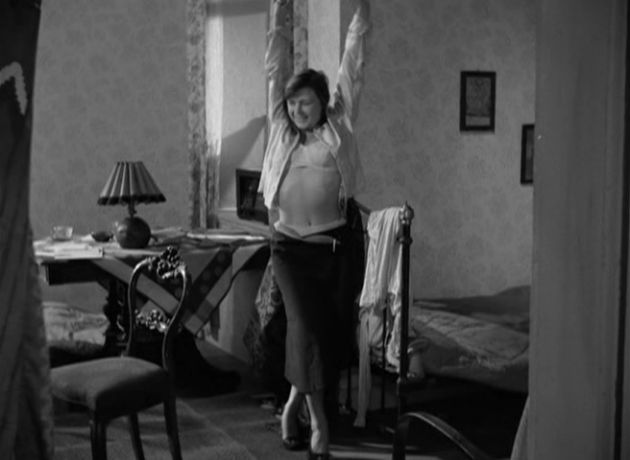
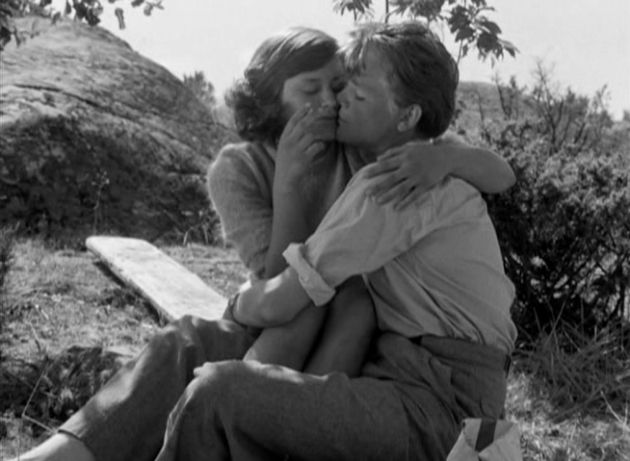
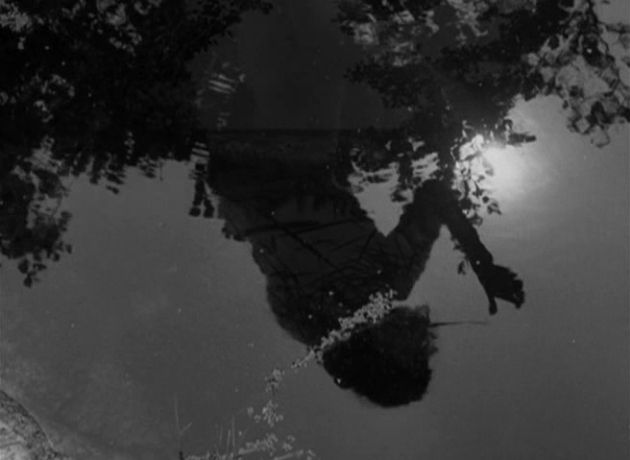
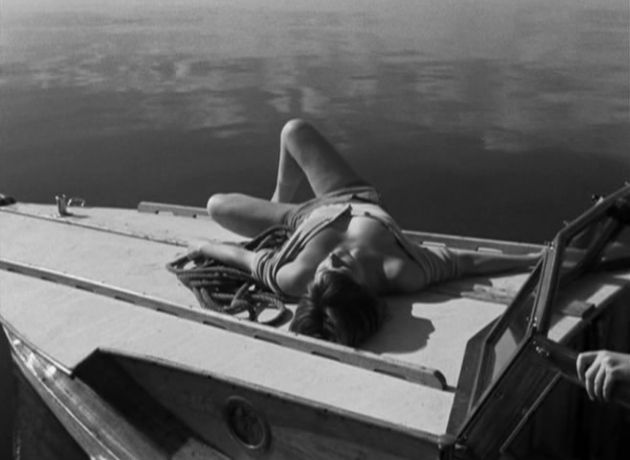
Monika (Harriet Andersson) and Harry (Lars Ekborg), young lowly stock room employees fall in love. Summer's near and after harassment at work and getting fired for being late, they run away to a remote island on Harry's dad's motor boat. For a while it's a paradise. They are in love and nothing really matters. No need to think about the future. Monika get's pregnant, supplies run out and soon they resort to stealing food from neighboring villages. In the end, they have to come back to Stockholm. Harry needs to get a job to provide and Monika's not satisfied with their less than glamorous life.

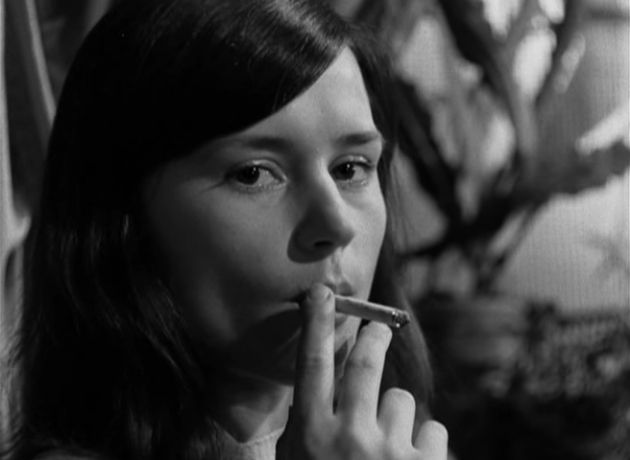
Andersson's youthful energy and insatiability for life is infectious and that's why that Monika staring into camera scene near the end is so chilling. She was slightly manipulative as any young pretty girls are, but there is something more pernicious in her eyes now. Her innocence and youthfulness is gone. Harry, now a regular boob, with the baby girl in his hand, pines for that glorious summer days. Bergman paints realistic picture of a Summer fling and its aftermath. It's not like in Hollywood movies that Monika likes. Summer with Monika plays out like an Italian neo-realist movie but has a more of a sinister edge to it.