Showing posts with label Non-Fiction. Show all posts

Wednesday, April 17, 2019

Preview: Art of the Real 2019

As an adventurous spectator of cinema who writes about films and very much interested in where cinema is headed as an art form, I can say enough that Art of the Real, a film series that showcases innovative, daring, non-narrative films, has been a great wealth of resource and a place of discovery over the years.

Since its inception in 2013, Art of the Real at New York's Film Society of Lincoln Center has been celebrating genre-bending, non-narrative filmmaking. In its 6th year, the series presents new such works by filmmakers from around the world, plus retrospective by Japanese experimental filmmaker Toshio Matstumoto's non fiction work and a tribute to the late Lebanese filmamker Jocelyne Saab. If you are a curious about the possibilities of cinema as an art form, and hungry for something new and thought provoking as well as entertaining, Art of the Real series is the place to be.

The series runs 4/18 - 4/28. For tickets and more info, please visit FSLC website.


Closing Time
4638fdcd-1f86-46cc-8677-11626e4f5420
Swiss filmmaker Nicole Vögele's observational film Closing Time focuses on a tiny late night food stall owned by Mr. Kuo and Mrs. Lin, under freeway overpass in Taipei. The film leisurely explores the surroundings of this night neighborhoods - an arcade parlor owned by a young couple, a dollar store next door, a wayward dog waiting for its long lost owner, a late night/early morning market where Mr. Kuo shops. Stragglers converse over a rice porridge with side dishes about the weather - the recent strong typhoon destroyed domestic produce, leaving not too much choices for Mr. Kuo to shop for ingredients, about the changing neighborhoods, about working too much... The couple prepares and cooks 6 nights a week. We barely get to see them in daytime. The sky is always dawn violet, the street is filled with thousands of mopeds, traffic lights and signs of the shops reflected on the puddles, with the sounds of the night. You get used to the rhythm of this working class microcosm. It's quiet and somnambulistic.

On his moped, Mr Kuo takes off on the road in the later part of the film and ends up in a small town down in the south of the country. We don't know what conspired for him to take this path. Was he tired of his daily routine? Did he want to get away? Don't matter. We are afforded to a lush scenery of Taiwan's countryside. Beautifully composed in Super 16mm in a rainy season of Taiwan, Closing Time is a contemplative film shedding a light on a part of the world that rarely gets attention.


Those Who Desire
Elena-Lopez-Riera-853x480
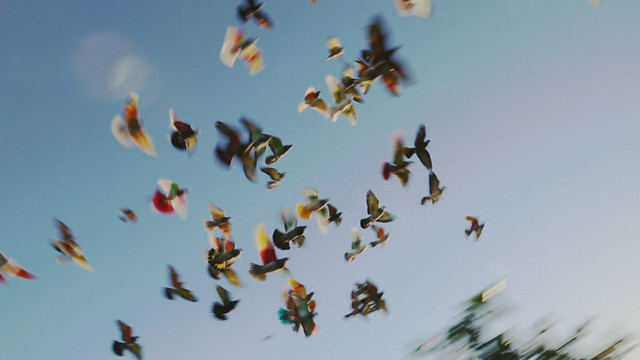
Valencia in southern Spain is a home of the Colombicultura, an exclusively male subculture where brightly colored male pigeons train and compete. Filmmaker Elena López Riera who grew up in the region, documents one of these competitions. The lone female pigeon is released in the air. Soon all male pigeons take to the air, chasing after her. There are amazing amount of rules and all these judges with walkies, watch intently every single move of these horny pigeons. It's not the speed, the narrator say, but lust and ability to conquer. I don't know what that means exactly. We see the swarm of pigeons in the air, on the ground. It's an orgiastic sight. But the competition ends due to bad weather before anything is determined.

Those Who Desire is the grossest projection of macho culture I've ever seen, but it's also fascinating.


Karelia: International with Monument
e07ee764-1d61-43ef-9458-bb97b92917b2
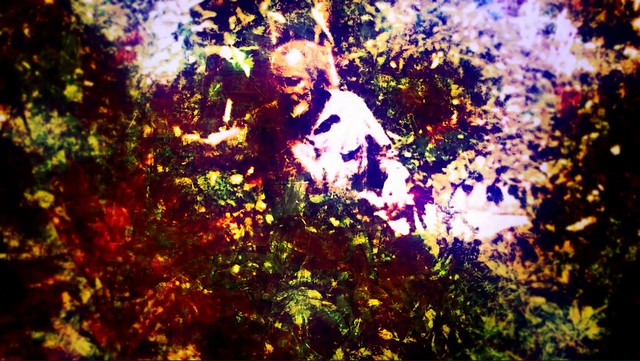
Karelia, the Northwest republic of The Russian Federation, bordering Finland has a rich cultural, political history. It had been occupied by Sweden, Finland and Russia. Spanish filmmaker Andrés Duque tries to link the cultural significance- the origins of Finnish epic where legends and magic with today's Karelia and ends up with documenting Orthodox Christian family, the Pankratevs, living in the remote area surrounded by nature, practicing some of the shamanism rituals handed down from generations. This first part of planned two part film about the region, Duque also digs up the not so flattering history of Stalin era massacres that took place in the same woods where Pankratev children play, and the Putin regime's effort to rewrite the history. Interesting history lesson contrasts with idylic family life in Karelia.


Movement of a Nearby Mountain
0xF12E1760863CFB1C13C8BC8AEB7095A4
Movement of a Nearby Mountain starts with a narration which tells a water fairy who was captured by hunters. In order to free from impending enslavement, the fairy promises the eternal riches pointing to the mountains. Iron. "Gold lasts a breath, silver lasts a lifetime and iron lasts forever". Soon as fairy was let go, it disappears into the water laughing. Its laughter forever lingering in the forest. This narrations repeats at the end of the film. Once in German, the other in Igbo.

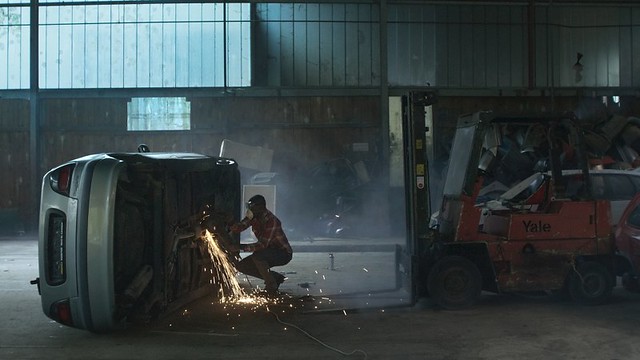
Cliff is a Nigerian man who owns and operates a chopshop in the Austrian Alps. He works there, cooks and eats there, shaves there - seems like his spends his waking life there. He buys cars, refurbishes, sells them whole or parts and also exports them to Nigeria. He deals with Hungarians and other Eastern European customers, sometimes in English, sometimes in German. Sometimes things heat up haggling the prices, but he seems to have his usual customers and well liked. But he is usually alone, spending days working. He sings Christian hymns under his breath.

We see a man of two worlds, bound by metal. The chorus of insects in the Nigerian jungle at night carries over the driving shot in the snowy Austrian Alps on autobahn. Sebastian Brameshuber's contemplation on these contrasts and the intimate portrait of one man against the stunning forest backdrop speaks volumes without saying much.


Swarm Season
Swarm Season
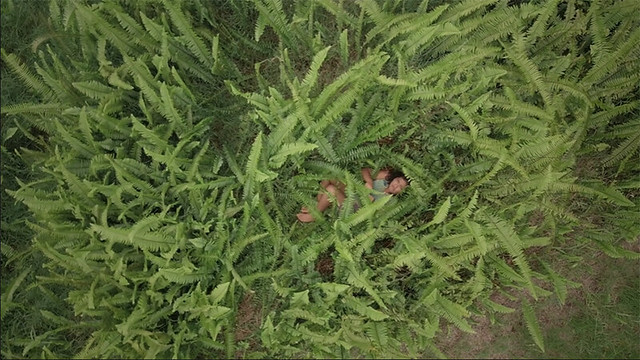
Hawaii's Big Island at a glance, is both a paradise and hellscape: the luscious vegetation along the coast contrasting vast black volcanic field created by overflowing volcanic activity inland that resembles the surface of Mars. Filmmaker Sarah Christman examines the intersection of elemental and superficial, nature and technology, ancient traditions and development, looking inward and space exploration, extinction and survival through the eyes of Manu, a preteen girl and her family who are in beekeeping business.

Manu helps out with her mom's honey producing by tracking wild bees and locating their beehives and relocating them. But she is also an average girl of her age, playing with My Little Pony toys in the sand and daydream while laying in the field. There are biologists collecting queen bees from the hives to study their swarming patterns and their survival.

Manu's dad is a tribal activist protesting the construction of another large telescope on top of the sacred volcanic mountain, Mauna Kea (13,803 ft). Then there is a group of astronaut training for Mars exploration in isolation on the mountain- ideal training ground because of similar climate (lack of oxygen and rough, barren terrain).

Swarm Season features some spectacular scenery of molten lava flowing out to sea, miles of barren black field created by volcanic eruptions, the underwater explosions as well as intimate tender moments with Manu and her family. The film's philosophical musings and seeing the bigger picture don't overshadow its anthropological study of its people and surroundings. It's a great film.


Accession
AOTR_Accession_01-1600x900-c-default
I've seen filming process as germination in one other film recently. It was Anocha Suwichakornpong's superb By the Time It Gets Dark. Where as the idea of film relating to germination was more of metaphorical one in By the Time, Tamer Hassan, Armand Yervant Tufenkian's Accession is more of a literal one. 13 correspondences in letter form about sending seeds are read mostly by someone related to the persons who wrote it, in various places and times in America, over the lovely hand processed 16mm footage. There are no other diegetic sound or effects sound to accompany these images and the narrations.

Accession is a testament of America as an agricultural society. Seed keeping, passed down to generations in families, is a dying tradition, so is the celluloid. Bringing forth new life year after year and the nurturing those who sow is somewhat equated here with the tradition of filming and creative process of so called 'experimental films'. Lovely, melancholic and resonant, Accession is a lovely piece of cinema.


Acid Forest
Screen Shot 2019-03-31 at 7.22.10 AM
Curonian Spit, a scenic peninsula in Lithuania is a Unesco Heritage site. It's also the home of Curonian Spit, a scenic peninsula in Lithuania is a Unesco Heritage site. It's also the home of Acid Forest, a swat of forests full of dead pine trees occupied by thousands of big, black, migrating cormorants who made those trees their homes. It's a tourist attraction. There is an elevated wooden platform to take in the scenery. Many tourists from all over the world climb up the wooden stairs to witness the devastating view. They all have something to say in their native language. Some comments that it looks like a nuclear fallout, or tornado aftermath. The guide explains to gaggle of Japanese tourists that trees died of the birds shitting on them constantly, to their amazement. Some invokes Hitchcock's Birds.

Many of these observations and amateur theories are downright hostile. Many jokes about having a gun and shooting them all down. Many complain that the birds are protected by the EU laws. Filmmaker Rugilė Barzdžiukaitė observes all the human activities from above, from a bird's eye view. Constant fly over shots of the whitened branches of the pine trees reveal thousands of these birds making home in Curonian Spit, oblivious of human crowing with their opinions down below.

A biologist is heard explaining to a TV crew that many of misconception about the birds are untrue, making a point that cormorants have existed since the ages of dinosaurs and it's not only their droppings that kill the forests. But we see the human interference at the end as we control much of our nature's destiny, unfortunately.


Walden
Walden
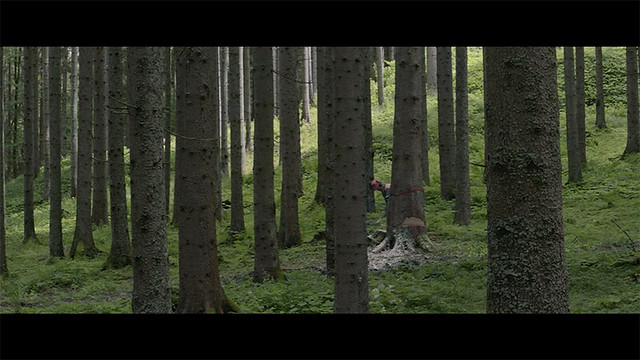
Walden consists of 13 slow 360° controlled panning shot from left to right. Each shot lasts about 10 minutes. It starts from Austrian forest where trees a being cut down with a buzz saw. Then the lumber is transported by trains, trucks, boats all the way to the Amazon, the lumber is finally transported by hands deep into the jungle. The film can be a slog for someone craving for a narrative or character to hold on to, but the key here is giving yourself up to the flow as the panning, moving picture creates its own steady velocity.

Each stage strategically stationed and shot in wide format and 50 fps for maximum coverage and the smooth movement, Swiss filmmaker Daniel Zimmerman's film takes an ironic, paradoxical look at a journey of timber in a global economy we are living in, done in a vigorously formalist approach.

Thursday, October 4, 2018

Being Relevant

Double vies/Non-Fiction (2018) - Assayas
Screen Shot 2018-09-20 at 6.49.20 AM
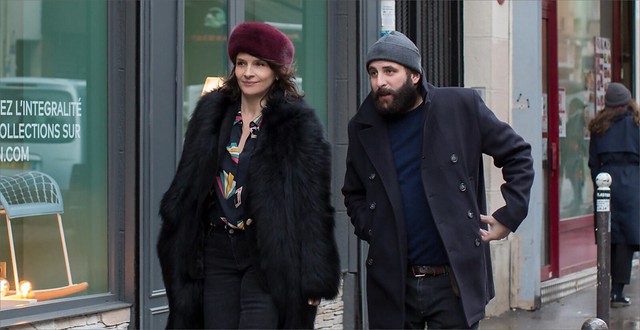
It seems, along with Godard, Olivier Assayas is one of the cinema's keenest chroniclers reflecting the soulless modern world in the late stages of capitalism. He reflected on the internet porn industry and shady side of desire in Demon Lover, corporate espionage and power politics in Boarding Gate, Hollywood & stardom in Clouds of Sils Maria and fashion industry in Personal Shopper. Now he takes on the fate of the print media with a biting new comedy, Non-Fiction. Unlike his last two collaborations with Kristen Stewart with international cast and locations, Non-Fiction takes place mostly in Paris with an ensemble cast of French actors - Juliette Binoche, Guillaume Canet, Vincent Macaigne and Nora Hamzawi. Although the scale of the film might seem smaller and less glamorous, Assayas' observation on the publishing industry and the rising popularity of TV are, as usual, spot-on.

Canet plays Alain, a book publisher. He is not too hot about the new manuscript of his long time client, Leonard (Macaigne), a semi-respected author. Alain used to like Leonard’s books, but the author's thinly veiled, self-aggrandizing autobiographical works have been getting on his nerves lately. So he decides to pass on his latest. Alain is also dealing with office politics with physical books transitioning into digital format and sales figures where prestige doesn't necessarily produce profit anymore. And there is a rumor of a large media conglomerate taking over the company he works for.

For Leonard, who is going through a hard time with his live-in girlfriend Valerie (Hamzawi), a sharp tongued political consultant for a major political candidate for the upcoming election, the news of Alain's refusal to publish his new book (titled Full Stop) is a big blow. Leonard also happens to be having a long term affair with Alain's actress wife Selena (Juliette Binoche) who also appears (thinly veiled of course) in Full Stop and she is deathly afraid of Alain finding out.

Valerie is getting frustrated because her earnest candidate's message is not getting through to people. In this post-Trump, post-truth era, there’s just too much noise for people to filter out, Leonard tries to console her to no avail. It doesn't help that when the allegation of sexual harassment turns up from the candidate's past.

Selena talks about a policier TV series that she has been starring for 4 seasons. It's physical work and kind of cool to be a feminist heroine but she doesn't feel any joy doing it anymore. Any TV show is something to put on when working stiffs get home after long day of work and binge watch and relax, she says. Alain chimes in that it's like those adult coloring books that are money-makers for publishing companies. They are for relaxation, nothing more. Selena complains that only other job offers she gets is Phaedra on stage, obviously because of her age.

All of these characters are trying very hard to make a mark in their own field. They want to desperately matter in an internet age where people prefer blogs instead of esteemed magazines and a twitter rumor can ruin someone's reputation in an instant.

Non-Fiction is a very wordy, very French film. In cafes, apartments and hotel rooms, they smoke, drink and talk non-stop. Leonard quips that because of twitter's narcissistic nature, it’s very French.

Printed literature versus e-book and the intellectual property rights versus the internet being the purveyor of democracy are all hot topics these days. Do we really prefer that digital media you bought, which eventually disappears from your computer’s digital library, to physical media that can never truly disappear? I feel that Assayas is the only major director who actually verbalizes these issues on screen.

A lot of big words are thrown about and discussed among these urban, cultured professionals - Unwitty witticism, auto-fiction, dematerialization, post-truth, etc. These characters embody the anti-thesis to the anti-intellectual world where everyone is free to spout three sentence haikus on twitter without any consequences.

Where it lacks Assayas' languid visual language, Non-fiction makes up with his sharp, witty dialog and humor. Macaigne, a comedian with his unkempt hair and portly disposition, appearing in many of quirky French comedies of late, is becoming a major figure in French cinema. He has worked his way up to having a full nude love scene with Juliette Binoche here.

In this fictional light comedy with its English Title Non-Fiction, along with its French Title Double vie, Assayas once again rightly reflects our society in real time. To top the movie's meta-ness, Alain tells that he is in negotiation with Juliette Binoche to do an audio book of Full Stop. This got the biggest laugh from the audiences at the film's press screening.

Wednesday, April 25, 2018

Art of the Real 2018 Preview

Art of the Real, FSLC's annual celebration of non-fiction cinema is back and remains my most anticipated cinema event even in the city that is not in short supply of great film series all year round. An amazing array of genre-defining, ever expanding cinematic experiments are presented to satiate your inquisitive cinematic minds! This year's lineup includes Infinite Football by Corneliu Porumboiu, Sergei Loznitsa’s Victory Day, Kazuhiro Soda's Inland Factory, and many more.

Again, Art of the Real is an immensely rewarding cinematic experience both in form and content. Don't miss it!

Art of the Real runs from April 26 through May 6, 2018 at Film Society of Lincoln Center in New York. Please visit FGSC for more info.

Here is preview of six notable films for your pleasure:

John McEnroe: In the Realm of Perfection *Opening Night Film
Screen Shot 2018-04-14 at 3.04.00 PM
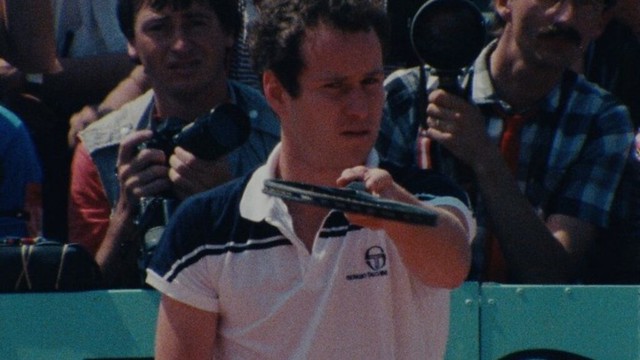
This terrific, archival footage documentary starts with a Godard quote - "Cinema Lies, Sport Doesn't." A French archivist Julien Faraut stumbled upon hours and hours of 16mm shot French Open matches at Roland Garros, initiated by Gil de Kermadec, the first director of French Tennis Federation, to study and make instruction films for aspiring athletes. But what Faraut saw was a compelling, verité style portraits of each players, and especially of McEnroe, who was at the time, the number one player in the world.

It happens that McEnroe wasn't a good model as an athlete who had atypical style for these often rigid, dry instructional films. His form was unusual and his methods were unpredictable, which gave his opponents a hard time. As a perfectionist of the game, he hated incompetency of people in the court and as a result, we've got to know him as who shouted and argued with umpires endlessly. He also hated being filmed or photographed. There are several moments where he stops the game to complain that the rolling cameras were bothering him while looking straight into camera.

Like last year's Dawson City: Frozen Time which uncovered the intersection of Gold Rush and cinema, In the Realm of Perfection finds the intersection of sport and cinema. Drolly narrated by Mathieu Amalric, Faraut creates Chris Marker style film that is both entertaining (thanks largely to McEnroe being himself) and thoughtful. The epic match between McEnroe and his long time nemesis Ivan Lendl in 1984 captured in grainy 16mm is literally, epic.

Casanova Gene
Screen Shot 2018-04-15 at 11.12.14 AM
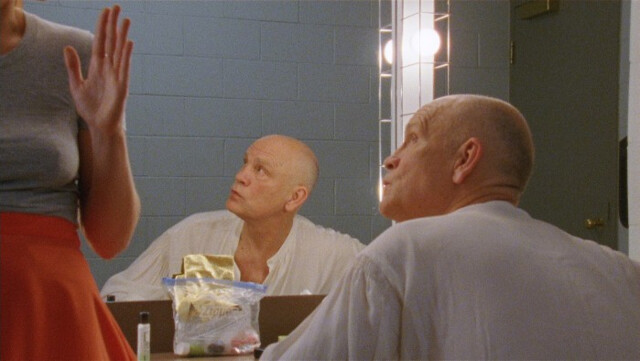
German filmmaker Louise Donschen examines desire of all forms in Casanova Gene and it's a fascinating one. In evolutionary biology studying finches in a science lab in the woods, an ornithologist tells us why female finches cheat on their partners - they inherited the Casanova gene from their fathers, as male finches are polygamous. "Is it beneficial to female finches?" the filmmaker asks off the frame and the ornithologist doesn't have an answer. John Malkovich plays Casanova or Malkovich the actor playing one, as he is interviewed by the filmmaker. He simply describes himself as a slave to his senses and explains the difference between character and temperament.

Carnival in Venice is juxtaposed with a church and the clergymen. Kids play in the forest, lights change, illuminating the rooms through the window, a dominatrix in SM studio holds a session, a hypnosis takes a place where a woman experiences intense orgasm. Then there is staged bar scene where transman complains that he misses uterus.

The colors - the red of the roses, orange beak of the finches, grey and red of the clothes- everything surreptitiously intermingles in this seemingly fragmented, yet arresting film that reminds me of the work of Alexander Kluge. A real gem.

Infinite Football
Screen Shot 2018-04-17 at 9.12.33 AM
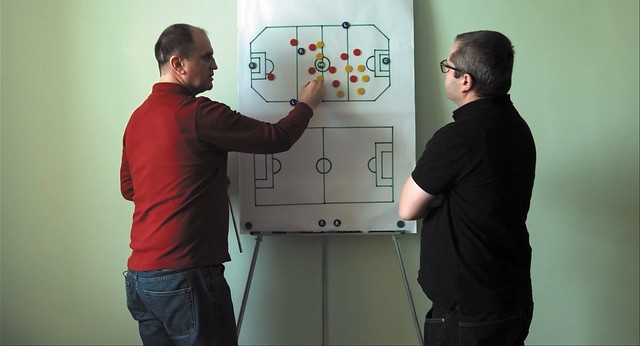
Romanian helmer Corneliu Porumboiu (Police Adjective, 12:08 East of Bucharest) makes a wacky yet poignant documentary about his childhood friend Laurentiu Ginghina, a middle aged bureaucrat who is obsessed with changing the rules of soccer to make the sport safer. At 19, he fractured his right fibula as many players in the opposite team ganged up on him in the corner when he had the ball. Because of the injury, he had to give up hope of going professional. Now he is hell-bent on changing the game - he wants to implement octagonal shaped soccer field with sectioned groups where 5 offensive and 5 defensive players can't cross each other's lines and no offsides. He says this improvement will speed up the game and make it smoother and safer.

He wanted to go to Forestry university but it required physical where you had to run which he couldn't do with his leg. His dream of coming to the US twice - first to run the ranch out in the West, then in Florida, gets thwarted by 9/11 and its aftermath with tighter restrictions. He ended up where he is, some desk job which is not that exciting. Ginghina's sad sap story, told in his office where he keeps getting interrupted with his daily tasks- an old lady with her inheritance questions, paperwork, meetings and appearances, brings out chuckles rather than sympathy.

Porumboiu prods his friend's obsession about 'the ball being free' in a sport where beauty is in player's skills and the ball is just an object. Our bureaucrat obviously is self aware, that deep down he equates himself with the ball and trying to escape from tight corners. That he sees himself as a superhero from comic books, like Superman or Spiderman who has a normal boring dayjob. Is his situation a stand-in for the general disillusionment with European Union, felt by majority of its members? Maybe.

After seeing his plan implemented on the indoor soccer field to not so enthusiastic results, he keeps changing his rules and therefore his creation being tagged as Infinite Football by Porumboiu. The film ends with Ginghina's poignant and touching monologue about the world where there is less violence which the director equates for political utopia. There is no fast zoom in/freeze frame or zany music for cheap laughs. Nor the film intentionally demeans our silly bureaucrat. Just like other Romanian new wave compatriots, Porumboiu knows how to justly reflect the lives of ordinary Romanians finding themselves riding along in a rapidly changing world and facing mildly amusing situations.

Braguino
Braguino
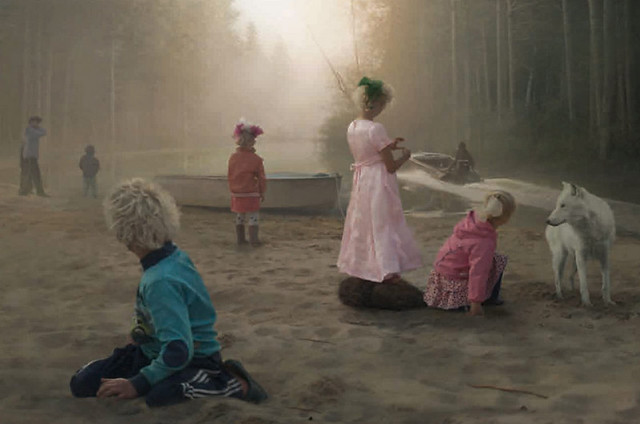
A French visual artist and film director, Clément Cogitore whose supernatural tinged Afgan war thriller, Neither Heaven Nor Earth, made waves at the film scene few years back, travels to remote Eastern Siberia to document the Braguinos, a family living off the environment. The head of the family tells us that they wanted to get away from it all, so they just packed up and left on their boat. Their 6 children were all born in the taiga. It is clear that the Braguino clan is not only dealing with family rivalry with the neighboring Kilins just other side of the river, but dangerous animals - especially bears and also ever expanding human presence in the region.

Cogitore and his cinematographer Sylvain Verdet is there to capture what can only be described as Tarkovsky-an beauty in rather dream-like Siberian taiga. The natural beauty is only accentuated by fair-haired Braguino children in their colorful dresses and clothes. As the helicopters full of heavily equipped newcomers landing on their territory, we all know that the happy days of the Braguinos are numbered. It's a striking non-fiction filmmaking featuring otherworldly beauty.

Milford Graves Full Mantis
Screen Shot 2018-04-21 at 10.06.50 AM
Milford Graves, a free-jazz percussionist, records his heartbeat with a self-made EKG machine hooked up to the computer and makes electronic melodies out of it. He is also a martial art enthusiast and practitioner- he learned his moves through studying preying mantis instead of going to a local dojo. His style is Yara, a yerba word for 'Nimble', a mixture of West African dance moves and martial arts. In the labyrinth of books, machines, instruments, artifacts of his house/studio in sunny South Jamaica in Queens, Graves reminds you of your eccentric uncle- a smart person with full of self-taught knowledge who forms a philosophy of life with first-hand experience. And when he plays, it's electrifying.

Relying completely on Graves' words, Jake Meginsky and Neil Young creates a compelling portrait of a modern day sage and a fantastic storyteller who is approachable and very down to earth. As he talks about his music being the conduit of vibrations of cosmos, you listen. He might be the remnants of 60s mind-body-spirit mumbo jumbo, but the way he is so in tune with nature, as he does gardening in his back yard, as he in tune with his body- his world view makes sense, especially now, when the whole world seems to have gone crazy.

All That Passes Through a Window That Doesn't Open
ALL THAT PASSES BY THROUGH A WINDOW THAT DOESN'T OPEN
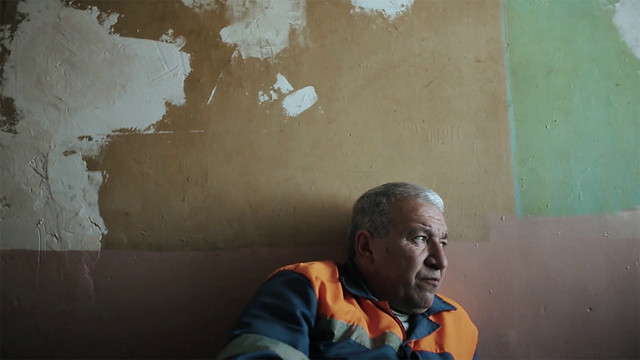
Martin DiCicco's film charts transcaucasian trail on two side of tracks - Azerbaijan and Armenia. Once a vibrant railway system linking Turkey - Georgia - Armenia and Azerbaijan which served as the crossroads of Eastern Europe and West Asia left in ruins by decades of neglect and regional conflict. Without saying much of its very complicated geo-political history, DiCicco elegantly concocts tale of two countries, one with full of hope and looking forward, the other reeling from the ghost of the past.

In the first 2/3rd, it concentrates on Azerbaijani side, where mostly young migrant workers living on the train cars while they travel to upgrade the railways. Voices of some of its workers narrates their days on the rails, how it's lulling affects their bodies own senses and memories. One says he likes railway works because it's measurable against time. That there's sense of accomplishment as he and his co-workers go closer to their destination. There's dancing, drinking and sense of camaraderie and dangers of accidents too.

After the war between two countries and neighboring Turkey supporting the muslim Azerbaijan and closing off its borders in 1993, Armenian side of the tracks which was a lifeline for trade to the west and east, left to rot. The last 1/3rd of the film features an Armenian station agent guarding the one such neglected station, waiting for it to be open again. His words and accompanying visuals are poignantly drawn out.

All That Passes Through... invokes the poignancy of Kiarostami's road films in contemplating on the time passing. DiCicco and his editor Iva Radivojevic draw a evocative picture of the region full of history, longing and hope.