Saturday, October 13, 2012

Resurrection of Alex Oscar

Holy Motors (2012) - Carax
HolyMotors
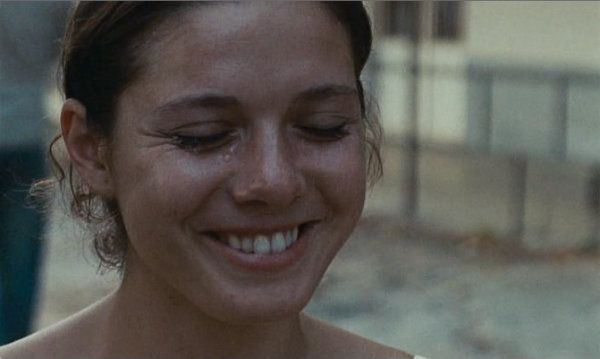
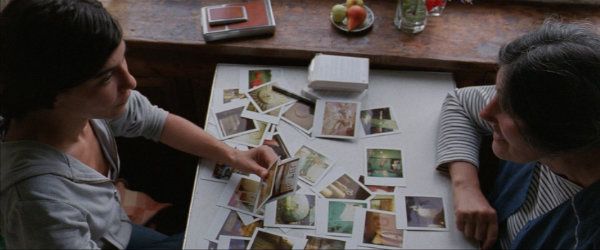
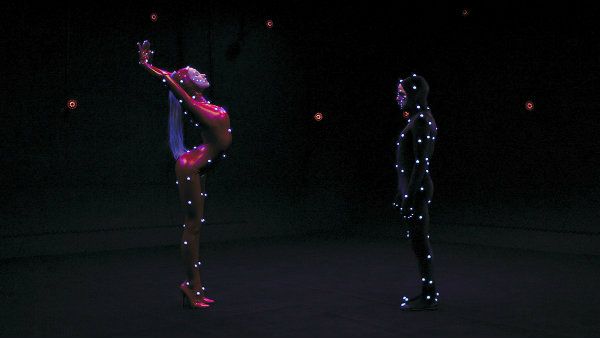
I'm pretty sure I won't see anything more audacious this year than Leos Carax's self reflexive, funny, goofy and touching ode to cinema. Holy Motors follows Alex the performer (Carax's alter ego played by Denis Lavant) as he goes through 9 different lives in one night. The film makes full use of Lavant's acrobatic skills- especially in 'the motion capture' segment that highlights the actor's physical agility and pays a tribute (on a treadmill) to his own film, Mauvais Sang. It also features some of the most bizarre casting choices- aside from Lavant, Michel Piccoli, Edith Scob, it also stars Eva Mendes and Kylie Minogue. Carax retraces his steps onto the Pont-neuf even, ever so slightly: after 20 years, old lovers Jean (Minogue) and Alex meet at empty Le Samaritaine department store overlooking the famed bridge which was the setting for Carax's magnum opus (and my personal favorite) Lovers on the Bridge (1991).

Holy Motors marks a comeback of a major French auteur (his last feature was Pola X in 1999). It was very disconcerting to see him all broken up and bitter at a Q&A session for an omnibus film, Tokyo!, in which his contribution Merde was definitely the highlight of the three. He was having a hard time financing any of his projects. He talked about his desire to use his character Merde (Lavant)- a flower eating, deformed creature living in the Tokyo sewer, again in some other occasions and I'm glad he gets to do that in this film. Holy Motors is a product of a frustrated artist finding ways to express himself under difficult financial circumstances. Its disjointed, episodic narrative reflects that. It's vastly different from his earlier work but just as mesmerizing nonetheless. And how can anyone get tired of watching Denis Lavant on screen? He is in top form in this.

Thursday, October 11, 2012

Lived In

Our Beloved Month of August/Aquele Querido Mês de Agosto (2008) - Gomes
our beloved month of august
Because of financial problems, a film crew is stuck in a small Portuguese mountain town, Arganil, without any actors. Director Miguel Gomes uses the woes to his advantage and concocts a charming doc/narrative fusion. It's the way he goes about it that seems so right- with two and a half hours running time, he slowly builds the relationship between the townspeople and the audience. There are scenes of normal folks talking about the movie production that is taking place in their town. They are discussing their acting abilities. There is not a shred of Altmanesque irony in them. Everything, from the religious procession to various travelling music groups to the towns old bridge, has a role to play. The original story which director had is some cliché summer fling story. But it becomes much more poignant because of the films first 2/3rds. There is fluidity to Gomes's filmmaking that is gentle yet furiously inventive. It's a great film.

Wednesday, October 10, 2012

Haptic Cinema

Leviathan (2012) - Castaing-Taylor & Paravel
leviathan
It's dark. First, you hear the eerie clanking of metal and waves: sound of something heavy, something industrial getting pulled out of the bubbling sea. It's all abstract: saturated colors- iridescent blue, yellow, red and green all mixed in. It takes some time to realize that we are on a giant commercial fishing boat, and the crew are detangling an enormous chain that is connected to the fishing net. It's a tedious and also dangerous process by the looks of it. The whole scene reminds me of late Godard films where he manipulates his video image into an abstraction. This is just the beginning of Lucien Castaing-Taylor and Verena Paravel's jaw dropping second feature, Leviathan.

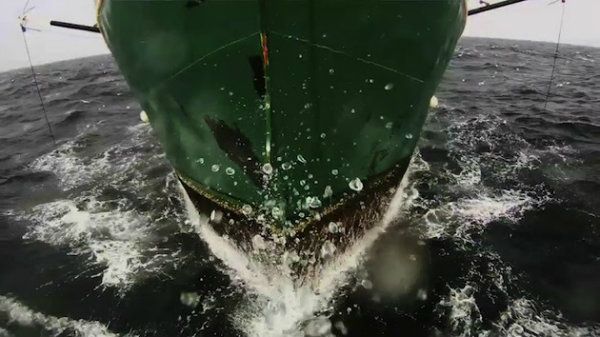
The images, shot entirely on tiny GoPro cameras, are startling and breathtakingly beautiful. For its tiny size, weight and durability, GoPro is widely used in extreme sports videography. Here, the filmmakers jerry rig and hand-hold them in various places on the ship. Thanks to no depth of field and limited exposure range, the image that this camera captures- dark and ominous, is unlike anything you've seen in a feature film before. There are many scenes that are just mindblowing: In one scene, the camera, mounted in front of the mast, plunges into roiling water, bobs up, down, up, over and over again, contrasting the sea and the sky in a spectacular manner. Amazing sound design by Ernst Karel adds to this visceral sensory experience.

The film, at times, becomes nauseating, considering many of the scenes are hand-held and seeing massive amount of dead fish with their bulging eyes and innards spilling out of their mouth swishing across the frame in blood. Even though there are some humans appearing in the frame, everything in Leviathan appears distant and abstract. It's the cruel nature seen and heard unapologetically and without much filter.

Leviathan is categorized as a documentary, but it is only considered as one in a sense that it's non-narrative. As I was watching it at the press screening, the only comparable movie experience I could think of was watching the films of French filmmaker/visual artist Philippe Grandrieux- especially Un Lac. Described by some critics as the haptic cinema, Grandrieux's work is regarded as the cinema of the senses before the intellect. That human brain processes many types of information that are not formed into thoughts before experienced and embodied. Leviathan needs to be seen on the big screen to get the full impact. It's an enthralling theater going experience from beginning to end.

True story: as I was standing in line to attend the press screening for the film, I noticed a little wild salt-pepper haired Frenchman with dark glasses in front of me. Could he be Philippe Grandrieux? I thought to myself. Grandrieux turned out to be a good friend of the filmmakers, as he joined the Q & A session after the screening, defending the filmmakers from a barrage of asinine questions like "What's the meaning of this film?"


Leviathan screens on Oct. 13, 6pm. For tickets, please go to NYFF website.

Tuesday, October 9, 2012

Playful Elegy

Tabu (2012) - Gomes
Tabu
Playful in its formality, Miguel Gomes's Tabu is a thing of a wonder and best kind of ode to cinema. Shot on full frame B&W, Tabu jumps from colonial past to modern day Lisbon and jumps back to a mystical setting in a sleepy colonial town at the foot of Tabu mountain. At once gentle and dreamlike,Tabu concerns Pilar, a good natured middle aged lady, her senile neighbor Aurora and her African maid Santa in modern day Lisbon.

At her deathbed, Aurora calls for her long lost love Ventura and Pilar is on the mission to find him. This sets up the sprawling romance back in colonial Africa where story of young Aurora and Ventura's illicit love affair takes place. The old Ventura narrates the whole affair and the whole thing is without dialog. Gomes's playing on colonialist past and its taboo (talking about it) contrasting with the make-believe nature of the African part of the film is just brilliant. Tragic yet uplifting, daring in it's minimal aesthetics, Tabu isn't anything like I've seen out there. Loved it.

"I want my movie to start with a big explosion..."

Ginger & Rosa (2012) - Potter
GingerandRosa
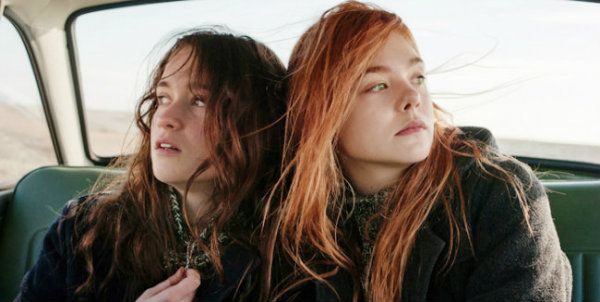
Director Sally Potter (Orlando, Tango Lesson)'s new film starts with stock footage of an atomic blast. A great way to open a film if it was an Ed Wood B-picture. But it's not. It's the story of BFFs Ginger (Elle Fanning) and Rosa (Alice Englert, daughter of Aussie director Jane Campion) both born in 1945, going through their lives in 60s London where everyone lives under the shadow of nuclear annihilation. It's also the time of the nuclear family. Rosa's father split early on. Ginger's ultra liberal dad, Roland (Alessandro Nivola), can't seem to keep his pants zipped, causing heartaches for mom (Mad Men's Christina Hendricks) and not providing any emotional support for the increasingly confused Ginger.

These feisty teenagers do everything together. Rosa usually leads Ginger to their little vices - staying up late, smoking, drinking, making out with the boys, etc. Shot by Robbie Ryan (Wuthering Heights, Red Road), these shenanigans are all blissful close-ups and sun flares and the camera obviously adores the two young leads: ethereal redhead Ginger and pouty vamp brunette Rosa.

Things get a little hairy when the atheist, pacifist, autonomy of mind-and-body preaching Roland takes a shine on Rosa, leaving Ginger jealous and very confused. She tries to take solace in the company of adults- her two fairy godfathers Mark 1 (Tim Spall) and Mark 2 (Oliver Platt) and Bella (unrecognizable Annette Benning). But you can see the emotional waterworks coming from miles away with tearful confrontations and a lot of finger-pointing.

Potter gets the 60s setting right and the largely non-British cast does a great job, especially newcomer Englert, who exudes a certain charisma and confidence. I understand Potter's desire not to make anyone antagonistic in Ginger & Rosa, but Roland is an irrevocably contemptible, immoral man. Just because of that, the film suffers greatly in the second half. Too bad, because it could've been a great film about finding one's identity in the time of imminent destruction. Instead, it gets bogged down in high melodrama and never recovers.

Ginger & Rosa premiered at this year's TIFF and plays NYFF on October 9 and 10. For more information and tickets, please visit NYFF 2012 website. It will open theatrically in the UK and Ireland on October 19.

Thursday, October 4, 2012

Social Experiment

Something in the Air (2012) - Assayas
something in the air
At the outset, Olivier Assayas's Something in the Air is a biographical nostalgia piece about growing up in the aftermath of the May '68 events in France. But what it really is, is a social experiment in which 18-19 year olds, most of them first-time actors, reenact the youth of perhaps the most volatile time in contemporaneous French society, when the revolution seemed palpable.

As it was revealed in my interview with Mia Hansen-Løve (director of Goodbye First Love and the current wife of Assayas) early this year that Assayas has a real knack for connecting with and getting great performances out of young actors (Hansen-Løve herself was in Assayas's Late August, Early September when she was 17 and swears that the experience changed her life).

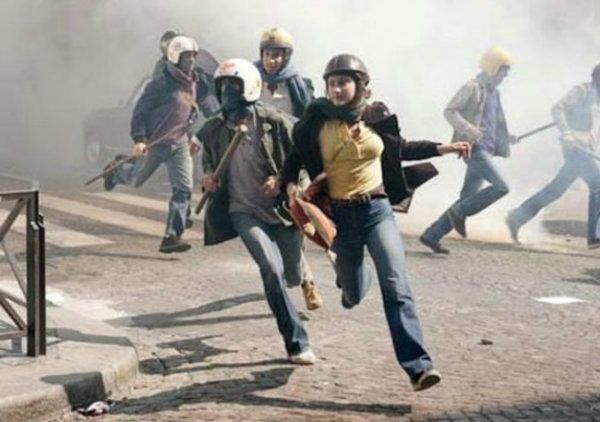
The French title (Après mai) refers to the student uprising and General Strike of May 1968. Something in the Air starts with a group of high school students' violent confrontation with baton wielding, teargas shooting cops on motorcycles. The scene is too energetic and immediate to be nostalgic. Set in 1971, this semi-autobiographical, ensemble piece about a group of friends in tumultuous times when everything seemed possible, is at once personal and sprawling. After vandalizing their school with revolutionary banners and graffiti, they end up injuring one of the security guards and are told to lay low during the summer. Puppy eyed, mild mannered aspiring painter Gilles (newcomer Clément Métayer), who just broke up with his ethereal poetess girlfriend (Carole Combes), hitches a ride with the Leftist filmmakers, along with a devout of the cause, Christine (Lola Créton of Bluebeard and Goodbye First Love) and artistically inclined Alain (Félix Armand) to Italy.

I don't pretend to be an expert in French history; I only have vague memories of that time period of France from textbooks and films. Assayas got all the political jargon and lingo down, as everyone was into politics at the time. If you think today's left is fractured and sectarian, France in the 70s would make your head spin: there was the French Communist Party, CGT (French Trade Union Federation), Trotskyites, Leninists, Le Secour Rouge, the Maoists, VLR (Vive la revolution), FLJ (Front de Liberation des Jeunes), and the list goes on.
Our Gilles is in the thick of all these political activities, but, at the same time, independent minded. He reads a newly published book criticizing (first of its kind) Chairman Mao's Cultural Revolution, despite the disapproval of many upper classmen. He also finds his own voice through art -- first painting then filmmaking -- while maintaining his counter culture attitude and general skepticism of the world. Assayas's energetic camera also turns to many of the sunny Tuscany locations, as many of his young protagonists pour out their youthful enthusiasm in art, love and politics. There is no voice over or flash forward. Assayas, born in 1955, who was of age back then, never once steps in to remind us that this is all in the past. No, this is not a nostalgia piece.

The film's hopefulness and youthful energy is quite infectious. In addition to the aforementioned great young actors (Metáyer, Combes, Créton and Armand), newcomers India Manuez and Hugo Conzelmann shine as Leslie, a free spirited American girl, and as Jean-Pierre, a dignified, honorable fellow student activist. One can't help but compare youth in the film with today's largely disaffected, docile young people. What happened to that passion, awareness and dedication? This is where Assayas's genius kicks in. He uses actual teenagers of today to play the part of youth of his generation! It's a social experiment on a smaller scale. None of the characters seem out of their element. His even handed attention to each character brings out a well-balanced, strong ensemble piece that is both relatable and affectionate without ever being coy or stereotypical. The more I think about the film, the more I like it. It is one of the best films I've seen at this year's New York Film Festival.

(Something in the Air screens on Oct. 5 6 p.m., Oct. 8 12 p.m. and Oct. 12 6:30 p.m. at Film Society of Lincoln Center. For tickets, please go to NYFF 2012 website.)

Wednesday, October 3, 2012

Andrea Arnold Interview

Photobucket
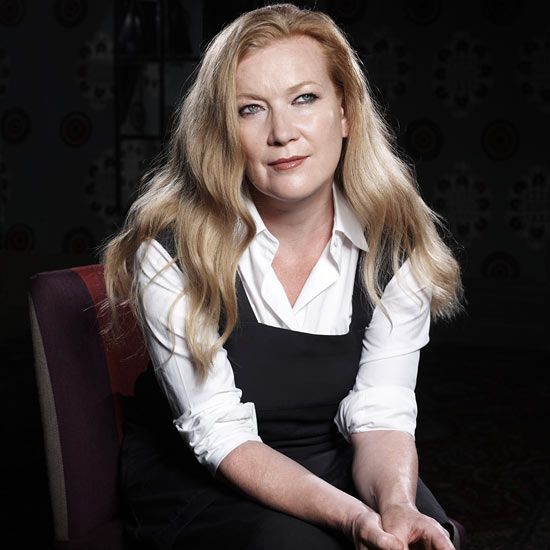
With only three feature films under her belt, Andrea Arnold has already established herself as one of the most prominent British film directors currently working today. Her brooding, sensual, class-conscious dramas, Red Road and Fish Tank, were well received by cinephiles world wide. But I wasn't really ready for her thrilling adaptation of Emily Brontë's gothic novel Wuthering Heights. It's an enrapturing experience to watch, especially on the big screen.

After making the festival rounds, it is finally getting a release in New York this weekend with further cities to follow. Even though jetlagged, Arnold was very friendly and chatty in discussing her breathtakingly beautiful re-conceptualization of the classic.  

You were known as a writer/director prior to Wuthering Heights. I was surprised that your next film after Fish Tank was an adaptation and also a costume drama. Why adaptation? How did it come about?

I often wonder why too. (laughs) It was a strange journey in a way. I was writing something else on my own and out of the blue I got an email from my agent if I was interested in doing Wuthering Heights. I knew it was in the works with a different director attached. I was quite jealous thinking, 'oh, I wish I could get my hands on that!' So I immediately stopped what I was doing and asked about the project a little bit more. Then I went on a journey, I just couldn't put it down. I couldn't stop. It was as if something possessed me. It wouldn't let me go. My first thought was of Heathcliff: In the book, Heathcliff turns out to be quite a dark character and that he had a really abused childhood. And I remember thinking, yes, his story needs to be told. But it was a difficult journey. I knew at some level it was a stupid thing to do because it is such a famous book, and I was joining something that had already been in production with two directors and actors attached, [it] had history and momentum and there was a script. There were producers who had been involved developing it and wanted to take [it] on quite fast. In hindsight, I don't want to join something in the middle of it ever again. But I couldn't put it down, worrying about Heathcliff and telling his story.

Was it a fast process? How long did it take you to do the project?

I think it took longer than they expected to. I wanted to get things right from script to everything. I remember when I first had a meeting with producers and they asked me about the crew and I hadn't even looked at the script properly. And I remember thinking, 'oh, this is a bit quick'. I remember feeling a bit alarmed by that. So there was this constant push to do it fast and there was a constant pull back from me trying to do the way I wanted to do it. And at the same time you try to do it right by everyone else. So you get into a muddle. It was tough actually and I wouldn't want to repeat that really.

So when I have an image in my mind, I can't just leave it alone and that's what happened. I always have an image that keeps me on track when I'm passionate about something. My image for this (which was never realized in the film), was on the moor in the twilight when the sky is blurring the land and in the middle of that is this large animal, you don't exactly know what kind of animal until you come closer and realize it's a man with rabbits on his back: that was my image of Heathcliff. That was the image! And every time I lost my way I would remember this and it would keep me going. But when it came to film that scene, we had ten minutes to film it and there was bright sunshine with blue skies and we didn't have very many rabbits to cover Solomon (Solomon Glave, who plays young Heathcliff)'s back. The string broke on the rabbits, so they kept falling off and we didn't have time to wove them back up to get a wide shot. The moor was not the moor I imagined that day. The shot came out completely different. But it's in the film.

I love it though. It's all hand-held, we see the back of Heathcliff with rabbits.

It was completely different than how I imagined. But you know the essence of it is in the film. But that's filmmaking for you.

Obviously the second half of the book is omitted from your film. How did you decide where to stop?

Yeah somebody asked me if there was anything that I missed out from the book that I feel sorry about, I say the whole second half (laughs). Partly it was because I joined something that was already going. But I actually believe that it's good to be instinctive. The filmmaking is such a deliberate process, especially [since] there is a lot of money and people involved. I do like when things are moving fast, that can bring about some interesting, instinctive decisions. And I always felt that the second half of the book was too complicated. I never intended to make a 'faithful' adaptation anyway. I just wanted to capture the essence of what Emily was going for. The kind of film I like to make is where I can explore details. For that, the book was just too much to deal with. I do love the second half of the book. It comes a full circle with Heathcliff's death and as a book it's fantastic. I don't like Heathcliff wandering by himself on the moor. That's sad. I'd rather he died. So I wasn't happy about leaving it out. But I couldn't see a way to include that in unless I had a resource and the right circumstances to do a ten-hour film. (laughs)

About casting black actors as Heathcliff...

Right.

I mean it's about time, I thought. We are not living in the time of Laurence Olivier...Where they put cocoa powder on his face. (we both laugh)

I know that the movie came out in the UK last year. I was wondering how it was received with a black Heathcliff.

I can only go by Q&As (where people are always nice) I did, because I don't read reviews or anything. And people always ask me about that. There must be a big debate about that on some Brontë webpage, I'm sure. It's always mixed.

I think having a black man playing that role was the right choice. I mean, he is describe as a foreigner in the book. It's very topical for this day and age.

I wanted to ask you about your process with non-actors in this film. I remember you describing the process in Fish Tank in a Q&A session a couple years back. You said you were holding back parts of the script from actors until just before the shoot, and encouraged them to improvise. Did you do that with Wuthering Heights?


Well, it's a famous book everyone knows. Everyone knows what happens at the end. So I didn't really do that too much in this. Obviously with Solomon and Shannon (Shannon Beer, young Cathy) I did that a bit because they are new and I didn't want to overwhelm them too much. We couldn't afford to shoot it in chronological order anyway. So no, not really on this one.

The look of the film, my god, it's so gorgeous.

Probably too gorgeous actually.

Too gorgeous?

If the style sticks out that much, you failed a bit actually. That's what I think. (Dustin laughs) I always think that if one of the disciplines sticks out, I failed to bring all the elements together. But I think there is no music and much of the dialog taken out, it relies on the images even more and sticks out more. But I can't really tell if it's sticking out the right way or wrong way.

It's stunning. For me, definitely the right way. I mean it takes place on the moor where everything is elemental. It has rain, wind, mud, blood, sweat and tears. It has to be cinematic. I first saw it on a smaller screen, then I saw it on the big screen.

Yeah, it has to be seen on the big screen.

That's what I mean! The emotional impact is much stronger when you see it on the big screen.

I wonder how your collaboration process with your DP Robbie Ryan went. I mean, he will be known for this film (he won various cinematography awards for Wuthering Heights). There are some absurd amount of hand-held scenes.


He loves to run around. He gets a little depressed when he can't run around. Yes, we've done four films together now. We have a shorthand: he pretty much knows what I want. We did a lot of tests with different stocks and we talked about what we try to achieve. The moment I worked with him, I immediately felt in tune with him in terms of aesthetics from the very first film together.

So will you always choose shooting full frame (4:3 ratio) from now on?

I've done it twice now (starting with Fish Tank). I didn't think about shooting this in 4:3. But we did some tests and we projected on the screen. You know 35mm in raw form is 4:3 and it looks so beautiful. It's great for portrait. It's very respectful for one person, like in Polaroids. I also like that you are not cropping anything. You are using the whole negative. So you get all that information. It feels more honest. It is quite hard to frame a two shot. But because I'm always telling the story from one person's point of view, I think it works. Also, it gets more sky. If you go this way (pointing to the sides), you get more green shooting on the moor. With full frame you get a different version of landscape. For me it takes away nothing. I think it adds more.

Was there any inspiration for the look of Wuthering Heights?

I showed Robbie some Todd Hido photos. I love his pictures, especially the ones through the glass. We did some of it for the film but didn't keep it in too much. I always like the shot of a person looking in from outside and vice versa. For some reason there are a lot of scenes like that in the script and that's why I thought of Hido's photographs. Back then, the glasses were pretty thick and they obscured the image and gave sort of water color feeling- things blurred into each other or [were] hard to see. For some reason that was very important to me. So I encouraged that sort of look.

It must've been tough shooting on the moor.

Yeah really. I think everyone on the crew said it was the hardest thing they've ever done. But they were a really great crew. Without their perseverance and their determination I don't know how I would've gotten it done really. The mud was really deep and it got deeper and deeper as more people trudged along in it. And we couldn't take vehicles so we had to carry all the camera equipment. So if we wanted a wide shot, we had to walk with the heavy camera boxes on our heads. That was very physical. And we had a lot of heavy layers of clothes and big boots because it was always cold and wet. And if you are unlucky, you get boxes with all the lenses in, which was really heavy. Nobody wanted to get that one. (laughs) and you always want to be fair and take what's handed to you. I remember it was the last week of shooting, I think. I was climbing up the hill with a heavy camera box on my head. I was really tired. And my knees gave in and I collapsed, with the box still on my head. I started to cry because I couldn't get back up. I pulled down my hat so no one would see me cry. When I finally got to the top of the hill I saw Rachel (Rachel Clark), Robbie's Camera Assistant, also crying with a camera box on her head (we both laugh). I mean, we were physically exhausted. It was mud everywhere, so we didn't have any place to sit and rest, really. And I don't know why they built the house up there. Because when it rained, all the water came gushing in to the house. And there were all these dead round moles from the ground washed up everywhere. They were so fat gauging on all the earthworms, I imagine. God, it was a tough, tough shoot.

So when we saw the film for the first time projected on the screen, we said, "damn it, that doesn't look nearly as bad as it was. How can I make you feel as bad as it was? You sit there for an hour and a half while we were out there ten hours a day?

Oh, it's beautiful (we both laugh). It's a great story. Do you plan to do another period piece?

No. I don't think I'll ever do it again. It was an experiment and an adventure and in some ways quite liberating for me to do something completely different.


Wuthering Heights opens in New York on Oct. 5 with a national roll-out to follow. For more information, please visit the Oscilloscope website.

My Wuthering Heights Review
Sunday, September 30, 2012

The Anatomy Lesson

Barbara (2012) - Petzold

As a leading figure of Berliner Schule, director Christian Petzold has been portraying 'lost' people in both literal and metaphorical sense: desperate souls cornered into making tough and sometimes wrong decisions brought on by economic hardships in the post-global recession era. In his new film Barbara, even though the setting is East Germany and the year is 1980, that portrayal of characters in (im)mobile state fits well and works superbly here.

It's East Germany and the year is 1980. Barbara (Nina Hoss) is a city doctor who gets banished to the country as a punishment when she applies for her exit visa to go west. In her new environment, she is under constant surveillance by secret police and subjected to inspections and body cavity search routinely. Deeply distrustful about her new neighbors and colleagues, she tries to keep a distance and concentrate on what she is good at- taking care of patients, all the while planning her escape to the west with her wealthy West German lover.

A young, good-natured fellow doctor Andre (Ronald Zehrfeld) slowly wins her trust with his talent and sincerity. It turns out that he shares a similar history. Andre uses Rembrandt's painting The Anatomy Lesson of Dr. Tulp as an analogy for what it's like to be living under communist regime in the 1980s: you want to divert the attention of the spectators (or in this case, of government officials) to obtain a little bit of relief/freedom in a rigid society. And this applies to Barbara's situation as well. There is a mutual attraction growing.

Things get a little more complicated when Stella, a teen runaway from a labor camp with meningitis is admitted to the hospital. She immediately latches on to Barbara. The official policy is to send her back to the camp as soon as she is well. Later Stella confides in Barbara that she is pregnant. Going back to the camp undoubtedly means an end to her unborn child. As the planned escape date approaches, Barbara's personal ethics and morality are being challenged.

Barbara is the fifth collaboration of Hoss and Petzold. As it is revealed at the skype Q & A session after the press screening, the role was written specifically for Hoss. And she is mesmerizing in it. She gives the character a quiet resolve and strength. Deeply moving and humanistic, the film concentrates on the small heroism of one person rather than looking accusingly at a failed ideology.

Barbara screens on Oct. 1, 6pm, Oct. 6, 12:15pm and Oct. 9, 1pm at Film Society of Lincoln Center. For tickets, please go to NYFF 2012 website.

Invisible Borders

Here (2011) - King
here
here 1
here 2
here 3
here 4
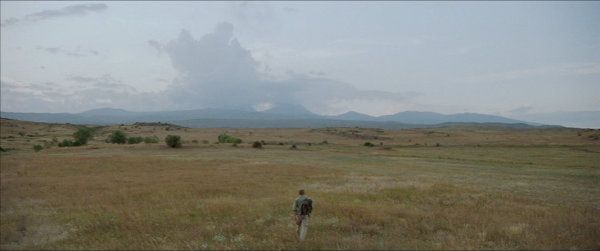
Music video director Braden King (Bonnie Prince Billy, Dirty Three, Totoise)'s meta-road movie Here isn't quite what he hopes it to be. But it's still quite beautiful. Filled with stunning images of Armenia, affable actors (Ben Foster and luminous Lubna Azabal) and poetic audio-visual interludes (by different experimental film artists, narrated by Peter Coyote), it tries to invoke a dream state. But the whole set up is pretty much grounded in reality- Will, an American satellite mapping engineer, Gadarine, a semi-famous photographer, a prodigal daughter coming back home.

As they travel through Armenian countryside as their projects intersect, they fall in love. There are a lot to admire in Here: Foster and Azabal have real chemistry together and the film is gorgeous to look at. And I wish someone put up the compilation of all the Coyote interludes under one roof. Because I can watch them over and over and over again. I really do think wanderlust, being lost in somewhere not familiar is innate human nature. Will trying to eradicate 'the edge of the world' so everything can be viewed on google map and Gadarine's effort to preserve the fleeting moment of time and place clash despite their attractions.

In the age of google, what does it mean being here instead of over there? Why do people have to separate? These are questions King touches upon but never follows through. But does he have to? The film lets us ponder the arbitrariness of the invisible borders between places and human beings. I would've liked it a lot more if King went all abstract and non-linear. It's a lofty concept he is playing with, but not fully realized but only we can, in our minds long after the end of the film.

Sunday, September 23, 2012

Beautifying Death

Dredd (2012) - Travis
dredd
If anything, the new Judge Dredd movie should be lauded for its unabashed visual aesthetics. Presumably unintentionally, it has taken JG Ballard's body/machine atrocity exhibition to a new height. Dredd's post apocalyptic future narcotic is called 'slo-mo'. It literally serves as stand-in for beautifying death in super slow motion- bullets penetrate and exit bodies, explosions makes human skin ripple like a plastic bag in the wind, flying bodies hit the floor from 100 story building Jackson Pollock style. Dredd (Karl Urban), Rookie (Olivia Thirlby) and Narco king pin Mama (Lena Headey in her quite possibly best role) have little or no back story. It's no nonsense comic book adaptation and doesn't seem to have any qualms being an R rated ultra violent 'this is your brain on drugs' campaign.

3D is totally unnecessary for this movie. If you are still curious, save your money and watch it in 2D.

Wednesday, September 19, 2012

No Boys

17 Girls (2011) - Coulin
17Girls
17 Girls, the debut feature of the Coulins (novelist Dephine and documentary filmmaker Muriel, hailing from Brittany), transcends its tabloid material and digs deeper into what it means to be young and female in the post-global recession era. Based on a real life story of the pregnancy pact in Gloucester, Massachusetts, where 17 girls became pregnant in the same school year, the film tells a story of a group of 16-year-old high school girls in Lorient, an economically depressed, grey seaside town in Brittany, who decide to get pregnant after one of their popular friends, Camille (Louise Grinberg) accidentally gets knocked up.

These girls, neglected at home by busy, working-class parents, living in the post-war-bright-future-never-delivered small town, decide to use their bodies the only way they know how, to express their somewhat distorted sense of rebellion and freedom. Dreaming of a utopian future where everyone takes care of each other and where the childhood friendship lasts forever, the girls decide to get pregnant together in one night at a beach party. Their idea should come across as childish and completely irresponsible, but it doesn't, thanks to the sensitive writing and direction of the Coulins and the portrayal of youth by many of its young actresses. The film achieves presenting something that is much more than a skin deep interpretation of the promiscuous girls gone wild scenario.

The film traipses a territory between Lynne Ramsay and Sophia Coppola sans their ethereal portrayal of youth. Sure, all the girls in the film are cellulite & blemish free and homogenous, looking like they just walked out of a Abercrombe & Fitch catalog, but their camaraderie seems genuine and their collective feelings of hope and despair ring true through their natural interactions. Shot on Canon 1D, 17 Girls almost feels like a documentary- intimate and immediate. More revealing are static shots of various girls in their rooms in their most private, contemplative moments- isolated, vulnerable and full of longing.

The one big difference of this film compared to other teen girl dramas is its lack of male characters. The boys are good for one thing and one thing only- an instrument for getting pregnant, but after that, they are almost non-existent. The girls' utopia has no room for them.

As the due dates approach, their resolve to stay together gets tested and their future seem more uncertain. But when it's all said and done, 17 Girls is a thoughtful memorialization of the fragile, fleeting beauty of youth.

[Premiered at last year's Critics Week in Cannes and featured in this year's Rendez-vous with French Cinema, 17 Girls has a limited release on 9/21 in New York and will be available on VOD.]

Wednesday, September 12, 2012

Bye Bye Cinema

Goodbye Dragon Inn (2003) - Tsai
dragon inn
dragon inn 1
dragon inn 2
dragon inn 3
dragon inn 4
Minimal dialog, great use of large spaces and framing, Tsai Ming-Liang's Goodbye Dragon Inn is a mesmerizing experience. Taking place almost exclusively in a grand, dilapidated movie theater, this atmospheric, moody, nostalgia driven ode to cinema doesn't sacrifice Tsai's usual theme - isolation and disconnectedness and a bit of eroticism. Exquisite. One of the best shot films I've seen in recent years.

Sunday, September 9, 2012

The Sea is His Mistress

Remorques/Stormy Water (1941) - Gremillon
remorques
remorques 1
remorques 2
remorques 3

I'm slowly beginning to realize how these non Hollywood oldies are so exceptionally written- the characters are complex and dialog non derivative. It's as if they went against everything you were taught in modern screenwriting class. Surely there are melodramatic flare but nothing seems deliberate and there is no 'hitting right on the nose'. Note that Jacques Prévert wrote Port of Shadows and Children of Paradise among others.
Remorques tells an affair of a sea captain André Laurent (Jean Gabin). The films shows once again, Gabin's greatness- beneath stoney manliness, lies a complicated man who is just as fragile as his sick wife. Michèle Morgan once again, plays a girl who steals Gabin's heart.

There are some Wellesian craftmanship going on here- tracking shots in the wedding banquet and a zooming out shot from the second story window are truly gasp-worthy. Even though it's a seafaring movie and does have some spectacular rescue mission scenes with the miniature boats but everything takes a back seat to the main story. I really loved it.

Too bad I'll miss seeing it on the big screen. :(

Monday, September 3, 2012

Bridging

Le Pont des Arts (2004) - Green
le pont des arts
le pont des arts 1
le pont des arts 2
Le Pont des Arts' highly theatrical style- actors talking directly into the camera, back to back reverse shots, no overlapping dialog and flat lighting almost threw me off in the beginning but I'm glad I stuck by it. There are two young mismatched couples: Pascal and Camille, both university students and Manuel and Sarah, computer scientist and a classical singer, respectively. It's a ponderous movie about the power of art connecting life and death. It's funny, tragic and touching. Eugène Green seems to have very unflattering view of the philosophy/music/theater establishment. The most hideous scene of all that shows his contempt is Jean-Astolphe (Olivier Gourmet), known as 'the Baroque genius' performing from Phédre in full drag in front of a male prostitute he just picked up. Natasha Régnier plays Sarah who is going through existential crisis. I gave in as soon as I saw her anxiety ridden eyebrows starting to twitch. The main attraction is of course, Monteverdi's Lamento della ninfa, a mournful song which is supposed to transcend life and death in appreciation, is indeed heart-wrenchingly beautiful. Loved it.


Thursday, August 30, 2012

Ghosting

Gespenster/Ghosts (2005) - Petzold
Ghosts Screen Shot 2020-01-24 at 3.45.39 PM gho10 I don't like those intricate puzzle piece films where all the elements neatly tie together and where everything gets explained at the end. Christian Petzold's Gespenster (Ghosts) is a beautifully structured film without sacrificing much of its enigmatic quality. And it's also mad affecting.

A sullen young girl Nina (Julia Hummer) who lives in a group home, witnesses Toni (Sabine Timoteo) getting physically assaulted by a couple of roughnecks in an wooded park. Lonely Nina is at once infatuated with Toni, a hard edged, snarling bad girl, who is in turn, unafraid of taking advantage of Nina and everything else. Then there is Françoise (Marianne Basler), a mentally disturbed French woman in Berlin, looking for her long lost daughter.

There is a revealing scene with Nina where she talks about her dream in her tiny voiced monologue- Toni is her best friend, protector & lover and it's been that way for a long time, even before they met.
Toni is her desire incarnate. There are desirers and desirees. There is fantasy and there is real life. The lines among them blurs in Gespenster, but not in an ethereal, non-sensical way. Nothing feels deliberate in a world Petzold creates.

Timoteo is a force of nature. Her cold stare breaks your heart a thousand times and her smile amends it a thousand before she breaks it again. But it's Hummer who shines in a demanding role as both desirer and desiree. It's a sad film. Nina is the Red Riding Hood or Alice who ends up exactly in the same place where she started. The implication of Nina being a ghost (not in physical sense) deeply affected me more than any other films I've seen in recent years.

Monday, August 27, 2012

Life as It Is

High School (1968) - Wiseman
high school
I like Wiseman's matter of fact approach to his subjects. He must have spend a lot of time around them, because no one's looking at the camera, no one does anything out of ordinary. It's High School kids being High School kids in 1968 which was kind of crazy times. These mostly white kids in the North Eastern High, Philadelphia, are smart enough to admit that they are in a bubble- well protected and well off. It's endearing to see High School in the media saturated age of reality shows and High School Musical and Glee and Skins. From a tough gym teacher with a crew cut to a wisecracking gynecologist in sex ed., to a blowhardy, disapproving parent of a student at the Teacher & Parents conference, everything seems authentic and rings true. A great doc.

Thursday, August 23, 2012

Germany's Reincarnation

Germany Year 90 Nine Zero (1991) - Godard
germany year 90
germany year 90 1
germany year 90 2
germany year 90 3
germany year 90 4
germany year 90 5
germany year 90 6
The film is Godard's contemplation of Germany after the fall of the Berlin Wall. The aged Lemmy Caution (Eddie Constantine) from Alphaville, slated as the last spy, marooned in East Germany, wanders across grey landscapes asking in French, "Which way is the west?" to equally confused bystanders. There are no similarities between the two films. Godard merely re-appropriates Caution as the archetype of cold war (in itself a parody) whose stone carved face stood on a solid ground and even more solid philosophy. Some thirty years later, he is nothing more than a relic and out of his element.

Godard is as critical of the failure of communism in the East as the Germany's Fascist past and rampant capitalism of the West. With jarring grey old film clips playing constantly sped up or slowed down and the classical music soundtrack by the greats- Liszt, Mozart, Bach, 90 Nine Zero is also contemplates the decline of culture and art. It works better in the last third when Caution finally reaches the West. He notices an East German girl he saw before, working as a maid in a fancy hotel he is staying in. He asks, "So you wanted to be free, huh?" and she answers, "Work makes you free (Arbeit macht frei)," which was the trademark of the concentration camp slogan. It is fitting even in the opulent west. With the soundtrack by Mozart, Liszt and Bach, 90 Nine Zero is yet another beautiful, biting one by Godard.

Tuesday, August 21, 2012

Aloft

Another Lomokino film by me, starring our friends Lisa, Jodi and my lady Nicole. Lisa and Jodi were gracious enough to invite us on their sailing expeditions. This is dedicated to you guys. You are awesome!

Sunday, August 19, 2012

The Rat is the New Unit of Currency!

Cosmopolis (2012) - Cronenberg
cosmopolis
Faithful word by word to Don DeLillo's source material, Cronenberg breezes through the one day in the life of the master of free market Eric Packer (Robert Pattinson). Spending most of his screen time in an indistinguishable white stretch limo, surrounded by glowing screens of charts and numbers and the interior design straight out of Prometheus, Packer conducts his daily business there. The president is in town. The streets are packed, with cars, protesters and ordinary people you will barely see or hear. It is Packer's universe we are living in, not the other way around.

There is a tangible threat to Packer's life, according to his high-tech security team. But he really need to go across town to get a haircut. Dialog is stilted and encounters are stagey just like in many of the other Cronenberg films. He is betting against Yuan (whatever that means) and by the end of the film he would be penniless. His demeanor doesn't change- he doesn't get hysterical or have a sudden epiphany. Detached as ever, his death wish gets fulfilled in the hand of a former employee (Paul Giamatti) living in a squalid building.

Cronenberg brilliantly captures DeLillo's take on the hideous amount of wealth accumulated by the Wall Street types before the crash. Packer's glass kingdom is done in not by the global protest movement, but by him questioning himself 'what's all this for?' He needs constant physical act to feel something- screwing, being voluntarily tased , shooting through his own hand. Juliette Binoche shows up for a quicky, only to be told by him to make an offer to buy an entire chapel filled with Rotko paintings, Samantha Morton drops in as his chief theorist and Matthieu Amalric cameos as the world's greatest pieing activist. Pattinson is perfect as a dead-eyed 28 year old master of the universe and the rest of the casting, impeccable like everything else about the film- sound design, cinematography, etc. You can take Cosmopolis as the driest black comedy in years- it's hilarious. One of the year's best.

Friday, August 17, 2012

Storytelling

Three Crowns of the Sailor (1983) - Ruiz
three crowns
three crowns 1
three crowns 2
three crowns 3
three crowns 4
three crowns 5
three crowns 6
A sailor (Jean-Bernard Guillard) promises his job to a fresh faced student who just murdered his employer for no good reason and needs to escape. All he wants in return is three Dutch crowns (croners?) and have his story listened to. Ruiz's take on Ship of the Dead is a nasty riddle. His play on the nature of narrative 'storytelling' is not meant to be satisfying- episodic stories within stories within stories never pan out. Rather, they go around in circles then change directions at a moment's notice. His typical visual style- wide lens, no depth of field trickery adds to our confusion and its dreamlike imagery and colors are constantly dazzling (Shot by Sacha Vierny of The Last Year at Marienbad and many of Peter Greenaway films). After a while you give in, and have his symbolic images wash over you, wondering how it will all end. Not as mesmerizing as City of Pirates, but Ruiz's filmography is definitely something I can see myself getting into.

Lunacy

In a Year of 13 Moons (1978) - Fassbinder
in a year with 13 moons
in a year with 13 moons 1
in a year of 13 moons 3
in a year of 13 moons 4
It's Fassbinder's version of Will O' the Wisp. Only in his version, the alchoholic protagonist is a fat, pathetic tranny Erwin/Elvira (Volker Spengler). She is first seen being verbally abused by her not around much anymore live-in boyfriend Christophe. It is apparent that his love for her is long gone and the same scene has played out many times before. We follow her for the final few days of her life as she encounters the assortment of people from her past and strangers whom she engages in philosophical conversations about life and death. Elvira's back story (all told breathlessly by others) is as dramatic as it gets - a boy who was abandoned at an early age and grew up in an orphanage ran by nuns where he learned to lie to please affection-hungry nuns. After he learned that there was no chance for him to get adapted, he became a sullen young man. While working for a butcher, he married a butcher's daughter and had a daughter with her. But after an offhand remark of a handsome meat market runner (now a ruthless industrialist Anton Saitz, played by young Gottfried John), that he would love Erwin back if he were a woman, Erwin flew to Casablanca and had a sex change operation and became Elvira.

In a Year of 13 Moons is filled with long monologue, absurd humor, spurts of raw emotions, many elegant visuals and lots of nutty characters. Spengler shines as a tragic heroine who made some grave mistakes in search of love and forced to live with the consequences. Not sure I want to try any more Fassbinder, but 13 Moons is an interesting, if not exhausting experience.