Showing posts with label Agathe Bonitzer. Show all posts

Monday, September 28, 2026

Love Abstractions

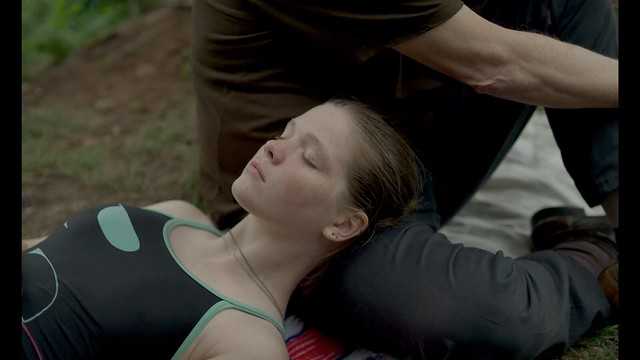
My Wife Cries (2026) - Schanelec My Wife Cries_Still_04 - 1 Angela Schanelec’s contemplation on love is even more opaque and abstract than usual in her latest, My Wife Cries. As usual, there will be people having difficulties in communicating their feelings, with their frustrations in full display on their sad faces. There will be overwhelming tender moments shared among them. And there will be visual cues so abstract and unknowable, they will remain mysteries until repeated viewing. There will be imbued silences and heart pouring, long monologues. And these are all the reasons why I eagerly await every new Schanelec film's release with anticipation. And she does not disappoint.

Thomas (Vladimir Vulevic), a lanky crane operator in a construction company, gets a distressing call from his young wife, Carla (Agathe Bonitzer, seen in Schanelec's Music). He later finds her crying in the woods, inconsolable. She asks why he stopped going to the dance classes with her. Why does he not find interest in her wants and desires? He finds out that her dance partner in a dance class she has been attending, has died in a car crash while she was with him. She confesses that she planned to run away with the man. Unlike Thomas, he understood her and had shown an interest in her desires and needs. Upon hearing this, which is too much to take for him, Thomas has a cardiac distress episode and gets hospitalized.

So goes My Wife Cries, perhaps Schanelec's most impenetrable and abstract film to date. But I say this every time after watching her new output. The film revolves around the couple and their immediate workfriends. There will be a Band of Outsiders style, out of nowhere choreographed dance scene, there will be color coded wordrobes, there will be odd characters with sad faces popping up. And there will be long continuous monologues. And just like her other films, there will be people trying desperately to connect with each other and failing. There will be wondrous and contemplative moments in nature, contrasting with traffic, industrial machine noises and a brass band's loud music in the street that drowns out the dialog.

Nothing is stated too obviously. The female characters, with their short hair and androgynous look, seem out of place against the harsh industrial landscapes. The lush greenery of Berlin as Thomas and Carla spend walking and talking, has a fairy tale, otherworldly quality to it, rather than a bustling city of 4 million. Schanelec's minimalist approach - lack of background music, camera movements and empty spaces as the characters stay still, staring off the frame, the film creates its own reality, far removed from our everyday lives, populated by sad, lonely people desperately trying to connect and understand each other.

My Wife Cries is another somber yet hypnotic puzzle piece about our yearning for human connections and our utter inability to understand one another. I can't wait to watch it again, to see if there's any other clues and bits I missed the first time to understand more and soak up all the human warmth and melancholy of Schanelec's lonely, yet lovely world.

Friday, June 9, 2023

Eternal

Music (2023) - Schanelec Screen Shot 2023-06-09 at 1.39.38 PM Screen Shot 2023-06-09 at 8.55.54 AM Screen Shot 2023-06-09 at 9.07.47 AM Screen Shot 2023-06-09 at 10.59.02 AMScreen Shot 2023-06-09 at 10.34.16 AMScreen Shot 2023-06-09 at 10.40.36 AM Screen Shot 2023-06-09 at 11.08.05 AM Screen Shot 2023-06-09 at 1.45.29 PM Screen Shot 2023-06-09 at 1.20.43 PM Screen Shot 2023-06-09 at 1.22.29 PM Angela Schanelec's new, nearly silent film, simply titled Music, is supposedly 'freely' based on the Greek Myth of Oedipus. It might be the most enigmatic offering from the esteemed German director. But its depiction of melancholy and fragility of human life is nevertheless so beautiful and timeless, I can't help tearing up by the end.

As always with Schanelec's films, there are striking images and a ghost of a narrative thread with lots of gaps that you will need to fill in yourself. Time is elastic in Music; in one scene you see an infant being found and adopted, the next we see Jon (Aliocha Schneider) accidentally killing someone (his father?) and going to prison. There's a prison guard Iro (French actress Agathe Bonitzer) who attends to his swollen feet (like Oedipus by his unsuspecting mother/lover), and gives him the list of classical composers to listen to. Then he's out of the prison, and they are expecting a baby. But fate would have it, tragedy follows Jon as his past catches up with him. He is a musician now, living in Berlin with his grown up daughter. He sings melancholic songs in falsetto on stages. And also, he is going blind.

Static framing and stoic acting that Schanelec cultivated over the years are all present here. Pivotal, life-altering actions happen mostly off frame. It's almost dialog free. And it doesn't really matter if Jon looks the same after many years, if not decades.

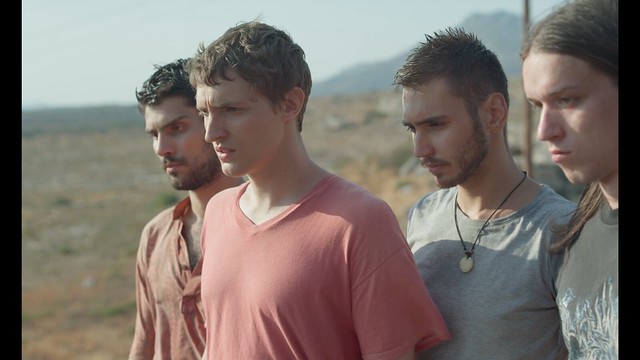
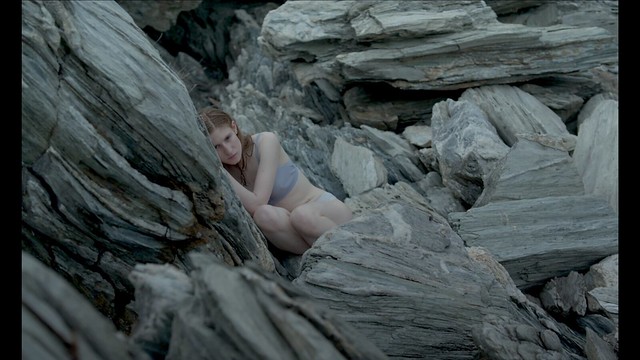
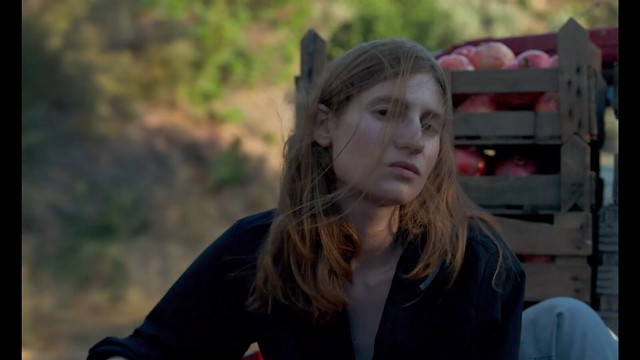
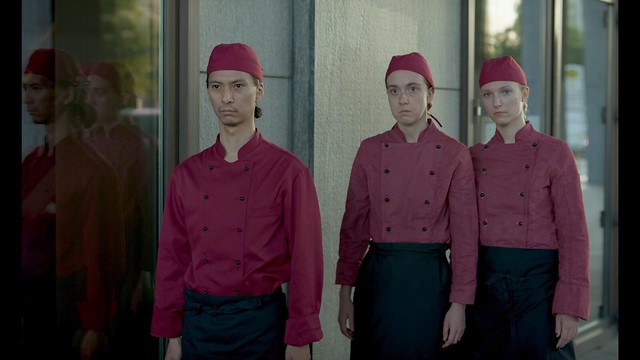
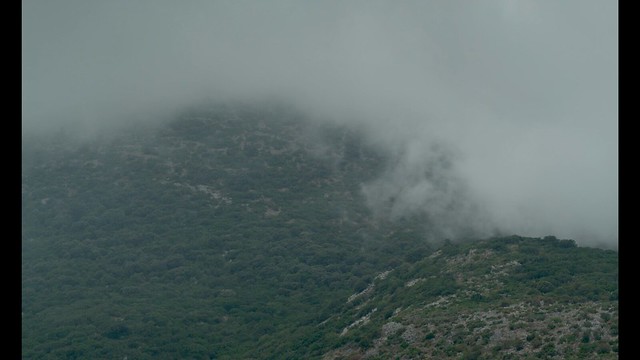
Schanelec told me once that she usually maps out an idea for a project from one or two images. This time, she takes a cue from a Greek theater. And images in Music are indeed striking. The windswept rocky Greek terrain against stunningly blue Aegean sea and sky in the first half invokes both the timelessness of nature and our impermanence in it. The static, staged scenes featuring groups of young people - street gang, wistful prison inmates, bystanders in uniformed kitchen staff strongly remind you of the world of Aki Kaurismaki. And of course, music flows where dialog would have been with the help of Canadian musician Doug Tielli in his high-pitched voice (a cross between Sigur Rós and Nick Drake). His songs not only serve as a Greek Chorus chronicling Jon's melancholy, but also as testaments to the beauty of music, transcending this fleeting dream we call human existence.

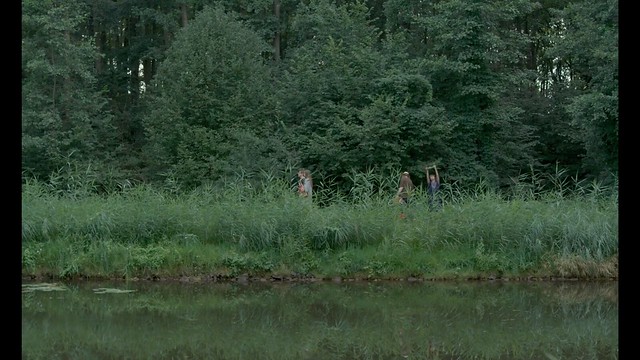
The long tracking shot that ends the film, filmed from the other side of the river embankment as the characters walk and sing in the beautiful summer day has the feeling of an eternity. It's an achingly beautiful film.