Showing posts with label Hirokazu Kore-Eda. Show all posts

Saturday, January 24, 2026

The Big Empty

Air Doll (2009) - Kore-eda Screen Shot 2026-01-23 at 7.57.09 PM Screen Shot 2026-01-23 at 8.01.13 PM Screen Shot 2026-01-23 at 8.21.02 PM Screen Shot 2026-01-24 at 4.17.34 PM Screen Shot 2026-01-24 at 4.20.23 PM Screen Shot 2026-01-24 at 4.26.44 PM Screen Shot 2026-01-24 at 4.49.21 PM Screen Shot 2026-01-24 at 4.54.41 PM Screen Shot 2026-01-24 at 4.57.19 PM Screen Shot 2026-01-24 at 5.05.41 PM Hirokazu Kore-eda's Air Doll appears to be tackling the modern society's illness - urban loneliness and soullessness, the themes explored by by other prominent Japanese auteurs of its time, namely, Kiyoshi Kurosawa, Sion Sono and Shinji Aoyama, with Korean actress Bae Doona (Linda, Linda, Linda, Sympathy for Mr. Vengeance, Host). The result is a mixed bag.

Adapted from a manga, about a blow-up sex doll, Air Doll is an odd choice for Kore-eda in his mid-career, because he had always been regarded as a Ozu's heir apparent with his gentle, life affirming, if not death obsessed films. It concerns a middle-aged man living alone with his sex doll (Bae), named after his ex-girlfriend Nozomi, as a companion. He talks to her and bathes her and has sex with her. While he is out working as a waiter at a restaurant, Nozomi comes to life and walks around the town. She even gets a job at a video rental store. People around her are unbothered by her demeanor or she has seam lines around her body. With her big eyes and blank expression, Bae approaches the role with pure wonder and innocence of a new born child.

Nozomi's accented Japanese narration serves well as an inanimate object which came to life and just gained a heart. Walking around and meeting people, observing and experiencing human conditions, she learns that there are others out there that compliment you and complete you to have a full life, that people need one another. She has an accident at the job and punctures her arm and deflates and her colleague Junichi (Arata) puts a plastic tape on her arm and blows air back into her navel. The romance begins. He says she and he are not unlike. He feels empty inside as well. He says many feel that way. She then experiences heartbreak, realizing that she is someone else's mere substitution.

She even tracks down her maker (Joe Odagiri). He philosophically explains that human life is both sad and beautiful. But when all is said and done, we are either burnable (humans) or unburnable (sex dolls, because of environmental restrictions) garbage. Yes, once it gets dark, it never lets up.

The film is closer to Spielberg's A.I- Dark yet saccharine. There are secondary stories of other characters we get only glimpses of, and don't quite resonate as it should. Air Doll is not quite the right fit for genteel filmmaker.

Saturday, September 14, 2024

Reach Out and Touch Faith

Distance (2001) - Kore-eda Screen Shot 2024-09-13 at 2.31.58 PM Screen Shot 2024-09-13 at 11.39.58 AM Screen Shot 2024-09-13 at 12.03.02 PM Screen Shot 2024-09-13 at 2.07.25 PM Screen Shot 2024-09-13 at 2.15.45 PM Screen Shot 2024-09-13 at 2.45.57 PM Screen Shot 2024-09-13 at 3.08.48 PM Screen Shot 2024-09-13 at 3.09.02 PM Screen Shot 2024-09-13 at 3.11.01 PM Screen Shot 2024-09-13 at 3.11.59 PM Hirokazu Kore-eda paints a complex picture in the aftermath of unspeakable acts of terrorism and contemplates on the collective responsibility in Distance, inspired by Aum Shinrikyo Sarin Gas Attack in Tokyo Subways in 1995. But in true Kore-eda fashion, the film is not about the carnage or condemnation of the soulless society, but a plea for us to reach out and take care of each other, even though understanding one another can be hard.

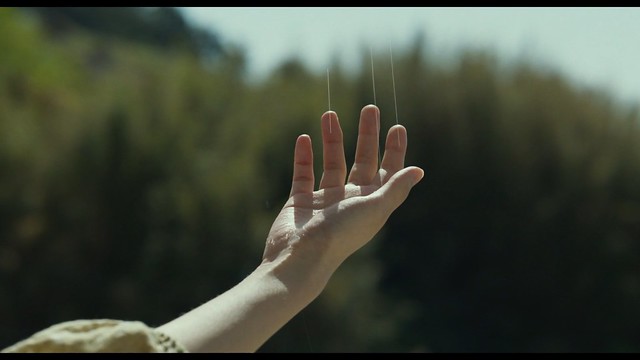
It's been three years since the Ark of Truth cult sabotaged Tokyo's water supply system that killed hundreds and injured thousands, we are informed by the TV broadcast. After the act, the members of the cult committed suicide, and their bodies burned and the ashes scattered. Four family members of the cultists, still grappling with the fact that their loved ones committed such a heinous act, get together and pay a visit to the lake in the countryside where the ashes are supposedly scattered. It is revealed that they've been doing this annually, making the trips together to pay respects to the dead.

On the way to the lake, they encounter a surviving cult member Sakata (Tadanobu Asano), who abandoned the group at the last minute, there as well. He keeps his distance. After the visit to the lake and paying respects in various forms, (laying flowers in the water, praying and just saying a few words) they turn back, only to find their car stolen. It's getting late and the rain storm is brewing in the distance, they have no choice but follow Sakata into a cabin which was home for cult members.

Talking to each other and asking Sakata as they spend the night together, they find out the insights and thinking behind their estranged family members. In the beginning, Kore-eda unhurriedly shows the four living their lives, doing their jobs - a swimming instructor, a teacher, a salaryman and a florist. In a series of flashbacks, we get to witness their interactions with their family members who became cult members. Something is missing in their lives, they want to start over, they want to heal their souls...

Just like his previous films - Maborosi and Afterlife, Kore-eda plays the pivotal memories of each character- their final goodbyes, losing them forever to the cult - things get violent for some, not understanding their family, some uneventful and more contemplative. However, that was the last interaction they have had with their loved ones.

Like all his other films, Kore-eda concentrates on the concept of a family in Distance. That it is our duty to shorten the distance between us before it becomes too far and unreachable. With the poetic visuals and contemplative nature, Distance is closer to his earlier films than family dramas of his later films. Unlike the Japanese cinema of disaffected in the late 90s and 2000s by filmmakers like Kiyoshi Kurosawa and others, Kore-eda wants to give us a glimpse of hope in human interactions and advocate reaching out and understanding each other with Distance.

Monday, January 8, 2024

Pig Brain

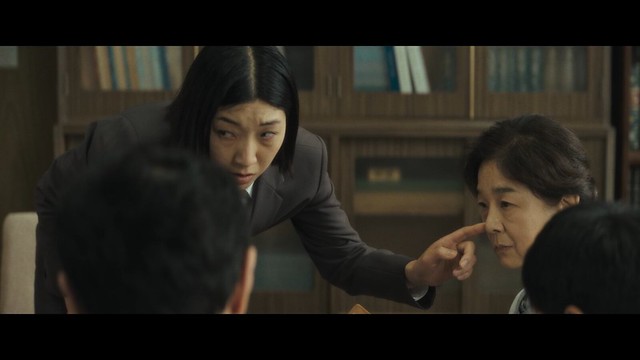
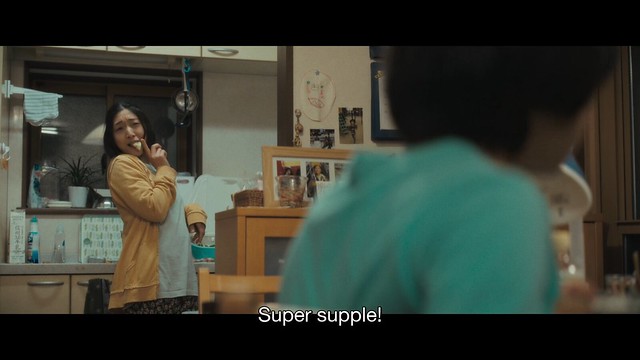
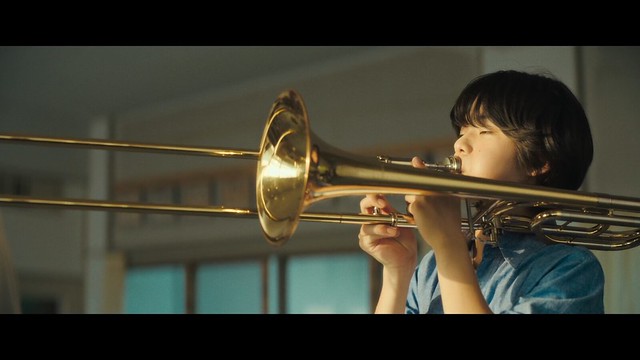
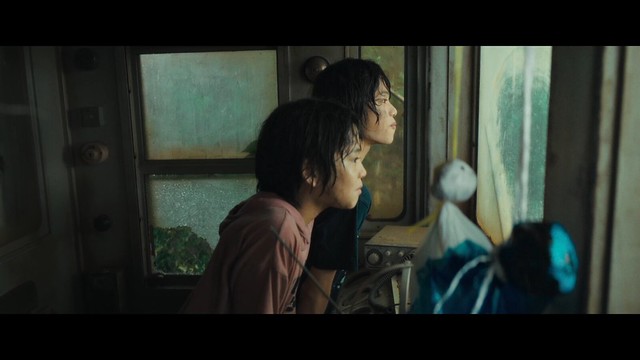
Monster (2023) - Kore-eda Screen Shot 2024-01-08 at 8.51.59 AM Screen Shot 2024-01-08 at 8.47.28 AM Screen Shot 2024-01-08 at 9.56.01 AM Screen Shot 2024-01-08 at 10.21.18 AM Screen Shot 2024-01-08 at 10.25.14 AM What seemingly starts out as a rashomon style abuse accusation in a school drama, Kore-eda's new film Monster is actually about something completely different. It's a massively poignant lovestory and an indictment of the bigotted society where people assume the worst in each other. It tells a elementary school kid Minato (Soya Kurokawa) being accused of bullying another child Yori (Hinata Hiiragi), and in turn punished by a young teacher Hori (Eita Nagayama). When Minato's single mom (Sakura Ando) notices about his son's odd behavior and sullenness, she complains to the principal of the school. But the principal and other teachers have already built an impenetrable wall to protect school's reputation and repeats the scripted response and apology to her. Enraged, mom finally gets Hori fired. But her son's odd behavior doesn't stop. On the eve of a tropical storm approaching the area, Minato disappears. His mom and Hori, start looking for him in the storm.

Then the film goes back to tell the same moments - some seemed insignificant and some pivotal before, from the kid's perspective and reveals innocent friendship and moving lovestory between two kids. Japan, like other countries (let's not kid ourselves, all countries are conservative) still maintain gender affirming activities in media and at home. Parents convince themselves that they can 'fix' their children if boys or girls are not behaving like boys or girls. We scrutinize everyone for their supposed roles in society and presume their shortfalls- Single mothers are drama queens, too protective of their children, Teachers should never visit bar hostesses, for example.

The society full of stereotyping and prejudices, children can't express what they feel, not only not to adults but to each other either. Rather they become cruel liars. It's not that they are evil. But the harm is done.

As is the case with Kore-eda films, he gets the most outstanding performances out of young actors. Both Kurokawa and Hiiragi shine in their demanding roles emoting in their uncertain stares and silences. As usual, Sakura Ando is a national treasure as a frustrated single mom and an unsuspecting role model. And both Nagayama and Yuko Tanaka (who plays the principal) are great in their supporting roles. The late Ryuichi Sakamoto's score adds to the film's greatness.

Thursday, August 4, 2022

Baby Box

Broker (2022) - Kore-eda Screen Shot 2022-08-03 at 10.54.41 AM Screen Shot 2022-08-03 at 1.15.43 PM Screen Shot 2022-08-03 at 12.08.47 PM Screen Shot 2022-08-03 at 11.42.31 AM Screen Shot 2022-08-03 at 12.15.51 PM Screen Shot 2022-08-03 at 12.40.56 PM Screen Shot 2022-08-03 at 1.17.50 PM Japanese filmmaker Hirokazu Kore-eda's foray into working internationally continues with Broker, a Korea set family drama with all Korean cast.
As the director of many films that prodded the traditional notion of family, such as Nobody Knows, Like Father Like Son, After the Storm and Shoplifters, he continues with Broker, a heartfelt film about makeshift family, which feels like a grittier and edgier version of its predecessor, Shoplifters. It seems that the film is the culmination of Kore-eda's desire to work with Korean actors within the booming Korean film industry (produced by CJ Entertainment) despite not speaking the language. Broker is a beautifully written and acted film that has just as much emotional resonance as his many celebrated Japanese films.

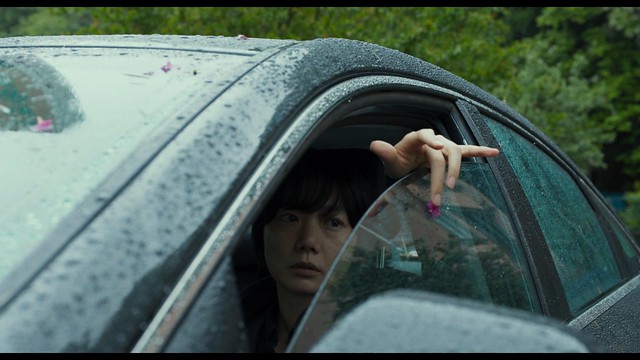
It's a rainy night in Busan, where a young mother, Soyoung (Lee Jieun, aka IU, a K-pop superstar) abandoning her newborn baby in front of a church. There is a baby box at the entrance where a unwanted baby can be dropped annonymously. The hesitant mother drops the baby right in front of the box and runs away, not knowing she is watched by two law inforcement agents (Bae Doona and Lee Juyoung), who have been doing a sting operation on the suspected baby-selling, broker operation by the church workers. Also witnessing the drop off are Sanghyeon (Song Kangho) and Dongsoo (Gang Dongwon), looking at the monitor inside the Church. They find the note with the baby by Soonjin that she will come back to fetch him soon. No date or contact info. So starts Broker, an ensemble piece with superb acting from everybody involved. It becomes a road movie as Soojin comes back to claim the baby and gets involved in underground baby broker business with Sanghyeon and Dongsoo, as they try to find a suitable parents-to-be for the baby (at the highest price). Boys can pull in upwards of 10,000,000 won ($76,000) and girls only half that. With the baby and an orphan boy from the orphanage where Dongsoo grew up in-tow, they make a makeshift family, traveling all over southern part of Korea to meet possible adoptive parents.

These are all down and out characters whose lives have been nothing but rosy. Kore-eda draws sharply on their resentment and distrust in each other in the beginning, but slowly builds on their commonality and innate human decency. The biggest 'change of heart' moment belongs to Bae Doona's Soojin, a veteran police woman whose hatred of Soyoung, from "Why even have a baby, only to abandon it?" to understanding people's circumstances as to why the decision was made. It also turns out Soyoung is on the run because she accidentally killed the rich baby daddy who didn't want the baby.

In a polarized era where the issue of abortion rights is much politicized, Broker might be seen as naive by not putting emphasis on the issue. But it has some sharp criticism on our modern society putting blames soley on women and lack of men's involvement in raising one and our collective role in raising the neglected ones in general. In a very touching scene, the orphan boy who hid himself in Sanghyeon's old van to sneak out of the orphanage, asks Soyoung to give a prayer before they all go to sleep in a hotel room. So Soyoung thanks everyone for being born. We do not have a say in us being born. Our circumstances might be different. But we are all here so we might as well give thanks.

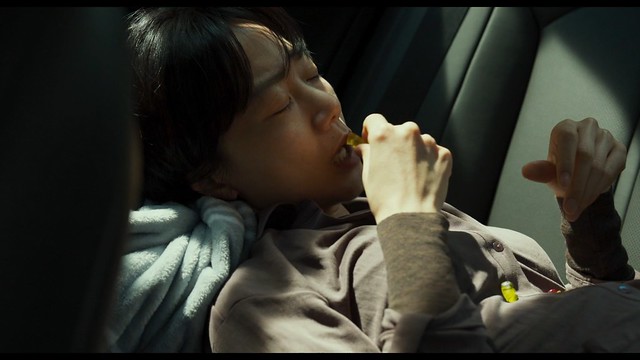
Song Kangho is wonderful as usual. He portrayal of Sanghyeon, a divorced man dreaming of his past, gives much humanity and subtle humor, very much resembling Lily Franky in Shoplifters. Bae Doona is also great as a cold hearted detective slowly realizing that criminals are not so different than the rest of us, that they are just trying to get by. We also get to see her eat a lot of junkfood in the car and being mean to her underling. The real acting revelation is Lee Jieun as a young mom. Her bitterness, her anxious stares tell thousands stories. Her looks convey both volatility and hidden tenderness.

I did not know that Baby Box was a thing. And that there is a black market for babies for chidless parents who don't want to go through legal huddles to adopt. And there are so many orphans who grow up dreaming of their mother returning to pick them up. All these nicely fit into Kore-eda universe of what consitutes a 'family'. Just like Shoplifters, everyone in Broker knows that they won't get a second chance at having a family. Everyone knows that good things will not last. What counts is the human connections made by this particular brokering and the extended parenting it created. That the kid will be all right.

Monday, January 9, 2017

It's Oh So Quiet in Kore-eda's After the Storm

After the Storm (2016) - Kore-eda
8zOfNUK
Kore-eda Hirokazu's new film, After the Storm, about a dead-beat dad getting over his divorce/letting go is as subtle as any other of his films. When I first heard the title, it immediately reminded me of the conversation I had with Kore-eda when he was presenting Like Father, Like Son. I asked him if the Fukushima disaster and the Great Eastern Earthquake of 2011 changed him as a filmmaker. He said the real impact of the disaster on Japan and its people was yet quite unknown. After a pause, he told me this:

But I think this time, in terms of making this film (Like Father, Like Son), there were a couple of motivations for it. One definitely had to be the earthquake. I think it really enforced the idea of bonds in Japan. The idea actually became very trendy. In a way, it wasn't so good in Japan before (in that regard). But the idea of bonds and people supporting each other and all of Japan becoming one has become very common in Japan. I've been thinking about that, about how we can reduce that feeling to a small community that is family. So I think in terms of how I came up with the idea for the movie about a man and his bond with his family, I suppose the earthquake played the role.

The idea of family bond is not a stretch for Kore-eda, considering his filmography. Then again, nor is death (Maborosi, Afterlife). But the implication of a incoming storm in After the Storm here is definitely about bonding and renewal than death and destruction.

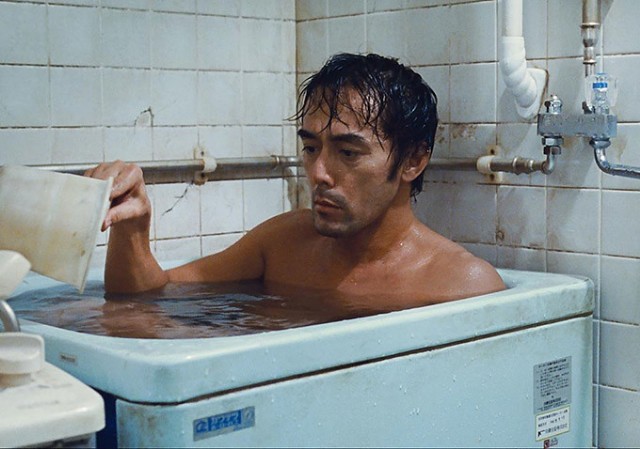
A Kore-eda regular Abe Hiroshi (Still Walking, I Wish), a long, sad faced actor, plays a one-hit-wonder, washed up writer Ryota, still carrying the torch for his ex Kyoko (Maki Yoko of Bitter Honey, Like Father, Like Son). He spends most of his time blowing money (that he earned at the detective agency - 'research for a book' temp job which became permanent) at the racetrack. With the custody arrangement, and sandwiched between his always patient aging mother (always marvelous Kiki Kirin) and grilling sister, he has to resort seeing his son who's in elementary school only on the weekends and constantly being asked for alimony payments.

Using his private detective skills, he starts spying on Kyoko's new romance with a manly man who coaches his son in a little league team. He is not a bad guy, but Ryota can’t help constantly asking his son if Kyoko is falling for him or not. Obviously Ryota wants to give it another go at her, even though it is a pretty hopeless prospect.

The news of incoming storm as an excuse, Ryota takes his son to his mother's and maroon themselves there with furious Kyoko, over one stormy night.

The Typhoon season (in Summer) is a yearly occurrence in Japan. Just like earthquakes, violent storms are part of Japanese people’s daily lives. But nothing too dramatic happens in After the Storm. Ryota gets to relive one more night, just like old times, with his wife, son eating his mother's food. Spending one last time with them as gajoku/family, before he lets his old feelings go and grows up and moves on, thanks to the storm. Thanks to the mother nature to smooth things over.

Taking on many Japanese social issues - divorce, unemployment, elderly care, albeit very subtly, After the Storm is another gentle family tale with great measured performances from everyone involved.

In Kore-eda’s world, the storm is not a cause of destruction and pain but a helping agent to bond with each other- something the current Japanese society has lost due to modern life taking its course. But the film is so old-fashioned and soft-edged, it hardly registers on an emotional level. Still a great little film. But after the greatness that was Our Little Sister, After the Storm feels like a minor Kore-eda.

After the Storm opens in New York and Lost Angeles on Friday March 17.

Wednesday, January 4, 2017

Heavenly Creatures

Our Little Sister (2015) - Kore-eda
7e75db88eab1c465fc9b68294e23a64e
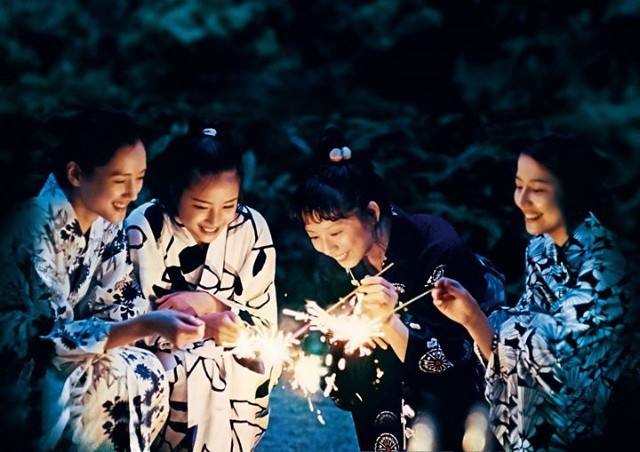
The movie starts. Three Koda sisters gather in a mountain town for their dad's funeral. They hadn't seen him in more than 15 years. He had an affair with other women and their mother ran away long ago. It was the eldest, Sachi (Haruka Ayase)'s job to take charge of their old style home in picturesque seaside Kamakura and raise her siblings. They find out they have a wide eyed, 15 yr old little step-sister, Suzu (Suzu Hirose) who'd been taking care of their father in his deathbed. She doesn't get along with her step-mother (he was married 3 times). Sachi decides to invite Suzu to live with them. Suzu accepts the offer and they say their goodbye at the train station until their next encounter. The little girl runs after the leaving train... waving madly at the strangers she just met... like a puppy dog in a shelter who just got some attention...

I break down. It's only been twenty minutes into the movie and I am sobbing like a little girl. Fucking Kore-eda. He got me real good. Our Little Sister is such an old fashioned movie - a small town where everybody knows each other, sibling rivalry, life's little complications, family traditions.... But it's done in such a gentle, loving way, you can't deny its honest-to-god innate goodness in ordinary people Kore-eda's portraying. It's achingly beautiful movie.

Thursday, January 16, 2014

Interview: Hirokazu Kore-eda on Like Father, Like Son and Parenting

 photo 6f1c0d6f-03c9-4d8a-a527-fa478de8faaa_zps3f37a590.jpg
Regarded by many as the best contemporary Japanese filmmaker and spiritual heir to the master filmmaker and humanist, Ozu Yasujiro, Kore-eda Hirokazu has been making quiet, deeply affecting films about childhood, family and death. I told myself not to cry while watching his new film Like Father, Like Son at the New York Festival last fall, but couldn't help tearing up at the end.

Soft spoken and a with gentle demeanor, Kore-eda was exactly how I imagined him to be when I sat down for an interview, one early October morning.

Many of your films deal with family and childhood and this film is no exception. I'd like to know about the origins of this particular film which involves a 'switched at birth' story.


For the last couple of films I tried to incorporate my life in it as much as possible. I tried to incorporate motifs and things from my life, the subjects that are close to me. In terms of this movie I think the starting point was what happened with my daughter. I actually didn't have very much time to spend with her. While working on my last film, I Wish, I was away for about a month and when I came home after being away for that duration, she recognized me as a father but I could see that there is this 'resetting' in her mind as to who I was. She was three at the time. Then when I was leaving the next day, in the hallway to say good bye, she said, "Please, come again." [laughs]

It was shocking to me. Then it came to me that even though we are connected by blood, a father has a very different existence and relationship, compared to that of a mother to a child. So I actually panicked. I thought, "this is not good." And based on that experience it made me to think about the ties between the parents and the children. Especially time. The time we spend together, compared to just blood ties - all these went into making this film.

So then do you feel closer to Ryota (played by Japanese TV and pop star, Fukuyama Masaharu) more so than Ryudai (Franky Lily)?

That's right. Ryota. And making him the main character, I thought about 'who would be the least appealing character in terms of who you want to raise your child with. And that was the type I'd like the least.

Fukuyama Masaharu, who plays Ryota is a big star in Japan. Did you have him in mind for the role?


I wasn't conscious about him playing the role when I was working on the screenplay. It was Fukuyama who approached me and wanted to work together. This offer from him was the starting point. I thought I'd portray him in a different way than the way he is usually portrayed before. So that was how it happened.

I couldn't help wondering about your method working with child actors. In films like Nobody Knows, I Wish and now Like Father, Like Son, you capture the moments of pure delight in their faces that is too real to be just them acting and being in characters.

It actually starts with an audition process, forming communication with them to see whether they understand what I'm saying and I understand what they are saying- that's where it all starts. Once that communication is formed with the premise (of the film) then we move audition into rehearsals. It's not that I'll pass out the scripts to them or give them lines to say. It's more of doing a particular scene with me or a person who's going to play the father and just to see how to say the words, have them hear through their ears and have them come out of their own. It's a natural process. Out of hundred children, there are maybe five or six who I'll be able to interact in this way, with those I'll bring them to the set. In terms of the lines, I don't feed them lines, I try to incorporate their words and vocabularies into the lines I create. So i consider myself sort of borrowing their words and returning them. They are the inspiration of those lines. I might say something like, 'try to say something like you did last time or say what you told me the other day'. That's how I've been working with children the last ten years or so.

Has the Great Eastern Earthquake that hit Japan and The Fukushima disaster which has been going on since then changed anything for you as a filmmaker?

Yes, it is something that I am conscious of. It's not really about something that has affected how I express myself. That's something I don't really know for sure. There's probably a portion which unconsciously incorporated into my work, but it's not really simple. Of course there are a lot of works regarding the subject and it's important. But I really think that we are not going to be able to digest everything that's happened until, maybe 5 or 10 years down the road, in terms of its impact on Japanese society.

[He pauses for a long time, then continues]

But I think this time, in terms of making this film, there were couple of motivations for it. One was definitely had to be the earthquake. I think it really enforced the idea of bonds in Japan. The idea actually became very trendy. In a way, it wasn't so good in Japan before (in that regard). But the idea of bonds and people supporting each other and all of Japan becoming one has become very common in Japan. I've been thinking about that, about how we can reduce that feeling to a small community that is family. So I think in terms of how I came up with the idea for the movie about a man and his bond with his family, I suppose the earthquake played the role.

There is always a sense of optimism I feel in your movies. Is it your inherent nature as a filmmaker to portray childhood or the next generation in optimistic light? Is it why you always go back to the subject of family?

In Japan, the word optimism doesn't have a positive connotation. It has a tinge of 'escape from reality'. I wouldn't use the word to describe my work. I don't like making films about downcast or pessimistic side of life. That's just not what I do. The thing about making movies about family is that it is a troublesome subject but also essential. Something that you need.

I know that you support the younger generation of filmmakers by producing their films. Nishikawa Miwa (Dear Doctor, Dreams for Sale) is one of them. I'm just wondering how you go about supporting certain projects with younger directors. And can you tell us some young directors you can think of that we need to know about?

Some of them I supported have already been in my crew so there is a connection already there. And when I actually read a script by someone and it seems interesting, I'd support them. That's usually the process. It may not be so in the film world, but in the Japanese TV community where I came from, it is pretty common practice to help younger pupils. And also I don't have any director friends, so it's a good way for me to make friends who are directors. [laughs] Young directors, young directors….

[Thinking really hard… asking others]

Yamashita Nobuhiro (Linda, Linda, Linda) and Nishikawa Miwa, come to think of it they are not that young. they are all in their forties. [we all laugh] Right now, they are the two I can think of…

Monday, September 30, 2013

Nature vs. Nurture

Like Father, Like Son (2013) - Kore-eda
like father, like son photo 2e5b11ef-ebd4-44af-b55a-c79a2cf5f27b_zpsada99c1c.jpg
It seems Kore-eda Hirokazu is incapable of making bad movies. The babies-switched-at-birth premise in films is nothing new. But he just makes it so darn affecting and poignant, avoiding all the clichés that go with this kind of blurry-eyed family drama. Him getting unbelievable performances out of his child actors is already legendary since, then 12-year old Yagira Yuya won the Best Actor Award at Cannes in 2004 for his film Nobody Knows. But it really stumps me how Kore-eda manages that with kids every time. Like Father, Like Son is no exception. For example, I really need to know how he captures moments where child actors shrieks in true delight while maintaining themselves in character. HOW? If Kore-eda's last film I Wish was more focused on childhood, Like Father, Like Son is more about parenting.

Ryota Nonomiya (Japanese TV star and pop idol, Fukuyama Masaharu) is a hard working architect who pushes his adorable, well-behaved son Keita a little too much to excel at everything. It's not that he doesn't love his son, but because he's always been pushing himself hard all his life to be successful- so naturally that's the way it is supposed to be with everyone around him. But married to his career, he doesn't have much time for his family. When he and his wife Midori (played wonderfully by Ono Machiko, Eureka, Mourning Forest) gets an urgent message about the switcheroo from the country hospital where Keita was born 6 years ago, their tranquil life gets turned upside down. They meet their counterparts, Saikis - Yudai (Franky Lily) and Yukari (Yoko Maki) a country bumpkin couple managing a small electrician's shop. They have three adorable children including Ryusei, Nonomiyas' real son. They happen to be a very loving, warm family. Both parties decide that it is best to switch them back before they get too old. Either way, it is going to be a scarring experience for both families.

In a funnily awkward scene, Ryota in his arrogance of the well-to-do, unknowingly insults the Saikis by offering money to take both children in. Astonished by this suggestion, Yudai, a little older than his counterpart, walks up to him and with a moment of hesitation, bonks Ryota in the head. Midori apologizes profusely for her insensitive husband's behavior of course. After that, they slowly agree to do family get-togethers and sleepovers to a permanent switch-over. Even though Ryota says that the switcheroo is not a clear-cut matter, he makes up his mind never to see Keita again.

The children are confused and don't really know what's going on. Ryusei is often left alone in their posh, hotel-like, apartment with Midori who is having hard time getting used to him. She still feels guilty about sending Keita off and starting to love Ryusei. It bothers Ryota that Ryusei's unruly behavior and table manners are not like that of Keita's. It is quite apparent Ryota has been mostly absent and quite terrible at being a father to Keita in many ways compared to affable, warm, funny Yudai.

How could one just ignore your child of 6 years and take up another just because he is your own flesh and blood? The good old, Nature vs Nurture debate aside, Kore-eda makes you think about what it means to be a good parent. Ryota's own daddy issues float up to the surface during the process and him realizing his faults plays out beautifully and naturally as the families reunite with their children who grew up with them.

It's another warm, life affirming film by Kore-eda with the help of pitch perfect acting from everyone involved. One of the best films I've seen this year so far.

Like Father, Like Son plays as part of NYFF. For showtimes and tickets, please visit FSLC website.

Thursday, May 10, 2012

Everyday Miracle

I Wish (2011) - Kore-eda
4
Hirokazu Kore-eda (Nobody Knows, Still Walking)'s endearing new film, I Wish concerns two brothers Koichi and Ryu (Koki and Ohshiro Maeda, real life brothers), who live in different parts of Kyushu (southernmost among Japan's 4 main islands) as a result of their young parents splitting up. Koichi always wishes that some day his family will reunite. He keeps constant contact with his carefree younger brother. The news of the bullet train between the two towns they live in inspire them to come up with wish granting myth- when south and north bound trains pass by each other, the energy created by the trains would be so tremendous, it will grant any wishes uttered at that moment. They enlist their close school friends with different wishes and aspirations to take a trip to a station located halfway between them, risking punishment from their parents and teachers for skipping class.

I Wish is sweeter and lighter than Kore-eda's previous films. Death, the director's usual theme, only occurs to a pet dog here. After becoming a father and making Ozu-esque family drama, Still Walking, this life affirming dramedy feels like the most logical next step for him to take.

One thing that struck me most upon watching I Wish was that it could've easily been a Ghibli film, and I say this in the most affectionate, positive way. From its adorable young protagonists, a rural setting, gentleness of the adult characters, languid pace, to life lessons learned along the way, it plays out like a Miyazaki film without a cat bus. But as was the case with Nobody Knows, It's the amazing performances of its child actors that are the front and center of the film. Kore-eda provides enough room not only for the fantastic Maeda brothers, but also for other amateur actors who portrayed their friends to shine in their respective roles with natural, nuanced performances full of childish yearnings and surprising grace.

Also many familiar faces show up in supporting roles as adults, including Jo Odagiri as the deadbeat father and a struggling musician and Hiroshi Abe as a strict teacher.

My favorite part of the film is the static shots of inanimate objects near the end: mementos from their journey. The shots are held just long enough for us to appreciate those shared eternal moments. By the end I realize that its Japanese title, Kiseki (Miracle), refers more to everyday miracles- meeting new friends, adventure to new places, kindness of strangers, taste of grandpa's homemade traditional cake, among others. Affectionate and mature, I Wish is a lovely film about embracing everything that life throws at us.

I Wish has a limited release on May 11 in New York and LA and other cities in June. Check Magnolia website for dates for a theater near you.

Friday, July 15, 2011

Headless Limbless Companion

Torso (2010) - Yamasaki
One might wonder that whether we need yet another film about a blow up sex doll, especially one coming from the long time Hirokazu Kore-Eda's cinematographer Yutaka Yamasaki. Not that Kore-Eda's approach in Air Doll was in any way sensationalistic, but Yamasaki's Torso is neither an over the top titillating sex comedy nor a whimsical fantasy about an inanimate semen receptacle coming to life. It's rather a quiet character study deeply rooted in realism.

Hiroko (Makiko Watanabe) is a thirty something office worker and by all account, a cold fish. She seems quite satisfied with her single woman status. Her interactions with people including her younger half-sister Mina (Love Exposure's Sakura Ando) are curt and distant. She declines invitations to the night outings by the men-hungry coworkers at the office. With no makeup and her scant wardrobe in shambles, she doesn't seem to try very hard even though she's not unnoticeable- with her black rimmed glasses and her hair tightly held back, she can pass as a sexy librarian. But she has a secret: every night, she inflates her male blowup torso, takes bath and snuggles up in bed with it. As the film progresses, we realize that this inflatable object is more than just a sex toy.

The tension rises when Mina moves in to Hiroko's tiny apartment after a fight with her abusive boyfriend Jiro (with whom Hiroko has a history with) and declares that she is pregnant. Forever a pesky little sister, Mina accuses her introverted older sister of ruining her life by introducing the womanizing brut to her. There is a strong sibling rivalry and complicated family dynamics at play. Their mother favors Mina and hates Hiroko for all her late husband's misdeeds. "When people die, they all become saints," mother replies, effectively cutting off Hiroko's reason for hating her dead stepfather and not showing up at his funeral. 

There is a funny beach getaway scene involving ecstatic Hiroko and her headless, limbless boyfriend in a Speedo that ends in skinny dipping. It's the first time we see her smile and giggle like a little schoolgirl. She seems to find the situation just as hilarious as the viewers do.

In Torso, there are no huge confrontations or public embarrassments to speak of. It is inevitable that Mina's snooping in the small apartment would result in finding out her sister's little secret. Would that be a big deal? Would it be less embarrassing if it was a dildo?

Yamasaki handles what could easily have been a sordid material with subtlety and maturity. Fortunately, in his hands, the inflatable object remains to be the inflatable object and never takes over the film as a centerpiece. It is Hiroko's emotional support system, a symbol of comfort against hurtful things. But she can't stay in her comfort zone forever. Torso is an astute observation on the state of arrested development, aided by hand-held, natural photography and pitch perfect acting by Watanabe and Ando.

Torso will be screening as part of Japan Cuts 2011 on Sunday, July 17th You can find out more information at Japan Cuts 2011 website