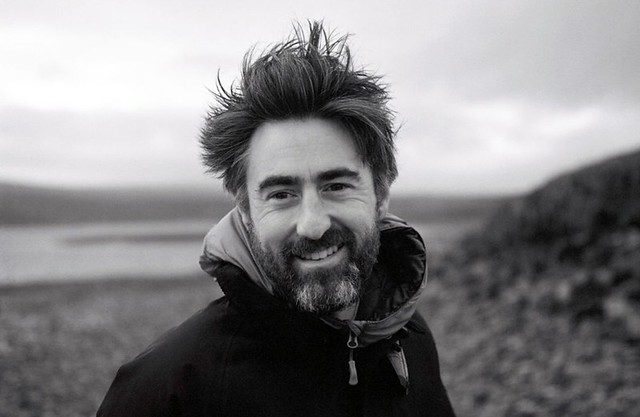
I had a privilege to watch Lady Macbeth at this year's New Directors/New Films Series this spring and got a chance to talk to its director William Oldroyd about his very accomplished first feature. The riveting, radical film was definitely the highlight of the series and is no doubt an early entry for one of the best films of the year.
Friendly and humble, Oldroyd talked about his transition from theater to film, his influences, his directing method and so on. But what struck me the most about him was his insistence to pay utmost respect to where it is due- his cast and crew, for the success of the film. Lady Macbeth signals the arrival of a major British directing talent since Andrea Arnold.
Lady Macbeth hits theaters July 14 in New York and Los Angeles.
When I watched the film I couldn’t believe that this is your first film! It’s so strong and accomplished. I know you were in theater and I want to know about your transition a from theater director to a film director.
Before I was working in theaters, I was in Art College and part of that program was to doing some multi-media. So I used an old VHS camera. But the things I was filming was something more abstract, non-narrative stuff. I’d project things on to difference surfaces and film it and so on.
But it did give me access to some simple editing facility. So I was able to learn how things come together. But then that got sort of lost for a decade when I got into theater and worked with actors and writers. That part of education I received was put aside and laid dormant. It was something I wanted to come back to eventually.
So when I found a script that I had quite an interest in, I wanted to see if I can film it. And so I got a little bit of money together and camera and some actors who I knew from theater, we just went for it. I wanted to see why that is different than theater. This is sort of how I began my education in cinema. I was relying too much on spoken words and had focused more or less on one direction. Then I started to watch films and broken them down, read some books and talked to filmmakers. Then I made a second short film, Best. It’s three minutes long.
I’ve seen it. It’s great.
I was more satisfied with it that I achieved something more cinematic. And then, when I was at Sundance, people told me; “You’ve made a short, so now you have to make a feature.” I thought to myself, “how do I go about it?” As you know for some people, the (Sundance) Lab helps you to do that. Similarly, in the UK, there’s I Features that supports independent filmmakers making features.
I see.
But you know, they still need, even the risk is pretty small - they produce 3 features for a million pounds each a year, you still need to prove to them, convince them that you will make a good film. So for me it was a further study. It was more like preparing a dissertation. Even if I was going to make a film alone, this is how I’d do it- providing all the supportive materials, test shooting, getting some actors together to show them. Actually, I’ve made a film before I shot it. (laughs)
But it was good. It was very useful. So when I got to do a real pre-production, I was already on the right path.
Lady Macbeth was based on a novel by Nicolai Leskov, a Russian writer. How is your film different than the source material?
The book for me was very plot heavy. It’s a novella so it’s pure plot really. What we had to do apart from Katherine is to flesh out the characters, because they are quite stereotypical. What Alice (Birch) did so brilliantly in writing a screenplay for Lady Macbeth was to make them live and breathe: Katherine is the same but Alexander and Boris are amalgamation of two other characters, Sebastian doesn’t exist in the book.
The ending we changed because it would be more satisfying from Katherine’s point of view that she’d get away with what she did rather than like all those women of that period…suffer. (laughs)
Like Mme. Bovary or…
Yes, exactly. I really supported that. It was great to allow her to get away with it even if that victory felt a little bit hollow.
Obviously we move it from Russia to England, so we had to be very careful about how to adapt it to reflect the class society and its penal system coming across the pond. We felt like we did just enough to get it right.
You mentioned Alice Birch who is also a playwright. Have you worked together before?
No. It was the first time.
How was the collaboration with her?
Great. We were very honest with each other. We both did theater. We both wanted to work on film. So we would go, “Is what I’m writing too theatrical?”, “Is what I’m filming too theatrical?” We would be constantly…we were just so super aware. I think what Alice wrote was very cinematic on the page.
There are two scenes I’m particularly pleased with, that they feel like as they were written which is when Katherine comes in drunk and there’s a confrontation with Boris making her spin on her hands and knees and the scene where Alexander comes in and says, ”You have to remain indoors.” and she humiliates him before the assault. And that’s literally what she wrote. We just presented it and filmed it as it was written. I knew when I read it that these are going to be remarkable. She uses these words like weapons. She is so precise. Her language is just amazing.
I can’t stress enough how visually striking the film is. It’s so accomplished with how it’s framed and so forth. There is a visual symmetry in the film I found very interesting. How did you come about this visual language?
Well, I watched film and I saw what I like. I like Haneke very much but I didn’t want to just rip off Haneke. I wanted to see what I liked about his films - the composition and the stillness and simplicity of the camera positions and how he presents a character in the framing. Then Ari (Wegner, cinematographer) pointed me to Last Days, which she liked very much. Night Moves, also. Kelly Reichardt and Gus Van Sant then became the directors we watched a lot of.
That’s interesting.
Because if you like Haneke, you like simplicity and that moved us into American minimalists or whatever you call them. Obviously when we mentioned Last Days, our editor didn’t jump for joy- when we suggested sort of slow single takes. He said, well you are going to be in trouble because when you go into edit, you are stuck. Then he encouraged us to get coverage because we were pushing for times, but shoot it, not to use it as he used to say. When you don’t have time and no money it doesn’t make sense to get coverage but I completely got it when we were there in the edit. Because had one of our longer takes wouldn’t have worked, we’d be in trouble.
Anyway, we had a system set up - trying to get the whole scene in one shot and think about two or three maximum set ups to get what we need to tell the story. We did 3 or 4 setups each scene, which makes sense if we had three hours for each scene.
Oomph, that's pretty short.
And that sort of defined out aesthetics. (We both laugh)
…which is experience i suppose. We then, for example, we didn’t shoot coverage. We didn’t get reverse, we didn’t get close ups and we didn’t get pickups. And that was the decision Ari and I made everyday. We were not going to set up for close up because we know what to use in one take. If we get coverage, there will be always a temptation to-
To use it.
I realized that I’d never have this opportunity again. We will never be allowed to do such things. People will say. “You need to insure that you get the scene.”
The coverage in that crawl scene wouldn't have been necessary. It's perfect as is.
I think I took my lead from Ari who were more experience than I am. She shot couple of films before. She would say, “We don’t do things like film our rehearsals because it always ends up in the film." Everyone will get upset because it will look like what it will look like, and performance won’t be right and that’s waste of time. I learned a lot from her that we make sure we have everything, as we want to be.
Gotcha.
Film is quite different. You have to break it down and it’s quite precise. And I’m used to running a scene 10-15 minutes just for the actors getting into it. Well you never do that in film, which is quite odd. It’s a little too mathematical, you know?
Is being a filmmaker just an extension of your artistic endeavor? Are you going back to theater after this?
Right now I’d like to do film. I can’t see doing both at the same time. It just takes so much time doing film. But there is something I love about being in a room with actors working out a scene. It’s really satisfying. I like that.
Speaking of actors. Florence Pugh is amazing in this.
She’s incredible.
How did she get involved?
Shaheen Baig, the casting director for The Falling, Carol Morley’s film, did the casting for our film and she knew Florence from that film. Brought her in because she thought Florence would be tremendous. So yes. We worked with her and she did few scenes and she came back. She’s just great.
Amazing, amazing performance. She is going somewhere because of this film.
Can you talk about those beautiful locations?
I was really lucky. There is a real love and support in UK for independent filmmakers. We were lucky because they are backed by government money. Each region has its own film agency. So it was Northern Film and Media in New Castle- they look after Northeast near the Scottish border. You go in and say, “we need a local crew and we need a location.” And they say, “well here is our location book, we know all of these people and here are the crew who are available.” And they introduced us to a person who runs the estate of all of Durham and they have this castle, which is empty. Probably because it’s too expensive to run. So when we walk around this empty castle, which is perfect, then you can have it for six weeks. So we moved in. We didn’t live there but we had our production office there, all of it- the equipment, wardrobe, everything was in there. It was kind of mini-studio.
And the outdoor scenes?
A lot of them are around the castle and we could afford two days in the moors. We were lucky because our location was 15-20 minutes from New Castle. The locals who were involved in it could commute in the morning. Had we found a house out of nowhere, people would’ve had to travel two hours each way to get there. So we shot the moor scenes on separate days.
It works. They match seamlessly.
As you said before and you changed the ending from the source material. Even though Katherine is a murderess, I can’t stop rooting for her. Does it make me a bad person?
No, because you understand what her predicament is. The stakes are pretty high. I don’t think we necessarily need to comprehend the consequences of her actions. But we understand how desperate her situation is. No I mean, Alice loves this character. We got few notes in early days of the production, “well she’s not likable.” Well, yeah. And? (laughs). It isn’t about making a film that young woman should be likable.
That’s the thing about this film though. She gets away with it precisely because she is a woman.
A woman of position.
That’s right.
That’s something that possibly in the States, there is a slight distinction that the class is very important in England. And it is very useful that your words are worth more if you are a woman of position than your servants. And it’s not to do with race. This is the thing that works in the UK and probably Russia because of those class distinctions.
That’s why the scene at the end makes the character Anna, much more tragic as you can see it in her face. What a great scene!
Naomi Ackie. She’s amazing.
Yes.
It’s not a criticism at all, but how do you feel about carrying the torch on behalf of women who are involved in the project - you have Alice Birch who wrote the script, you have Ari Wegman who was your DP, you have your producer, actresses making a film about a defiant young woman in a very patriarchal world?
I’m delighted. I think it’s fantastic. I was very lucky to have Alice as a writer and Ari who shot the film as well. Shaheen who casted all the great talent, Jacqueline (Abrahams), who was a production designer, Holly (Waddington) who did costumes, Sarah Golding who was our script editor… there are so many I want to name them all. Over 50 percent of cast and crew were women. And that’s the way it should be.

