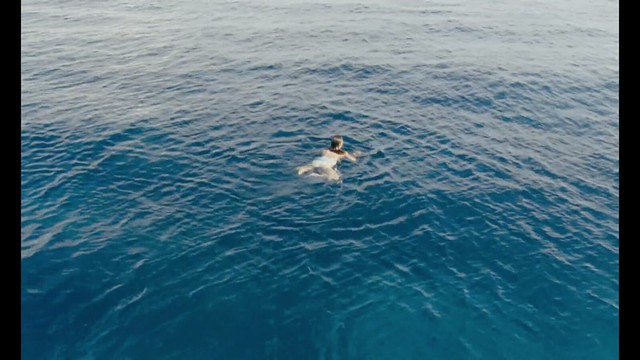
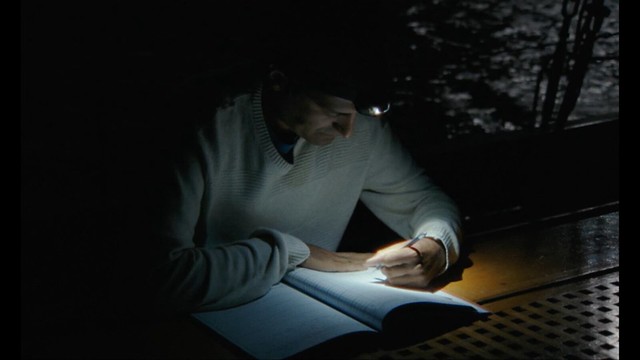


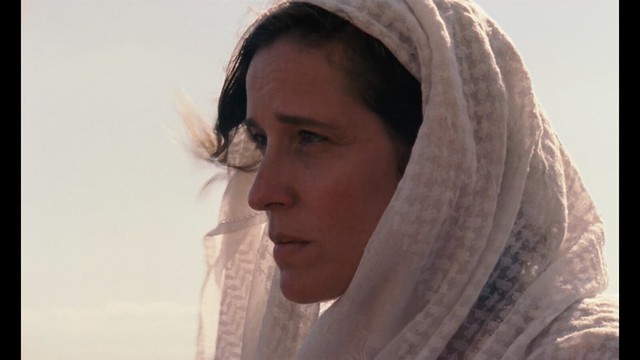

 "When you have no home, a round world is the best you could have," is one of many poignant phrases uttered in Helena Wittmann's sopomore film The Human Flowers of Flesh. Just like her debut film Drift, Wittmann's preoccupation with being at sea continues. "A woman from Marselle who lives on her sailing ship with her crew," turns out to be Ida (Angeliki Papoulia of Dog Tooth). Most of the film we see Ida and her crew doing chores and living on the ship - cleaning, cooking, reading, exchanging annecdotes and stories and swimming.
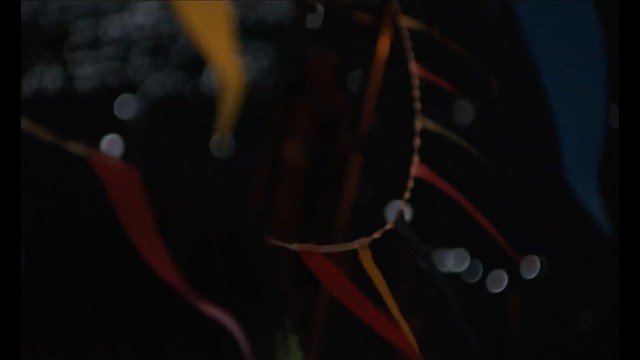
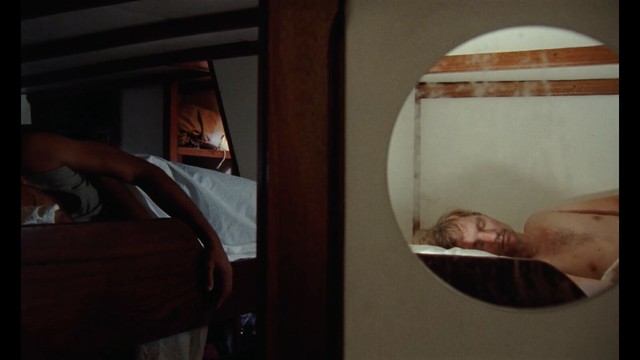
We see forever undulating sea on the deck and through the round windows from inside the ship, the horizontal sea level bobbing up and down as the ship sails through the waves. Just like Drift, the long stretches of these scenes has its own hypnotic rhythm. The crew converse in many different languages - English, German, Arabic, Portuguese, Greek and so on, yet nothing is explained about their background. Instead, Wittmann concentrates on the film's visually blissful moments - the shimmering sunlight reflected on the waves just below the deck, a piece of reef Ida brought from Antigua being passed around the crew, a dance party on the deck at night with colorful flags and lights gleaming and the blue sea as Ida swims back and forth. There are some show stoppers like the camera plunging into the blue depth to find a wreckage of a downed WWII plane at the bottom of the ocean floor. The film's full of sensual images that recalls Claire Denis films. But I think the aime here is different. In Wittmann's hands, the gleaming water and the sun are the subjects. They are vital to human life and we see that in Ida and her crew's uneroticised browned skin.
Speaking of Denis, Wittmann touches upon the legacy of colonialism and French Legionnaires in Mediterranean world and North Africa. As the ship lands on the shores of these parts, we see Ida walking past the military ports. At times we hear the military choir singing a legionnaire's hyper militaristic song of sacrifice. Then we see paratroopers jumping out of the planes, dotting the frame against the blue sky in Corsica. It's Denis Lavant's presence that accentuates this historical context cinematically. As we cinephiles are aware, Lavant played a lovelorn dancing French Legionnaire in Claire Denis's masterpiece, Beau Travail, in 1999. Lavant, almost a quarter decade older but still very much a physical presence, shows up at the end of the film in the streets of North Africa, and invites Ida, who's been following him, for some scrambled eggs in his flat. Is this Wittmann's way of commenting on the colonialism or what's left of it? I'd like to think that it's more of a kinship between two people who understand not having a home and its loneliness.
Poupolina, also starring in any less enigmatic A Little Love Package (by Argentine Gaston Solnicki), rises as a big supporter/collaborator of new talents who are pushing the cinematic boundaries into uncharted territories. And I very much welcome it.


