Showing posts with label Cannes 2018. Show all posts

Sunday, June 9, 2019

They Deserve Better

Shoplifters (2018) - Kore-eda
npzqw0jyoi31pfi0m8dd
When you talk about films of Kore-eda Hirokazu, they are typically self contained, uncomplicated, affecting little perfectly made films. There is usually a crisis in the family - death, disappearance, divorce, economic hardship etc. The emotional clutch always is the innate goodness in children that gets us teary eyed at the end. The grownups in his movies learn something from children. The world is good again. The end. But the children in turn are left with their own devices to deal with agony of time, of growing up. In lesser successful (if you could call them that because he never makes bad movies) Kore-eda films tend to end with unresolved issues, narratives, feelings. Adults are children themselves who were forced into adulthood. Those are usually the best of his films. After the Storm, with a less than perfect, slight and messy narrative (for Kore-eda standard), upon reflection, is one of his best.

He has always been a supporter for concept of choosing the family instead of family through blood- nurture over nature. So is the premise of Shoplifters - a widely uneven lecture about 'the family is what you make of it' in modern society. A couple with a dark past, played by Franky Lily and Ando Sakura, has been collecting neglected, abandoned children along with a not blood related grandma (Kiki Kirin), as a makeshift functioning family unit, working menial jobs in a squalor. They substitute their meager incomes with shoplifting. You know something is gonna go wrong. You know this won't end well.

As always, child actors are spectacular in Shoplifters, especially Kairi Jyo who plays Shota. An abandoned young boy who got picked up by the couple, only knew them as family and shoplifting as only means of survival, Shota has a revelation that something is not right when the couple brings in Yuri, a neglected, recipient of domestic violence from the neighborhood. He feels it's wrong to be teaching Yuri how to shoplift. She needs something better than this. And oh god, Ando Sakura is a national treasure. She is amazing in this.

'Something better than this' is the theme in Shoplifters. Adults in the film are not angels. They consciously or unconsciously shoplifted children to make a family. But Kore-eda doesn't want to go psychoanalytic here. When it's all said and done, again, we adults learn things or two and children are left with their own devices to fend for themselves, like, for real. The film is unusually messy for Kore-eda. The ending is just as harrowing as Nobody Knows and not emotionally satisfying at all. But I'd take messy Kore-eda anytime over tidy Kore-eda.

Saturday, August 25, 2018

Economic Emasculation: Lee Chang-dong Adapts Murakami in Burning

Burning (2018) - Lee
Screen Shot 2018-08-24 at 6.52.41 AM
Screen Shot 2018-08-24 at 7.04.47 AM
Screen Shot 2018-08-24 at 6.47.42 AM
Screen Shot 2018-08-24 at 7.05.28 AM
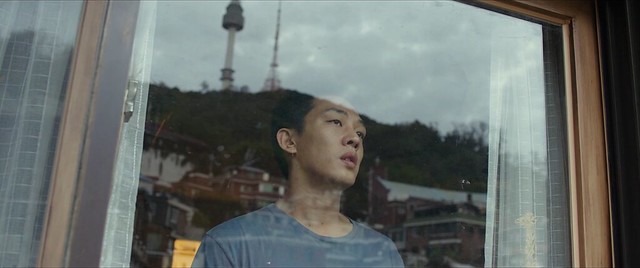
The film revolves around Jong-su (Yoo Ah-in), a farm boy from a small town near the North-South border, doing menial jobs here and there in the outskirts of Seoul and dreaming of being a novelist. His father is in police custody for assault charges. His mom ran off when he was young because of dad's anger issues. He runs into a childhood friend Haemi (Jeong Jong-seo), who dances in costumes in front of a department store to lure the customers in. She teases him for not recognizing her. It's because she had a facelift. Haemi is one of those thoughtful, attractive girls who sometimes falls into pit of melancholy as she thinks about the big questions in life - Why are we here? What's our purpose? So obviously Jong-su falls for her. Haemi has a favor to ask. She's been saving up for a trip to Africa. She wants Jong-su to take care of her cat while she's gone. What cat? He never sees her cat in her tiny apartment which faces Namsan TV Tower (its presence to Seoul-lites is as synonymous with Empire State Building is to NYers or Space Needle is to Seattlelites). But he knows the cat is there because its food bowl gets emptied out and there is occasional poo in its litter box every time he visits. He masturbates thinking of her, looking out the window, facing the tower.

Things get complicated when Haemi returns from the trip. At the airport, Jong-su finds Haemi with her new friend, Benny (Steven Yeun), a mysterious yet affable man. He doesn't have a job. Seemingly extremely well off, he is chaperoning Hae-mi in his porche to nice restaurants and cafés while inviting Jong-su along. There is something off about Benny. His detached attitude, his nonchalance- it's as if he is gliding through life. Jong-su is also jealous that Haemi is smitten by the charming yet strange man. He doesn't seem to care about anything and anybody, including his well-to-do friends.

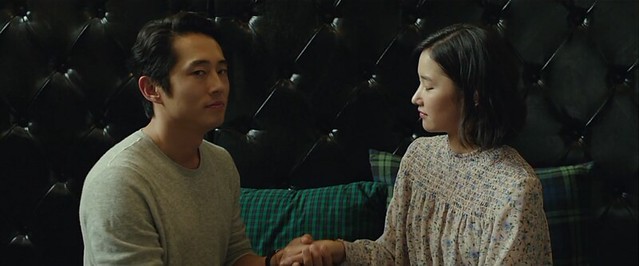
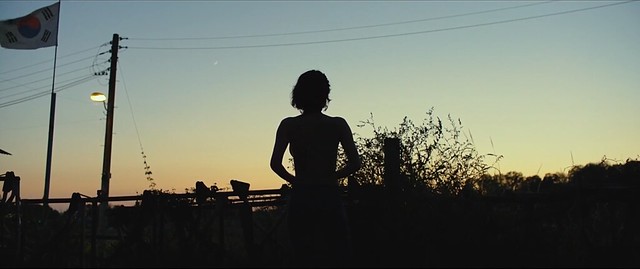
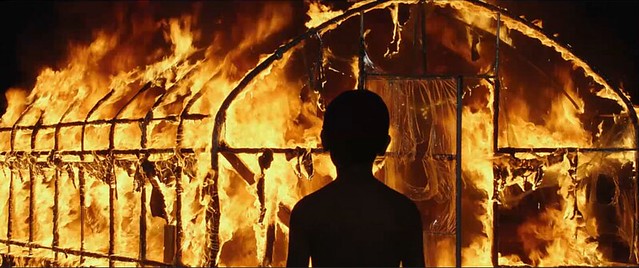
After his father gets sentenced, Jong-su goes back to his old house to sort through the mess. One day, Haemi and Benny visits the house unannounced. They drink and smoke pot and the two men watch Haemi dance topless. Her dance is so emotionally charged and beautiful, the two men blurts out their innermost thoughts after Haemi collapses on the couch. Ben likes to burn greenhouses down. It's thrilling because he doesn't get caught. In fact, the visit to his humble house was for scouting a new target. Jong-su angrily tells him that he loves Haemi. Then couple days later, Haemi disappears. And what about the cat?

Even though Burning is based on Haruki Murakami's short story Barn Burning, it's a very Korean film in every way. Yes, Murakami's typical - disaffected, nihilistic, don't-ever-have-to-worry-about-money hero is there, superbly embodied by Korean-American actor Steven Yeun- his slight otherness is perfect for the role. But Lee Chang-dong's emphasis is on the society's deep chasm between haves and have-nots, city vs countryside, living under the shadow of capitalism and the always imminent threat of war are all very Korean.

Burning is a slow-burn thriller that is utterly captivating from beginning to end. It's economic emasculation that brings inevitable violence at the end. Once again, it's Lee's script that shines: layered with hefty metaphors and symbolism, yet the film is surprisingly subtle and never loses its magnetism.