Showing posts with label Lee Chang-dong. Show all posts

Saturday, August 25, 2018

Economic Emasculation: Lee Chang-dong Adapts Murakami in Burning

Burning (2018) - Lee
Screen Shot 2018-08-24 at 6.52.41 AM
Screen Shot 2018-08-24 at 7.04.47 AM
Screen Shot 2018-08-24 at 6.47.42 AM
Screen Shot 2018-08-24 at 7.05.28 AM
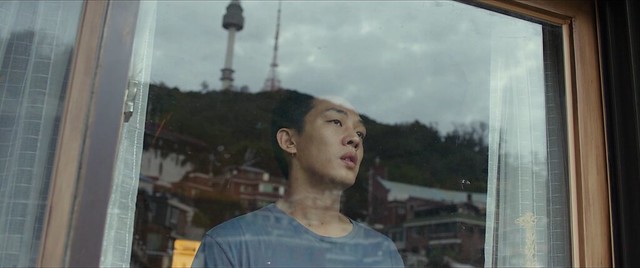
The film revolves around Jong-su (Yoo Ah-in), a farm boy from a small town near the North-South border, doing menial jobs here and there in the outskirts of Seoul and dreaming of being a novelist. His father is in police custody for assault charges. His mom ran off when he was young because of dad's anger issues. He runs into a childhood friend Haemi (Jeong Jong-seo), who dances in costumes in front of a department store to lure the customers in. She teases him for not recognizing her. It's because she had a facelift. Haemi is one of those thoughtful, attractive girls who sometimes falls into pit of melancholy as she thinks about the big questions in life - Why are we here? What's our purpose? So obviously Jong-su falls for her. Haemi has a favor to ask. She's been saving up for a trip to Africa. She wants Jong-su to take care of her cat while she's gone. What cat? He never sees her cat in her tiny apartment which faces Namsan TV Tower (its presence to Seoul-lites is as synonymous with Empire State Building is to NYers or Space Needle is to Seattlelites). But he knows the cat is there because its food bowl gets emptied out and there is occasional poo in its litter box every time he visits. He masturbates thinking of her, looking out the window, facing the tower.

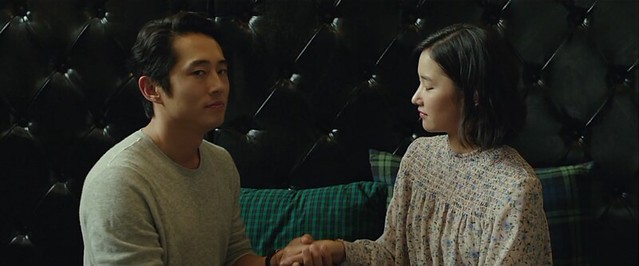
Things get complicated when Haemi returns from the trip. At the airport, Jong-su finds Haemi with her new friend, Benny (Steven Yeun), a mysterious yet affable man. He doesn't have a job. Seemingly extremely well off, he is chaperoning Hae-mi in his porche to nice restaurants and cafés while inviting Jong-su along. There is something off about Benny. His detached attitude, his nonchalance- it's as if he is gliding through life. Jong-su is also jealous that Haemi is smitten by the charming yet strange man. He doesn't seem to care about anything and anybody, including his well-to-do friends.

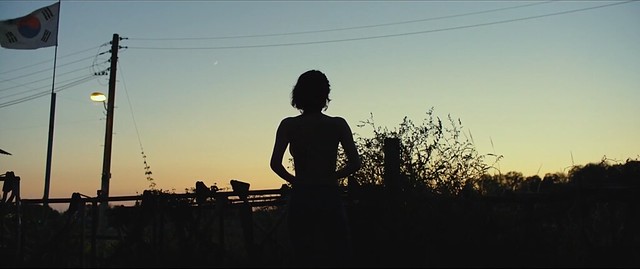
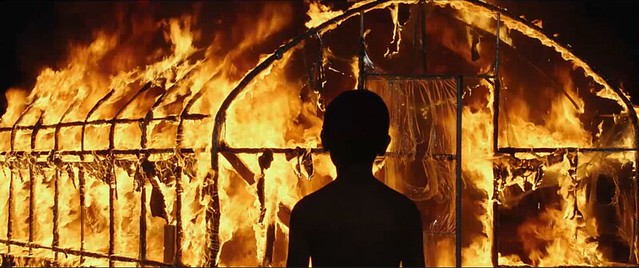
After his father gets sentenced, Jong-su goes back to his old house to sort through the mess. One day, Haemi and Benny visits the house unannounced. They drink and smoke pot and the two men watch Haemi dance topless. Her dance is so emotionally charged and beautiful, the two men blurts out their innermost thoughts after Haemi collapses on the couch. Ben likes to burn greenhouses down. It's thrilling because he doesn't get caught. In fact, the visit to his humble house was for scouting a new target. Jong-su angrily tells him that he loves Haemi. Then couple days later, Haemi disappears. And what about the cat?

Even though Burning is based on Haruki Murakami's short story Barn Burning, it's a very Korean film in every way. Yes, Murakami's typical - disaffected, nihilistic, don't-ever-have-to-worry-about-money hero is there, superbly embodied by Korean-American actor Steven Yeun- his slight otherness is perfect for the role. But Lee Chang-dong's emphasis is on the society's deep chasm between haves and have-nots, city vs countryside, living under the shadow of capitalism and the always imminent threat of war are all very Korean.

Burning is a slow-burn thriller that is utterly captivating from beginning to end. It's economic emasculation that brings inevitable violence at the end. Once again, it's Lee's script that shines: layered with hefty metaphors and symbolism, yet the film is surprisingly subtle and never loses its magnetism.

Tuesday, June 25, 2013

High Melodrama

Secret Sunshine (2007) - Lee
 photo 2762ec79-7730-4995-b006-3cc0da9e09a4_zps8e3ac70a.jpg
Secret Sunshine tells a story of tragedy prone Shin-ae (Jeon Do-yeon). After her husband's death, She and her young son move to a small southern town called Milyang (meaning secret sunshine), the birth place of her deceased husband, to start anew. As soon as she somewhat acclimates herself to the country living, another tragedy strikes. And when she is most vulnerable, she finds Jesus. Does everything really happen for a reason? Is everywhere the same? Is there a meaning in that sunshine?

At times, the film is as corny as it sounds. It is definitely not as good as Lee Chang Dong's other films (Peppermint Candy, Poetry). Sunshine does avoid many of the pitfalls of stereotypes associated with Korean melodramas but not nearly enough. Though it is saved by Jeon Do-yeon's performance. You just want to protect her at all cost. And that's what happens to a local businessman Jongchan (Song Gangho). Known for his comic performances, Song's everyman hopelessly in love with someone who is clearly above his class is just as well drawn as that of Jeon's protagonist. Watch it for the performances.

Tuesday, June 11, 2013

Life is Beautiful


Peppermint Candy (1999) - Lee
Image
Image
The film chronicles key events in the life of Kim Young-ho (Sol Kyung-gu). It opens with Kim stumbling into his school reunion outing near an idyllic creek under the railroad tracks. After making a scene, he throws himself in front of an oncoming train. Tracing backward into 20 years, it shows the dehumanizing effect that the violence has on a person. With a crooked smile and bad temper, Kim is not a nice guy. But he wasn't always like that. It's hard to believe that he was once a young man who liked looking at wild flowers and wanted to be a photographer.

The Gwangju Masssacre in 1980 in which thousands of pro-democracy students lost their lives by the military force, deeply scarred a generation of Korean people. Peppermint Candy deals with that incident in a personal storytelling that is amazingly effective. Kim's sneering detachment, unhappiness and violent nature of his later years is explained slowly through traveling back in time in an absorbing, revealing way. Its accumulative power in making us sympathize with this deeply detestable person is undeniable. Lee Chang-dong is a gifted writer/filmmaker whose use of 'time traveling' device here is much more elegant and resonant here than the likes of Memento and Irreversible. His attention to detail and use of different cinematic devices (music, phrases and especially peppermint candy) for connecting different times are not showy but beautifully done, almost reminding me of Kieslowski films- again, much more resonant given the historical/personal context. I can't say anything more than that it's an amazingly beautiful, touching film.

Tuesday, January 24, 2012

Drama

Poetry (2010) - Lee
Photobucket
Loved it. I normally would not touch Lee Chang-dong's high melodrama with a ten foot pole, especially when it's titled 'Poetry'. I wasn't too sure in the first thirty minutes and thought about turning it off many times. The icky subject matter, an invalid old man, Alzheimer's, all competing for my prejudices in movies. Oh god, what am I getting myself into, I thought. Waterworks probably. But I stuck with it.

Poetry is nothing like what I expected. High melodrama for sure, but it's understated and not afraid of reflecting life's nitty-gritty, ugly, awkward details. Much thanks to Yun Jeong-hie's performance as a sixty five year old woman trying to write poetry for the first time while struggling with whatever life throws at her, everything feels real and honest.

It could've been handled horribly, but no. Compared to other humanist filmmakers like the Dardennes and Koreeda, Poetry lacks the smooth narrative that has clean emotional closures and certain visual style or flare. It feels rough around the edges. What the film does is making you smooth those edges yourself. It makes you breathe. That's perhaps the best way I can describe it. But it feels much more real and honest and even wiser than the said filmmakers' work. I'm very taken by it.

*Thank you Ari for letting me to keep the film all this time. I finally got around to it and you were right. It's a beautiful film.