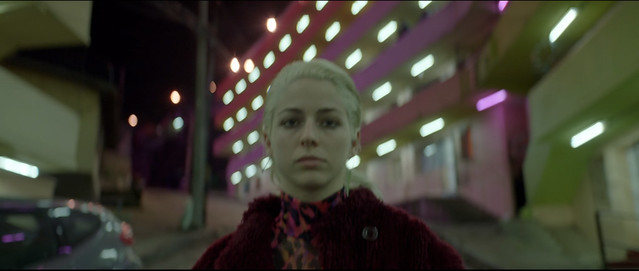
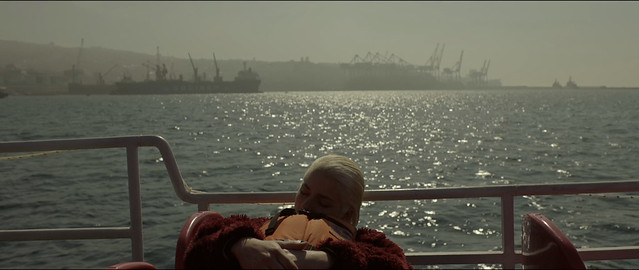
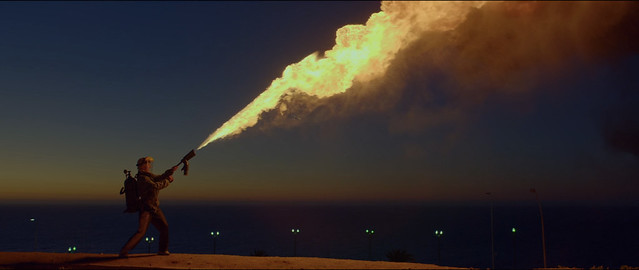
It's been six years since we heard from Julia Loktev after her minimalist, downright Bressonian suicide bomber film,
Day Night Day Night. Her new film
The Loneliest Planet, shot in the Caucasus mountains in Georgia, is just as enigmatic and elliptical as her first one, if not more. In person, Loktev appears to be fiercely intelligent and thoughtful. But just like her films, I had a very hard time pinning her down on what the film is all about.
It's been a while since your last film Day Night Day Night, why the gap?
What a rude question to ask a filmmaker?! (laughs)
Oh I didn't mean to be rude...
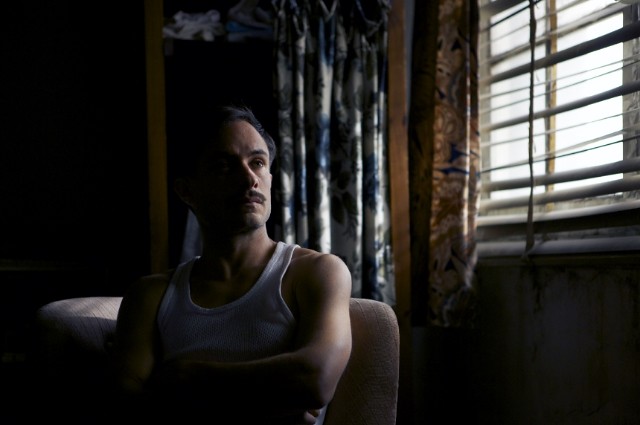
I was just talking to someone about how we were supposed to shoot the film one year earlier. We had to delay it for a year because it took a while to get the money together. It's amazing how long it takes to get everything done. I wish I could make a film a year. In this day and age, I think that's very hard to accomplish. In this case we had most of the budget, we needed about twenty five percent of it. And the story takes place in the mountains, so there is a very short window to shoot from the month of May through September. After that, it's all snow and they are closed for business. We were going to shoot the previous summer and had an investor who came in and said, "We will give you the last 25 percent of the money, if you could move the location to China. So we were going to move to China even though the script was originally set in Georgia. Then they pulled the plug two weeks before the shoot, and we had to wait another year. Luckily, by that time I had Gael (Gael Garcia Bernal) and Hani (Israeli actress Hani Furstenberg) cast and they both stuck with the project and came back after a year to do it.
That's pretty awesome. How long did it take you to write the script?
That's a hard thing to measure because you know, it takes a while to come up with the initial idea and there is a germination period before you flesh out what you want to say. I never understand people asking "what version of the script are you on?" because I keep on writing everyday even on the set. And I'm constantly editing while I am writing it, it's much more of a fluid process for me.
You said it was conceived with Georgia in mind and the film is stunning to look at. Why Georgia?
I was born in Russia (technically in Soviet Union) when Georgia was part of the USSR. It's where I can still get around speaking Russian even though it is a different country with their culture and language. That's where my mother used to go for hikes when she was a university student. So there was this kind of family connection to the mountains even though I went to Georgia for the first time for a film festival a few years back.
Was it very hard to shoot in the mountains?
It was the hardest thing I've ever done. Yes, it was incredibly difficult. Not because we were shooting in Georgia. Georgians are actually amazingly easy to work with and made everything very easy for us, we really couldn't have done it without them. We had a small international crew and some of them were made up of Georgian mountaineers. It was run like an expedition, so in terms of organization, it was fantastic. But what made difficult was the sun because I had a very specific visual in mind. Most of the time the sun was too harsh to shoot. We had very short windows to shoot with a particular direction in mind and it really, completely limited how we shot. Perhaps limited is not the right word. The sun was definitely an obstruction and a challenge.
There was a rainy scene in the film though.
We did manage to get one rainy day scene. We planned it and waited for it and got it done. Most of the time we couldn't find a cloud in the sky. We wanted to get a nice overcast look but no luck. There was a heat wave and we had to wait for the sun to go behind the mountain so we could get some relief.
How big of a crew did you have?
About a dozen on set. It had to be very small and mobile because we had to hike into a lot of our locations. We came back all thinner and healthier. (laugh)
I find it interesting to see non-American actors (Bernal and Furstenberg) playing an American couple. Same with Day Night Day night, where young suicide bomber (Louisa Williams) is of unknown ethnicity. Do they share the theme of anonymity?
I wouldn't say it's anonymous. But they are not caricatures. They are not a blonde haired, blue eyed couple from Wisconsin and I wanted to make a point of that. Look at us here sitting and talking. Where are you from?
Korea.
You are from Korea and I'm from Russia. To me that's the world that surrounds me- many people I know are from somewhere else and to me that's very natural.
What happens in the middle of the film, I have to say, I never have seen such a subtle and sharp criticism of masculinity anywhere.
I don't know if it's a criticism of masculinity or desire for masculinity.
I've seen some other films that deal with the same theme, Bruno Dumont's "29 Palms" and possibly Claire Denis' "White Material" in which emasculating circumstances bring about the violence and destruction. Alex (Gael Garcia Bernal)'s action in the film baffles himself.
That's a very... reductive way to look at it. But it's incredibly hard to be a man now for sure. (laughs) Yes. In our culture it is incredibly difficult. As a woman I have a lot of flexibility: I can be strong, I can be vulnerable. I can kind of choose how I want to play that. And we are telling guys to be sensitive. I do like sensitive men. But there are times part of me wants a man to be a man with a capital M. That's always kind of confusing to me, about myself.
There is something vulnerable and boyishness about his behavior, like hiding behind his mom...
I don't really equate vulnerability and boyishness.
Cowardice?
No, cowardice will fall in any case. I mean we all have a case when we feel vulnerable. All the way from our childhood to old age, there are moments that challenge who you are and catch you off guard, that aren't planned for and wherein you fail. And then what do you do? It's always the aftermath, that's the question. I wouldn't call it cowardice. It's quite natural. Then, would it be more forgivable if it was a woman in his shoes? Most people would say that I wouldn't have a movie if it was like that. That's so screwy now, I mean, all this talk about challenging gender roles, we always come back to that fact. It could've been man and man or woman and woman. But we are veering off from the subject...
Well, the character's played by Gael, who obviously brings in certain masculinity and that's why that scene is so surprising.
Yeah, I think it's very important but it's not someone big. You would expect this to be built into their character but what he does something that is very out of character. That was the reason I cast Gael. Because he always seems like he knows what he's doing.
How did it come about casting Gael and Hani?
Obviously they were committed to the project even though it was delayed. I think they were both attracted to the central question in the script. They tried to find a way into those characters and tried to unpack all those very complicated yet very simple and primal emotions. The way they worked together was incredibly important to me. How they clicked from the very first day they met. They had a very good chemistry together. On the first day, they looked like a believable couple and they brought things out from each other. And also how they fit with the guide (Bidzina Gujabidze). I think the chemistry among them is what made the film work.
There is something very Antonioni about this film. How does the location factor into the couple's relationship?
I think it is like music. It colors the tone and feel of the film. The landscape completely affects the emotions and I don't mean in a straightforward way necessarily. I didn't want to have an emotionally difficult story in a difficult landscape. Like a desert for example. I actually like the idea that it is set in a soft and lush landscape. It becomes more and more beautiful as their relationships get more and more strained. It's a beautiful place. I've traveled a lot and went up a lot of mountains. But it really is an astonishing looking place and I've never been any place like that before.
Are there any contemporary filmmakers you find affinity with?
I don't know if I can say I find affinity with any particular directors. There are certainly directors I like. And I like a lot of different directors- from Claire Denis to Park Chan-wook. But I tend to be attracted to the movies that deal with image and sound more strongly than just talking.
The last half of the film is pretty much dialog-less, except for Bidzina's long monologue at the end. How did you approach that with the actors?
It's all about their inability to talk about this thing- it should be talked about but it can't be talked about. What on earth can they possibly say afterward? How do they negotiate the space between them and try to find the way toward each other? They have no idea what to say and don't have any space to talk either because they are not alone. There is the guide present the whole time. So they try to show it with their body language and so on. I think they did a tremendous job.
Is there anything you are working on right now?
Not enough I want to talk about. (laughs) It's always easier to talk about it afterward. And I don't want to jinx it.
Both of your films are really fascinating. And I'm hoping you come out with more films, because I'm really interested in what you are after.
Well thank you. I hope so too.
The Loneliest Planet opens Oct. 26 in New York and Los Angeles and will be available on VOD Oct. 30.